Distortion of a relativistic jet echoing a magnetic flux eruption
Pith reviewed 2026-05-07 15:12 UTC · model grok-4.3
The pith
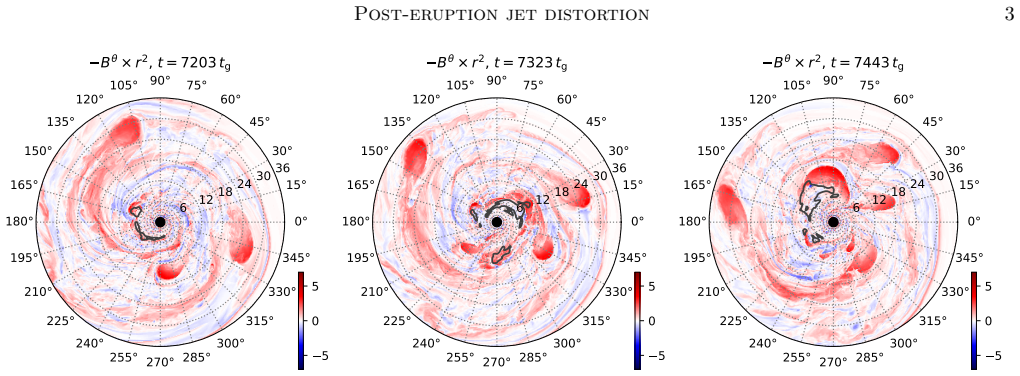
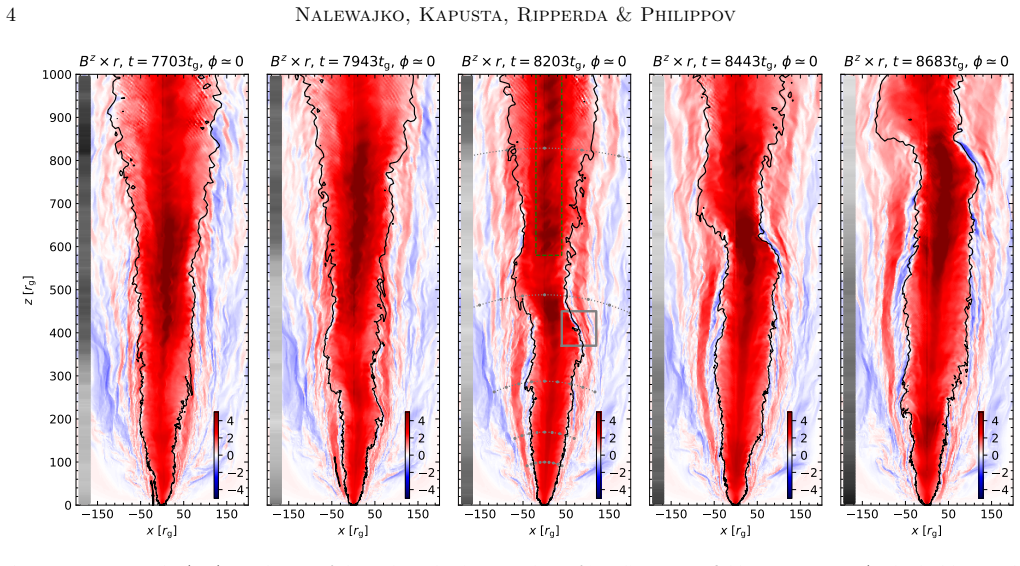
Following a magnetic flux eruption, a weakened relativistic jet develops a helical distortion with poloidal bypasses along its sheath.
A machine-rendered reading of the paper's core claim, the machinery that carries it, and where it could break.
Core claim
In a single cycle of magnetic flux eruption and re-accumulation within a high-resolution 3D general-relativistic magnetohydrodynamic simulation of geometrically thick, magnetically arrested accretion onto a high-spin Kerr black hole, the weakened jet develops a strong helical distortion. The poloidal magnetic field along the jet core remains unaffected by the eruption. Toroidal field lines ejected from the black hole during the eruption and subsequently re-advected onto it form poloidal bypasses along the inner jet sheath. The section of the jet re-powered by renewed magnetic flux accumulation is tilted by a few degrees.
What carries the argument
The distinct post-eruption magnetic field configuration in which unaffected poloidal lines occupy the jet core while re-advected toroidal lines create poloidal bypasses along the inner sheath.
If this is right
- The distortion may appear in sources fed by geometrically thick accretion flows as an asymmetric superluminal knot strongly interacting with the jet sheath along an oblique working surface.
- The re-powered jet section being tilted by a few degrees implies significant variations in radiation boost toward observers of BL Lac blazars.
- The intrinsic structure of the jet spine remains consistent with axisymmetric semi-analytical models.
- Such helical features are expected only in jets launched from magnetically saturated accretion states.
Where Pith is reading between the lines
- Radio monitoring campaigns could search for helical distortions and spine tilts to identify past flux eruption events in active galactic nuclei.
- The bypass structure may alter the long-term stability and collimation of relativistic jets beyond the immediate post-eruption phase.
- Linking the simulated tilt and knot asymmetry to observed blazar variability timescales could constrain the typical interval between flux accumulation and eruption cycles.
Load-bearing premise
The high-resolution 3D general-relativistic magnetohydrodynamic simulation accurately captures the episodic magnetic flux eruption and the subsequent jet distortion without significant numerical artifacts from resolution, grid choice, or artificial resistivity.
What would settle it
High-resolution radio or very-long-baseline interferometry imaging that shows a helical jet distortion with a few-degree spine tilt and clear poloidal bypass signatures occurring immediately after a measurable temporary drop in jet power would support the claim; the repeated absence of such structures in monitored blazar jets would falsify it.
Figures



read the original abstract
Magnetized accretion onto spinning black holes can accumulate a large magnetic flux across the event horizon and launch a pair of relativistic jets via the Blandford-Znajek mechanism. In the magnetically saturated (arrested) state, excess magnetic flux is ejected from the black hole in episodic magnetic flux eruptions, which result in a significant yet temporary reduction of jet power. We analyze results of a high-resolution 3D general-relativistic magneto-hydro-dynamic numerical simulation of geometrically thick magnetically saturated accretion onto a high-spin Kerr black hole for a single cycle of magnetic flux eruption and accumulation. We show that following an eruption, a weakened jet develops a strong helical distortion with distinct structure of magnetic fields - the poloidal field along the jet core is unaffected by the eruption; while toroidal field lines, ejected from the black hole during the eruption and later re-advected onto it, form poloidal `bypasses' along the inner jet sheath. Such a distortion may appear in sources fed by geometrically thick accretion flows as an asymmetric superluminal knot, strongly interacting with the jet sheath along an oblique working surface. The jet section re-powered by magnetic flux re-accumulated on the black hole is tilted by a few degrees, implying significant variations in radiation boost towards observers of BL Lac blazars. The intrinsic structure of the jet spine is consistent with axisymmetric semi-analytical models.
Editorial analysis
A structured set of objections, weighed in public.
Referee Report
Summary. The paper analyzes a single high-resolution 3D GRMHD simulation of geometrically thick, magnetically arrested accretion onto a high-spin Kerr black hole. It claims that after an episodic magnetic flux eruption, the temporarily weakened relativistic jet develops a strong helical distortion in which the poloidal magnetic field along the jet core remains unaffected while toroidal field lines ejected during the eruption and subsequently re-advected form poloidal 'bypasses' along the inner jet sheath. The re-powered jet section is tilted by a few degrees, and the overall spine structure is stated to be consistent with axisymmetric semi-analytical models, with possible observational signatures as asymmetric superluminal knots or variable beaming in BL Lac blazars.
Significance. If the reported post-eruption magnetic reorganization is physical, the work supplies a concrete 3D picture of how flux eruptions temporarily alter jet structure and power in MAD flows, extending axisymmetric models with a specific helical distortion and bypass topology. This could help interpret superluminal features and intra-jet working surfaces in sources fed by thick disks, as well as modest changes in Doppler boosting. The explicit linkage to prior axisymmetric results is a positive grounding.
major comments (1)
- [Abstract and simulation description] Abstract and simulation description: The central claims about the helical distortion, unaffected poloidal core field, and toroidal bypasses rest on output from one high-resolution 3D GRMHD run. No cell counts across the jet, effective resolution in the sheath, artificial resistivity value, or convergence tests at varied resolutions/grid geometries are reported, leaving open the possibility that the reported field-line topology is sensitive to numerical dissipation or grid alignment (directly addressing the weakest assumption identified in the stress-test note).
minor comments (2)
- [Abstract] The abstract states the jet section is 'tilted by a few degrees' without quoting the measured angle or the time window over which it is evaluated; adding this quantitative detail would strengthen the observational implication for BL Lac variability.
- [Abstract] The phrase 'distinct structure of magnetic fields' is used without an accompanying definition or diagnostic (e.g., field-line tracing method or integrated flux ratios); a brief clarification would improve reproducibility.
Simulated Author's Rebuttal
We thank the referee for their insightful comments on our paper. We address the major comment point by point below and plan to make revisions to improve the clarity and completeness of the numerical description.
read point-by-point responses
-
Referee: [Abstract and simulation description] Abstract and simulation description: The central claims about the helical distortion, unaffected poloidal core field, and toroidal bypasses rest on output from one high-resolution 3D GRMHD run. No cell counts across the jet, effective resolution in the sheath, artificial resistivity value, or convergence tests at varied resolutions/grid geometries are reported, leaving open the possibility that the reported field-line topology is sensitive to numerical dissipation or grid alignment (directly addressing the weakest assumption identified in the stress-test note).
Authors: We thank the referee for this comment. We agree that the manuscript would benefit from additional details on the numerical setup. In the revised manuscript, we will expand the simulation description to include the grid resolution (cell counts across the jet), effective resolution in the sheath, the value of artificial resistivity used, and a discussion of resolution tests performed. These details will help demonstrate that the reported field-line topology is not an artifact of numerical dissipation or grid alignment. We maintain that the analysis of this single high-resolution run provides valuable insight into the 3D structure following a flux eruption, consistent with our axisymmetric comparisons, but we will clarify the numerical robustness. revision: yes
Circularity Check
Simulation outputs are self-contained numerical results with no algebraic circularity
full rationale
The paper presents claims about post-eruption jet distortion and magnetic field reorganization (poloidal core unaffected while toroidal lines form sheath bypasses) as direct outputs from analyzing one high-resolution 3D GRMHD simulation of magnetically arrested accretion. No derivation chain reduces these structures to fitted parameters, self-referential definitions, or load-bearing self-citations; the results follow from evolving the GRMHD equations on the chosen grid and initial conditions. The abstract's consistency note with semi-analytical models is observational rather than a foundational assumption. This is a standard numerical experiment whose validity hinges on resolution and convergence (unreported here) but not on logical circularity.
Axiom & Free-Parameter Ledger
free parameters (2)
- Black hole spin a
- Initial magnetic flux normalization
axioms (2)
- standard math General-relativistic magneto-hydrodynamics in Kerr spacetime
- domain assumption Blandford-Znajek mechanism launches the jets
Reference graph
Works this paper leans on
-
[1]
Ackermann, M., Anantua, R., Asano, K., et al.\ 2016, , 824, 2, L20
work page 2016
-
[2]
C., Balokovi \'c , M., Chandra, S., et al.\ 2024, , 692, A140
Algaba, J. C., Balokovi \'c , M., Chandra, S., et al.\ 2024, , 692, A140
work page 2024
-
[3]
Appl, S., Lery, T., & Baty, H.\ 2000, , 355, 818
work page 2000
-
[4]
Asada, K., Inoue, M., Uchida, Y., et al.\ 2002, , 54, L39
work page 2002
-
[5]
C., Scepi, N., & Dexter, J.\ 2022, , 511, 2, 2040
Begelman, M. C., Scepi, N., & Dexter, J.\ 2022, , 511, 2, 2040
work page 2022
-
[6]
Beskin, V. S. & Nokhrina, E. E.\ 2009, , 397, 3, 1486
work page 2009
- [7]
-
[8]
Blandford, R. D. & Znajek, R. L.\ 1977, , 179, 433
work page 1977
-
[9]
Blandford, R., Meier, D., & Readhead, A.\ 2019, , 57, 467
work page 2019
- [10]
-
[11]
Broderick, A. E. & McKinney, J. C.\ 2010, , 725, 1, 750
work page 2010
-
[12]
B., Davelaar, J., et al.\ 2019, , 884, 1, 39
Bromberg, O., Singh, C. B., Davelaar, J., et al.\ 2019, , 884, 1, 39
work page 2019
-
[13]
Camenzind, M.\ 1989, Accretion Disks and Magnetic Fields in Astrophysics, 156, 129
work page 1989
-
[14]
Chashkina, A., Bromberg, O., & Levinson, A.\ 2021, , 508, 1241
work page 2021
-
[15]
Chatterjee, K., Kaaz, N., Liska, M., et al.\ 2025, , 112, 6, 063013
work page 2025
- [16]
-
[17]
Davelaar, J., Mo \'s cibrodzka, M., Bronzwaer, T., et al.\ 2018, , 612, A34
work page 2018
-
[18]
Davelaar, J., Ripperda, B., Sironi, L., et al.\ 2023, , 959, 1, L3
work page 2023
-
[19]
C., Markoff, S., et al.\ 2014, , 440, 3, 2185
Dexter, J., McKinney, J. C., Markoff, S., et al.\ 2014, , 440, 3, 2185
work page 2014
-
[20]
Fuentes, A., G \'o mez, J. L., Mart \' , J. M., et al.\ 2023, Nature Astronomy, 7, 1359
work page 2023
-
[21]
Galishnikova, A., Philippov, A., Quataert, E., et al.\ 2025, , 978, 2, 148
work page 2025
-
[22]
Giannios, D., Uzdensky, D. A., & Begelman, M. C.\ 2009, , 395, 1, L29
work page 2009
- [23]
-
[24]
G \'o mez, J. L., Marscher, A. P., Jorstad, S. G., et al.\ 2008, , 681, 2, L69
work page 2008
-
[25]
Goyal, A., Soida, M., Stawarz, ., et al.\ 2022, , 927, 2, 214
work page 2022
-
[26]
Hakobyan, H., Ripperda, B., & Philippov, A. A.\ 2023, , 943, 2, L29
work page 2023
- [27]
-
[28]
C., Lowell, B., et al.\ 2025, arXiv:2510.25842
Jacquemin-Ide, J., Begelman, M. C., Lowell, B., et al.\ 2025, arXiv:2510.25842
-
[29]
Jia, H., Ripperda, B., Quataert, E., et al.\ 2023, , 526, 2, 2924
work page 2023
-
[30]
Jorstad, S. G., Marscher, A. P., Mattox, J. R., et al.\ 2001, , 134, 2, 181
work page 2001
-
[31]
Jorstad, S. G., Marscher, A. P., Morozova, D. A., et al.\ 2017, , 846, 2, 98
work page 2017
-
[32]
Kim, J.-Y., Krichbaum, T. P., Broderick, A. E., et al.\ 2020, , 640, A69
work page 2020
-
[33]
Liska, M. T. P., Musoke, G., Tchekhovskoy, A., et al.\ 2022, , 935, 1, L1
work page 2022
-
[34]
Liska, M. T. P., Chatterjee, K., Issa, D., et al.\ 2022, , 263, 2, 26
work page 2022
- [35]
- [36]
-
[37]
Lovelace, R. V. E., Newman, W. I., & Romanova, M. M.\ 1997, , 484, 2, 628
work page 1997
- [38]
-
[39]
Lyubarsky, Y.\ 2009, , 698, 2, 1570
work page 2009
- [40]
-
[41]
Mahlmann, J. F., Levinson, A., & Aloy, M. A.\ 2020, , 494, 3, 4203
work page 2020
-
[42]
Marscher, A. P., Jorstad, S. G., G \'o mez, J.-L., et al.\ 2002, , 417, 6889, 625
work page 2002
-
[43]
McKinney, J. C. & Uzdensky, D. A.\ 2012, , 419, 1, 573
work page 2012
-
[44]
F., Dhawan, V., Chaty, S., et al.\ 1998, , 330, L9
Mirabel, I. F., Dhawan, V., Chaty, S., et al.\ 1998, , 330, L9
work page 1998
-
[45]
Mirabel, I. F. & Rodr \' guez, L. F.\ 1999, , 37, 409
work page 1999
-
[46]
C., & Obergaulinger, M.\ 2008, , 492, 3, 621
Moll, R., Spruit, H. C., & Obergaulinger, M.\ 2008, , 492, 3, 621
work page 2008
-
[47]
Musoke, G., Porth, O., & Liska, M.\ 2022, 44th COSPAR Scientific Assembly, 44, 1769
work page 2022
- [48]
- [49]
-
[50]
C., et al.\ 2011, , 413, 1, 333
Nalewajko, K., Giannios, D., Begelman, M. C., et al.\ 2011, , 413, 1, 333
work page 2011
-
[51]
C., & Sikora, M.\ 2014, , 789, 2, 161
Nalewajko, K., Begelman, M. C., & Sikora, M.\ 2014, , 789, 2, 161
work page 2014
-
[52]
Nalewajko, K.\ 2017, Galaxies, 5, 4, 64
work page 2017
-
[53]
Nalewajko, K., Kapusta, M., & Janiuk, A.\ 2024, , 692, A37
work page 2024
-
[54]
Narayan, R., Igumenshchev, I. V., & Abramowicz, M. A.\ 2003, , 55, L69
work page 2003
-
[55]
Narayan, R., Chael, A., Chatterjee, K., et al.\ 2022, , 511, 3, 3795
work page 2022
-
[56]
O'Connor, B., Troja, E., Ryan, G., et al.\ 2023, Science Advances, 9, 23, eadi1405
work page 2023
-
[57]
A., et al.\ 2022, , 931, 2, 137
Ortu \ n o-Mac \' as, J., Nalewajko, K., Uzdensky, D. A., et al.\ 2022, , 931, 2, 137
work page 2022
-
[58]
Parfrey, K., Giannios, D., & Beloborodov, A. M.\ 2015, , 446, L61
work page 2015
-
[59]
L., et al.\ 2021, , 923, 1, L5
Pasetto, A., Carrasco-Gonz \'a lez, C., G \'o mez, J. L., et al.\ 2021, , 923, 1, L5
work page 2021
-
[60]
Piran, T.\ 2004, RvMP, 76, 1143
work page 2004
-
[61]
Rees, M. J. & Meszaros, P.\ 1994, , 430, L93
work page 1994
-
[62]
Ripperda, B., Bacchini, F., & Philippov, A. A.\ 2020, , 900, 2, 100
work page 2020
-
[63]
Ripperda, B., Liska, M., Chatterjee, K., et al.\ 2022, , 924, L32
work page 2022
-
[64]
Ro, H., Kino, M., Hada, K., et al.\ 2026, , 999, 2, 169
work page 2026
-
[65]
Rybicki, G. B. & Lightman, A. P.\ 1986, Radiative Processes in Astrophysics, pp. 400. ISBN 0-471-82759-2. Wiley-VCH
work page 1986
-
[66]
Salas, L. D. S., Musoke, G., Chatterjee, K., et al.\ 2024, , 533, 254
work page 2024
-
[67]
Sikora, M., Nalewajko, K., & Madejski, G. M.\ 2020, , 499, 3, 3749
work page 2020
-
[68]
Sironi, L., Petropoulou, M., & Giannios, D.\ 2015, , 450, 183
work page 2015
-
[69]
Sobacchi, E., Lyubarsky, Y. E., & Sormani, M. C.\ 2017, , 468, 4, 4635
work page 2017
-
[70]
Spada, M., Ghisellini, G., Lazzati, D., et al.\ 2001, , 325, 1559
work page 2001
-
[71]
Sridhar, N., Ripperda, B., Sironi, L., et al.\ 2025, , 979, 2, 199
work page 2025
-
[72]
Tchekhovskoy, A., Narayan, R., & McKinney, J. C.\ 2011, , 418, L79
work page 2011
-
[73]
Tsunetoe, Y., Narayan, R., & Ricarte, A.\ 2025, , 983, 1, 77
work page 2025
-
[74]
Weaver, Z. R., Jorstad, S. G., Marscher, A. P., et al.\ 2022, , 260, 1, 12
work page 2022
- [75]
- [76]
-
[77]
A.\ 2023, Physical Review Research, 5, 4, 043023
Zhdankin, V., Ripperda, B., & Philippov, A. A.\ 2023, Physical Review Research, 5, 4, 043023
work page 2023
discussion (0)
Sign in with ORCID, Apple, or X to comment. Anyone can read and Pith papers without signing in.