An Asymptotic-Preserving Dual Formulation Finite-Volume Method for the Thermal Rotating Shallow Water Equations
Pith reviewed 2026-05-07 14:52 UTC · model grok-4.3
The pith
A dual formulation finite-volume method solves both conservative and nonconservative forms of the thermal rotating shallow water equations simultaneously to handle multi-scale regimes accurately.
A machine-rendered reading of the paper's core claim, the machinery that carries it, and where it could break.
Core claim
The authors claim that simultaneously discretizing both the conservative and nonconservative forms within a finite-volume framework yields a second-order asymptotic-preserving scheme that reproduces the thermal quasi-geostrophic asymptotics at low Rossby numbers and converges to physically relevant weak solutions at high Rossby numbers.
What carries the argument
The dual formulation finite-volume (DF-FV) framework, in which the conservative and primitive (nonconservative) forms of the equations are solved simultaneously to exploit their complementary strengths across flow regimes.
If this is right
- The method preserves the correct asymptotic behavior in nearly thermal quasi-geostrophic regimes.
- It provides robust shock capturing in high-Rossby-number regimes where nonconservative discretizations may fail.
- It achieves second-order accuracy while remaining stable across regime transitions.
- The complementary strengths of each formulation are used without creating new interface inconsistencies.
Where Pith is reading between the lines
- The dual approach could apply to other multi-scale hyperbolic systems that transition between balanced and unbalanced regimes.
- Local monitoring of the Rossby number might allow dynamic weighting between the two formulations in future extensions.
- The method could reduce reliance on separate regime-specific solvers in geophysical modeling codes.
Load-bearing premise
That simultaneously solving the conservative and nonconservative forms will preserve correct asymptotic behavior in low Rossby regimes and converge to weak solutions in high Rossby regimes without introducing inconsistencies or instabilities.
What would settle it
A low Rossby number numerical test where the solution deviates from the expected thermal quasi-geostrophic balance, or a high Rossby number test where a shock is not captured at the correct speed or location.
Figures




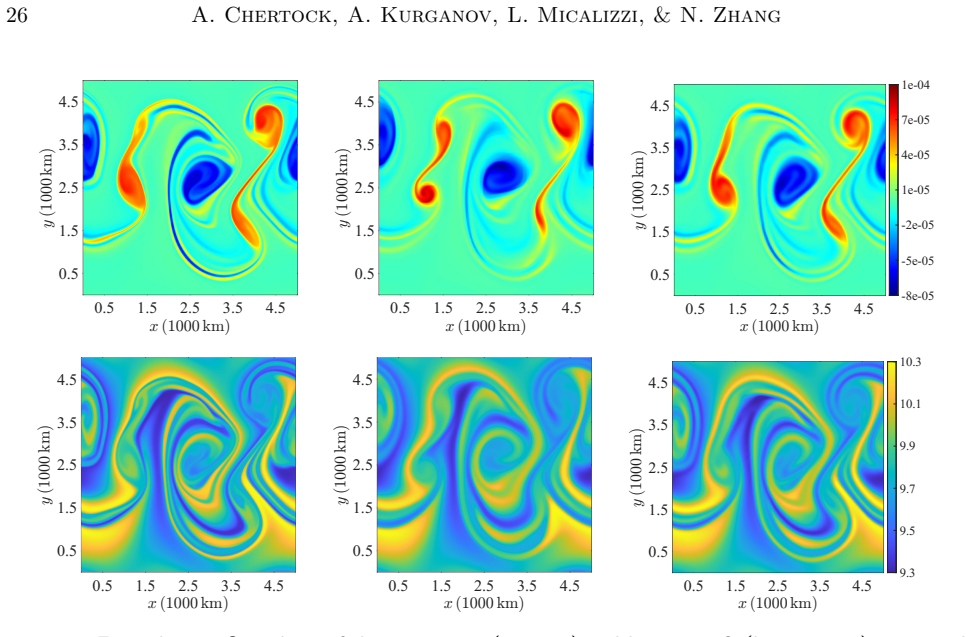


read the original abstract
We propose a new second-order asymptotic-preserving (AP) dual formulation finite-volume (DF-FV) method for the thermal rotating shallow water (TRSW) equations. The TRSW system models geophysical flows characterized by horizontal temperature/density variations, exhibiting multi-scale dynamics due to the coexistence of fast rotational waves and slower advective processes. To efficiently address challenges associated with the multiscale nature of the TRSW system, we follow the DF-FV framework and develop a DF-FV method, in which both the conservative and nonconservative (primitive) forms of the equations are simultaneously solved, allowing the method to exploit the complementary strengths of each representation across different flow regimes. The primitive formulation is better suited for preserving the correct asymptotic behavior in nearly thermal quasi-geostrophic (TQG) regimes characterized by a low Rossby number, while the conservative formulation is essential for robust shock capturing in high-Rossby-number regimes, in which nonconservative discretizations may fail to converge to physically relevant weak solutions.
Editorial analysis
A structured set of objections, weighed in public.
Referee Report
Summary. The manuscript proposes a new second-order asymptotic-preserving dual formulation finite-volume (DF-FV) method for the thermal rotating shallow water (TRSW) equations. It simultaneously solves the conservative and nonconservative (primitive) forms of the equations to exploit the primitive form's suitability for preserving asymptotic behavior in low-Rossby nearly thermal quasi-geostrophic regimes and the conservative form's robustness for shock capturing in high-Rossby regimes.
Significance. If verified, the method would offer a unified, efficient framework for multi-scale geophysical flows with density variations, addressing challenges from fast waves and slow advection without regime-specific schemes. The dual-formulation construction is a clear strength, providing a parameter-free approach that builds directly on the DF-FV framework for complementary use of equation representations.
major comments (2)
- Abstract: the central claim that the DF-FV coupling preserves the asymptotic-preserving property in the Ro → 0 limit and converges to physically relevant weak solutions at high Rossby rests on an unspecified mechanism for combining the two discretizations; no details are given on the coupling operator, blending strategy, or shared flux/pressure terms that would guarantee consistency across regimes or at discontinuities.
- The manuscript supplies no numerical experiments, error tables, convergence rates, or verification tests of the AP limit or shock-capturing behavior, so the soundness of the dual-formulation claims cannot be assessed beyond the descriptive outline.
Simulated Author's Rebuttal
We thank the referee for the thorough review and constructive feedback on our manuscript. We address each major comment below and will incorporate revisions to strengthen the presentation of the dual-formulation mechanism and to provide numerical verification.
read point-by-point responses
-
Referee: Abstract: the central claim that the DF-FV coupling preserves the asymptotic-preserving property in the Ro → 0 limit and converges to physically relevant weak solutions at high Rossby rests on an unspecified mechanism for combining the two discretizations; no details are given on the coupling operator, blending strategy, or shared flux/pressure terms that would guarantee consistency across regimes or at discontinuities.
Authors: The abstract is intentionally concise, but the full manuscript (Sections 3 and 4) specifies the dual-formulation construction: both conservative and primitive forms are discretized on the same mesh with identical numerical fluxes for the conserved variables and a consistent pressure term derived from the equation of state; the coupling is achieved by solving the two systems simultaneously and using the primitive variables to inform the non-conservative terms while retaining conservation in the integrated form. This ensures the AP property is inherited from the primitive discretization in the low-Ro limit and weak-solution convergence from the conservative discretization at high Ro. We will revise the abstract to include a brief statement of this coupling strategy and add a short clarifying paragraph in the introduction. revision: yes
-
Referee: The manuscript supplies no numerical experiments, error tables, convergence rates, or verification tests of the AP limit or shock-capturing behavior, so the soundness of the dual-formulation claims cannot be assessed beyond the descriptive outline.
Authors: The present version emphasizes the derivation and consistency analysis of the DF-FV scheme. We agree that numerical evidence is required to substantiate the claims. The revised manuscript will include a dedicated numerical section containing: (i) tests confirming the AP property as Ro → 0 with error tables and observed convergence rates to the thermal quasi-geostrophic limit, (ii) standard shock-capturing benchmarks at high Rossby number demonstrating convergence to physically relevant weak solutions, and (iii) comparisons against single-formulation schemes. revision: yes
Circularity Check
No circularity: constructive proposal of DF-FV scheme with no self-referential reduction
full rationale
The paper presents a new second-order asymptotic-preserving dual-formulation finite-volume method that simultaneously discretizes the conservative and primitive forms of the TRSW equations. This is a direct algorithmic construction that exploits complementary properties of each form across regimes; the AP property and shock-capturing behavior are asserted as consequences of the chosen discretizations and coupling, not as quantities fitted to or defined by the method's own outputs. No derivation step reduces an equation or limit to a parameter or ansatz taken from the same paper, and the DF-FV framework is invoked as an established template rather than a load-bearing self-citation that would render the central claim tautological. The manuscript therefore remains self-contained against external benchmarks.
Axiom & Free-Parameter Ledger
axioms (2)
- domain assumption Finite-volume discretizations of hyperbolic systems converge to weak solutions when the scheme is conservative and consistent.
- domain assumption Properly designed asymptotic-preserving schemes recover the correct reduced model (TQG) in the low-Rossby limit.
Reference graph
Works this paper leans on
-
[1]
" write newline "" before.all 'output.state := FUNCTION fin.entry add.period write newline FUNCTION new.block output.state before.all = 'skip after.block 'output.state := if FUNCTION not #0 #1 if FUNCTION and 'skip pop #0 if FUNCTION or pop #1 'skip if FUNCTION new.block.checka empty 'skip 'new.block if FUNCTION field.or.null duplicate empty pop "" 'skip ...
-
[2]
R. Abgrall , A combination of residual distribution and the active flux formulations or a new class of schemes that can combine several writings of the same hyperbolic problem: application to the 1 D E uler equations, Commun. Appl. Math. Comput., 5 (2023), pp. 370--402
work page 2023
-
[3]
R. Abgrall, A. Chertock, A. Kurganov, and L. Micalizzi , Dual formulation finite-volume methods on overlapping meshes for hyperbolic conservation laws, Comput. & Fluids, 307 (2026). Paper No. 106952
work page 2026
-
[4]
R. Abgrall and S. Karni , A comment on the computation of non-conservative products, J. Comput. Phys., 229 (2010), pp. 2759--2763
work page 2010
-
[5]
R. Abgrall and Y. Liu , A new approach for designing well-balanced schemes for the shallow water equations: a combination of conservative and primitive formulations, SIAM J. Sci. Comput., 46 (2024), pp. A3375--A3400
work page 2024
-
[6]
R. Abgrall and D. Torlo , High order asymptotic preserving deferred correction implicit-explicit schemes for kinetic models, SIAM J. Sci. Comput., 42 (2020), pp. B816--B845
work page 2020
-
[7]
P. Allegrini and M.-H. Vignal , Study of a new low-oscillating second-order all- M ach number IMEX finite volume scheme for the full E uler equations, SIAM J. Sci. Comput., 47 (2025), pp. A268--A299
work page 2025
-
[8]
M. Anandan, B. Boutin, and N. Crouseilles , High order asymptotic preserving scheme for diffusive scaled linear kinetic equations with general initial conditions, ESAIM Math. Model. Numer. Anal., 58 (2024), pp. 1107--1135
work page 2024
-
[9]
U. M. Ascher, S. J. Ruuth, and R. J. Spiteri , Implicit-explicit R unge- K utta methods for time-dependent partial differential equations, Appl. Numer. Math., 25 (1997), pp. 151--167
work page 1997
-
[10]
W. Bauer and F. Gay-Balmaz , Towards a geometric variational discretization of compressible fluids: the rotating shallow water equations, J. Comput. Dyn., 6 (2019), pp. 1--37
work page 2019
- [11]
-
[12]
S. Boscarino, F. Filbet, and G. Russo , High order semi-implicit schemes for time dependent partial differential equations, J. Sci. Comput., 68 (2016), pp. 975--1001
work page 2016
-
[13]
S. Boscarino, L. Pareschi, and G. Russo , Implicit-explicit R unge- K utta schemes for hyperbolic systems and kinetic equations in the diffusion limit, SIAM J. Sci. Comput., 35 (2013), pp. A22--A51
work page 2013
-
[14]
S. Boscarino, J.-M. Qiu, and G. Russo , Implicit-explicit integral deferred correction methods for stiff problems, SIAM J. Sci. Comput., 40 (2018), pp. A787--A816
work page 2018
-
[15]
S. Boscarino, J.-M. Qiu, G. Russo, and T. Xiong , A high order semi-implicit IMEX WENO scheme for the all- M ach isentropic E uler system, J. Comput. Phys., 392 (2019), pp. 594--618
work page 2019
-
[16]
S. Boscarino, J.-M. Qiu, G. Russo, and T. Xiong , High order semi-implicit WENO schemes for all- M ach full E uler system of gas dynamics, SIAM J. Sci. Comput., 44 (2022), pp. B368--B394
work page 2022
-
[17]
W. Boscheri, G. Dimarco, R. Loub\`ere, M. Tavelli, and M.-H. Vignal , A second order all M ach number IMEX finite volume solver for the three dimensional E uler equations, J. Comput. Phys., 415 (2020). Paper No. 109486
work page 2020
-
[18]
O. B\" u hler , On the vorticity transport due to dissipating or breaking waves in shallow-water flow, J. Fluid Mech., 407 (2000), pp. 235--263
work page 2000
-
[19]
S. Busto and M. Dumbser , A staggered semi-implicit hybrid finite volume / finite element scheme for the shallow water equations at all F roude numbers, Appl. Numer. Math., 175 (2022), pp. 108--132
work page 2022
-
[20]
M. J. Castro D\' az, A. Kurganov, and T. Morales de Luna , Path-conservative central-upwind schemes for nonconservative hyperbolic systems, ESAIM Math. Model. Numer. Anal., 53 (2019), pp. 959--985
work page 2019
-
[21]
W. Chen, K. Wu, and T. Xiong , High order structure-preserving finite difference WENO schemes for MHD equations with gravitation in all sonic M ach numbers, J. Sci. Comput., 99 (2024). Paper No. 36
work page 2024
-
[22]
A. Chertock, S. Cui, A. Kurganov, and T. Wu , Well-balanced positivity preserving central-upwind scheme for the shallow water system with friction terms, Internat. J. Numer. Meth. Fluids, 78 (2015), pp. 355--383
work page 2015
-
[23]
A. Chertock, Q. Fu, A. Kurganov, and L. Micalizzi , New adaptive numerical methods based on dual formulation of hyperbolic conservation laws. Submitted; arXiv:2601.20000
-
[24]
A. Chertock, S. Karni, A. Kurganov, and L. Micalizzi , A new asymptotic-preserving dual formulation finite-volume method for the compressible E uler equations. in preparation
-
[25]
J. Y.-K. Cho, K. Menou, B. M. S. Hansen, and S. Seager , Atmospheric circulation of close-in extrasolar giant planets. I . G lobal, barotropic, adiabatic simulations, Astroph. J., 675 (2008), pp. 817--845
work page 2008
-
[26]
S. Chu, A. Kurganov, and M. Na , Fifth-order A - WENO schemes based on the path-conservative central-upwind method, J. Comput. Phys., 469 (2022). Paper No. 111508
work page 2022
-
[27]
F. Couderc, A. Duran, and J.-P. Vila , An explicit asymptotic preserving low F roude scheme for the multilayer shallow water model with density stratification, J. Comput. Phys., 343 (2017), pp. 235--270
work page 2017
- [28]
-
[29]
G. Dimarco, R. Loub\`ere, and M.-H. Vignal , Study of a new asymptotic preserving scheme for the E uler system in the low M ach number limit, SIAM J. Sci. Comput., 39 (2017), pp. A2099--A2128
work page 2017
-
[30]
G. Dimarco and L. Pareschi , Asymptotic preserving implicit-explicit R unge- K utta methods for nonlinear kinetic equations, SIAM J. Numer. Anal., 51 (2013), pp. 1064--1087
work page 2013
-
[31]
A. Duran, J.-P. Vila, and R. Baraille , Semi-implicit staggered mesh scheme for the multi-layer shallow water system, C. R. Math. Acad. Sci. Paris, 355 (2017), pp. 1298--1306
work page 2017
- [32]
-
[33]
F. Filbet and S. Jin , A class of asymptotic-preserving schemes for kinetic equations and related problems with stiff sources, J. Comput. Phys., 229 (2010), pp. 7625--7648
work page 2010
-
[34]
S. Gottlieb, C.-W. Shu, and E. Tadmor , Strong stability-preserving high-order time discretization methods, SIAM Rev., 43 (2001), pp. 89--112
work page 2001
-
[35]
E. Gouzien, N. Lahaye, V. Zeitlin, and T. Dubos , Thermal instability in rotating shallow water with horizontal temperature/density gradients, Phys. Fluids, 29 (2017). Paper No. 101702
work page 2017
- [36]
-
[37]
T. Y. Hou and P. G. LeFloch , Why nonconservative schemes converge to wrong solutions: error analysis, Math. Comp., 62 (1994), pp. 497--530
work page 1994
-
[38]
J. Hu, S. Jin, and Q. Li , Asymptotic-preserving schemes for multiscale hyperbolic and kinetic equations, in Handbook of numerical methods for hyperbolic problems, vol. 18 of Handb. Numer. Anal., Elsevier/North-Holland, Amsterdam, 2017, pp. 103--129
work page 2017
- [39]
- [40]
- [41]
- [42]
-
[43]
Jin , Efficient asymptotic-preserving ( AP ) schemes for some multiscale kinetic equations, SIAM J
S. Jin , Efficient asymptotic-preserving ( AP ) schemes for some multiscale kinetic equations, SIAM J. Sci. Comput., 21 (1999), pp. 441--454
work page 1999
-
[44]
B. Karas\" o zen, S. Yıldız, and M. Uzunca , Energy preserving reduced-order modeling of the rotating thermal shallow water equation, Phys. Fluids, 34 (2022). Paper No. 056603
work page 2022
-
[45]
C. A. Kennedy and M. H. Carpenter , Additive R unge- K utta schemes for convection-diffusion-reaction equations, Appl. Numer. Math., 44 (2003), pp. 139--181
work page 2003
-
[46]
A. Klar , An asymptotic preserving numerical scheme for kinetic equations in the low M ach number limit, SIAM J. Numer. Anal., 36 (1999), pp. 1507--1527
work page 1999
-
[47]
Klein , Semi-implicit extension of a G odunov-type scheme based on low M ach number asymptotics
R. Klein , Semi-implicit extension of a G odunov-type scheme based on low M ach number asymptotics. I . O ne-dimensional flow, J. Comput. Phys., 121 (1995), pp. 213--237
work page 1995
-
[48]
A. Kurganov, Y. Liu, and M. Luk\' a c ov\' a -Medvi d ov\' a , A well-balanced asymptotic preserving scheme for the two-dimensional rotating shallow water equations with nonflat bottom topography, SIAM J. Sci. Comput., 44 (2022), pp. A1655--A1680
work page 2022
-
[49]
A. Kurganov, Y. Liu, and V. Zeitlin , A well-balanced central-upwind scheme for the thermal rotating shallow water equations, J. Comput. Phys., 411 (2020). Paper No. 109414
work page 2020
-
[50]
A. Kurganov, Y. Liu, and V. Zeitlin , Thermal versus isothermal rotating shallow water equations: comparison of dynamical processes by simulations with a novel well-balanced central-upwind scheme, Geophys. Astrophys. Fluid Dyn., 115 (2021), pp. 125--154
work page 2021
-
[51]
A. Kurganov, S. Noelle, and G. Petrova , Semidiscrete central-upwind schemes for hyperbolic conservation laws and H amilton- J acobi equations, SIAM J. Sci. Comput., 23 (2001), pp. 707--740
work page 2001
-
[52]
R. L. Lavoie , A mesoscale numerical model of lake-effect storms, J. Atmos. Sci., 29 (1972), pp. 1025--1040
work page 1972
-
[53]
D. Y. Le Roux and B. Pouliot , Analysis of numerically induced oscillations in two-dimensional finite-element shallow-water models. II . F ree planetary waves, SIAM J. Sci. Comput., 30 (2008), pp. 1971--1991
work page 2008
- [54]
-
[55]
X. Liu , A well-balanced asymptotic preserving scheme for the two-dimensional shallow water equations over irregular bottom topography, SIAM J. Sci. Comput., 42 (2020), pp. B1136--B1172
work page 2020
-
[56]
X. Liu, A. Chertock, and A. Kurganov , An asymptotic preserving scheme for the two-dimensional shallow water equations with C oriolis forces, J. Comput. Phys., 391 (2019), pp. 259--279
work page 2019
-
[57]
Majda , Introduction to PDE s and waves for the atmosphere and ocean, vol
A. Majda , Introduction to PDE s and waves for the atmosphere and ocean, vol. 9 of Courant Lecture Notes in Mathematics, New York University, Courant Institute of Mathematical Sciences, New York, 2003
work page 2003
-
[58]
J. P. McCreary, P. K. Kundu, and R. L. Molinari , A numerical investigation of dynamics, thermodynamics and mixed-layer processes in the I ndian O cean, Prog. Oceanog., 31 (1993), pp. 181--244
work page 1993
-
[59]
H. Nessyahu and E. Tadmor , Nonoscillatory central differencing for hyperbolic conservation laws, J. Comput. Phys., 87 (1990), pp. 408--463
work page 1990
-
[60]
Pedlosky , Geophysical Fluid Dynamics, Springer New York, 1987
J. Pedlosky , Geophysical Fluid Dynamics, Springer New York, 1987
work page 1987
-
[61]
K. Ricardo, K. Duru, and D. Lee , An entropy stable discontinuous G alerkin method for the spherical thermal shallow water equations, SIAM J. Sci. Comput., 46 (2024), pp. A3353--A3374
work page 2024
-
[62]
Ripa , On improving a one-layer ocean model with thermodynamics, J
P. Ripa , On improving a one-layer ocean model with thermodynamics, J. Fluid Mech., 303 (1995), pp. 169--201
work page 1995
-
[63]
M. L. Salby , Deep circulations under simple classes of stratification, Tellus, 41A (1989), pp. 48--65
work page 1989
-
[64]
P. K. Sweby , High resolution schemes using flux limiters for hyperbolic conservation laws, SIAM J. Numer. Anal., 21 (1984), pp. 995--1011
work page 1984
-
[65]
T. A. Tambyah, D. Lee, and S. Badia , Energy and entropy conserving compatible finite elements with upwinding for the thermal shallow water equations, J. Comput. Phys., 531 (2025). Paper No. 113937
work page 2025
-
[66]
S. Vater and R. Klein , A semi-implicit multiscale scheme for shallow water flows at low F roude number, Commun. Appl. Math. Comput. Sci., 13 (2018), pp. 303--336
work page 2018
-
[67]
E. S. Warneford and P. J. Dellar , The quasi-geostrophic theory of the thermal shallow water equations, J. Fluid Mech., 723 (2013), pp. 374--403
work page 2013
-
[68]
E. S. Warneford and P. J. Dellar , Thermal shallow water models of geostrophic turbulence in J ovian atmospheres, Phys. Fluids, 26 (2014). Paper No. 016603
work page 2014
-
[69]
X. Xie, H. Dong, and M. Li , High order well-balanced asymptotic preserving IMEX RKDG schemes for the two-dimensional nonlinear shallow water equations, J. Comput. Phys., 510 (2024). Paper No. 113092
work page 2024
-
[70]
X. Xie, H. Dong, and M. Li , Numerical simulations of the shallow water equations with C oriolis forces in full F roude number by an asymptotic preserving DG scheme, J. Appl. Math. Comput., 71 (2025), pp. 947--972
work page 2025
-
[71]
W. R. Young , The subinertial mixed layer approximation, J. Phys. Oceanogr., 24 (1994), pp. 1812--1826
work page 1994
-
[72]
H. Zakerzadeh , The RS - IMEX scheme for the rotating shallow water equations with the C oriolis force, in Finite volumes for complex applications VIII ---hyperbolic, elliptic and parabolic problems, vol. 200 of Springer Proc. Math. Stat., Springer, Cham, 2017, pp. 199--207
work page 2017
-
[73]
J. Zeifang, J. Sch\" u tz, K. Kaiser, A. Beck, M. Luk\' a c ov\' a -Medvid'ov\' a , and S. Noelle , A novel full- E uler low M ach number IMEX splitting, Commun. Comput. Phys., 27 (2020), pp. 292--320
work page 2020
-
[74]
V. Zeitlin , Geophysical Fluid Dynamics: Understanding (almost) everything with rotating shallow water models, Oxford University Press, 2018
work page 2018
-
[75]
M. Zerroukat and T. Allen , A moist B oussinesq shallow water equations set for testing atmospheric models, J. Comput. Phys., 290 (2015), pp. 55--72
work page 2015
- [76]
-
[77]
N. Zhang , Well-balanced finite difference WENO - AO scheme for rotating shallow water equations with C oriolis force, Comput. & Fluids, 273 (2024). Paper No. 106209
work page 2024
- [78]
discussion (0)
Sign in with ORCID, Apple, or X to comment. Anyone can read and Pith papers without signing in.