Semantic Foam: Unifying Spatial and Semantic Scene Decomposition
Pith reviewed 2026-05-07 13:37 UTC · model grok-4.3
The pith
Semantic Foam attaches semantic features to Voronoi cells for consistent object segmentation in reconstructed scenes.
A machine-rendered reading of the paper's core claim, the machinery that carries it, and where it could break.
Core claim
The paper claims that integrating Radiant Foam's natural spatial volumetric Voronoi mesh with an explicit semantic feature field parameterized at the cell level enables direct spatial regularization. This prevents artifacts caused by occlusion or inconsistent supervision across views, which are common in other point-based representations, and yields superior object-level segmentation performance.
What carries the argument
Cell-level semantic feature field attached to the Voronoi mesh cells.
If this is right
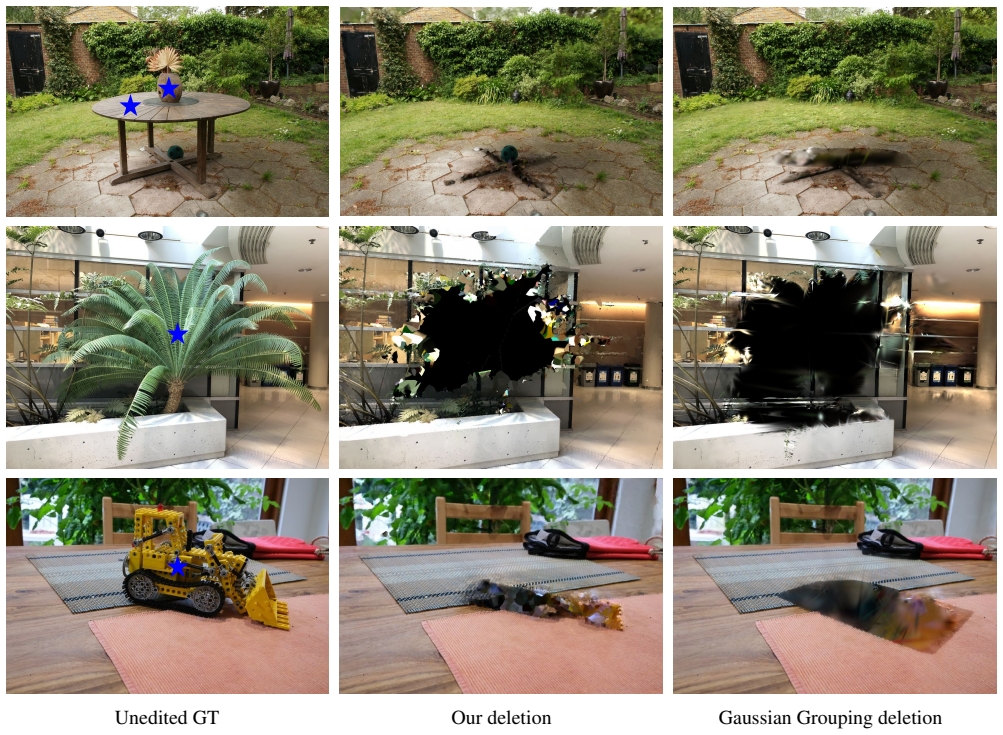
- Superior object-level segmentation compared to methods such as Gaussian Grouping.
- Reduced artifacts from occlusion and inconsistent multi-view supervision.
- Direct spatial regularization becomes feasible because features live on the volumetric cells.
- The base real-time rendering speed and quality remain available alongside the new semantic output.
Where Pith is reading between the lines
- The cell-wise structure could simplify post-hoc editing of semantic labels without retraining the geometry.
- Combined spatial-semantic output may support downstream tasks such as 3D object manipulation or scene editing in interactive graphics.
- The same cell parameterization might transfer to other volumetric decompositions beyond the original foam representation.
Load-bearing premise
Attaching semantic features to the Voronoi cells will preserve the original rendering quality while delivering consistent segmentation without new artifacts or loss of detail.
What would settle it
A multi-view dataset with known occlusions where either novel-view PSNR drops below the non-semantic baseline or cross-view segmentation labels show visible inconsistencies after training.
Figures


read the original abstract
Modern scene reconstruction methods, such as 3D Gaussian Splatting, deliver photo-realistic novel view synthesis at real-time speeds, yet their adoption in interactive graphics applications has been limited. A major bottleneck is the difficulty of interacting with these representations compared to traditional, human-authored 3D assets. While previous research has attempted to impose semantic decomposition on these models, significant challenges remain regarding segmentation quality and consistency. To address this, we introduce Semantic Foam, extending the recently proposed Radiant Foam representations to semantic decomposition tasks. Our approach integrates the natural spatial volumetric decomposition of Radiant Foam's Voronoi mesh with an explicit semantic feature field parameterized at the cell level. This explicit structure enables direct spatial regularization, which prevents artifacts caused by occlusion or inconsistent supervision across views - common pitfalls for other point-based representations. Experimental results show that our method achieves comparable or superior object-level segmentation performance compared to state-of-the-art methods like Gaussian Grouping and SAGA.
Editorial analysis
A structured set of objections, weighed in public.
Referee Report
Summary. The paper claims to introduce Semantic Foam by extending Radiant Foam's Voronoi-based spatial decomposition with a semantic feature field at the cell level. This explicit parameterization allows spatial regularization to achieve consistent semantic segmentation without artifacts from occlusion or inconsistent multi-view supervision, and experimental results purportedly demonstrate superior performance compared to Gaussian Grouping and SAGA.
Significance. If substantiated, this could provide a valuable unification of spatial and semantic decomposition in real-time scene representations, facilitating better interactivity in graphics applications. The explicit structure is a strength that could avoid common pitfalls in point-based semantic methods.
major comments (2)
- [Abstract] The abstract asserts superior segmentation performance over Gaussian Grouping and SAGA, but the manuscript provides no metrics, experimental setup, ablation studies, or quantitative results to support this claim.
- [Proposed Approach] The central assumption that attaching semantic features to radiance-optimized Voronoi cells will preserve rendering quality and yield consistent segmentation is unexamined. The Voronoi tessellation may not align with semantic boundaries, potentially causing detail loss or inconsistent segments when cells overlap multiple objects, which directly impacts the claim that spatial regularization prevents artifacts.
Simulated Author's Rebuttal
We thank the referee for their constructive comments on our manuscript. We address each major comment point by point below, indicating planned revisions where appropriate.
read point-by-point responses
-
Referee: [Abstract] The abstract asserts superior segmentation performance over Gaussian Grouping and SAGA, but the manuscript provides no metrics, experimental setup, ablation studies, or quantitative results to support this claim.
Authors: We agree that the abstract summarizes a claim of superior performance that requires full substantiation in the manuscript. The current version references experimental results but does not present the supporting quantitative metrics, experimental setups, or ablation studies. In the revised manuscript, we will expand the Experiments section to include these elements, such as mIoU scores, segmentation consistency measures, detailed comparisons against Gaussian Grouping and SAGA, and ablations on the spatial regularization, to directly support the abstract claims. revision: yes
-
Referee: [Proposed Approach] The central assumption that attaching semantic features to radiance-optimized Voronoi cells will preserve rendering quality and yield consistent segmentation is unexamined. The Voronoi tessellation may not align with semantic boundaries, potentially causing detail loss or inconsistent segments when cells overlap multiple objects, which directly impacts the claim that spatial regularization prevents artifacts.
Authors: The manuscript explains that the explicit cell-level semantic features combined with spatial regularization avoid occlusion and view-inconsistency artifacts common in point-based methods. We acknowledge, however, that the potential for Voronoi cells to span semantic boundaries and the resulting effects on detail or consistency were not explicitly examined or analyzed. In the revision, we will add to the Proposed Approach section a dedicated analysis of cell-semantic alignment, including boundary visualizations and overlap metrics, plus targeted experiments showing that regularization still delivers consistent segmentation in multi-object cell cases. This will strengthen the justification for the approach. revision: partial
Circularity Check
No circularity: extension of external prior with independent regularization and experimental validation
full rationale
The derivation chain begins with the external Radiant Foam Voronoi mesh (cited as recently proposed prior work) and adds a new per-cell semantic feature field plus spatial regularization term. Neither the feature attachment nor the regularization is defined in terms of the target segmentation outputs; the mesh geometry remains fixed from the radiance stage while semantics are optimized separately. Performance claims rest on comparative experiments against Gaussian Grouping and SAGA rather than any fitted parameter being relabeled as a prediction or any uniqueness theorem imported from self-citation. No equation reduces the claimed consistency or artifact prevention to a tautology of the inputs.
Axiom & Free-Parameter Ledger
axioms (1)
- domain assumption Radiant Foam representations provide a natural spatial volumetric decomposition via Voronoi mesh suitable for extension to semantics
invented entities (1)
-
Semantic feature field parameterized at the cell level
no independent evidence
discussion (0)
Sign in with ORCID, Apple, or X to comment. Anyone can read and Pith papers without signing in.