Rendering-Aware Sparse Sampling for BRDF Acquisition
Pith reviewed 2026-07-01 08:36 UTC · model grok-4.3
The pith
A rendering-aware sampler selects sparse BRDF measurements that improve final rendered appearance more than BRDF-space optimization.
A machine-rendered reading of the paper's core claim, the machinery that carries it, and where it could break.
Core claim
We formulate sparse adaptive acquisition as a rendering-aware optimization problem using a set encoder, a fixed pretrained BRDF reconstructor, and a differentiable renderer. Gradients from the rendered-image loss train the sampler to pick directions informative under the learned material distribution, separating acquisition design from prior fitting.
What carries the argument
The rendering-aware optimization that keeps the BRDF reconstructor fixed while using gradients from rendered-image loss to train the sampler for measurement locations.
If this is right
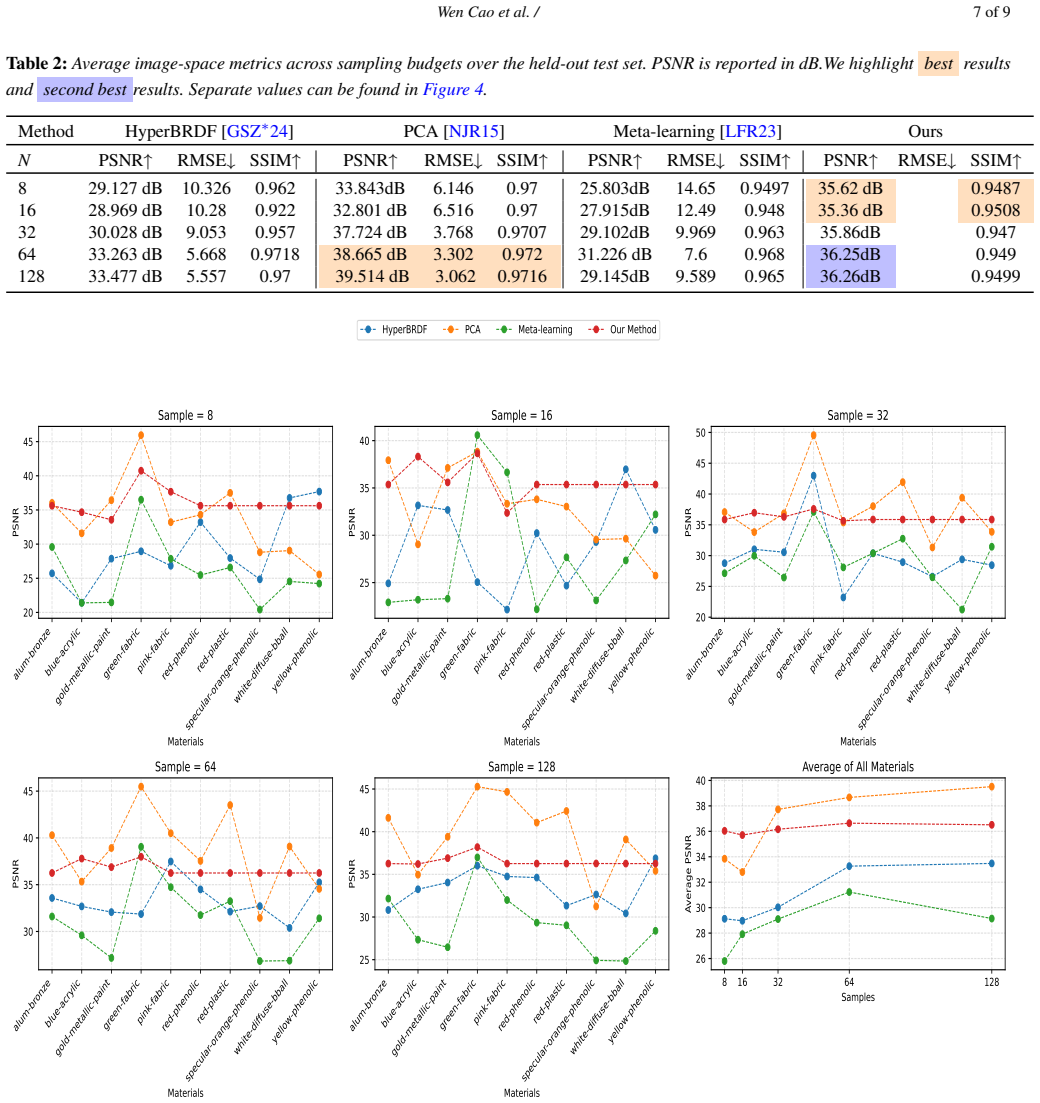
- Learned samplers outperform uniform, meta-learning, and HyperBRDF baselines in rendering metrics under matched conditions.
- BRDF-space and combined losses serve as ablations showing image loss is key for the target.
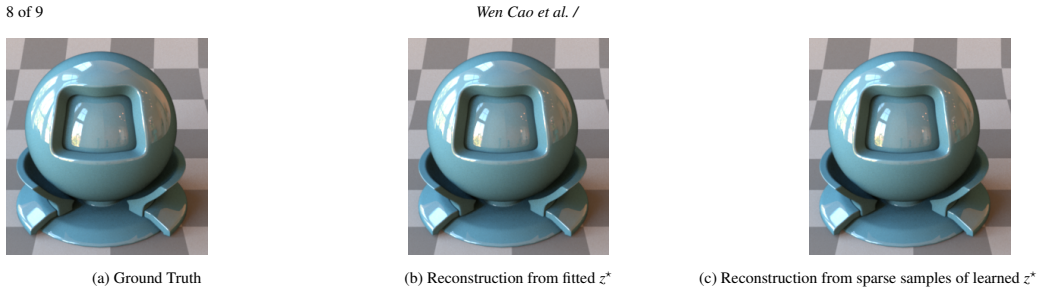
- Joint refinement and image-only latent fitting are tested for unseen materials.
Where Pith is reading between the lines
- Acquisition design can be decoupled from prior fitting to focus on rendering-relevant directions.
- The approach may generalize to other inverse rendering problems where measurement selection depends on final image quality.
- For real hardware, the learned locations could be used to guide physical gonioreflectometer scans.
Load-bearing premise
The pretrained hypernetwork-based/PCA-based BRDF reconstructor accurately captures the relevant material distribution and can remain fixed while gradients from the rendered-image loss optimize the sampler.
What would settle it
If measurements selected by the learned sampler produce no better rendered images than uniform sampling when reconstructing materials from a held-out set using the same reconstructor.
Figures


read the original abstract
Accurate BRDF acquisition is essential for realistic rendering, but dense gonioreflectometer measurements are slow and expensive. We study how to select a small set of BRDF measurements that is most informative for reconstructing material appearance under a learned BRDF prior. Existing sparse-acquisition methods often optimize samples for BRDF-space reconstruction for all materials, while the perceptual importance of a adaptive measurement ultimately depends on its effect on each rendered appearance. We therefore formulate sparse adaptive acquisition as a rendering-aware optimization problem. Our method combines a set encoder for sparse coordinate--value observations, a pretrained hypernetwork-based/PCA-based BRDF reconstructor, and a differentiable renderer. During sampler training, the reconstructor remains fixed, and gradients from a rendered-image loss optimize the measurement locations. This separates acquisition design from prior fitting and encourages the sampler to choose directions that are informative under the learned material distribution. To make the comparison controlled, we evaluate the uniform baseline, meta-learning method, HyperBRDF method, and our learned sampler under matched sample numbers, train/test split, rendering scene, object mask, image mapping, and metrics. Our central claim: rendering-aware sampling improves extremely sparse BRDF acquisition when final rendered appearance is the target. BRDF-space and combined losses are reported only as ablations, together with joint refinement and image-only latent fitting for unseen materials.
Editorial analysis
A structured set of objections, weighed in public.
Referee Report
Summary. The paper proposes rendering-aware sparse sampling for BRDF acquisition. It formulates sample selection as an optimization problem that uses a set encoder on sparse coordinate-value pairs, a fixed pretrained hypernetwork-based or PCA-based BRDF reconstructor, and a differentiable renderer. Gradients from a rendered-image loss optimize the measurement locations while the reconstructor remains frozen. The central claim is that this approach improves extremely sparse BRDF acquisition when the target is final rendered appearance, outperforming uniform sampling, meta-learning, and HyperBRDF baselines under matched conditions; BRDF-space losses and joint refinement are presented only as ablations.
Significance. If validated, the separation of a fixed reconstructor from gradient-based sampler optimization via rendering loss could improve efficiency of BRDF measurements by prioritizing directions relevant to rendered appearance under the learned material distribution. The controlled evaluation protocol with matched sample counts, splits, scenes, and metrics is a methodological strength. The approach avoids direct circularity between acquisition design and prior fitting. However, the significance cannot be determined from the abstract alone, as no quantitative results, error analysis, or implementation details are provided.
minor comments (1)
- The manuscript text consists solely of the abstract; full sections on method details, quantitative results, figures, and error analysis are required for a complete technical review.
Simulated Author's Rebuttal
We thank the referee for the review. The controlled evaluation protocol is indeed a strength of the work, and we appreciate the note that the method avoids circularity between acquisition design and prior fitting. We address the primary concern raised.
read point-by-point responses
-
Referee: However, the significance cannot be determined from the abstract alone, as no quantitative results, error analysis, or implementation details are provided.
Authors: The complete manuscript contains the quantitative results, error analysis, and implementation details under the matched conditions described in the abstract (identical sample counts, train/test splits, rendering scenes, object masks, image mappings, and metrics). These results support the central claim that rendering-aware sampling improves extremely sparse BRDF acquisition when the target is final rendered appearance, outperforming the listed baselines. The abstract is intentionally concise and focuses on the method and claim; the full evidence appears in the experiments section. revision: no
Circularity Check
No significant circularity detected from available text
full rationale
The abstract describes a method with an explicitly fixed pretrained reconstructor whose parameters are not updated during sampler optimization; gradients flow only through the differentiable renderer to the measurement locations. No equations are shown, no self-citations appear, and the central claim is supported by controlled comparisons to external baselines (uniform, meta-learning, HyperBRDF) under matched train/test splits and metrics. The derivation therefore does not reduce to its own inputs by construction.
Axiom & Free-Parameter Ledger
axioms (2)
- domain assumption A pretrained hypernetwork/PCA reconstructor can be held fixed while a sampler is optimized via rendered-image gradients.
- domain assumption The differentiable renderer accurately propagates gradients from image loss to measurement locations.
discussion (0)
Sign in with ORCID, Apple, or X to comment. Anyone can read and Pith papers without signing in.