Digital Simulation of Non-Hermitian Knotted Bands on Quantum Hardware
Pith reviewed 2026-05-07 11:13 UTC · model grok-4.3
The pith
Non-Hermitian knotted bands are simulated on quantum hardware by mapping eigenstate windings to braid topology.
A machine-rendered reading of the paper's core claim, the machinery that carries it, and where it could break.
Core claim
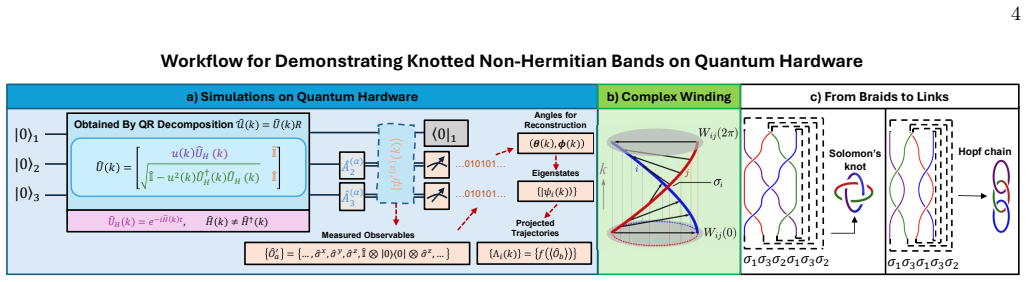
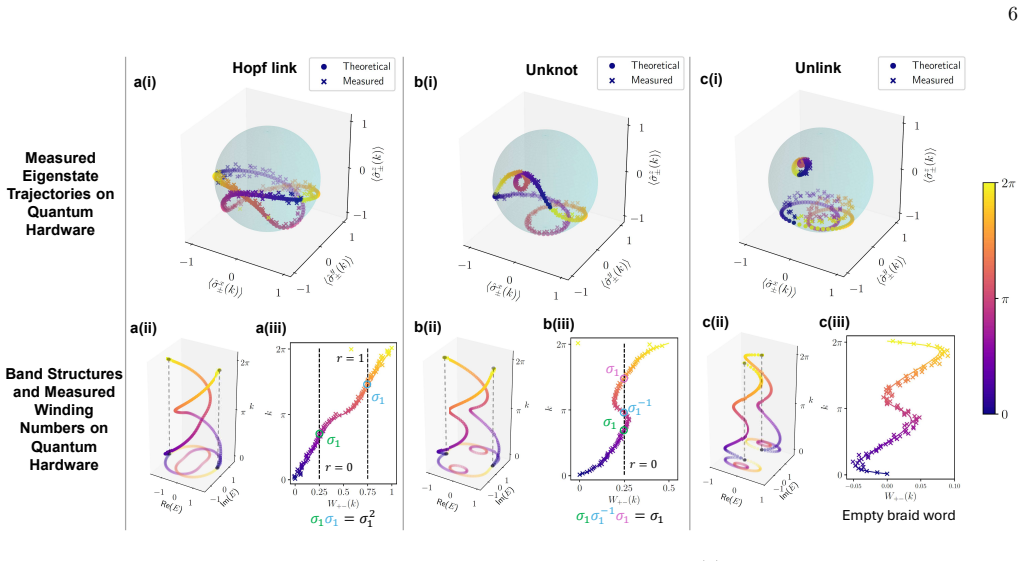
We introduce a family of non-Hermitian multi-band twister models and implement a non-variational protocol on a superconducting quantum processor to characterize their complex braided band structures. By mapping the winding of eigenstates to the spectral topology, the protocol extracts braid information including braid words and knot invariants such as the Alexander and Jones polynomials without full spectral tomography or repeated optimization. We experimentally reconstruct complicated knots and links such as the Hopf chain and Solomon's knot.
What carries the argument
The mapping from eigenstate winding to spectral topology in non-Hermitian multi-band twister models, which enables extraction of braid words and knot invariants from quantum measurements.
Load-bearing premise
The winding of eigenstates in these models accurately reflects the spectral topology and braid information even in the presence of noise on the quantum hardware.
What would settle it
Running the protocol on the quantum processor for the Solomon's knot and finding that the extracted Jones polynomial does not match the expected mathematical value for that knot.
Figures





read the original abstract
Knots and links represent a fundamental motif of non-local connectivity that permeates the physical sciences from string theory to protein folds. While spectral braiding has been explored in two-band non-Hermitian models across various platforms, its direct simulation and characterization on programmable quantum hardware, particularly beyond two strands, remains a formidable challenge due to the limitations of variational optimization in these systems. Here, we introduce a family of non-Hermitian multi-band twister models and implement a non-variational protocol to characterize their complex braided band structures on a programmable superconducting quantum processor. By mapping the winding of eigenstates to the spectral topology, we devise an efficient measurement strategy that extracts braid information, including braid words and knot invariants like the Alexander and Jones polynomials, without requiring full spectral tomography or repeated optimization. We experimentally demonstrate the reconstruction of complicated knots and links such as the Hopf chain and Solomon's knot. Our approach provides a general framework for investigating exotic non-Hermitian topology on near-term quantum devices, opening a route to simulate more sophisticated topological structures in knot theory.
Editorial analysis
A structured set of objections, weighed in public.
Referee Report
Summary. The paper introduces a family of non-Hermitian multi-band twister models and a non-variational protocol to simulate their complex braided band structures on a programmable superconducting quantum processor. By mapping the winding of eigenstates to spectral topology, the protocol extracts braid words and knot invariants (Alexander and Jones polynomials) without full tomography or optimization, and the authors report an experimental demonstration of reconstructing structures such as the Hopf chain and Solomon's knot.
Significance. If the winding-to-topology mapping remains faithful under realistic device noise for multi-band systems, the work supplies a general, scalable framework for hardware simulation of non-Hermitian knotted topology that extends beyond two-band models and avoids variational methods, thereby opening routes to study more intricate topological structures in knot theory on near-term quantum devices.
major comments (2)
- [Abstract] Abstract: the central experimental claim that the protocol reconstructs the Hopf chain and Solomon's knot is presented without quantitative fidelity metrics, error bars on extracted invariants, or explicit checks that finite-shot winding measurements preserve the braid word under typical superconducting-device noise (decoherence, readout errors, imperfect non-Hermitian dilation).
- [Protocol description] The non-variational mapping from measured eigenstate windings to braid words and invariants is asserted to be accurate for multi-band twister models, yet the manuscript supplies no noise-robustness analysis or comparison against full tomography that would confirm the mapping does not shift topology on noisy hardware.
minor comments (2)
- [Model definition] Notation for the multi-band twister models and the precise definition of the winding extraction procedure could be clarified with an explicit algorithmic pseudocode or flowchart to aid reproducibility.
- [Abstract and Introduction] The abstract and introduction would benefit from a brief statement of the number of qubits, circuit depth, and shot counts used in the hardware runs.
Simulated Author's Rebuttal
We thank the referee for their careful reading of the manuscript and for the constructive comments. We address each major point below and have revised the manuscript to strengthen the presentation of the experimental results and protocol validation.
read point-by-point responses
-
Referee: [Abstract] Abstract: the central experimental claim that the protocol reconstructs the Hopf chain and Solomon's knot is presented without quantitative fidelity metrics, error bars on extracted invariants, or explicit checks that finite-shot winding measurements preserve the braid word under typical superconducting-device noise (decoherence, readout errors, imperfect non-Hermitian dilation).
Authors: We agree that the abstract would benefit from these quantitative details. The original version was kept concise, but we have revised the abstract to report fidelity metrics for the reconstructed invariants along with error bars obtained from finite-shot statistics. We have also added explicit discussion and supporting numerical checks in the main text and supplementary material confirming that the braid word is preserved under realistic levels of decoherence, readout errors, and imperfect dilation for the device parameters employed. revision: yes
-
Referee: [Protocol description] The non-variational mapping from measured eigenstate windings to braid words and invariants is asserted to be accurate for multi-band twister models, yet the manuscript supplies no noise-robustness analysis or comparison against full tomography that would confirm the mapping does not shift topology on noisy hardware.
Authors: The referee correctly notes the absence of a dedicated robustness study in the initial submission. While the mapping is derived exactly in the ideal case, we have now added a direct comparison of the protocol outputs against full state tomography on both simulated and experimental data, showing agreement within statistical uncertainties. We have further included noise-robustness analysis in the revised methods and supplementary sections using realistic superconducting-device noise models, which demonstrates that the extracted braid words and knot invariants remain topologically stable. revision: yes
Circularity Check
No circularity: experimental extraction of braid invariants from measured eigenstate windings is self-contained
full rationale
The paper introduces non-Hermitian multi-band twister models and a non-variational protocol that maps measured eigenstate windings directly to spectral topology on quantum hardware. Braid words and knot invariants (Alexander/Jones polynomials) are extracted from finite-shot measurements without optimization or full tomography, and the reported reconstructions of structures such as the Hopf chain and Solomon's knot are presented as direct experimental outcomes. No derivation step reduces by construction to a fitted parameter, self-citation chain, or definitional equivalence; the central mapping is a newly devised measurement strategy whose validity is tested against hardware data rather than assumed tautologically. The work is therefore self-contained against external benchmarks.
Axiom & Free-Parameter Ledger
axioms (1)
- standard math Standard non-Hermitian Hamiltonian formalism and eigenstate topology
invented entities (1)
-
non-Hermitian multi-band twister models
no independent evidence
Forward citations
Cited by 1 Pith paper
-
Fibonacci many-body scars in a decorated Rule-54 quantum cellular automaton
Exact Fibonacci many-body scars engineered via soliton skeleton and invisible decorations in Rule-54 QCA, with finite translation orbits producing low-entanglement Floquet states.
Reference graph
Works this paper leans on
-
[1]
K. Wang, J. L. K. König, K. Yang, L. Xiao, W. Yi, E. J. Bergholtz, and P. Xue, Observation of braid- protected unpaired exceptional points, Phys. Rev. Lett. 136, 056602 (2026)
work page 2026
-
[2]
S. H. Simon,Topological Quantum(Oxford University Press, 2023)
work page 2023
-
[3]
Kitaev, Fault-tolerant quantum computation by anyons, Ann
A. Kitaev, Fault-tolerant quantum computation by anyons, Ann. Phys. (N. Y).303, 2 (2003)
work page 2003
- [4]
-
[5]
T. I. Andersenet al., Non-Abelian braiding of graph vertices in a superconducting processor, Nature618, 264 (2023)
work page 2023
-
[6]
Z. K. Minev, K. Najafi, S. Majumder, J. Wang, A. Stern, E.-A. Kim, C.-M. Jian, and G. Zhu, Realiz- ing string-net condensation: Fibonacci anyon braiding for universal gates and sampling chromatic polynomials, Nat. Commun.16, 6225 (2025)
work page 2025
-
[7]
M. Iqbal, N. Tantivasadakarn, R. Verresen, S. L. Camp- bell, J. M. Dreiling, C. Figgatt, J. P. Gaebler, J. Jo- hansen, M. Mills, S. A. Moses, J. M. Pino, A. Rans- ford, M. Rowe, P. Siegfried, R. P. Stutz, M. Foss-Feig, A. Vishwanath, and H. Dreyer, Non-Abelian topologi- cal order and anyons on a trapped-ion processor, Nature 626, 505 (2024)
work page 2024
-
[8]
S. Xu, Z.-Z. Sun, K. Wang, H. Li, Z. Zhu, H. Dong, J. Deng, X. Zhang, J. Chen, Y. Wu, C. Zhang, F. Jin, X. Zhu, Y. Gao, A. Zhang, N. Wang, Y. Zou, Z. Tan, F. Shen, J. Zhong, Z. Bao, W. Li, W. Jiang, L.-W. Yu, Z. Song, P. Zhang, L. Xiang, Q. Guo, Z. Wang, C. Song, H. Wang, and D.-L. Deng, Non-Abelian braiding of Fi- bonacci anyons with a superconducting pr...
work page 2024
-
[9]
W. D. Heiss, The physics of exceptional points, J. Phys. A Math. Theor.45, 444016 (2012)
work page 2012
-
[10]
C. Dembowski, H.-D. Gräf, H. L. Harney, A. Heine, W. D. Heiss, H. Rehfeld, and A. Richter, Experimental 19 Observation of the Topological Structure of Exceptional Points, Phys. Rev. Lett.86, 787 (2001)
work page 2001
-
[11]
R. El-Ganainy, K. G. Makris, M. Khajavikhan, Z. H. Musslimani, S. Rotter, and D. N. Christodoulides, Non- Hermitian physics and PT symmetry, Nat. Phys.14, 11 (2018)
work page 2018
-
[12]
H.Xu, D.Mason, L.Jiang,andJ.G.E.Harris,Topolog- ical energy transfer in an optomechanical system with exceptional points, Nature537, 80 (2016)
work page 2016
- [13]
-
[14]
C. E. Rüter, K. G. Makris, R. El-Ganainy, D. N. Christodoulides, M. Segev, and D. Kip, Observation of parity–time symmetry in optics, Nat. Phys.6, 192 (2010)
work page 2010
-
[15]
M. Yang and C. H. Lee, Beyond the non-hermitian skin effect: Scaling-controlled topology from exceptional- bound bands, Advanced Science13, e23989 (2026)
work page 2026
-
[16]
K. Yokomizo and S. Murakami, Non-bloch band theory of non-hermitian systems, Physical review letters123, 066404 (2019)
work page 2019
- [17]
-
[18]
R. Lin, T. Tai, L. Li, and C. H. Lee, Topological non- hermitian skin effect, Frontiers of Physics18, 53605 (2023)
work page 2023
- [19]
-
[20]
K. Kawabata, K. Shiozaki, M. Ueda, and M. Sato, Sym- metry and Topology in Non-Hermitian Physics, Phys. Rev. X9, 041015 (2019)
work page 2019
-
[21]
P. Delplace, T. Yoshida, and Y. Hatsugai, Symmetry- ProtectedMultifoldExceptionalPointsandTheirTopo- logical Characterization, Phys. Rev. Lett.127, 186602 (2021)
work page 2021
-
[22]
Y.-X. Xiao and C. T. Chan, Topology in non-Hermitian Chern insulators with skin effect, Phys. Rev. B105, 075128 (2022)
work page 2022
-
[23]
H. Jiang, C. Yang, and S. Chen, Topological invariants and phase diagrams for one-dimensional two-band non- Hermitian systems without chiral symmetry, Phys. Rev. A98, 10.1103/PhysRevA.98.052116 (2018)
- [24]
-
[25]
D. S. Borgnia, A. J. Kruchkov, and R. J. Slager, Non- Hermitian Boundary Modes and Topology, Phys. Rev. Lett.124, 56802 (2020)
work page 2020
-
[26]
K. Ding, C. Fang, and G. Ma, Non-Hermitian topology and exceptional-point geometries, Nat. Rev. Phys.4, 745 (2022)
work page 2022
-
[27]
F. K. Kunst, E. Edvardsson, J. C. Budich, and E. J. Bergholtz, Biorthogonal Bulk-Boundary Corre- spondence in Non-Hermitian Systems, Phys. Rev. Lett. 121, 026808 (2018)
work page 2018
- [28]
-
[29]
Y. Wang, Y. Wu, X. Ye, C.-K. Duan, Y. Wang, H. Hu, X. Rong, and J. Du, Non-Hermitian non-Abelian topo- logical transition in the S = 1 electron spin system of a nitrogen vacancy centre in diamond, Nat. Nanotechnol. 20, 873 (2025)
work page 2025
-
[30]
Y. S. Patil, J. Höller, P. A. Henry, C. Guria, Y. Zhang, L. Jiang, N. Kralj, N. Read, and J. G. Harris, Measur- ing the knot of non-Hermitian degeneracies and non- commuting braids, Nature607, 271 (2022)
work page 2022
-
[31]
M.-M. Cao, K. Li, W.-D. Zhao, W.-X. Guo, B.-X. Qi, X.-Y. Chang, Z.-C. Zhou, Y. Xu, and L.-M. Duan, Probing Complex-Energy Topology via Non-Hermitian Absorption Spectroscopy in a Trapped Ion Simulator, Phys. Rev. Lett.130, 163001 (2023)
work page 2023
-
[32]
W. Cao, W. Zhang, and X. Zhang, Observation of knot topology of exceptional points, Phys. Rev. B109, 165128 (2024)
work page 2024
-
[33]
W. Cao, X. Qin, W. Zhang, X. Zhou, and X. Zhang, Topological fractal braiding of non-Hermitian bands, Commun. Phys.8, 391 (2025)
work page 2025
- [34]
-
[35]
P. R. Han, W. Ning, X. J. Huang, R. H. Zheng, S. B. Yang, F. Wu, Z. B. Yang, Q. P. Su, C. P. Yang, and S. B. Zheng, Measuring topological invariants for higher-order exceptional points in quantum three-mode systems, Nat. Commun.15, 8 (2024)
work page 2024
-
[36]
A. Wang and C. Q. Chen, Observing non-Bloch braids and phase transitions by precise manipulation of the non-Hermitian boundary and size, Communications Physics8, 294 (2025)
work page 2025
-
[37]
Z. Rao, C. Meng, Y. Han, L. Zhu, K. Ding, and Z. An, Braiding reflectionless states in non-Hermitian magnon- ics, Nat. Phys.20, 1904 (2024)
work page 1904
- [38]
- [39]
-
[40]
S. Tong, Q. Zhang, L. Qi, G. Li, X. Feng, and C. Qiu, Observation of Floquet-Bloch Braids in Non-Hermitian Spatiotemporal Lattices, Phys. Rev. Lett.134, 126603 (2025)
work page 2025
-
[41]
W. Tang, K. Ding, and G. Ma, Experimental realiza- tion of non-Abelian permutations in a three-state non- Hermitian system, Natl. Sci. Rev.9, 22 (2022)
work page 2022
-
[42]
J. Chen, Z. Wang, Y.-T. Tan, C. Wang, and J. Ren, Ma- chine learning of knot topology in non-hermitian band braids, Communications Physics7, 209 (2024)
work page 2024
-
[43]
Y. Long, H. Xue, and B. Zhang, Unsupervised learning of topological non-Abelian braiding in non-Hermitian bands, Nature Machine Intelligence6, 904 (2024)
work page 2024
-
[44]
M. Naghiloo, M. Abbasi, Y. N. Joglekar, and K. Murch, Quantumstatetomographyacrosstheexceptionalpoint in a single dissipative qubit, Nature Physics15, 1232 (2019)
work page 2019
-
[45]
Y. Wu, W. Liu, J. Geng, X. Song, X. Ye, C.-K. Duan, X. Rong, and J. Du, Observation of parity-time symme- try breaking in a single-spin system, Science364, 878 (2019). 20
work page 2019
-
[46]
J. Li, A. K. Harter, J. Liu, L. de Melo, Y. N. Joglekar, andL.Luo,Observationofparity-timesymmetrybreak- ing transitions in a dissipative floquet system of ultra- cold atoms, Nature Communications10, 855 (2019)
work page 2019
-
[47]
M. Partanen, J. Goetz, K. Y. Tan, K. Kohvakka, V. Sevriuk, R. E. Lake, R. Kokkoniemi, J. Ikonen, D. Hazra, A. Mäkinen,et al., Exceptional points in tunable superconducting resonators, Physical Review B 100, 134505 (2019)
work page 2019
-
[48]
L. Ding, K. Shi, Q. Zhang, D. Shen, X. Zhang, and W. Zhang, Experimental determination of pt-symmetric exceptional points in a single trapped ion, Physical Re- view Letters126, 083604 (2021)
work page 2021
-
[49]
W.-C. Wang, Y.-L. Zhou, H.-L. Zhang, J. Zhang, M.-C. Zhang, Y. Xie, C.-W. Wu, T. Chen, B.-Q. Ou, W. Wu, H. Jing, and P.-X. Chen, Observation ofPT-symmetric quantum coherence in a single-ion system, Phys. Rev. A103, L020201 (2021)
work page 2021
-
[50]
W. Liu, Y. Wu, C.-K. Duan, X. Rong, and J. Du, Dy- namically encircling an exceptional point in a real quan- tum system, Phys. Rev. Lett.126, 170506 (2021)
work page 2021
-
[51]
Z. Ren, D. Liu, E. Zhao, C. He, K. K. Pak, J. Li, and G.-B. Jo, Chiral control of quantum states in non- hermitian spin–orbit-coupled fermions, Nature Physics 18, 385 (2022)
work page 2022
-
[52]
T. Chen, R. Shen, C. H. Lee, and B. Yang, High-fidelity realization of the AKLT state on a NISQ-era quantum processor, SciPost Phys.15, 170 (2023)
work page 2023
-
[53]
A. Jebraeilli and M. R. Geller, Quantum simulation of a qubit with a non-Hermitian Hamiltonian, Phys. Rev. A111, 032211 (2025)
work page 2025
-
[54]
C. Zheng, Duality quantum simulation of a general parity-time-symmetric two-level system, EPL (Euro- physics Letters)123, 40002 (2018)
work page 2018
-
[55]
M. Huang, R.-K. Lee, L. Zhang, S.-M. Fei, and J. Wu, Simulating broken PT-symmetric hamiltonian systems by weak measurement, Physical Review Letters123, 080404 (2019)
work page 2019
-
[56]
J. M. Koh, T. Tai, Y. H. Phee, W. E. Ng, and C. H. Lee, Stabilizing multiple topological fermions on a quantum computer, npj Quantum Information8, 16 (2022)
work page 2022
-
[57]
H. Liu, X. Yang, K. Tang, L. Che, X. Nie, T. Xin, J. Li, and D. Lu, Practical quantum simulation of small- scale non-hermitian dynamics, Physical Review A107, 062608 (2023)
work page 2023
- [58]
- [59]
-
[60]
J. Wen, C. Zheng, X. Kong, S. Wei, T. Xin, and G.-L. Long, Experimental demonstration of a digital quantum simulation of a general PT-symmetric system, Physical Review A99, 062122 (2019)
work page 2019
-
[61]
T. Chen, R. Shen, C. Hua Lee, B. Yang, and R. Weda Bomantara, A robust large-period discrete time crystal and its signature in a digital quantum com- puter, Quantum Science and Technology11, 025030 (2026)
work page 2026
- [62]
-
[63]
J. M. Koh, T. Tai, and C. H. Lee, Realization of higher- order topological lattices on a quantum computer, Na- ture Communications15, 5807 (2024)
work page 2024
-
[64]
Z. Lin, L. Zhang, X. Long, Y.-a. Fan, Y. Li, K. Tang, J.Li, X.Nie, T.Xin, X.-J.Liu,andD.Lu,Experimental quantum simulation of non-hermitian dynamical topo- logical states using stochastic Schrödinger equation, npj Quantum Information8, 77 (2022)
work page 2022
-
[65]
J. Bian, P. Lu, T. Liu, H. Wu, X. Rao, K. Wang, Q. Lao, Y. Liu, F. Zhu, and L. Luo, Quantum simulation of a general anti-PT-symmetric hamiltonian with a trapped ion qubit, Fundamental Research3, 904 (2023)
work page 2023
- [66]
-
[67]
R. Shen, F. Qin, J.-Y. Desaules, Z. Papić, and C. H. Lee, Enhanced many-body quantum scars from the non- hermitian fock skin effect, Physical Review Letters133, 216601 (2024)
work page 2024
- [68]
- [69]
- [70]
-
[71]
R. Shen, T. Chen, B. Yang, and C. H. Lee, Observa- tion of the non-hermitian skin effect and fermi skin on a digital quantum computer, Nature Communications 16, 1340 (2025)
work page 2025
-
[72]
Y. Wu, Y. Wang, X. Ye, W. Liu, C.-K. Duan, Y. Wang, X. Rong, and J. Du, Observation of the knot topology of non-hermitian systems in a single spin, Physical Review A108, 052409 (2023)
work page 2023
-
[73]
Observation of feedback-directed quantum dynamics in large-scale quantum processors
R. Shen and C. H. Lee,Observation of feedback-directed quantum dynamics in large-scale quantum processors, arXiv preprint arXiv:2604.11900 (2026)
work page internal anchor Pith review Pith/arXiv arXiv 2026
-
[74]
Preskill, Quantum Computing in the NISQ era and beyond, Quantum2, 79 (2018)
J. Preskill, Quantum Computing in the NISQ era and beyond, Quantum2, 79 (2018)
work page 2018
-
[75]
H.-L. Zhang, P.-R. Han, X.-J. Yu, S.-B. Yang, J.-H. Lü, W. Ning, F. Wu, Q.-P. Su, C.-P. Yang, Z.-B. Yang, and S.-B. Zheng, Implementation and topological character- ization of weyl exceptional rings in quantum-mechanical systems, Science Bulletin70, 2446 (2025)
work page 2025
-
[76]
Y.-Y. Chen, K. Li, L. Zhang, Y.-K. Wu, J.-Y. Ma, H.- X. Yang, C. Zhang, B.-X. Qi, Z.-C. Zhou, P.-Y. Hou, Y. Xu, and L.-M. Duan, Quantum tomography of a third-order exceptional point in a dissipative trapped ion, Nature Communications16, 7478 (2025)
work page 2025
- [77]
-
[78]
P.-R. Han, W. Ning, X.-J. Huang, R.-H. Zheng, S.-B. Yang, F. Wu, Z.-B. Yang, Q.-P. Su, C.-P. Yang, and S.- 21 B. Zheng, Measuring topological invariants for higher- order exceptional points in quantum three-mode sys- tems, Nature Communications15, 10293 (2024)
work page 2024
-
[79]
Y. Wang, Y. Wu, X. Ye, C.-K. Duan, Y. Wang, H. Hu, X. Rong, and J. Du, Non-hermitian non-abelian topo- logical transition in the S = 1 electron spin system of a nitrogen vacancy centre in diamond, Nature Nanotech- nology20, 873 (2025)
work page 2025
-
[80]
T. Laakkonen, E. Rinaldi, C. N. Self, E. Chertkov, M. DeCross, D. Hayes, B. Neyenhuis, M. Benedetti, and K. Meichanetzidis, Less Quantum, MoreAdvantage: An End-to-End Quantum Algorithm for the Jones Polyno- mial, arXiv preprint arXiv:2503.05625 (2025)
discussion (0)
Sign in with ORCID, Apple, or X to comment. Anyone can read and Pith papers without signing in.