Observation of feedback-directed quantum dynamics in large-scale quantum processors
Pith reviewed 2026-05-10 15:51 UTC · model grok-4.3
The pith
Feedback-directed measurements steer random quantum dynamics to produce intrinsic asymmetry on large-scale processors.
A machine-rendered reading of the paper's core claim, the machinery that carries it, and where it could break.
Core claim
Feedback-directed circuit architectures integrate spatially structured mid-circuit measurements with real-time conditional operations to steer the evolution of random dynamics, thereby generating directional information flow and intrinsic asymmetry that is observed in a robust and noise-resilient manner on IBM quantum processors and is distinct from the non-Hermitian skin effect.
What carries the argument
Feedback-directed monitored circuits in which measurement outcomes serve as active control signals to direct non-unitary evolution and create asymmetry.
Load-bearing premise
The quantum hardware executes the intended mid-circuit measurements and conditional operations faithfully enough that the observed asymmetry originates from the feedback design rather than from noise or calibration artifacts.
What would settle it
Running the same circuits on the processor but with the conditional feedback operations disabled while retaining the mid-circuit measurements, and checking whether the reported asymmetry signature disappears.
Figures


read the original abstract
Programmable quantum hardware provides an emerging platform for exploring and controlling non-unitary quantum dynamics through measurement-based operations. In this work, we introduce feedback-directed circuit architectures that integrate spatially structured mid-circuit measurements with real-time conditional operations to steer the evolution of random dynamics, and perform their large-scale simulations (up to 100 qubits) on programmable digital quantum processors. By promoting measurement from a passive readout to an active control signal, these adaptive monitored circuits enable directional information flow and generate intrinsic asymmetry in random circuit simulations. We implement this framework on IBM superconducting quantum processors and observe robust, noise-resilient signatures of feedback-induced asymmetry distinct from the more well-known non-Hermitian skin effect. Our results establish feedback as a programmable resource for non-unitary control, opening new avenues for engineering measurement-based dynamics, non-equilibrium phenomena, and tunable open-system behavior on large-scale quantum hardware.
Editorial analysis
A structured set of objections, weighed in public.
Referee Report
Summary. The manuscript introduces feedback-directed circuit architectures that integrate spatially structured mid-circuit measurements with real-time conditional operations to steer the evolution of random quantum dynamics. Large-scale simulations (up to 100 qubits) are performed classically, and the framework is implemented on IBM superconducting quantum processors, where the authors report observing robust, noise-resilient signatures of feedback-induced asymmetry that are claimed to be distinct from the non-Hermitian skin effect.
Significance. If the experimental results hold and the observed asymmetry can be rigorously attributed to the feedback mechanism rather than hardware artifacts, this would constitute a meaningful contribution to the study of measurement-based non-unitary dynamics. It positions feedback as a programmable control resource on current quantum hardware, with potential implications for engineering open-system behavior and non-equilibrium phenomena. The classical simulations up to 100 qubits provide a useful benchmark for the ideal case.
major comments (1)
- The central experimental claim (abstract and hardware implementation section) that mid-circuit measurements plus real-time conditionals produce directional asymmetry distinct from the non-Hermitian skin effect rests on the unverified assumption that IBM hardware faithfully realizes the intended architecture. The manuscript must include quantitative control experiments (e.g., delayed feedback, randomized conditionals) and comparisons against realistic noise models to demonstrate that latency, readout errors, and calibration artifacts do not dominate or mimic the reported signatures; without these, the robustness and distinction claims cannot be assessed.
minor comments (1)
- The abstract would benefit from explicit numerical metrics (e.g., asymmetry measures, error bars, or statistical significance) for the 'robust, noise-resilient signatures' to allow immediate evaluation of the observation strength.
Simulated Author's Rebuttal
We thank the referee for the constructive review and for highlighting the importance of rigorously validating the experimental implementation against hardware artifacts. We address the major comment below and will strengthen the manuscript accordingly.
read point-by-point responses
-
Referee: The central experimental claim (abstract and hardware implementation section) that mid-circuit measurements plus real-time conditionals produce directional asymmetry distinct from the non-Hermitian skin effect rests on the unverified assumption that IBM hardware faithfully realizes the intended architecture. The manuscript must include quantitative control experiments (e.g., delayed feedback, randomized conditionals) and comparisons against realistic noise models to demonstrate that latency, readout errors, and calibration artifacts do not dominate or mimic the reported signatures; without these, the robustness and distinction claims cannot be assessed.
Authors: We agree that additional quantitative controls are required to substantiate that the observed asymmetry arises from the feedback mechanism rather than hardware-specific effects. The current manuscript compares experimental data to ideal classical simulations up to 100 qubits and notes qualitative differences from the non-Hermitian skin effect, but does not include the specific controls suggested. In the revised manuscript we will add a dedicated subsection presenting: (i) delayed-feedback control runs in which the conditional operations are intentionally postponed by several circuit layers, (ii) randomized-conditional runs that replace the structured feedback with random bit flips of equal probability, and (iii) direct comparisons of the measured asymmetry against noise models constructed from IBM’s reported readout and gate-error calibrations for the same device. These additions will allow readers to assess whether the reported signatures survive when the intended feedback architecture is disrupted or when realistic noise is applied. revision: yes
Circularity Check
No significant circularity in experimental observation and simulation
full rationale
The paper introduces feedback-directed circuit architectures and reports their implementation on IBM superconducting quantum processors along with classical simulations up to 100 qubits. The central claims consist of direct experimental observations of feedback-induced asymmetry, presented as hardware results rather than any mathematical derivation or prediction that reduces to fitted parameters, self-citations, or ansatzes by construction. No load-bearing step equates an output to its own inputs via definition or prior author work; the architecture is defined and executed explicitly, with asymmetry signatures distinguished from the non-Hermitian skin effect through comparison of observed data. This is self-contained experimental work with independent content from hardware execution and simulation.
Axiom & Free-Parameter Ledger
Forward citations
Cited by 2 Pith papers
-
Fibonacci many-body scars in a decorated Rule-54 quantum cellular automaton
Exact Fibonacci many-body scars engineered via soliton skeleton and invisible decorations in Rule-54 QCA, with finite translation orbits producing low-entanglement Floquet states.
-
Digital Simulation of Non-Hermitian Knotted Bands on Quantum Hardware
Non-Hermitian multi-band twister models are simulated on quantum hardware via a direct measurement protocol that extracts braid information and knot invariants such as Alexander and Jones polynomials, demonstrated on ...
Reference graph
Works this paper leans on
-
[1]
1(a), which serves to ef- fect information scrambling [61, 70, 71]
Unitary random circuit without measurements and feedback As the most basic example, we consider the random quantum-circuit ansatz in Fig. 1(a), which serves to ef- fect information scrambling [61, 70, 71]. Its architecture 3 Random circuit + single-qubit conditional X operators If 0 Measurement with conditional SWAP Classical register = SWAP R Random R ga...
-
[2]
1(b)) after each random unitary layer (blue) at every iteration i
Random circuit with pure mid-circuit measurements To generate non-unitary, measurement-induced dy- namics, the most direct approach is to stochastically ap- ply mid-circuit measurements (red boxes in Fig. 1(b)) after each random unitary layer (blue) at every iteration i. One layer of evolution is then described by the quan- tum channel ρ7→M Pure meas(ρscr...
-
[3]
We first consider the single-qubit feedback protocol of Eq
Random circuit with conditional single-qubit X operators To implement asymmetrically directed feedback, we now attach conditional operations to the mid-circuit mea- surements. We first consider the single-qubit feedback protocol of Eq. 3, illustrated by the purple boxes in Fig. 1(c). In this protocol, if qubitjis measured and the outcome is 0, a condition...
-
[4]
Random circuit with conditional 2-qubit SWAP operators To realize asymmetrically directed feedback, we next consider a more sophisticated protocol based on two- qubit conditional-SWAP operations, as described by Eq. 4 and illustrated in Fig. 1(d). In this architecture, each green block denotes a measurement-conditioned op- eration applied with fixed proba...
-
[5]
Effective stochastic model for feedback-directed dynamics To further understand the measurement feedback dy- namics, we provide a complementary approximate de- scription of it from a stochastic perspective. In our measurement-based circuits, the dynamics between mea- surement events are largely governed by the unitary scrambling layers. Mid-circuit measur...
-
[6]
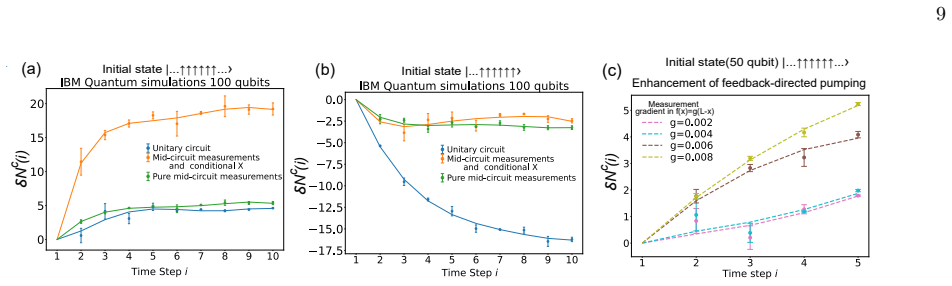
Quantitative characterization of the extent of dynamical feedback We next quantitatively characterize the measured dy- namical evolution in the 100-qubit chain subject to con- ditional spin flips. To isolate initial boundary effects, we 8 consider the net center-of-mass shift at iteration (time)i δN c(i) =L(⟨N c(i)⟩ − ⟨N c(1)⟩),(24) whereLis the system si...
-
[7]
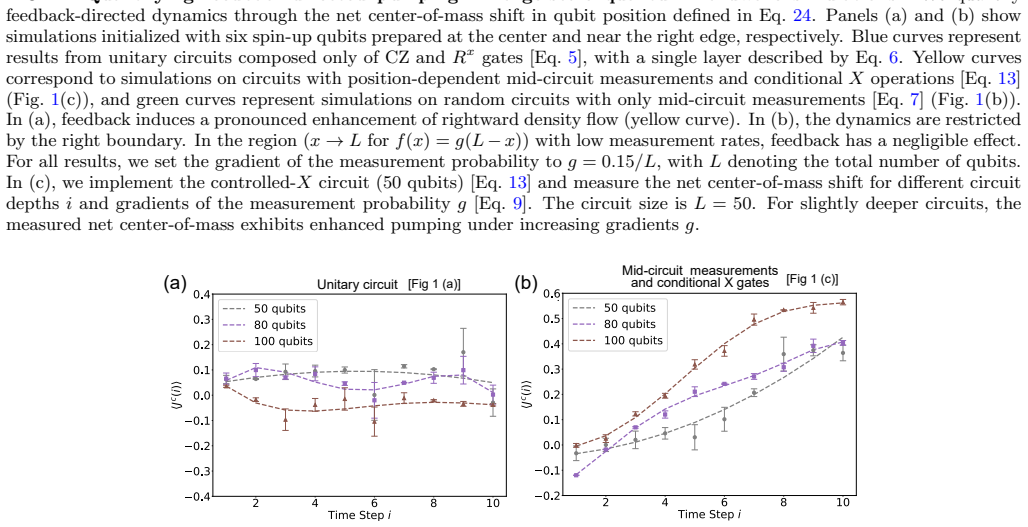
Measurements of robust transport signatures The above results demonstrate that mid-circuit mea- surements combined with conditional operations can gen- erate a robust directional flow that remains observable up to system sizes of 100 qubits. For larger systems, how- ever, the dynamics naturally spread over an extended bulk region, so the feedback-induced ...
-
[8]
is described by the local quantum channel Ex,x+1(ρ) =K 0ρK † 0 +K 1ρK † 1 +K idρK † id,(26) with Kraus operatorsK 0 =p pSWAPSWAPx,x+1Px[0], K1 = p pSWAP Px[1], Kid =p 1−p SWAP I.HereP x[0] =|0⟩ ⟨0|andP x[1] =|1⟩ ⟨1| project onto the measured outcomes at qubitx. Thus, with probabilityp SWAP, qubitxis measured; if the outcome is 0, a SWAP is applied between...
-
[9]
Preskill, Quantum Computing in the NISQ era and beyond, Quantum2, 79 (2018)
J. Preskill, Quantum Computing in the NISQ era and beyond, Quantum2, 79 (2018)
work page 2018
-
[10]
Y. Kim, A. Eddins, S. Anand, K. X. Wei, E. Van Den Berg, S. Rosenblatt, H. Nayfeh, Y. Wu, M. Zale- tel, K. Temme,et al., Evidence for the utility of quan- tum computing before fault tolerance, Nature618, 500 (2023)
work page 2023
-
[11]
T. Chen, R. Shen, C. H. Lee, and B. Yang, High-fidelity realization of the aklt state on a nisq-era quantum pro- cessor, SciPost Physics15, 170 (2023)
work page 2023
- [12]
-
[13]
A. Miessen, D. J. Egger, I. Tavernelli, and G. Mazzola, Benchmarking digital quantum simulations above hun- dreds of qubits using quantum critical dynamics, PRX Quantum5, 040320 (2024)
work page 2024
-
[14]
T. I. Andersen, N. Astrakhantsev, A. H. Karamlou, J. Berndtsson, J. Motruk, A. Szasz, J. A. Gross, A. Schuckert, T. Westerhout, Y. Zhang,et al., Thermal- ization and criticality on an analogue–digital quantum simulator, Nature638, 79 (2025)
work page 2025
- [15]
- [16]
-
[17]
S. J. Evered, D. Bluvstein, M. Kalinowski, S. Ebadi, T. Manovitz, H. Zhou, S. H. Li, A. A. Geim, T. T. Wang, N. Maskara,et al., High-fidelity parallel entangling gates on a neutral-atom quantum computer, Nature622, 268 (2023)
work page 2023
- [18]
- [19]
- [20]
-
[21]
K. Kawabata, K. Shiozaki, M. Ueda, and M. Sato, Sym- metry and topology in non-hermitian physics, Physical Review X9, 041015 (2019)
work page 2019
-
[22]
R. El-Ganainy, K. G. Makris, M. Khajavikhan, Z. H. Musslimani, S. Rotter, and D. N. Christodoulides, Non- hermitian physics and pt symmetry, Nature Physics14, 11 (2018)
work page 2018
- [23]
-
[24]
R. Lin, T. Tai, L. Li, and C. H. Lee, Topological non- hermitian skin effect, Frontiers of Physics18, 53605 (2023)
work page 2023
- [25]
-
[26]
A. N. Poddubny, Interaction-induced analog of a non- hermitian skin effect in a lattice two-body problem, Phys- ical Review B107, 045131 (2023)
work page 2023
-
[27]
R. Shen, T. Chen, M. M. Aliyu, F. Qin, Y. Zhong, H. Loh, and C. H. Lee, Proposal for observing yang-lee criticality in rydberg atomic arrays, Physical Review Let- ters131, 080403 (2023)
work page 2023
-
[28]
M. Yang, L. Yuan, and C. H. Lee, Non-hermitian strong bosonic clustering through interaction-induced caging, Communications Physics8, 388 (2025)
work page 2025
-
[29]
S. Liu, H. Jiang, W.-T. Xue, Q. Li, J. Gong, X. Liu, and C. H. Lee, Non-hermitian entanglement dip from scaling- induced exceptional criticality, Science Bulletin70, 2929 (2025)
work page 2025
- [30]
- [31]
- [32]
-
[33]
F. Qin, R. Shen, C. H. Lee,et al., Non-hermitian squeezed polarons, Physical Review A107, L010202 (2023)
work page 2023
- [34]
-
[35]
N. Matsumoto, K. Kawabata, Y. Ashida, S. Furukawa, and M. Ueda, Continuous phase transition without gap closing in non-hermitian quantum many-body systems, Physical review letters125, 260601 (2020)
work page 2020
-
[36]
E. Lee, H. Lee, and B.-J. Yang, Many-body approach to non-hermitian physics in fermionic systems, Physical Review B101, 121109 (2020)
work page 2020
-
[37]
H. Li, H. Wu, W. Zheng, and W. Yi, Many-body non- hermitian skin effect under dynamic gauge coupling, Physical Review Research5, 033173 (2023)
work page 2023
- [38]
-
[39]
R. Shen and C. H. Lee, Non-hermitian skin clusters from strong interactions, Communications Physics5, 1 (2022)
work page 2022
-
[41]
C. H. Lee, Many-body topological and skin states with- out open boundaries, Physical Review B104, 195102 (2021)
work page 2021
-
[42]
K. Kawabata, T. Numasawa, and S. Ryu, Entanglement phase transition induced by the non-hermitian skin effect, Phys. Rev. X13, 021007 (2023)
work page 2023
-
[43]
R. Shen, W. J. Chan, and C. H. Lee, Non-hermitian skin effect along hyperbolic geodesics, Physical Review B111, 045420 (2025)
work page 2025
-
[44]
M. Yang and C. H. Lee, Beyond the non-hermitian skin effect: Scaling-controlled topology from exceptional- bound bands, Advanced Science , e23989 (2025)
work page 2025
-
[45]
F. Qin, R. Shen, L. Li, and C. H. Lee, Kinked linear re- sponse from non-hermitian cold-atom pumping, Physical Review A109, 053311 (2024)
work page 2024
-
[46]
J. Gliozzi, G. De Tomasi, and T. L. Hughes, Many-body non-hermitian skin effect for multipoles, Physical review letters133, 136503 (2024)
work page 2024
-
[47]
R. Shen, T. Chen, B. Yang, and C. H. Lee, Observa- tion of the non-hermitian skin effect and fermi skin on a digital quantum computer, Nature Communications16, 1340 (2025)
work page 2025
-
[48]
R. Shen, F. Qin, J.-Y. Desaules, Z. Papi´ c, and C. H. Lee, Enhanced many-body quantum scars from the non- hermitian fock skin effect, Physical Review Letters133, 216601 (2024)
work page 2024
- [49]
-
[50]
R. Shen, T. Chen, B. Yang, Y. Zhong, and C. H. Lee, Robust simulations of many-body symmetry-protected topological phase transitions on a quantum processor, npj Quantum Information11, 179 (2025)
work page 2025
- [51]
- [52]
-
[53]
M.-M. Cao, K. Li, W.-D. Zhao, W.-X. Guo, B.-X. Qi, X.- Y. Chang, Z.-C. Zhou, Y. Xu, and L.-M. Duan, Probing complex-energy topology via non-hermitian absorption spectroscopy in a trapped ion simulator, Physical Review Letters130, 163001 (2023)
work page 2023
-
[54]
Z. Lin, L. Zhang, X. Long, Y.-a. Fan, Y. Li, K. Tang, J. Li, X. Nie, T. Xin, X.-J. Liu,et al., Experimental quantum simulation of non-hermitian dynamical topo- logical states using stochastic schr¨ odinger equation, npj Quantum Information8, 77 (2022)
work page 2022
-
[55]
J. Hines and T. Proctor, Pauli noise learning for mid- circuit measurements, Physical Review Letters134, 020602 (2025)
work page 2025
-
[56]
J. M. Koh, S.-N. Sun, M. Motta, and A. J. Minnich, Measurement-induced entanglement phase transition on a superconducting quantum processor with mid-circuit readout, Nature Physics19, 1314 (2023)
work page 2023
-
[57]
E. Deist, Y.-H. Lu, J. Ho, M. K. Pasha, J. Zeiher, Z. Yan, and D. M. Stamper-Kurn, Mid-circuit cavity measure- ment in a neutral atom array, Physical Review Letters 129, 203602 (2022)
work page 2022
-
[58]
Y. Li, X. Chen, and M. P. Fisher, Quantum zeno ef- fect and the many-body entanglement transition, Physi- cal Review B98, 205136 (2018)
work page 2018
-
[59]
B. Skinner, J. Ruhman, and A. Nahum, Measurement- induced phase transitions in the dynamics of entangle- ment, Physical Review X9, 031009 (2019)
work page 2019
-
[60]
M. J. Gullans and D. A. Huse, Dynamical purifica- tion phase transition induced by quantum measurements, Physical Review X10, 041020 (2020)
work page 2020
-
[61]
M. J. Gullans and D. A. Huse, Scalable probes of measurement-induced criticality, Physical review letters 125, 070606 (2020)
work page 2020
- [62]
-
[63]
D. Zhu, G. D. Kahanamoku-Meyer, L. Lewis, C. Noel, O. Katz, B. Harraz, Q. Wang, A. Risinger, L. Feng, D. Biswas,et al., Interactive cryptographic proofs of quantumness using mid-circuit measurements, Nature Physics19, 1725 (2023)
work page 2023
-
[64]
M. DeCross, E. Chertkov, M. Kohagen, and M. Foss-Feig, Qubit-reuse compilation with mid-circuit measurement and reset, Physical Review X13, 041057 (2023)
work page 2023
-
[65]
E. B¨ aumer, V. Tripathi, D. S. Wang, P. Rall, E. H. Chen, S. Majumder, A. Seif, and Z. K. Minev, Efficient long- range entanglement using dynamic circuits, PRX Quan- tum5, 030339 (2024)
work page 2024
-
[66]
R. S. Gupta, E. Van Den Berg, M. Takita, D. Riste, K. Temme, and A. Kandala, Probabilistic error cancel- lation for dynamic quantum circuits, Physical Review A 109, 062617 (2024)
work page 2024
-
[67]
E. B¨ aumer, V. Tripathi, A. Seif, D. Lidar, and D. S. Wang, Quantum fourier transform using dynamic cir- cuits, Physical Review Letters133, 150602 (2024)
work page 2024
-
[68]
A. J. Friedman, O. Hart, and R. Nandkishore, Measurement-induced phases of matter require feedback, 15 PRX Quantum4, 040309 (2023)
work page 2023
- [69]
-
[70]
M. P. Fisher, V. Khemani, A. Nahum, and S. Vijay, Random quantum circuits, Annual Review of Condensed Matter Physics14, 335 (2023)
work page 2023
-
[71]
S. Pai, M. Pretko, and R. M. Nandkishore, Localization in fractonic random circuits, Physical Review X9, 021003 (2019)
work page 2019
-
[72]
V. Ravindranath, Y. Han, Z.-C. Yang, and X. Chen, En- tanglement steering in adaptive circuits with feedback, Physical Review B108, L041103 (2023)
work page 2023
-
[73]
T. Iadecola, S. Ganeshan, J. Pixley, and J. H. Wilson, Measurement and feedback driven entanglement transi- tion in the probabilistic control of chaos, Physical review letters131, 060403 (2023)
work page 2023
- [74]
-
[75]
C. Noel, P. Niroula, D. Zhu, A. Risinger, L. Egan, D. Biswas, M. Cetina, A. V. Gorshkov, M. J. Gullans, D. A. Huse,et al., Measurement-induced quantum phases realized in a trapped-ion quantum computer, Nature Physics18, 760 (2022)
work page 2022
-
[76]
B. Bertini and L. Piroli, Scrambling in random unitary circuits: Exact results, Physical Review B102, 064305 (2020)
work page 2020
-
[77]
Measurement-induced entanglement and teleportation on a noisy quantum processor, Nature622, 481 (2023)
work page 2023
- [78]
-
[79]
C. W. von Keyserlingk, T. Rakovszky, F. Pollmann, and S. L. Sondhi, Operator hydrodynamics, otocs, and en- tanglement growth in systems without conservation laws, Physical Review X8, 021013 (2018)
work page 2018
- [80]
- [81]
discussion (0)
Sign in with ORCID, Apple, or X to comment. Anyone can read and Pith papers without signing in.