uGMRT and MeerKAT observation of RXCJ0232-4420: a quiet cluster with a giant radio halo
Pith reviewed 2026-05-07 09:16 UTC · model grok-4.3
The pith
A cool-core galaxy cluster hosts an Mpc-scale giant radio halo sustained by minor-merger turbulence.
A machine-rendered reading of the paper's core claim, the machinery that carries it, and where it could break.
Core claim
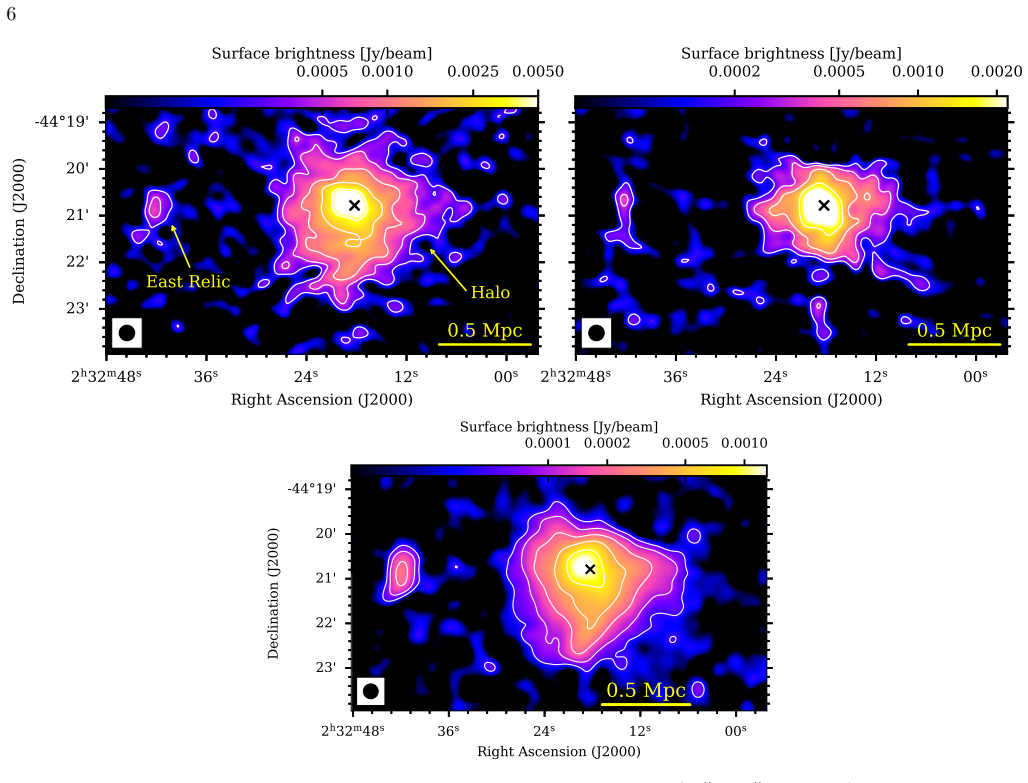
The central claim is that RXCJ0232-4420 hosts a giant radio halo with an extent beyond 1 Mpc at all observed frequencies, a mostly uniform spectral index between -1.0 and -1.3, and an exponential surface brightness profile whose e-folding radius stays constant with frequency. The halo emission correlates morphologically and point-to-point with the thermal X-ray gas, yielding a sublinear slope of roughly 0.8 with no frequency dependence. A candidate 300-kpc relic to the east shows a flatter spectrum. These observations establish that merger-driven turbulence from minor disturbances can maintain cluster-wide particle re-acceleration while preserving the cool core.
What carries the argument
The multi-frequency spectral imaging and radio-X-ray point-to-point correlation analysis that quantifies the spatial extent, spectral uniformity, and brightness scaling of the Mpc-scale emission.
If this is right
- Mpc-scale radio halos can form in dynamically intermediate clusters that retain cool cores.
- Merger-driven turbulence need not be violent to sustain cluster-wide particle re-acceleration.
- The traditional separation between giant halos in merging clusters and mini-halos in cool cores becomes less sharp.
- The radio surface brightness follows a single exponential profile whose scale length does not change with frequency.
- The candidate east relic is a separate structure with a flatter spectrum than the halo.
Where Pith is reading between the lines
- Cluster dynamical states may form a continuum rather than two discrete categories.
- Low-frequency surveys could uncover faint giant halos in other apparently relaxed cool-core systems.
- Particle acceleration models may need to incorporate sustained low-level turbulence as a viable driver for large-scale emission.
Load-bearing premise
The Mpc-scale radio emission is powered by turbulence from minor merger disturbances rather than another process, and the cluster is in a truly intermediate dynamical state.
What would settle it
X-ray or optical imaging that reveals a recent major merger capable of destroying the cool core, or spectral and morphological data showing the radio emission originates from AGN activity instead of distributed turbulence.
Figures




read the original abstract
Giant radio halos are the Mpc-scale extended sources associated with the merging clusters, while the mini-halos are preferentially associated with cool-core clusters. Both trace the ICM plasma physical process, and recent low-frequency observations increasingly blur the distinction between the two classes. We present the first multi-frequency spectral analysis of the galaxy cluster RXCJ0232--4420, hosting a cool core, using uGMRT (400 and 650 MHz) and MeerKAT (1283 MHz) observations. The central radio emission extends beyond $\sim 1$ Mpc at all frequencies, confirming it as a giant radio halo. One candidate relic (in the east) has also been detected, with an extent of $\sim 300$ kpc. The integrated spectral indices of halo and candidate east relic are $\alpha = -1.17 \pm 0.17$, and $\alpha = -0.85 \pm 0.17$, respectively. The resolved spectral map of the halo is mostly uniform ($-1.0$ to $-1.3$) and does not show any radial steepening. The radio surface brightness profile is well modelled by a single exponential law, with the e-folding radius constant across frequencies. The radio halo emission is morphologically well correlated with the thermal emission. Point-to-point radio-X-ray correlation analysis gives a sublinear relationship (slope $\sim 0.80$), with no frequency evolution. The presence of Mpc-scale emission in the cool-core cluster shows that such emission can arise in dynamically intermediate systems. Our results demonstrate that merger-driven turbulence, even from minor disturbances, can sustain cluster-wide particle re-acceleration without destroying the cool core.
Editorial analysis
A structured set of objections, weighed in public.
Referee Report
Summary. The manuscript reports uGMRT (400 and 650 MHz) and MeerKAT (1283 MHz) observations of the cool-core galaxy cluster RXCJ0232-4420. It detects Mpc-scale radio emission identified as a giant radio halo (with integrated spectral index α = -1.17 ± 0.17), a candidate eastern relic (α = -0.85 ± 0.17), a uniform spectral-index map without radial steepening, a single-exponential surface-brightness profile whose e-folding radius is frequency-independent, and a sub-linear, frequency-independent radio-X-ray correlation (slope ~0.80). The authors conclude that giant halos can arise in dynamically intermediate systems via minor-merger turbulence without destroying the cool core.
Significance. If the detection and analysis are robust, the result would be significant for cluster radio-source taxonomy and re-acceleration physics. It supplies a concrete example of Mpc-scale emission coexisting with a cool core, supporting turbulence models in which even modest dynamical activity can sustain cluster-wide particle acceleration. The multi-frequency consistency, lack of spectral steepening, and sub-linear correlation provide testable constraints on the underlying electron population and magnetic-field structure.
major comments (2)
- [Abstract and dynamical-state discussion] Abstract and dynamical-state discussion: the classification of RXCJ0232-4420 as dynamically intermediate (and therefore the inference that minor-merger turbulence powers the halo) rests on cool-core survival plus halo presence. No quantitative X-ray morphological metrics (power ratio, centroid shift) or galaxy velocity-dispersion data are supplied to place the system on the minor-merger side of published thresholds or to exclude residual major-merger or sloshing scenarios; this is load-bearing for the headline claim.
- [Methods / data-reduction section] Methods / data-reduction section: the central claim of a genuine Mpc-scale halo depends on reliable extended-emission recovery after point-source subtraction. Without explicit documentation of the subtraction procedure, uv-coverage matching across bands, flux-density error budgets, and tests for residual artifacts, the single-exponential fit and frequency-independent correlation slope cannot yet be fully evaluated.
minor comments (2)
- [Abstract] Abstract: the title calls the system a 'quiet cluster' while the text describes it as dynamically intermediate; a short clarifying sentence would remove potential confusion.
- [Spectral-index map description] Spectral-index map description: the quoted range (-1.0 to -1.3) is given without stating the common-resolution beam size or the uv-range used to construct the map; this affects interpretation of the reported uniformity.
Simulated Author's Rebuttal
We thank the referee for the constructive and positive review, which highlights the potential significance of our results for understanding radio halos in cool-core systems. We address each major comment below and will revise the manuscript to improve clarity and documentation where needed.
read point-by-point responses
-
Referee: [Abstract and dynamical-state discussion] Abstract and dynamical-state discussion: the classification of RXCJ0232-4420 as dynamically intermediate (and therefore the inference that minor-merger turbulence powers the halo) rests on cool-core survival plus halo presence. No quantitative X-ray morphological metrics (power ratio, centroid shift) or galaxy velocity-dispersion data are supplied to place the system on the minor-merger side of published thresholds or to exclude residual major-merger or sloshing scenarios; this is load-bearing for the headline claim.
Authors: We agree that quantitative morphological metrics would provide additional support for the dynamical classification. The manuscript bases the 'dynamically intermediate' assessment on the well-established fact that major mergers disrupt cool cores on timescales comparable to or shorter than the lifetime of giant halos, while the Mpc-scale halo requires some merger-driven turbulence. In the revised manuscript we will expand the dynamical-state discussion to include references to existing X-ray analyses of RXCJ0232-4420 (e.g., from Chandra/XMM data in the literature) and will explicitly compare the cool-core properties to published thresholds for relaxed versus merging systems. Public velocity-dispersion catalogs do not contain measurements for this cluster, but the intact cool core already excludes a recent major merger; we will note this limitation and strengthen the minor-merger interpretation with supporting arguments from similar systems. revision: partial
-
Referee: [Methods / data-reduction section] Methods / data-reduction section: the central claim of a genuine Mpc-scale halo depends on reliable extended-emission recovery after point-source subtraction. Without explicit documentation of the subtraction procedure, uv-coverage matching across bands, flux-density error budgets, and tests for residual artifacts, the single-exponential fit and frequency-independent correlation slope cannot yet be fully evaluated.
Authors: We appreciate the referee's emphasis on methodological transparency. The submitted manuscript outlines the data reduction (SPAM pipeline for uGMRT and standard MeerKAT processing) and point-source subtraction, but we acknowledge that more explicit detail is warranted. In the revised version we will expand the Methods section to describe: (i) the exact modeling and subtraction steps for compact sources, (ii) the tapering and weighting schemes used to match uv-coverage across the three frequency bands, (iii) the full flux-density error budget (including calibration, thermal noise, and subtraction residuals), and (iv) validation tests such as residual-image inspection and jackknife tests confirming that no significant artifacts affect the extended emission. These additions will allow readers to fully assess the reliability of the exponential fits and radio-X-ray correlation results. revision: yes
Circularity Check
No significant circularity; results are direct observational measurements
full rationale
The paper reports new uGMRT and MeerKAT imaging data on RXCJ0232-4420. All reported quantities (integrated spectral indices, resolved spectral maps, exponential surface-brightness fits, radio-X-ray point-to-point slopes) are extracted directly from the images via standard reduction and fitting procedures. The interpretive statement that the system is dynamically intermediate follows from the observed coexistence of a cool core and Mpc-scale halo; this is an inference from the data rather than a derivation that reduces to its own inputs by construction. No equations, fitted parameters, or self-citations are presented as independent predictions, and the central claims do not rely on a load-bearing self-citation chain or ansatz smuggling.
Axiom & Free-Parameter Ledger
free parameters (2)
- integrated spectral index of halo =
-1.17
- radio-X-ray correlation slope =
0.80
axioms (1)
- domain assumption Extended radio emission traces relativistic electrons in the intracluster medium re-accelerated by turbulence
discussion (0)
Sign in with ORCID, Apple, or X to comment. Anyone can read and Pith papers without signing in.