What Influences Readers' and Writers' Perceived Necessity of AI Disclosure?
Pith reviewed 2026-05-07 08:39 UTC · model grok-4.3
The pith
Readers consider AI disclosure in writing more necessary than writers do, especially when the AI contribution is irreplaceable, directly incorporated, and not intentionally steered by the writer.
A machine-rendered reading of the paper's core claim, the machinery that carries it, and where it could break.
Core claim
In the vignette study, readers judge disclosure of AI use more necessary than writers judge it. Perceived necessity increases when AI's contribution is irreplaceable by the writer, when the AI output is incorporated directly, and when the writer does not intentionally steer the generation. The intentionality of AI use produces contrasting effects on readers' and writers' perceptions. Writing effort shows no significant effect on necessity ratings. These patterns supply empirical evidence on grassroots attitudes toward transparent AI use in writing.
What carries the argument
Vignette-based survey design that systematically varies the evaluator's perspective (reader or writer), the text's purpose, and four procedural attributes of AI involvement (replaceability, effortfulness, intentionality, and directness) to measure perceived necessity of disclosure.
Load-bearing premise
Judgments collected from responses to hypothetical vignette scenarios accurately reflect the stable real-world views people hold about AI disclosure necessity.
What would settle it
A study using actual AI-assisted writing samples and real reader or writer participants that finds no difference in perceived necessity when AI contributions are irreplaceable versus replaceable, or when use is direct versus indirect.
Figures


read the original abstract
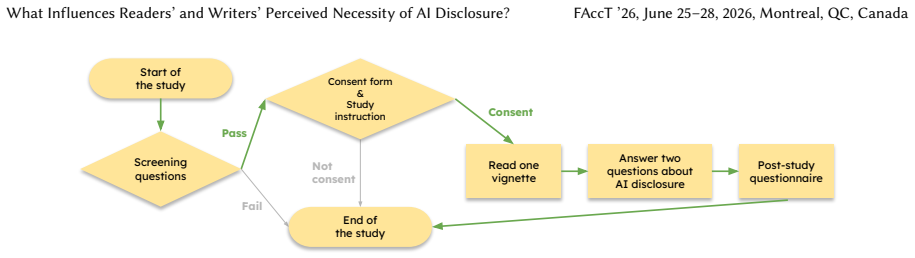
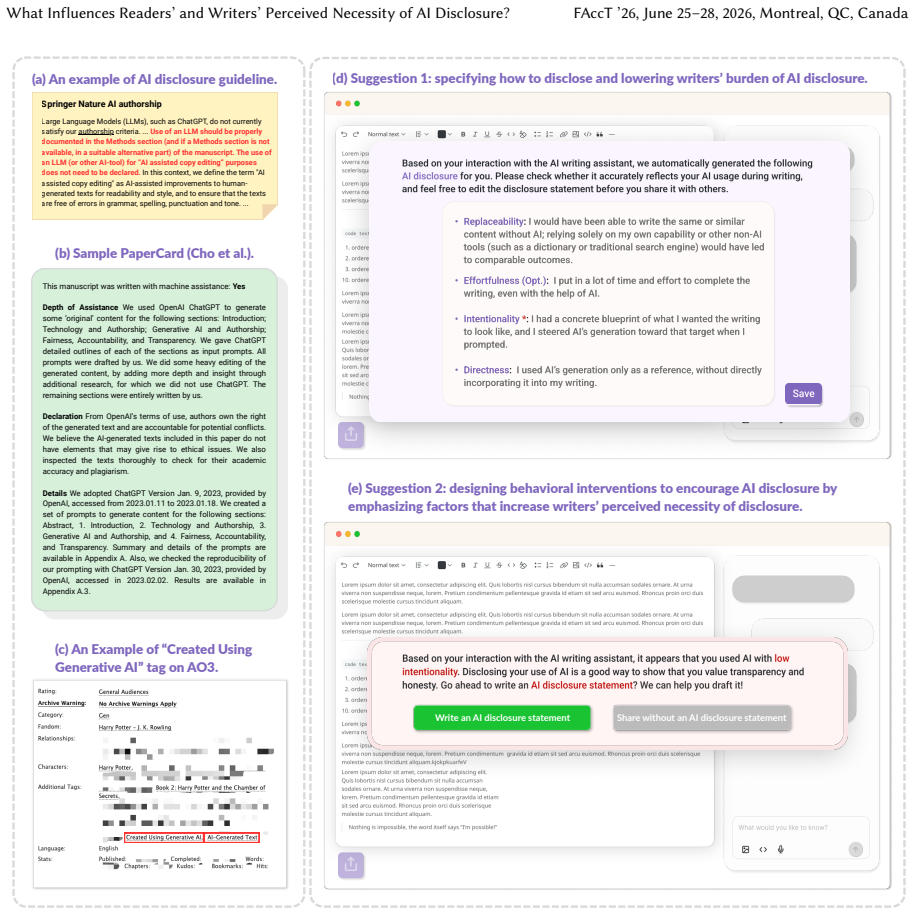
The growing capability of artificial intelligence (AI) leads to its increasing adoption in writing, spurring discussions around whether writers should disclose their AI use in writing. What influences the perceived necessity of disclosure? We look into this question from three dimensions: perspective (reader or writer of the text), purpose (the goal of reading or writing), and procedural factors (how AI was used in the writing process in terms of replaceability, effortfulness, intentionality, and directness). In a vignette study (N = 727), we find that readers consider disclosure to be more necessary than writers, and disclosure is regarded as more necessary when AI's contribution in writing is irreplaceable, directly incorporated, and when the writer does not intentionally steer AI generation. To our surprise, the writers' intentionality of AI use produces contrasting effects on readers' and writers' perceived necessity of disclosure. Moreover, the effort of writing shows no significant effect on the perceived necessity. This study contributes to the conversation on transparent AI use by revealing readers' and writers' grassroots judgments, providing a unique angle to reflect on existing regulations, and offering insights into how AI disclosure guidance and tools could be designed to better align with readers' and writers' perceptions.
Editorial analysis
A structured set of objections, weighed in public.
Referee Report
Summary. The paper reports a between-subjects vignette study (N=727) that examines how perspective (reader vs. writer), purpose, and procedural factors (replaceability, directness, intentionality, and effort of AI use) influence perceived necessity of disclosing AI assistance in writing. It claims readers rate disclosure necessity higher than writers; necessity increases when AI contributions are irreplaceable and directly incorporated and when writers do not intentionally steer generation; intentionality produces opposite effects across perspectives; and effort has no significant effect. The work positions these grassroots judgments as input for regulations and AI tool design.
Significance. If the directional findings prove robust, the study supplies empirical evidence on divergent reader/writer perceptions that is currently scarce in HCI and AI ethics literature. The large sample and multi-factor vignette design allow clean isolation of procedural variables, and the contrasting intentionality result is a potentially novel contribution. These data could usefully inform disclosure guidelines, though the absence of behavioral validation weakens direct policy translation.
major comments (3)
- [Methods] Methods section: the vignette construction, pretesting for realism, and checks for demand characteristics or social-desirability bias are not described in sufficient detail to evaluate whether the reported effects (e.g., irreplaceability and intentionality) could be artifacts of the hypothetical framing.
- [Discussion] Results and Discussion: the manuscript draws regulatory and design recommendations directly from vignette ratings without behavioral validation, comparison to real AI-assisted writing tasks, or explicit discussion of ecological validity, making the policy claims load-bearing on an untested assumption.
- [Results] Results: while directional findings are stated, the text provides no effect sizes, exact statistical tests, exclusion criteria, or control variables, preventing assessment of the practical magnitude of the reader-writer gap and the opposing intentionality effects.
minor comments (2)
- [Abstract] Abstract: the phrase 'to our surprise' for the intentionality result is informal; a brief statement of the opposing directions would improve clarity for readers.
- [Methods] The paper would benefit from a table summarizing the four procedural factors and their levels to aid quick reference.
Simulated Author's Rebuttal
We thank the referee for the detailed and constructive comments. We address each major point below and describe the revisions we will make to strengthen the manuscript.
read point-by-point responses
-
Referee: [Methods] Methods section: the vignette construction, pretesting for realism, and checks for demand characteristics or social-desirability bias are not described in sufficient detail to evaluate whether the reported effects (e.g., irreplaceability and intentionality) could be artifacts of the hypothetical framing.
Authors: We agree that the Methods section requires greater detail to allow readers to assess potential artifacts from the vignette design. In the revised manuscript we will expand the description of vignette construction, including how the four procedural factors were operationalized and balanced across conditions; report any pretesting or pilot work used to verify realism and comprehensibility; and describe steps taken to check for demand characteristics or social-desirability bias (or, if none were performed, explicitly note this limitation and its implications for interpretation). revision: yes
-
Referee: [Discussion] Results and Discussion: the manuscript draws regulatory and design recommendations directly from vignette ratings without behavioral validation, comparison to real AI-assisted writing tasks, or explicit discussion of ecological validity, making the policy claims load-bearing on an untested assumption.
Authors: We accept that the current framing of recommendations overreaches given the vignette methodology. In the revision we will add a dedicated limitations subsection that explicitly discusses ecological validity, the absence of behavioral measures or real-task comparisons, and the hypothetical nature of the scenarios. We will rephrase all regulatory and design implications as preliminary, hypothesis-generating insights rather than direct prescriptions, and we will state that further validation in naturalistic settings is required before these findings can inform policy. revision: yes
-
Referee: [Results] Results: while directional findings are stated, the text provides no effect sizes, exact statistical tests, exclusion criteria, or control variables, preventing assessment of the practical magnitude of the reader-writer gap and the opposing intentionality effects.
Authors: We will revise the Results section to report effect sizes (e.g., partial eta-squared or Cohen’s d) for all key contrasts, include the full statistical output (F or t values, degrees of freedom, exact p-values), detail participant exclusion criteria and any data-cleaning steps, and specify whether demographic or other control variables were included in the models. These additions will allow readers to evaluate both statistical significance and practical magnitude of the reported effects. revision: yes
Circularity Check
Empirical vignette study with no derivations or self-referential reductions
full rationale
This paper reports results from a between-subjects vignette experiment (N=727) in which independent participant ratings of disclosure necessity are collected and statistically compared across conditions varying perspective, replaceability, directness, intentionality, and effort. All central claims (readers > writers; irreplaceable/direct use increases necessity; intentionality produces opposite effects; effort null) are direct outputs of these participant responses. No equations, fitted parameters, predictions, uniqueness theorems, or ansatzes appear; no self-citations are invoked as load-bearing premises. The derivation chain consists solely of data collection and analysis, making the study self-contained against external benchmarks.
Axiom & Free-Parameter Ledger
axioms (1)
- domain assumption Participant responses to hypothetical vignettes reflect genuine perceptions of disclosure necessity that would generalize beyond the study scenarios.
Reference graph
Works this paper leans on
-
[1]
Rudaiba Adnin, Atharva Pandkar, Bingsheng Yao, Dakuo Wang, and Maitraye Das. 2025. Examining Student and Teacher Perspectives on Undisclosed Use of Generative AI in Academic Work. InProceedings of the 2025 CHI Conference on Human Factors in Computing Systems. 1–17
2025
-
[2]
Cheryl S Alexander and Henry Jay Becker. 1978. The use of vignettes in survey research.Public opinion quarterly42, 1 (1978), 93–104
1978
-
[3]
Forough Amirjalili, Masoud Neysani, and Ahmadreza Nikbakht. 2024. Exploring the boundaries of authorship: A comparative analysis of AI-generated text and human academic writing in English literature. InFrontiers in Education, Vol. 9. Frontiers Media SA, 1347421
2024
-
[4]
Christiane Atzmüller and Peter M Steiner. 2010. Experimental vignette studies in survey research.Methodology(2010)
2010
-
[5]
Albert Bandura. 1977. Self-efficacy: toward a unifying theory of behavioral change.Psychological review84, 2 (1977), 191
1977
-
[6]
Oloff C Biermann, Ning F Ma, and Dongwook Yoon. 2022. From tool to companion: Storywriters want AI writers to respect their personal values and writing strategies. InProceedings of the 2022 ACM Designing Interactive Systems Conference. 1209–1227. 6https://www.grammarly.com/browser. Accessed December 2025. 7https://chatgpt.com/. Accessed December 2025. FAc...
2022
-
[7]
ACM Publications Board. n.d.. ACM Policy on Authorship. https://www.acm.org/publications/policies/new-acm-policy-on-authorship. Accessed: 2025-04-15
2025
-
[8]
Robert Bowman, Camille Nadal, Kellie Morrissey, Anja Thieme, and Gavin Doherty. 2023. Using thematic analysis in healthcare HCI at CHI: A scoping review. InProceedings of the 2023 CHI Conference on Human Factors in Computing Systems. 1–18
2023
-
[9]
Virginia Braun and Victoria Clarke. 2019. Reflecting on reflexive thematic analysis.Qualitative research in sport, exercise and health11, 4 (2019), 589–597
2019
-
[10]
Olivia Burrus, Amanda Curtis, and Laura Herman. 2024. Unmasking AI: Informing authenticity decisions by labeling AI-generated content.Interactions31, 4 (2024), 38–42
2024
-
[11]
Alex Calderwood, Vivian Qiu, Katy Ilonka Gero, and Lydia B Chilton. 2020. How novelists use generative language models: An exploratory user study. InHAI-GEN+user2agent@IUI
2020
-
[12]
I Deleted It After the Overturn of Roe v. Wade
Jiaxun Cao, Hiba Laabadli, Chase H Mathis, Rebecca D Stern, and Pardis Emami-Naeini. 2024. "I Deleted It After the Overturn of Roe v. Wade": Understanding Women’s Privacy Concerns Toward Period-Tracking Apps in the Post Roe v. Wade Era. InProceedings of the 2024 CHI Conference on Human Factors in Computing Systems(Honolulu, HI, USA)(CHI ’24). Association ...
-
[13]
Ana Caraban, Evangelos Karapanos, Daniel Gonçalves, and Pedro Campos. 2019. 23 ways to nudge: A review of technology-mediated nudging in human-computer interaction. InProceedings of the 2019 CHI conference on human factors in computing systems. 1–15
2019
-
[14]
Peter W Cardon and Anthony W Coman. 2025. Professionalism and Trustworthiness in AI-Assisted Workplace Writing: The Benefits and Drawbacks of Writing With AI.International Journal of Business Communication(2025), 23294884251350599
2025
-
[15]
Jim Chang and Jason S Chang. 2015. WriteAhead2: Mining lexical grammar patterns for assisted writing. InProceedings of the 2015 conference of the north American chapter of the association for computational linguistics: Demonstrations. 106–110
2015
-
[16]
Inyoung Cheong, Alicia Guo, Mina Lee, Zhehui Liao, Kowe Kadoma, Dongyoung Go, Joseph Chee Chang, Peter Henderson, Mor Naaman, and Amy X. Zhang. 2025. Penalizing Transparency? How AI Disclosure and Author Demographics Shape Human and AI Judgments About Writing. arXiv:2507.01418 [cs.CY] https://arxiv.org/abs/2507.01418
- [17]
-
[18]
Seulgi Choi, Hyewon Lee, Yoonjoo Lee, and Juho Kim. 2024. VIVID: Human-AI collaborative authoring of vicarious dialogues from lecture videos. InProceedings of the 2024 CHI Conference on Human Factors in Computing Systems. 1–26
2024
-
[19]
Creative Commons. [n. d.]. Creative Commons Licenses List. https://creativecommons.org/licenses/. Accessed: 2025-09-06
2025
-
[20]
Marilyn M Cooper. 1986. The ecology of writing.College English48, 4 (1986), 364–375
1986
-
[21]
Eric Corbett and Remi Denton. 2023. Interrogating the T in FAccT. InProceedings of the 2023 ACM Conference on Fairness, Accountability, and Transparency. 1624–1634
2023
-
[22]
Cropanzano, Erica L
Russell S. Cropanzano, Erica L. Anthony, Shanna R. Daniels, and Alison V Hall. 2017. Social Exchange Theory: A Critical Review with Theoretical Remedies.The Academy of Management Annals11 (2017), 479–516. https://api.semanticscholar.org/CorpusID:152122495
2017
-
[23]
Igor Douven. 2018. A Bayesian perspective on Likert scales and central tendency.Psychonomic bulletin & review25, 3 (2018), 1203–1211
2018
-
[24]
Fiona Draxler, Anna Werner, Florian Lehmann, Matthias Hoppe, Albrecht Schmidt, Daniel Buschek, and Robin Welsch. 2024. The AI ghostwriter effect: When users do not perceive ownership of AI-generated text but self-declare as authors.ACM Transactions on Computer-Human Interaction31, 2 (2024), 1–40
2024
-
[25]
Xianzhe Fan, Zihan Wu, Chun Yu, Fenggui Rao, Weinan Shi, and Teng Tu. 2024. ContextCam: Bridging context awareness with creative human-AI image co-creation. InProceedings of the 2024 CHI Conference on Human Factors in Computing Systems. 1–17
2024
- [26]
-
[27]
Tira Nur Fitria. 2021. Grammarly as AI-powered English Writing Assistant: Students’ Alternative for Writing English.The Journal of English Language and Literature(2021). https://api.semanticscholar.org/CorpusID:236381621
2021
-
[28]
Richard Fletcher and R Nielsen. 2024. What does the public in six countries think of generative AI in news? (2024)
2024
-
[29]
Linda Flower and John R Hayes. 1981. A cognitive process theory of writing.College Composition & Communication32, 4 (1981), 365–387
1981
- [30]
-
[31]
Conner Ganjavi, Michael B Eppler, Asli Pekcan, Brett Biedermann, Andre Abreu, Gary S Collins, Inderbir S Gill, and Giovanni E Cacciamani. 2024. Publishers’ and journals’ instructions to authors on use of generative artificial intelligence in academic and scientific publishing: bibliometric analysis.bmj384 (2024)
2024
-
[32]
Catherine A Gao, Frederick M Howard, Nikolay S Markov, Emma C Dyer, Siddhi Ramesh, Yuan Luo, and Alexander T Pearson. 2023. Comparing scientific abstracts generated by ChatGPT to real abstracts with detectors and blinded human reviewers.NPJ digital medicine6, 1 (2023), 75
2023
-
[33]
Katy Ilonka Gero and Lydia B Chilton. 2019. How a Stylistic, Machine-Generated Thesaurus Impacts a Writer’s Process. InProceedings of the 2019 Conference on Creativity and Cognition. 597–603. What Influences Readers’ and Writers’ Perceived Necessity of AI Disclosure? FAccT ’26, June 25–28, 2026, Montreal, QC, Canada
2019
-
[34]
Katy Ilonka Gero, Vivian Liu, and Lydia Chilton. 2022. Sparks: Inspiration for science writing using language models. InProceedings of the 2022 ACM Designing Interactive Systems Conference. 1002–1019
2022
-
[35]
Fabrizio Gilardi, Sabrina Di Lorenzo, Juri Ezzaini, Beryl Santa, Benjamin Streiff, Eric Zurfluh, and Emma Hoes. 2024. Willingness to Read AI-Generated News Is Not Driven by Their Perceived Quality. https://api.semanticscholar.org/CorpusID:272423570
2024
-
[36]
Louie Giray. 2024. AI Shaming: The Silent Stigma among Academic Writers and Researchers.Annals of biomedical engineering(2024). https://api.semanticscholar.org/CorpusID:271063327
2024
-
[37]
GitHub, Inc. 2024. GitHub Community Code of Conduct. https://docs.github.com/en/site-policy/github-terms/github-community- code-of-conduct. Accessed: 2025-08-21
2024
-
[38]
Nina Grgić-Hlača, Christoph Engel, and Krishna P Gummadi. 2019. Human decision making with machine assistance: An experiment on bailing and jailing.Proceedings of the ACM on human-computer interaction3, CSCW (2019), 1–25
2019
-
[39]
Pamela Grimm. 2010. Social desirability bias.Wiley international encyclopedia of marketing(2010)
2010
-
[40]
Maxine Hairston. 1982. The winds of change: Thomas Kuhn and the revolution in the teaching of writing.College Composition & Communication33, 1 (1982), 76–88
1982
-
[41]
Hans WA Hanley and Zakir Durumeric. 2024. Machine-made media: Monitoring the mobilization of machine-generated articles on misinformation and mainstream news websites. InProceedings of the international AAAI conference on web and social media, Vol. 18. 542–556
2024
-
[42]
Jessica He, Stephanie Houde, and Justin D Weisz. 2025. Which contributions deserve credit? perceptions of attribution in human-ai co-creation. InProceedings of the 2025 CHI Conference on Human Factors in Computing Systems. 1–18
2025
-
[43]
Jess Hohenstein, Rene F Kizilcec, Dominic DiFranzo, Zhila Aghajari, Hannah Mieczkowski, Karen Levy, Mor Naaman, Jeffrey Hancock, and Malte F Jung. 2023. Artificial intelligence in communication impacts language and social relationships.Scientific reports13, 1 (2023), 5487
2023
-
[44]
Md Naimul Hoque, Tasfia Mashiat, Bhavya Ghai, Cecilia D Shelton, Fanny Chevalier, Kari Kraus, and Niklas Elmqvist. 2024. The HaLLMark effect: Supporting provenance and transparent use of large language models in writing with interactive visualization. In Proceedings of the 2024 CHI Conference on Human Factors in Computing Systems. 1–15
2024
-
[45]
C Blaine Horton Jr, Michael W White, and Sheena S Iyengar. 2023. Bias against AI art can enhance perceptions of human creativity. Scientific reports13, 1 (2023), 19001
2023
-
[46]
Mina Huh, Ding Li, Kim Pimmel, Hijung Valentina Shin, Amy Pavel, and Mira Dontcheva. 2025. VideoDiff: Human-AI Video Co-Creation with Alternatives. InProceedings of the 2025 CHI Conference on Human Factors in Computing Systems. 1–19
2025
-
[47]
Angel Hsing-Chi Hwang, Q Vera Liao, Su Lin Blodgett, Alexandra Olteanu, and Adam Trischler. 2025. ’It was 80% me, 20% AI’: Seeking Authenticity in Co-Writing with Large Language Models.Proceedings of the ACM on Human-Computer Interaction9, 2 (2025), 1–41
2025
-
[48]
International Committee of Medical Journal Editors (ICMJE). [n. d.]. Defining the Role of Authors and Contributors. https://www.icmje. org/recommendations/browse/roles-and-responsibilities/defining-the-role-of-authors-and-contributors.html. Accessed: 2025-08-21
2025
-
[49]
2025.Amazon to require some authors to disclose the use of AI material
Hillel Italie. 2025.Amazon to require some authors to disclose the use of AI material. https://apnews.com/article/amazon-ai-authors- guild-345bb1a2d80b0a6ddb26978b25c9fb4b AP News, Accessed: 2025-08-21
2025
-
[50]
Maurice Jakesch, Jeffrey T Hancock, and Mor Naaman. 2023. Human heuristics for AI-generated language are flawed.Proceedings of the National Academy of Sciences120, 11 (2023), e2208839120
2023
-
[51]
Ziwei Ji, Nayeon Lee, Rita Frieske, Tiezheng Yu, Dan Su, Yan Xu, Etsuko Ishii, Ye Jin Bang, Andrea Madotto, and Pascale Fung. 2023. Survey of hallucination in natural language generation.ACM computing surveys55, 12 (2023), 1–38
2023
-
[52]
Haiyan Jia, Alyssa Appelman, Mu Wu, and Steve Bien-Aime. 2024. News bylines and perceived AI authorship: Effects on source and message credibility.Computers in Human Behavior: Artificial Humans2, 2 (2024), 100093
2024
-
[53]
Nikhita Joshi and Daniel Vogel. 2025. Writing with AI Lowers Psychological Ownership, but Longer Prompts Can Help. InProceedings of the 7th ACM Conference on Conversational User Interfaces. ACM, 1–17. doi:10.1145/3719160.3736608
-
[54]
Donal Khosrowi, Finola Finn, and Elinor Clark. 2023. Diffusing the creator: Attributing credit for generative AI outputs. InProceedings of the 2023 AAAI/ACM Conference on AI, Ethics, and Society. 890–900
2023
-
[55]
Byung-Jik Kim and Min-Jik Kim. 2024. How artificial intelligence-induced job insecurity shapes knowledge dynamics: the mitigating role of artificial intelligence self-efficacy.Journal of Innovation & Knowledge9, 4 (2024), 100590. doi:10.1016/j.jik.2024.100590
-
[56]
Christian Koch, Moritz Lode, Denny Stohr, Amr Rizk, and Ralf Steinmetz. 2018. Collaborations on YouTube: From unsupervised detection to the impact on video and channel popularity.ACM Transactions on Multimedia Computing, Communications, and Applications (TOMM)14, 4 (2018), 1–23
2018
-
[57]
Kalpesh Krishna, Yixiao Song, Marzena Karpinska, John Wieting, and Mohit Iyyer. 2023. Paraphrasing evades detectors of ai-generated text, but retrieval is an effective defense.Advances in Neural Information Processing Systems36 (2023), 27469–27500
2023
-
[58]
Justin Kruger, Derrick Wirtz, Leaf Van Boven, and T William Altermatt. 2004. The effort heuristic.Journal of Experimental Social Psychology40, 1 (2004), 91–98
2004
-
[59]
Laida Kushnareva, Tatiana Gaintseva, German Magai, Serguei Barannikov, Dmitry Abulkhanov, Kristian Kuznetsov, Eduard Tulchinskii, Irina Piontkovskaya, and Sergey Nikolenko. 2024. AI-generated Text Boundary Detection with RoFT. InFirst Conference on Language FAccT ’26, June 25–28, 2026, Montreal, QC, Canada Fang et al. Modeling
2024
-
[60]
Gedas Kučinskas and Eimant˙e Survilaite. 2025. Revealing AI Involvement in Ad Creation: Effects on Authenticity, Brand Perceptions and Consumer Intentions.Journal of Information Systems Engineering and Management10, 16s (6 March 2025). doi:10.52783/jisem. v10i16s.2659 Accessed: 2025-08-21
-
[61]
Zola Chi-Chin Lai. 2025. The Impact of AI-Assisted Blended Learning on Writing Efficacy and Resilience.International Journal of Computer-Assisted Language Learning and Teaching(2025). https://api.semanticscholar.org/CorpusID:278550494
2025
-
[62]
Tomas Lawton, Kazjon Grace, and Francisco J Ibarrola. 2023. When is a tool a tool? user perceptions of system agency in human–ai co-creative drawing. InProceedings of the 2023 ACM Designing Interactive Systems Conference. 1978–1996
2023
-
[63]
Alghamdi, Tal August, Avinash Bhat, Madiha Zahrah Choksi, Senjuti Dutta, Jin L.C
Mina Lee, Katy Ilonka Gero, John Joon Young Chung, Simon Buckingham Shum, Vipul Raheja, Hua Shen, Subhashini Venugopalan, Thiemo Wambsganss, David Zhou, Emad A. Alghamdi, Tal August, Avinash Bhat, Madiha Zahrah Choksi, Senjuti Dutta, Jin L.C. Guo, Md Naimul Hoque, Yewon Kim, Simon Knight, Seyed Parsa Neshaei, Antonette Shibani, Disha Shrivastava, Lila Shr...
-
[64]
Mina Lee, Percy Liang, and Qian Yang. 2022. Coauthor: Designing a human-ai collaborative writing dataset for exploring language model capabilities. InProceedings of the 2022 CHI conference on human factors in computing systems. 1–19
2022
-
[65]
Angelica Lermann Henestrosa and Joachim Kimmerle. 2024. The Effects of Assumed AI vs. Human Authorship on the Perception of a GPT-Generated Text.Journalism and Media5 (2024). doi:10.3390/journalmedia5030069
-
[66]
Tianyi Li, Mihaela Vorvoreanu, Derek DeBellis, and Saleema Amershi. 2023. Assessing human-AI interaction early through factorial surveys: a study on the guidelines for human-AI interaction.ACM Transactions on Computer-Human Interaction30, 5 (2023), 1–45
2023
-
[67]
Zhuoyan Li, Chen Liang, Jing Peng, and Ming Yin. 2024. How Does the Disclosure of AI Assistance Affect the Perceptions of Writing?. InProceedings of the 2024 Conference on Empirical Methods in Natural Language Processing. 4849–4868
2024
-
[68]
Weixin Liang, Zachary Izzo, Yaohui Zhang, Haley Lepp, Hancheng Cao, Xuandong Zhao, Lingjiao Chen, Haotian Ye, Sheng Liu, Zhi Huang, et al. 2024. Monitoring AI-modified content at scale: a case study on the impact of ChatGPT on AI conference peer reviews. In Proceedings of the 41st International Conference on Machine Learning. 29575–29620
2024
-
[69]
Weixin Liang, Yaohui Zhang, Mihai Codreanu, Jiayu Wang, Hancheng Cao, and James Zou. 2025. The widespread adoption of large language model-assisted writing across society.Patterns(2025), 101366. doi:10.1016/j.patter.2025.101366
-
[70]
Weixin Liang, Yaohui Zhang, Zhengxuan Wu, Haley Lepp, Wenlong Ji, Xuandong Zhao, Hancheng Cao, Sheng Liu, Siyu He, Zhi Huang, et al. 2024. Mapping the Increasing Use of LLMs in Scientific Papers. InFirst Conference on Language Modeling
2024
-
[71]
Vera Liao and Jennifer Wortman Vaughan
Q. Vera Liao and Jennifer Wortman Vaughan. 2024. AI Transparency in the Age of LLMs: A Human-Centered Research Roadmap. Harvard Data Science ReviewSpecial Issue 5 (may 31 2024). https://hdsr.mitpress.mit.edu/pub/aelql9qy
2024
-
[72]
Chaeyeon Lim. 2025. Agency as an Emergent Property in Human-AI Collaboration: A Case Study of AI-Enhanced Whiteboarding Tool (tldraw). InAdjunct Proceedings of the 4th Annual Symposium on Human-Computer Interaction for Work. 1–5
2025
-
[73]
Bingjie Liu, Jin Kang, and Lewen Wei. 2024. Artificial intelligence and perceived effort in relationship maintenance: Effects on relationship satisfaction and uncertainty.Journal of Social and Personal Relationships41, 5 (2024), 1232–1252
2024
-
[74]
Chang Liu and Han Yu. 2023. Ai-empowered persuasive video generation: A survey.Comput. Surveys55, 13s (2023), 1–31
2023
- [75]
-
[76]
Duri Long and Brian Magerko. 2020. What is AI literacy? Competencies and design considerations. InProceedings of the 2020 CHI conference on human factors in computing systems. 1–16
2020
-
[77]
Tao Long, Dorothy Zhang, Grace Li, Batool Taraif, Samia Menon, Kynnedy Simone Smith, Sitong Wang, Katy Ilonka Gero, and Lydia B. Chilton. 2023. Tweetorial Hooks: Generative AI Tools to Motivate Science on Social Media. InProceedings of the 14th Conference on Computational Creativity (ICCC ’23). Association for Computational Creativity
2023
-
[78]
Daniel McFarland. 2024. Generative AI can elevate the peer-review process—if used responsibly.Nature Human Behaviour(2024). doi:10.1038/s41562-024-01848-z
-
[79]
Gianluca Micchi, Louis Bigo, Mathieu Giraud, Richard Groult, and Florence Levé. 2021. I keep counting: An experiment in human/AI co-creative songwriting.Transactions of the International Society for Music Information Retrieval (TISMIR)4, 1 (2021), 263–275
2021
-
[80]
Dale T Miller and Michael Ross. 1975. Self-serving biases in the attribution of causality: Fact or fiction?Psychological bulletin82, 2 (1975), 213
1975
discussion (0)
Sign in with ORCID, Apple, or X to comment. Anyone can read and Pith papers without signing in.