GenAI in Software Engineering: The Role of Technology Acceptance Models
Pith reviewed 2026-05-07 05:33 UTC · model grok-4.3
The pith
UTAUT combined with Bayesian analysis can identify individual barriers to GenAI adoption in software engineering.
A machine-rendered reading of the paper's core claim, the machinery that carries it, and where it could break.
Core claim
The paper establishes that the Unified Theory of Acceptance and Use of Technology supplies a useful base for studying why software engineers adopt or resist generative AI, provided its constructs are refined to capture the technology's transformational character, its operationalization is strengthened for better validity and comparability, and Bayesian methods are applied to enable reliable inference from small samples through prior knowledge and iterative updating.
What carries the argument
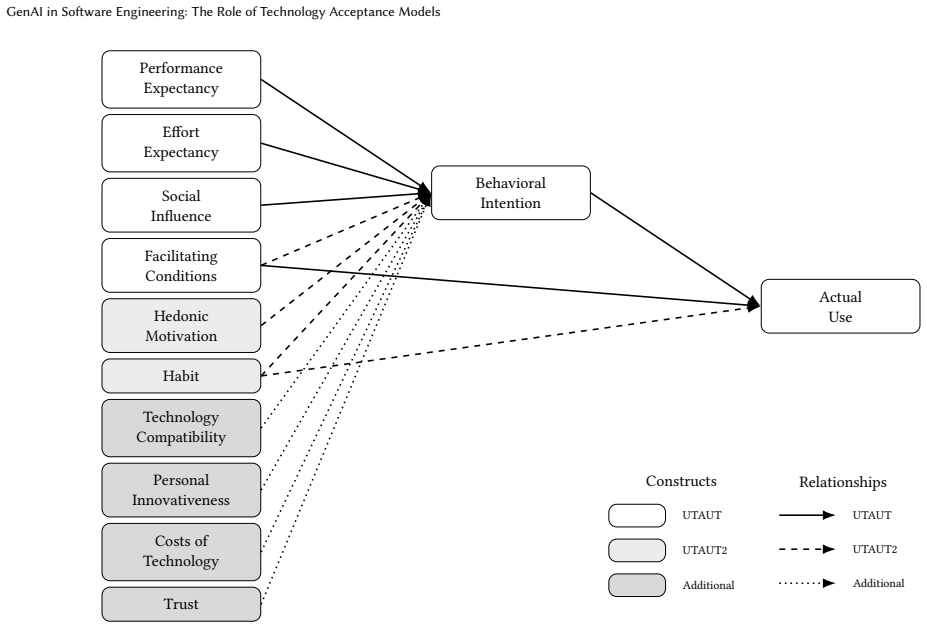
The UTAUT framework, its core constructs of performance expectancy, effort expectancy, social influence and facilitating conditions, together with Bayesian analysis for small-sample inference and scenario simulation.
If this is right
- Refined UTAUT constructs will allow researchers to measure GenAI-specific factors such as changes in developer workflows and code ownership.
- Stronger operationalization practices will produce acceptance data that can be compared reliably across different software engineering studies and organizations.
- Bayesian methods will support practical insights even when only small numbers of teams have begun using GenAI, by updating beliefs as new data arrive.
- The combined approach will give organizations clearer pictures of individual-level barriers such as perceived effort or social pressure around GenAI tools.
- Additional acceptance theories beyond UTAUT will likely be needed to explain the full range of factors influencing GenAI use in software teams.
Where Pith is reading between the lines
- Organizations could apply the refined model during pilot programs to decide which training or support interventions are most likely to increase GenAI uptake.
- The same Bayesian-plus-refined-construct strategy might transfer to studying acceptance of other AI tools, such as automated testing or code review systems.
- Long-term tracking of acceptance using iterative Bayesian models could reveal how barriers shift as GenAI capabilities evolve.
- This line of work could connect to broader questions about how technology acceptance models must change when the technology itself alters the nature of the work being performed.
Load-bearing premise
The original UTAUT constructs can be adjusted to reflect GenAI's specific impacts in software engineering without losing the model's basic structure or its ability to be compared with earlier acceptance studies.
What would settle it
An empirical study that applies both unmodified UTAUT and a GenAI-refined version to the same set of software teams and finds that the unmodified version predicts actual usage rates at least as accurately, or that Bayesian models produce no clearer or more stable insights than frequentist methods on the same data.
Figures
read the original abstract
Context: Many organizations are keen to incorporate generative~AI (GenAI) into their software development processes. Technology acceptance models, such as the Unified Theory of Acceptance and Use of Technology (UTAUT), are traditionally used to identify individual-level barriers to the acceptance of new technologies and can facilitate the transition to GenAI. However, UTAUT has seen limited use within software engineering (SE) research. Objective: Using UTAUT as an example, to identify key areas for future research on GenAI acceptance, including the role of Bayesian approaches for data analysis. Method: We review foundational and SE-specific literature on UTAUT and analyze its emerging applications for GenAI in SE. Results: We identify three priorities for future research: (1) identifying and refining constructs to account for GenAI's nature and transformational impact; (2) improving operationalization practices to strengthen construct validity and cross-study comparability; and (3) incorporating Bayesian analysis to support small-sample inference by integrating prior knowledge, iterative model updating, and simulation of scenarios. Conclusion: UTAUT is a suitable candidate to combine with Bayesian analysis for practical insights on individual-level barriers to GenAI use in SE, but additional theories should be considered.
Editorial analysis
A structured set of objections, weighed in public.
Referee Report
Summary. The manuscript conducts a literature review of the Unified Theory of Acceptance and Use of Technology (UTAUT) applied to software engineering (SE) and generative AI (GenAI). It notes the limited application of UTAUT in SE research despite its use in identifying individual-level barriers to technology adoption. The authors analyze foundational and SE-specific UTAUT literature and emerging GenAI applications, leading to three proposed priorities for future research: (1) refining UTAUT constructs to better capture GenAI's unique characteristics and impact, (2) enhancing operationalization to improve validity and comparability across studies, and (3) integrating Bayesian statistical methods to enable robust inference from small samples by leveraging prior knowledge and scenario simulation. The paper concludes that UTAUT, augmented with Bayesian analysis, offers a promising framework for understanding barriers to GenAI adoption in SE, while advocating for the consideration of additional theoretical perspectives.
Significance. If the identified research priorities are addressed, this work could significantly advance the systematic study of technology acceptance in the SE community, particularly for emerging technologies like GenAI. The structured review provides a clear agenda that bridges information systems and software engineering research. The suggestion to use Bayesian approaches is particularly relevant for SE, where sample sizes are often small, allowing for the incorporation of existing knowledge. However, the significance hinges on successfully operationalizing these ideas in domain-specific contexts. The paper's forward-looking nature and call for multi-theory approaches add value by encouraging broader theoretical integration.
major comments (2)
- [Results] In the Results section describing priority (3), the proposal for incorporating Bayesian analysis to support small-sample inference by integrating prior knowledge does not specify how to derive or validate SE-specific priors for UTAUT constructs (e.g., performance expectancy or social influence) in the GenAI context. Given the paper's acknowledgment of limited UTAUT use in SE, reliance on imported priors from general IS domains risks misspecification due to unaddressed factors such as code generation accuracy, IDE integration, and IP concerns; the discussion of iterative updating and simulation lacks detail on calibration or sensitivity testing against this domain gap.
- [Results] In the Results section describing priority (1), the call to identify and refine constructs to account for GenAI's transformational impact does not discuss potential trade-offs with the core UTAUT structure or how refinements would maintain cross-study comparability, which is explicitly listed as an objective in priority (2). Without concrete examples of operationalization or a proposed refinement framework, the claim that UTAUT remains a suitable candidate remains underdeveloped.
minor comments (2)
- [Abstract] The abstract contains 'generative~AI' (with a tilde), which appears to be a typesetting artifact; this should be corrected to 'generative AI' for clarity.
- [Method] The Method description is high-level; adding details on the literature search strategy, databases used, or inclusion/exclusion criteria would improve reproducibility of the review.
Simulated Author's Rebuttal
We thank the referee for the constructive and detailed comments on our manuscript. The feedback identifies opportunities to strengthen the articulation of the proposed research priorities. We agree that additional elaboration is needed on both construct refinement and the application of Bayesian methods. We will revise the manuscript to address these points while preserving the paper's focus as a forward-looking literature review and research agenda. Point-by-point responses follow.
read point-by-point responses
-
Referee: In the Results section describing priority (3), the proposal for incorporating Bayesian analysis to support small-sample inference by integrating prior knowledge does not specify how to derive or validate SE-specific priors for UTAUT constructs (e.g., performance expectancy or social influence) in the GenAI context. Given the paper's acknowledgment of limited UTAUT use in SE, reliance on imported priors from general IS domains risks misspecification due to unaddressed factors such as code generation accuracy, IDE integration, and IP concerns; the discussion of iterative updating and simulation lacks detail on calibration or sensitivity testing against this domain gap.
Authors: We thank the referee for highlighting this gap. The manuscript is a literature review that proposes high-level research priorities rather than delivering a complete methodological implementation. We agree that more guidance on prior derivation is warranted to mitigate risks of misspecification. In the revised version, we will expand the discussion under priority (3) to outline practical approaches for deriving SE-specific priors, including expert elicitation from software engineering practitioners, use of meta-analytic summaries from the broader information systems literature as starting points, and explicit incorporation of GenAI-specific factors such as code generation accuracy, IDE integration, and IP concerns. We will also add text on calibration via pilot studies and sensitivity analyses to assess robustness against domain gaps. These additions will provide a clearer roadmap while noting that fully validated, domain-specific priors would require subsequent empirical work. revision: partial
-
Referee: In the Results section describing priority (1), the call to identify and refine constructs to account for GenAI's transformational impact does not discuss potential trade-offs with the core UTAUT structure or how refinements would maintain cross-study comparability, which is explicitly listed as an objective in priority (2). Without concrete examples of operationalization or a proposed refinement framework, the claim that UTAUT remains a suitable candidate remains underdeveloped.
Authors: We appreciate this observation and agree that the discussion of priority (1) can be strengthened by explicitly addressing the interplay with priority (2). In the revision, we will add a dedicated paragraph under priority (1) that discusses trade-offs between adapting constructs for GenAI's unique characteristics and preserving the core UTAUT structure to support cross-study comparability. We will propose a refinement framework consisting of two steps: (1) systematic validation of existing UTAUT constructs against GenAI-SE literature, and (2) targeted, evidence-based extensions (for example, adding a construct capturing 'perceived generative AI reliability' to reflect code accuracy and integration concerns) that maintain backward compatibility with original constructs. Concrete examples will be drawn from recent studies on tools such as GitHub Copilot and similar code-generation systems. These changes will better substantiate the claim that UTAUT remains a suitable foundation. revision: yes
Circularity Check
No circularity: literature review with forward-looking proposals
full rationale
The paper is a literature review identifying gaps in UTAUT application to GenAI in SE and proposing three future research priorities, including Bayesian integration. No derivation chain, equations, fitted parameters, or predictions exist that reduce to the paper's own inputs by construction. Claims rest on external foundational and SE-specific literature citations rather than self-referential definitions or self-citation load-bearing steps. The conclusion that UTAUT is a suitable candidate is presented as an assessment of reviewed evidence, not a forced outcome from internal fits or ansatzes. This is a standard non-circular review structure.
Axiom & Free-Parameter Ledger
axioms (2)
- domain assumption UTAUT constructs can be refined to account for GenAI's nature and transformational impact while preserving validity
- domain assumption Bayesian analysis is appropriate and beneficial for small-sample inference in SE by integrating prior knowledge
Reference graph
Works this paper leans on
-
[1]
Margaretha Ari Aggorowati, Nur Iriawan, Suhartono, and Hasyim Gautama
-
[2]
doi:10.3844/ajassp.2012.496.504
Restructuring and Expanding Technology Acceptance Model Structural Equation Model and Bayesian Approach.American Journal of Applied Sciences9, 4 (April 2012), 496–504. doi:10.3844/ajassp.2012.496.504
-
[3]
Markus Blut, Alain Yee Loong Chong, Zayyad Tsiga, and Viswanath Venkatesh
-
[4]
Meta-Analysis of the Unified Theory of Acceptance and Use of Technology (UTAUT): Challenging its Validity and Charting a Research Agenda in the Red Ocean.Journal of the Association for Information Systems23, 1 (2022), 13–95. doi:10.17705/1jais.00719
- [5]
-
[6]
Rudrajit Choudhuri, Bianca Trinkenreich, Rahul Pandita, Eirini Kalliamvakou, Igor Steinmacher, Marco Gerosa, Christopher Sanchez, and Anita Sarma. 2025. What Guides Our Choices? Modeling Developers’ Trust and Behavioral Inten- tions Towards GenAi. InProceedings of the 47th International Conference on Software Engineering. 1691–1703. doi:10.1109/ICSE55347....
-
[7]
Fred D. Davis. 1989. Perceived Usefulness, Perceived Ease of Use, and User Acceptance of Information Technology.MIS Quarterly13, 3 (Sept. 1989), 319. jstor:249008 doi:10.2307/249008
-
[8]
Reducibility among combinatorial problems
Fred D. Davis and Andrina Granić. 2024.The Technology Acceptance Model: 30 Years of TAM. Springer International Publishing, Cham. doi:10.1007/978-3-030- 45274-2
-
[9]
Christof Ebert and Panos Louridas. 2023. Generative AI for software practitioners. IEEE Software40, 4 (2023), 30–38
work page 2023
-
[10]
Elinzano and Michelle Renee Ching
Gerand Boy O. Elinzano and Michelle Renee Ching. 2025. ChatGPT Acceptance and Use Among Software Developers in the Philippines: A Structural Equation Modeling Approach Based on Extended UTAUT. InMulti-Disciplinary Trends in Artificial Intelligence, Chattrakul Sombattheera, Paul Weng, and Jun Pang (Eds.). Springer Nature, Singapore, 177–188. doi:10.1007/97...
-
[11]
Carlo Alberto Furia, Robert Feldt, and Richard Torkar. 2019. Bayesian Data Analysis in Empirical Software Engineering Research.IEEE Transactions on Software Engineering(2019), 1–1. doi:10.1109/TSE.2019.2935974
-
[12]
Andrew Gelman, John B. Carlin, Hal S. Stern, David B. Dunson, Aki Vehtari, and Donald B. Rubin. 2013.Bayesian Data Analysis. Chapman and Hall/CRC. doi:10.1201/b16018
-
[13]
Ahmad Nauman Ghazi, Kai Petersen, Sri Sai Vijay Raj Reddy, and Harini Nekkanti
-
[14]
doi:10.1109/ACCESS.2018.2881041
Survey Research in Software Engineering: Problems and Mitigation Strate- gies.IEEE Access7 (2019), 24703–24718. doi:10.1109/ACCESS.2018.2881041
-
[15]
Sumeet Gupta and Hee W. Kim. 2008. Linking Structural Equation Modeling to Bayesian Networks: Decision Support for Customer Retention in Virtual Communities.European Journal of Operational Research190, 3 (Nov. 2008), 818–833. doi:10.1016/j.ejor.2007.05.054
-
[16]
Robert R. Hoffman, Shane T. Mueller, Gary Klein, and Jordan Litman. 2023. Measures for Explainable AI: Explanation Goodness, User Satisfaction, Mental Models, Curiosity, Trust, and Human-AI Performance.Frontiers in Computer Science5 (Feb. 2023), 1096257. doi:10.3389/fcomp.2023.1096257
-
[17]
Kamble, Angappa Gunasekaran, Vikas Kumar, Amine Belhadi, and Cyril Foropon
Sachin S. Kamble, Angappa Gunasekaran, Vikas Kumar, Amine Belhadi, and Cyril Foropon. 2021. A Machine Learning Based Approach for Predicting Blockchain Adoption in Supply Chain.Technological Forecasting and Social Change163 (Feb. 2021), 120465. doi:10.1016/j.techfore.2020.120465
-
[18]
Cheong Kim. 2025. Understanding Factors Influencing Generative AI Use In- tention: A Bayesian Network-Based Probabilistic Structural Equation Model Approach.Electronics14, 3 (Jan. 2025), 530. doi:10.3390/electronics14030530
-
[19]
Young Woo Kim, Min Chul Cha, Sol Hee Yoon, and Seul Chan Lee. 2025. Not Merely Useful but Also Amusing: Impact of Perceived Usefulness and Perceived Enjoyment on the Adoption of AI-Powered Coding Assistant.International Journal of Human–Computer Interaction41, 10 (May 2025), 6210–6222. doi:10. 1080/10447318.2024.2375701
-
[20]
Stefano Lambiase, Gemma Catolino, Fabio Palomba, Filomena Ferrucci, and Daniel Russo. 2025. Investigating the Role of Cultural Values in Adopting Large Language Models for Software Engineering.ACM Transactions on Software Engineering and Methodology35, 1 (2025). doi:10.1145/3725529
-
[21]
Richard McElreath. 2020.Statistical Rethinking: A Bayesian Course with Examples in R and Stan(2 ed.). Chapman and Hall/CRC. doi:10.1201/9780429029608
-
[22]
Anh Nguyen-Duc, Beatriz Cabrero-Daniel, Adam Przybylek, Chetan Arora, Dron Khanna, Tomas Herda, Usman Rafiq, Jorge Melegati, Eduardo Guerra, Kai-Kristian Kemell, Mika Saari, Zheying Zhang, Huy Le, Tho Quan, and Pekka Abrahamsson. 2025. Generative Artificial Intelligence for Software Engineering— A Research Agenda.Software: Practice and Experience55, 11 (N...
work page 2025
-
[23]
doi:10.1002/spe.70005
-
[24]
Eunil Park. 2025. Continuance Use of AI Coding Assistants among South Korean Industry Developers: A Survey Case Study with Large Language Models.Empir- ical Software Engineering30, 6 (Dec. 2025), 177. doi:10.1007/s10664-025-10730-1
-
[25]
Daniel Russo. 2024. Navigating the Complexity of Generative AI Adoption in Soft- ware Engineering.ACM Transactions on Software Engineering and Methodology 33, 5 (June 2024), 1–50. doi:10.1145/3652154
-
[26]
Hashem Salarzadeh Jenatabadi, Sedigheh Moghavvemi, Che Wan Jasimah Bt Wan Mohamed Radzi, Parastoo Babashamsi, and Mohammad Arashi. 2017. Testing Students’ e-Learning via Facebook through Bayesian Structural Equation Model- ing.PLOS ONE12, 9 (Sept. 2017), e0182311. doi:10.1371/journal.pone.0182311
-
[27]
Jaakko Sauvola, Sasu Tarkoma, Mika Klemettinen, Jukka Riekki, and David Doermann. 2024. Future of software development with generative AI.Automated Software Engineering31, 1 (2024), 26
work page 2024
-
[28]
Deo Shao and Fredrick Ishengoma. 2026. Empirical Analysis of Generative AI Tool Adoption in Software Development.Information and Software Technology 192 (2026). doi:10.1016/j.infsof.2026.108036
-
[29]
Viktoria Stray, Geir Kjetil Hanssen, Astri Barbala, Darja Šmite, and Klaas-Jan Stol. 2025. What Is Generative AI Good for? Introduction to the Special Issue on Generative AI in Software Engineering.Information and Software Technology 187 (Nov. 2025), 107857. doi:10.1016/j.infsof.2025.107857
-
[30]
Viswanath Venkatesh. 2022. Adoption and Use of AI Tools: A Research Agenda Grounded in UTAUT.Annals of Operations Research308, 1-2 (Jan. 2022), 641–652. doi:10.1007/s10479-020-03918-9
-
[31]
Viswanath Venkatesh, Michael G. Morris, Gordon B. Davis, and Fred D. Davis
-
[32]
MIS Quarterly: Management Information Systems27, 425–478 (2003)
User Acceptance of Information Technology: Toward a Unified View.MIS Quarterly27, 3 (2003), 425–478. doi:10.2307/30036540
-
[33]
Viswanath Venkatesh, James Thong, and Xin Xu. 2016. Unified Theory of Acceptance and Use of Technology: A Synthesis and the Road Ahead.Journal of the Association for Information Systems17, 5 (May 2016), 328–376. doi:10.17705/ 1jais.00428
work page 2016
-
[34]
Viswanath Venkatesh, James Y. L. Thong, and Xin Xu. 2012. Consumer Ac- ceptance and Use of Information Technology: Extending the Unified Theory of Acceptance and Use of Technology.MIS Quarterly36, 1 (March 2012), 157–178. doi:10.2307/41410412
-
[35]
Ilya Zakharov, Ekaterina Koshchenko, and Agnia Sergeyuk. 2025. AI in Software Engineering: Perceived Roles and Their Impact on Adoption. InProceedings of the 33rd International Conference on the Foundations of Software Engineering. 1305–1309. doi:10.1145/3696630.3730563
discussion (0)
Sign in with ORCID, Apple, or X to comment. Anyone can read and Pith papers without signing in.