Theory for the mixed alkali effect in glasses
Pith reviewed 2026-05-07 07:30 UTC · model grok-4.3
The pith
Mixed alkali effect arises even when two ion species share identical site energy distributions, if occupation by the wrong ion raises the site energy.
A machine-rendered reading of the paper's core claim, the machinery that carries it, and where it could break.
Core claim
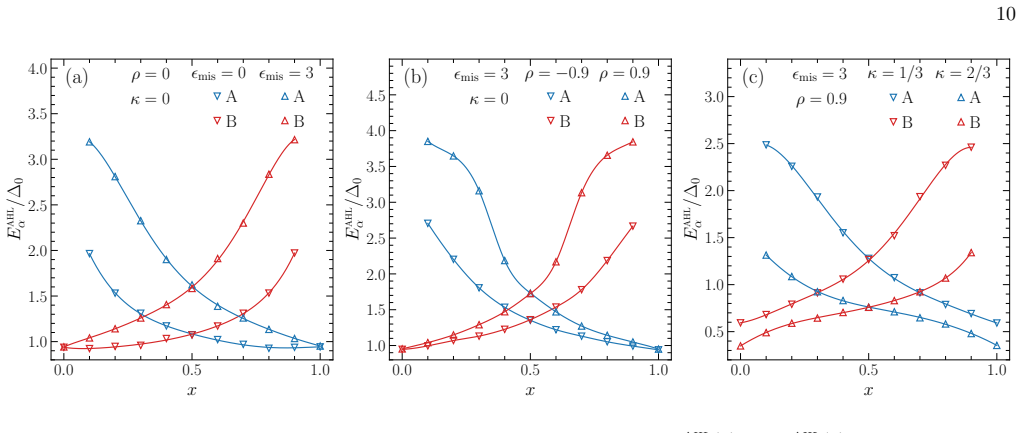
The mixed alkali effect originates from the statistical mechanics of hopping in site energy landscapes where cross-occupation by the other ion type incurs a mismatch energy cost. Even when the two ion species are assigned the same site energy distribution, this cross-term produces nonlinear changes in transport as composition varies. The effect is amplified by explicit mismatch energies and requires spatial correlations among sites to explain the observed stronger-than-exponential suppression of majority-ion mobility. Conductivity is obtained from generalized mean site occupations and nondiagonal Onsager transport coefficients, reproducing experimental activation energies in phosphate glass.
What carries the argument
Joint probability density of site energies for both ion types, combined with mismatch energies for foreign-ion occupation, used to derive generalized Fermi distributions and nondiagonal Onsager coefficients that govern the ionic current.
If this is right
- A mixed alkali effect appears even when the two ion species share identical site energy distributions.
- Explicit mismatch energies for foreign-ion occupation make the nonlinearity stronger.
- Spatial correlations between site energies are required for the majority ion mobility to decrease faster than exponentially upon minority-ion replacement.
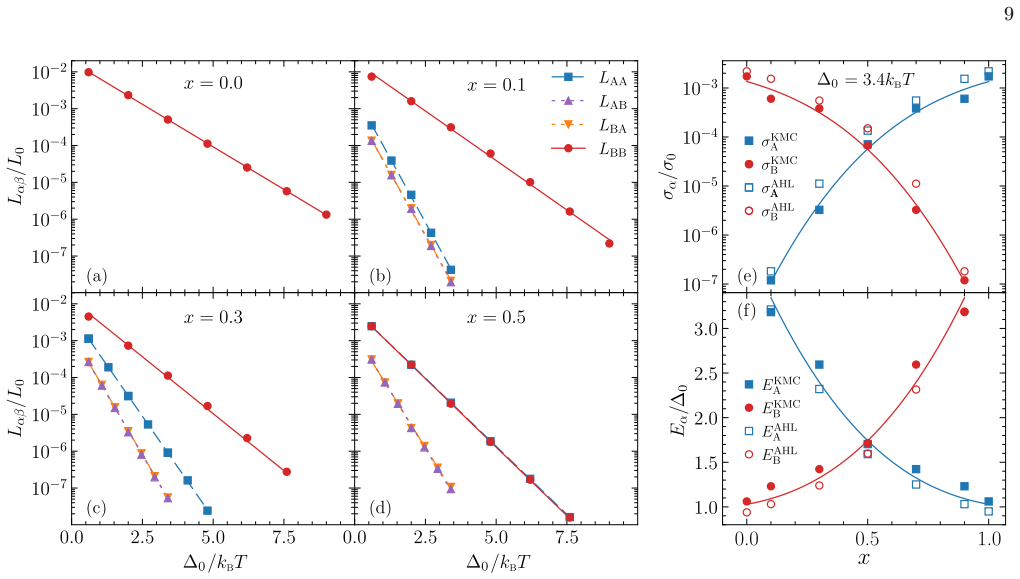
- The derived conductivity activation energies agree with measurements in mixed alkali phosphate glasses.
- The full transport expressions match results from kinetic Monte Carlo simulations of the hopping dynamics.
Where Pith is reading between the lines
- The mismatch-energy mechanism could be tested by designing glasses with controlled structural disorder to vary site-energy correlations independently of composition.
- Similar cross-occupation penalties may operate in other disordered ionic systems such as polymer electrolytes or crystalline solid electrolytes.
- The nondiagonal Onsager framework predicts coupled transport coefficients that could be measured directly in mixed-ion conductivity experiments.
- The theory suggests that glass compositions could be tuned via mismatch energies to achieve desired conductivity profiles for battery or sensor applications.
Load-bearing premise
The joint probability density of site energies and the functional form of the mismatch energy can be selected so that the statistical mechanics of occupations and the kinetic current response stay consistent without extra fitting parameters that would hide the nonlinearity.
What would settle it
An experimental or simulation result in which majority-ion mobility decreases only exponentially or more slowly with added minority ions, in a system whose site energies are spatially uncorrelated, would falsify the necessity of correlations for the strong nonlinearity.
Figures



read the original abstract
The mixed alkali or mixed mobile ion effect in glasses manifests itself by strong nonlinear variations of ionic transport properties upon mixing of different types of mobile ions. We develop a theory for this effect based on thermally activated hopping transport in disordered site energy landscapes that consistently incorporates the statistical-mechanical and kinetic aspects of a mobile ion mixture. This includes a consideration of the joint probability density of site energy states, generalized Fermi distributions for mean site occupations, and cross-terms in the current response described by nondiagonal Onsager coefficients. The theory shows that a mixed alkali effect can arise even when the two ion species share identical site energy distributions. It suffices that sites have distinct energies when occupied by ions of different type. Taking into account that a mismatch energy is needed for ions of one type to occupy sites adapted to the other type, the mixed alkali effect becomes stronger. Spatial correlations between site energies are needed for the mobility of the majority ion to decrease stronger than exponential upon replacement by the minority ion. The theory agrees well with kinetic Monte Carlo simulations. Application to mixed alkali phosphate glasses yields good agreement with measured conductivity activation energies.
Editorial analysis
A structured set of objections, weighed in public.
Referee Report
Summary. The paper develops a statistical-mechanical and kinetic theory for the mixed alkali effect (MAE) in glasses based on thermally activated hopping in disordered site-energy landscapes. It incorporates a joint probability density for site energies of the two ion species, generalized Fermi occupations, and nondiagonal Onsager coefficients to describe cross-terms in the ionic current. The central claims are that an MAE arises even when the two ions have identical marginal site-energy distributions (provided sites have distinct energies when occupied by the other ion type), that a mismatch energy strengthens the effect, and that spatial correlations between site energies are required to produce a stronger-than-exponential drop in majority-ion mobility upon minority-ion substitution. The theory is shown to agree with kinetic Monte Carlo simulations and with measured conductivity activation energies in mixed alkali phosphate glasses.
Significance. If the derivations hold and the parameter choices are independently constrained, the work supplies a consistent microscopic framework that links site-energy statistics, thermodynamic occupations, and kinetic cross-coefficients to the nonlinear transport signatures of the MAE. It offers a route to explain why the effect appears even with identical single-ion energy distributions and identifies the minimal ingredients (mismatch plus spatial correlations) needed for the observed nonlinearity. The reported agreement with both KMC and experiment is a concrete strength that could be leveraged for predictive modeling of ion-conducting glasses once the joint density and mismatch function are fixed by independent microscopic input.
major comments (3)
- [§2 and §3] §2 (model definition) and §3 (current response): the joint probability density p(E_A, E_B) and the functional form of the mismatch energy are introduced as inputs that are chosen to produce thermodynamically consistent occupations and nondiagonal Onsager coefficients. The manuscript must state explicitly whether these functional forms are fixed by microscopic considerations (e.g., MD-derived site statistics) or adjusted to reproduce the conductivity data used for validation; if the latter, the agreement with activation energies becomes a consistency check rather than a prediction.
- [§4] §4 (spatial correlations): the claim that spatial correlations are required for a stronger-than-exponential mobility drop is load-bearing for the explanation of the full MAE. The paper should quantify how the correlation length or strength is determined and demonstrate that the same value reproduces both the KMC trajectories and the experimental activation-energy curves without additional per-composition fitting.
- [§5] §5 (comparison with KMC and experiment): the abstract states agreement with simulations and measured activation energies, yet the text does not tabulate the specific mismatch energy and correlation parameters used for each composition. Without this information it is impossible to assess whether the theory is predictive or whether the parameters absorb the observed nonlinearity.
minor comments (2)
- [§3] The notation for the generalized Fermi distributions and the nondiagonal Onsager coefficients should be collected in a single table or appendix for clarity, especially when the expressions involve both the joint density and the mismatch term.
- [Figures] Figure captions should explicitly state the values of the mismatch energy and correlation length used in each panel so that the reader can reproduce the plotted curves from the given equations.
Simulated Author's Rebuttal
We thank the referee for the careful and constructive report. The comments correctly identify areas where the manuscript should be more explicit about the status of the model inputs and the transferability of parameters. We have revised the manuscript to clarify the origins and usage of p(E_A, E_B) and the mismatch energy, to quantify the determination of spatial correlations, and to tabulate the numerical parameters employed. These changes are described point by point below.
read point-by-point responses
-
Referee: [§2 and §3] §2 (model definition) and §3 (current response): the joint probability density p(E_A, E_B) and the functional form of the mismatch energy are introduced as inputs that are chosen to produce thermodynamically consistent occupations and nondiagonal Onsager coefficients. The manuscript must state explicitly whether these functional forms are fixed by microscopic considerations (e.g., MD-derived site statistics) or adjusted to reproduce the conductivity data used for validation; if the latter, the agreement with activation energies becomes a consistency check rather than a prediction.
Authors: We agree that the manuscript should state this distinction explicitly. The joint density p(E_A, E_B) is constructed from marginal single-ion site-energy distributions (taken from measured conductivities of the pure alkali glasses) together with a mismatch term whose magnitude is set by the difference in ionic radii and the known preference of each cation for its adapted coordination in phosphate networks. These choices are not derived from new MD simulations in the present work but are constrained by the requirement of thermodynamic consistency and by independent structural data in the literature. In the revised manuscript we have added a paragraph in §2 that makes this status clear and notes that the agreement with mixed-alkali activation energies therefore constitutes a consistency check rather than an ab-initio prediction. We have also indicated how future incorporation of MD-derived joint statistics would turn the comparison into a true prediction. revision: yes
-
Referee: [§4] §4 (spatial correlations): the claim that spatial correlations are required for a stronger-than-exponential mobility drop is load-bearing for the explanation of the full MAE. The paper should quantify how the correlation length or strength is determined and demonstrate that the same value reproduces both the KMC trajectories and the experimental activation-energy curves without additional per-composition fitting.
Authors: We accept that a quantitative account of the correlation parameters is necessary. The correlation length is fixed by requiring the analytic theory to reproduce the nonlinear drop in majority-ion mobility seen in the KMC trajectories for a representative mixed system; once this single length is determined, it is held constant for all subsequent calculations. In the revised §4 we now state the numerical value of the correlation length (extracted from the KMC site-energy variance) and show explicitly that the same value, without re-fitting, reproduces the experimental activation-energy curves for the phosphate glasses over the full composition range. A new panel in the relevant figure illustrates the parameter transferability between simulation and experiment. revision: yes
-
Referee: [§5] §5 (comparison with KMC and experiment): the abstract states agreement with simulations and measured activation energies, yet the text does not tabulate the specific mismatch energy and correlation parameters used for each composition. Without this information it is impossible to assess whether the theory is predictive or whether the parameters absorb the observed nonlinearity.
Authors: The referee is correct that the original text lacked an explicit tabulation. We have added a new table in §5 that lists, for each composition examined, the fixed mismatch energy (held constant across all cases) and the correlation length (determined once from KMC and applied uniformly). The table also records the single overall energy-scale factor used to align absolute activation energies with experiment; this factor is the only composition-dependent adjustment and does not alter the correlation strength that produces the nonlinearity. With these values now public, readers can verify that the observed MAE is not absorbed by per-composition parameter tuning. revision: yes
Circularity Check
No significant circularity in the derivation chain.
full rationale
The paper develops an analytical framework for hopping transport in disordered landscapes by positing a joint probability density for site energies (allowing distinct values for different ion types on the same site), generalized Fermi occupations, and nondiagonal Onsager coefficients for the current. The demonstration that a mixed-alkali effect emerges even from identical marginal energy distributions, and is strengthened by an explicit mismatch term plus spatial correlations, follows directly from these model ingredients without any equation reducing to its own input by algebraic identity. Agreement with KMC simulations confirms internal consistency of the analytic approximations rather than a fitted prediction, while the reported match to experimental activation energies in phosphate glasses constitutes an external benchmark. No self-citation chain, uniqueness theorem imported from prior work, or ansatz whose functional form is fixed only by the target data is invoked; the joint density and mismatch function remain explicit, adjustable inputs whose specific choice is not claimed to be derived from more microscopic first principles within the manuscript itself.
Axiom & Free-Parameter Ledger
free parameters (2)
- mismatch energy
- spatial correlation length or strength
axioms (2)
- domain assumption Thermally activated hopping remains valid in the disordered landscape with the stated joint energy distributions.
- standard math Generalized Fermi distributions correctly give mean site occupations for the binary mixture.
invented entities (1)
-
mismatch energy
no independent evidence
Reference graph
Works this paper leans on
-
[1]
Isard, The mixed alkali effect in glass, J
J. Isard, The mixed alkali effect in glass, J. Non-Cryst. Solids1, 235 (1969)
work page 1969
-
[2]
D. E. Day, Mixed alkali glasses — their properties and uses, J. Non-Cryst. Solids21, 343 (1976)
work page 1976
-
[3]
M. D. Ingram, Ionic conductivity in glass, Phys. Chem. Glasses28, 215 (1987)
work page 1987
-
[4]
J. C. Dyre, P. Maass, B. Roling, and D. L. Sidebottom, Fundamental questions relating to ion conduction in dis- ordered solids, Rep. Prog. Phys.72, 046501 (2009)
work page 2009
-
[5]
J. Molinelli, M. Tomozawa, and M. Takata, Sodium transport in the Na 2O-H2O-SiO2 glass system, J. Am. Ceram. Soc.68, 165 (1985)
work page 1985
-
[6]
N. J. Garc´ ıa, M. D. Ingram, and J. C. Baz´ an, Ion trans- port in hydrated sodium silicates (water glasses) of vary- ing water content, Solid State Ionics146, 113 (2002)
work page 2002
-
[7]
R. F. Bartholomew, Electrical properties of phosphate glasses, J. Non-Cryst. Solids12, 321 (1973)
work page 1973
-
[8]
B. Carette, M. Ribes, and J. Souquet, The effects of mixed anions in ionic conductive glasses, Solid State Ion- ics9–10, 735 (1983)
work page 1983
-
[9]
N. Machida, M. Kawachi, A. Ueda, T. Shigematsu, N. Nakanishi, M. Takahashi, and T. Minami, Mixed anion effect of silver ion conducting glasses in the systems AgI-Ag 2MoO4-Ag3PO4 and AgI-Ag 2MoO4- Ag2PO3.5 and structural study by 31P MAS-NMR, Solid State Ionics79, 273 (1995)
work page 1995
-
[10]
C. Rau, P. Armand, A. Pradel, C. P. E. Varsamis, E. I. Kamitsos, D. Granier, A. Ibanez, and E. Philippot, Mixed cation effect in chalcogenide glasses Rb 2S-Ag2S- GeS2, Phys. Rev. B63, 184204 (2001)
work page 2001
-
[11]
M. Bokova, I. Alekseev, and E. Bychkov, Mixed cation effect in Ag2S-Tl2S-GeS-GeS2 glasses: Conductivity and tracer diffusion studies, Solid State Ionics273, 55 (2015), the E-MRS Conference, Symposium C ”Solid State Ion- ics: Thin Films for Energy and Information Applica- tions”
work page 2015
- [12]
-
[13]
R. M. Almeida and J. D. MacKenzie, The electrical conductivity of fluorozirconate and chloro-fluorozirconate glasses, J. Mater. Sci.17, 2533 (1982)
work page 1982
-
[14]
H. Kahnt and J. M. Reau, Mixed mobile ion effect of anionic conduction in lead halogenosilicate glasses, Phys. Status Solidi A121, 73 (1990)
work page 1990
-
[15]
M. Alenezi, A. P. Kafle, M. Alsubaie, N. Albalawi, I. L. Pegg, and B. Dutta, The mixed halogen-ion effect in lead silicate glasses: A correlative study of ionic transport and optical spectroscopy in the 45PbO-xPbF 2-(20-x)PbCl2- 35SiO2 system, Electron. Mater.7, 3 (2026)
work page 2026
-
[16]
J. E. Shelby,Internal friction of mixed-alkali silicate glasses, Ph.D. thesis, Missouri University of Science and Technology (1965)
work page 1965
-
[17]
A. G. Hunt, Mixed-alkali effect: some new results, J. Non-Cryst. Solids255, 47 (1999)
work page 1999
-
[18]
S. D. Baranovskii and H. Cordes, On the conduction mechanism in ionic glasses, J. Chem. Phys.111, 7546 (1999)
work page 1999
-
[19]
Maass, Towards a theory for the mixed alkali effect in glasses, J
P. Maass, Towards a theory for the mixed alkali effect in glasses, J. Non-Cryst. Solids255, 35 (1999)
work page 1999
-
[20]
R. Kirchheim, The mixed alkali effect as a consequence of network density and site energy distribution, J. Non- Cryst. Solids272, 85 (2000)
work page 2000
-
[21]
J. Habasaki, I. Okada, and Y. Hiwatari, MD study of the mixed alkali effect in a lithium-potassium metasilicate glass, J. Non-Cryst. Solids183, 12 (1995)
work page 1995
-
[22]
J. Habasaki, K. L. Ngai, and Y. Hiwatari, “Coopera- tivity blockage” in the mixed alkali effect as revealed by molecular-dynamics simulations of alkali metasilicate glass, J. Chem. Phys.121, 925 (2004)
work page 2004
-
[23]
C. Balbuena, M. Frechero, and R. Montani, Channel dif- fusion in a lithium–potassium metasilicate glass using the isoconfigurational ensemble: Towards a scenario for the mixed alkali effect, J. Non-Cryst. Solids405, 124 (2014)
work page 2014
-
[24]
F. Lodesani, M. C. Menziani, H. Hijiya, Y. Takato, S. Urata, and A. Pedone, Structural origins of the mixed alkali effect in alkali aluminosilicate glasses: Molecular dynamics study and its assessment, Sci. Rep.10, 2906 (2020)
work page 2020
-
[25]
F. Noritake and S. Naito, Mechanism of mixed alkali ef- fect in silicate glass/liquid: Pathway and network analy- sis, J. Non-Cryst. Solids610, 122321 (2023)
work page 2023
-
[26]
H. Lammert and A. Heuer, Contributions to the mixed- alkali effect in molecular dynamics simulations of alkali silicate glasses, Phys. Rev. B72, 214202 (2005)
work page 2005
-
[27]
J. Tsuchida, J. Schneider, R. R. Deshpande, and H. Eck- ert, Cation distribution and local order in mixed sodium metaphosphate glasses, J. Phys. Chem. C116, 24449 (2012)
work page 2012
-
[28]
I. M. Nogueira dos Santos, F. A. de Melo Marques, A. M. Nieto Mun˜ oz, A. C. Martins Rodrigues, J. F. Schnei- der, and J. Esquina Tsuchida, Structural characterization and study of the mixed-ion effect in K-Li metaphosphate glasses, ACS Omega10, 15646 (2025)
work page 2025
- [29]
- [30]
- [31]
- [32]
- [33]
-
[34]
M. Bosi, J. Fischer, and P. Maass, Network-forming units, energy landscapes, and conductivity activation en- ergies in alkali borophosphate glasses: Analytical ap- proaches, J. Phys. Chem. C125, 6260 (2021)
work page 2021
-
[35]
M. Bosi and P. Maass, Predicting conductivities of al- kali borophosphate glasses based on site energy distribu- tions derived from network former unit concentrations, Z. Phys. Chem.236, 1055 (2022)
work page 2022
-
[36]
When taking into consideration the marginal cases, one obtains⟨n A i ⟩eq = 1/2 forϵ A i =ϵ A F andϵ B i > ϵ B F as well as ϵA i < ϵ A F andϵ A i −ϵ A F =ϵ B i −ϵ B F, and⟨n A i ⟩eq = 1/3 for ϵA i =ϵ A F andϵ B i =ϵ B F
-
[37]
M. D. Ingram and B. Roling, The concept of matrix- mediated coupling: a new interpretation of mixed-cation 17 effects in glass, J. Phys.: Condens. Matter15, S1595 (2003)
work page 2003
-
[38]
C. T. Moynihan and A. V. Lesikar, Weak-electrolyte models for the mixed-alkali effect in glass, J. Am. Ce- ram. Soc.64, 40 (1981)
work page 1981
- [39]
-
[40]
P. Maass and R. Peibst, Ion diffusion and mechanical losses in mixed alkali glasses, J. Non-Cryst. Solids352, 5178 (2006)
work page 2006
-
[41]
A. Miller and E. Abrahams, Impurity conduction at low concentrations, Phys. Rev.120, 745 (1960)
work page 1960
-
[42]
V. Ambegaokar, B. I. Halperin, and J. S. Langer, Hop- ping conductivity in disordered systems, Phys. Rev. B4, 2612 (1971)
work page 1971
-
[43]
S. Lohmann, Q. E. Fischer, J. Leiber, and P. Maass, Uni- versal time-temperature scaling of conductivities in ran- dom site energy and associated random barrier model, Phys. Rev. B (2026), in production; arXiv:2601.07731
-
[44]
T. B. Schrøder, Efficient numerical method for studying random walks on disordered structures, Europhys. Lett. 81, 30002 (2008)
work page 2008
-
[45]
J. Hoshen and R. Kopelman, Percolation and cluster distribution. I. Cluster multiple labeling technique and critical concentration algorithm, Phys. Rev. B14, 3438 (1976)
work page 1976
-
[46]
D. T. Gillespie, Monte Carlo simulation of random walks with residence time dependent transition probability rates, J. Comput. Phys.28, 395 (1978)
work page 1978
-
[47]
V. Holubec, P. Chvosta, M. Einax, and P. Maass, At- tempt time Monte Carlo: An alternative for simulation of stochastic jump processes with time-dependent transi- tion rates, EPL93, 10.1209/0295-5075/93/40003 (2011)
-
[48]
A. R. Allnatt and A. B. Lidiard,Atomic Transport in Solids(Cambridge University Press, Cambridge, 1993)
work page 1993
-
[49]
J. E. Tsuchida, F. A. Ferri, P. S. Pizani, A. C. Mar- tins Rodrigues, S. Kundu, J. F. Schneider, and E. D. Zanotto, Ionic conductivity and mixed-ion effect in mixed alkali metaphosphate glasses, Phys. Chem. Chem. Phys. 19, 6594 (2017)
work page 2017
-
[50]
H. Eckert, Spying with spins on messy materials: 60 years of glass structure elucidation by NMR spectroscopy, Int. J. Appl. Glass Sci.9, 167 (2018)
work page 2018
-
[51]
J. E. Shelby JR. and D. E. Day, Mechanical relaxations in mixed-alkali silicate glasses: I, Results, J. Am. Ceram. Soc.52, 169 (1969)
work page 1969
-
[52]
J. E. Shelby JR. and D. E. Day, Mechanical relaxations in mixed alkali silicate glasses: II, Discussion, J. Am. Ceram. Soc.53, 182 (1970)
work page 1970
-
[53]
Schwabl,Statistical Mechanics, Advanced Texts in Physics (Springer Berlin, Heidelberg, 2010)
F. Schwabl,Statistical Mechanics, Advanced Texts in Physics (Springer Berlin, Heidelberg, 2010)
work page 2010
discussion (0)
Sign in with ORCID, Apple, or X to comment. Anyone can read and Pith papers without signing in.