Signatures of time-reversal-symmetry breaking in multiband 2H-TaS2 revealed by zero-field Josephson nonreciprocity
Pith reviewed 2026-05-09 18:53 UTC · model grok-4.3
The pith
Zero-field Josephson nonreciprocity in 2H-TaS2 junctions signals intrinsic time-reversal symmetry breaking from its multiband superconducting phase.
A machine-rendered reading of the paper's core claim, the machinery that carries it, and where it could break.
Core claim
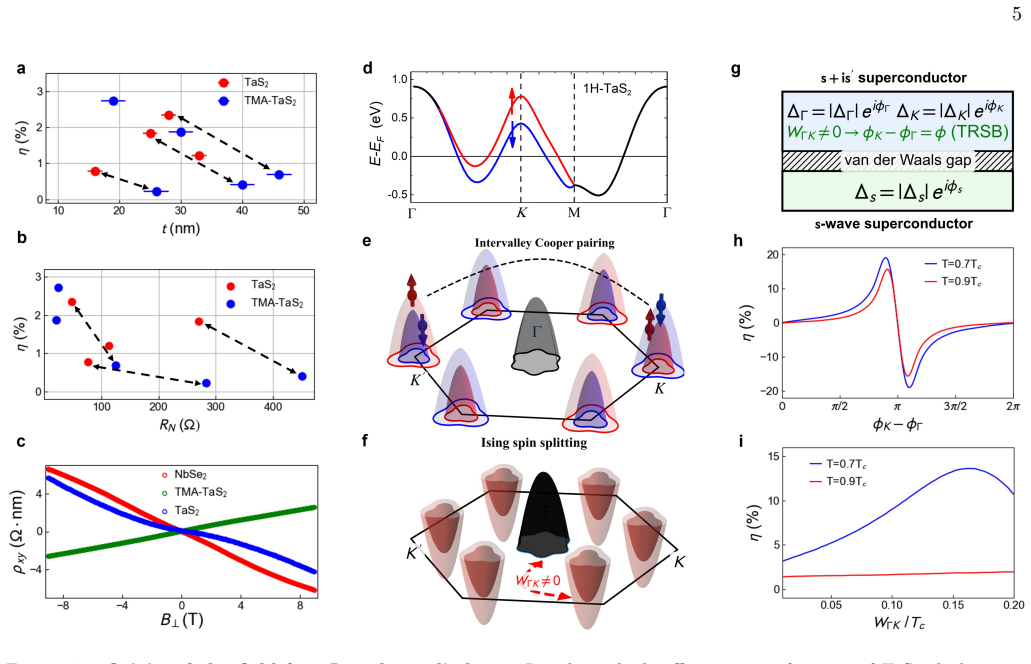
We report a zero-field Josephson diode effect in noncentrosymmetric 2H-TaS2/2H-NbSe2 van der Waals junctions. The diode efficiency shows no systematic correlation with supercurrent amplitude, TaS2 thickness, or normal-state resistance, arguing against simple extrinsic, purely interfacial, or transparency-driven mechanisms. Time-reversal-symmetric scenarios are further tested using symmetry-controlled and molecule-intercalated control devices, in which the nonreciprocal response is absent or strongly reduced. Normal-state Hall transport in TaS2 exhibits a nonlinear response consistent with multiband correlated electronic states. Within a Josephson framework, our modelling shows that interband
What carries the argument
Interband scattering acting as a phase-locking mechanism that generates an intrinsic anomalous phase difference and nonsinusoidal asymmetric current-phase relation in the Josephson junction.
If this is right
- Multiband spin-singlet superconductors can exhibit intrinsic time-reversal symmetry breaking without external fields or unconventional pairing.
- Zero-field Josephson nonreciprocity serves as a direct probe of multiband phase structure in layered materials.
- Nonlinear Hall transport provides independent evidence for the correlated multiband electronic states that enable the symmetry breaking.
- Symmetry-controlled and intercalated control devices isolate intrinsic effects from device-specific asymmetries.
Where Pith is reading between the lines
- Similar zero-field nonreciprocity may occur in other multiband transition-metal dichalcogenide superconductors where interband scattering is strong.
- Tuning interband coupling via thickness or intercalation could provide a route to control diode efficiency in future superconducting devices.
- Junctions with rotated crystal axes or different superconducting partners could test whether the anomalous phase difference depends on the specific band structure of TaS2.
Load-bearing premise
The observed nonreciprocity arises intrinsically from interband scattering and phase locking rather than from any residual extrinsic asymmetry or fitting choices in the Josephson model.
What would settle it
Observation of zero-field rectification that persists even after complete suppression of interband scattering or that appears in a known single-band spin-singlet superconductor without TRS breaking would falsify the intrinsic origin.
Figures


read the original abstract
Superconductors that spontaneously break time-reversal symmetry host complex order parameters and are widely regarded as a hallmark of unconventional superconductivity. Whether such symmetry breaking can also arise in superconductors with nominally isotropic spin-singlet pairing remains an open question. Here we report a zero-field Josephson diode effect in noncentrosymmetric 2H-TaS2/2H-NbSe2 van der Waals junctions. The diode efficiency shows no systematic correlation with supercurrent amplitude, TaS2 thickness, or normal-state resistance, arguing against simple extrinsic, purely interfacial, or transparency-driven mechanisms. Time-reversal-symmetric scenarios are further tested using symmetry-controlled and molecule-intercalated control devices, in which the nonreciprocal response is absent or strongly reduced. Normal-state Hall transport in TaS2 exhibits a nonlinear response consistent with multiband correlated electronic states. Within a Josephson framework, our modelling shows that interband scattering acts as a phase-locking mechanism generating an intrinsic anomalous phase difference and a nonsinusoidal asymmetric current-phase relation, leading to finite zero-field rectification. Together, zero-field Josephson nonreciprocity and nonlinear Hall transport provide complementary evidence for a multiband superconducting phase structure in 2H-TaS2, consistent with intrinsic time-reversal-symmetry breaking.
Editorial analysis
A structured set of objections, weighed in public.
Referee Report
Summary. The manuscript reports observation of a zero-field Josephson diode effect in 2H-TaS2/2H-NbSe2 van der Waals junctions. Diode efficiency shows no systematic correlation with supercurrent amplitude, TaS2 thickness or normal-state resistance. Nonreciprocity is absent or reduced in symmetry-controlled and intercalated control devices. Normal-state nonlinear Hall transport in TaS2 is consistent with multiband correlated states. Josephson modeling indicates that interband scattering generates an intrinsic anomalous phase difference and nonsinusoidal asymmetric current-phase relation, producing finite zero-field rectification. The authors conclude that zero-field nonreciprocity and nonlinear Hall provide complementary evidence for a multiband superconducting phase structure in 2H-TaS2 consistent with intrinsic time-reversal symmetry breaking.
Significance. If the central claim holds, the result is significant as it supplies evidence for spontaneous TRS breaking in a nominally isotropic spin-singlet multiband superconductor, an open question in the field. The Josephson nonreciprocity serves as a new probe complementary to Hall transport, and the control experiments plus lack of correlation with extrinsic variables strengthen the intrinsic interpretation. The interband-scattering model, if shown to be predictive rather than fitted, would be a notable technical contribution.
major comments (2)
- [Modeling section] Modeling section (or equivalent): the abstract states that 'our modelling shows that interband scattering acts as a phase-locking mechanism generating an intrinsic anomalous phase difference' leading to rectification, yet no explicit equations, Hamiltonian, or derivation of the current-phase relation from the interband scattering strength are provided. It is therefore impossible to verify whether the predicted zero-field diode efficiency is an independent output of the model or is tuned to the data. Please supply the key equations and demonstrate parameter independence.
- [Results section on diode efficiency] Results section on diode efficiency and controls: the central claim that diode efficiency is uncorrelated with supercurrent amplitude, thickness, and resistance (and suppressed in controls) is used to rule out extrinsic mechanisms. Without quantitative correlation plots, statistical measures (e.g., Pearson coefficients or p-values), or error bars on the efficiency values, the strength of this exclusion remains unclear. Specify the relevant figure or table and add the quantitative analysis.
minor comments (2)
- [Abstract] Abstract: the phrasing 'noncentrosymmetric 2H-TaS2' is potentially misleading because bulk 2H-TaS2 crystallizes in a centrosymmetric space group; clarify whether the noncentrosymmetry refers to the heterostructure, a thin-film reconstruction, or a specific stacking configuration.
- [Figures and methods] Figure captions and methods: ensure all Josephson I-V traces and Hall data include raw traces or representative datasets with error bars, and that the normal-state resistance and thickness values used in the correlation analysis are tabulated.
Simulated Author's Rebuttal
We thank the referee for their careful reading of the manuscript and for the constructive comments, which have helped us clarify the presentation of our results. We address each major comment below and have revised the manuscript to incorporate the requested details.
read point-by-point responses
-
Referee: [Modeling section] Modeling section (or equivalent): the abstract states that 'our modelling shows that interband scattering acts as a phase-locking mechanism generating an intrinsic anomalous phase difference' leading to rectification, yet no explicit equations, Hamiltonian, or derivation of the current-phase relation from the interband scattering strength are provided. It is therefore impossible to verify whether the predicted zero-field diode efficiency is an independent output of the model or is tuned to the data. Please supply the key equations and demonstrate parameter independence.
Authors: We agree that the modeling section in the original submission did not include sufficient explicit derivations to allow independent verification. In the revised manuscript we have added a dedicated subsection that presents the microscopic Hamiltonian incorporating interband scattering, the self-consistent solution for the anomalous phase difference, and the resulting nonsinusoidal current-phase relation. The diode efficiency is shown to emerge directly from the phase-locking condition for a broad range of interband scattering strengths; we explicitly demonstrate that the zero-field rectification remains finite and of comparable magnitude across this parameter space without any adjustment to match the experimental data points. revision: yes
-
Referee: [Results section on diode efficiency] Results section on diode efficiency and controls: the central claim that diode efficiency is uncorrelated with supercurrent amplitude, thickness, and resistance (and suppressed in controls) is used to rule out extrinsic mechanisms. Without quantitative correlation plots, statistical measures (e.g., Pearson coefficients or p-values), or error bars on the efficiency values, the strength of this exclusion remains unclear. Specify the relevant figure or table and add the quantitative analysis.
Authors: We accept that quantitative statistical support strengthens the exclusion of extrinsic mechanisms. In the revised manuscript we have added a new panel (and accompanying table) that plots diode efficiency against supercurrent amplitude, TaS2 thickness, and normal-state resistance for all measured devices, together with Pearson correlation coefficients and p-values. Error bars derived from repeated measurements on the same junctions are now shown on the efficiency values. The updated analysis confirms the absence of statistically significant correlations, consistent with the intrinsic interpretation. revision: yes
Circularity Check
No significant circularity; derivation remains self-contained
full rationale
The paper's central chain proceeds from experimental observations of zero-field Josephson nonreciprocity (with controls ruling out extrinsic asymmetries via absent correlations and reduced signals in intercalated/symmetry-controlled devices) to a separate modeling step that invokes interband scattering as a phase-locking mechanism to produce an anomalous phase difference and asymmetric CPR. No equations, parameter fits, or self-citations are quoted that reduce the rectification output to a direct renaming or tuning of the input data. The nonlinear Hall transport is presented as independent corroboration. Absent explicit reduction (e.g., fitted parameter renamed as prediction or ansatz smuggled via self-citation), the derivation does not collapse by construction and scores as non-circular.
Axiom & Free-Parameter Ledger
free parameters (1)
- interband scattering strength
axioms (1)
- domain assumption Standard Josephson junction theory applies to the van der Waals interface
Reference graph
Works this paper leans on
- [1]
-
[2]
J. Ma, R. Zhan, and X. Lin, Superconducting diode effects: Mechanisms, materials and applications, Adv. Phys. Res.4, 2400180 (2025)
work page 2025
-
[3]
N. F. Q. Yuan and L. Fu, Supercurrent diode ef- fect and finite-momentum superconductors, PNAS119, e2119548119 (2022)
work page 2022
-
[4]
M. Davydova, S. Prembabu, and L. Fu, Universal Joseph- son diode effect, Science Advances8, eabo0309 (2022)
work page 2022
- [5]
-
[6]
J. J. He, Y. Tanaka, and N. Nagaosa, A phenomenolog- ical theory of superconductor diodes, New J. Phys.24, 053014 (2022)
work page 2022
-
[7]
B. Pal, A. Chakraborty, P. K. Sivakumar, M. Davydova, A. K. Gopi, A. K. Pandeya, J. A. Krieger, Y. Zhang, M. Date, S. Ju, N. Yuan, N. B. M. Schr¨ oter, L. Fu, and S. S. P. Parkin, Josephson diode effect from Cooper pair momentum in a topological semimetal, Nat. Phys.18, 1228 (2022)
work page 2022
-
[8]
R. Wakatsuki, Y. Saito, S. Hoshino, Y. M. Itahashi, T. Ideue, M. Ezawa, Y. Iwasa, and N. Nagaosa, Nonre- ciprocal charge transport in noncentrosymmetric super- conductors, Sci. Adv.3, e1602390 (2017)
work page 2017
-
[9]
F. Ando, Y. Miyasaka, T. Li, J. Ishizuka, T. Arakawa, Y. Shiota, T. Moriyama, Y. Yanase, and T. Ono, Obser- vation of superconducting diode effect, Nature584, 373 (2020)
work page 2020
- [10]
-
[11]
C. Baumgartner, L. Fuchs, A. Costa, S. Reinhardt, S. Gronin, G. C. Gardner, T. Lindemann, M. J. Manfra, P. E. Faria Junior, D. Kochan, J. Fabian, N. Paradiso, 8 and C. Strunk, Supercurrent rectification and magne- tochiral effects in symmetric Josephson junctions, Nat. Nanotechnol.17, 39 (2022)
work page 2022
-
[12]
D. Margineda, A. Crippa, E. Strambini, Y. Fukaya, M. T. Mercaldo, M. Cuoco, and F. Giazotto, Sign reversal diode effect in superconducting Dayem nanobridges, Commun. Phys.6, 343 (2023)
work page 2023
-
[13]
Supercurrent diode effect and magnetochiral anisotropy in few-layer NbSe2, Nat. Commun.13, 4266 (2022)
work page 2022
-
[14]
A. Costa, C. Baumgartner, S. Reinhardt, J. Berger, S. Gronin, G. C. Gardner, T. Lindemann, M. J. Man- fra, J. Fabian, D. Kochan, N. Paradiso, and C. Strunk, Sign reversal of the josephson inductance magnetochi- ral anisotropy and 0–π-like transitions in supercurrent diodes, Nat. Nanotechnol.18, 1266 (2023)
work page 2023
-
[15]
N. Lotfizadeh, W. F. Schiela, B. Pekerten, P. Yu, B. H. Elfeky, W. M. Strickland, A. Matos-Abiague, and J. Sha- bani, Superconducting diode effect sign change in epitax- ial Al-InAs josephson junctions, Commun. Phys.7, 120 (2024)
work page 2024
-
[16]
Y.-Y. Lyu, J. Jiang, Y.-L. Wang, Z.-L. Xiao, S. Dong, Q.-H. Chen, M. V. Miloˇ sevi´ c, H. Wang, R. Divan, J. E. Pearson, P. Wu, F. M. Peeters, and W.-K. Kwok, Super- conducting diode effect via conformal-mapped nanoholes, Nat. Commun.12, 2703 (2021)
work page 2021
-
[17]
Y. Hou, F. Nichele, H. Chi, A. Lodesani, Y. Wu, M. F. Ritter, D. Z. Haxell, M. Davydova, S. Ili´ c, O. Glezakou- Elbert, A. Varambally, F. S. Bergeret, A. Kamra, L. Fu, P. A. Lee, and J. S. Moodera, Ubiquitous Superconduct- ing Diode Effect in Superconductor Thin Films, Phys. Rev. Lett.131, 027001 (2023)
work page 2023
-
[18]
M. Castellani, O. Medeiros, A. Buzzi, R. A. Foster, M. Colangelo, and K. K. Berggren, A superconducting full-wave bridge rectifier, Nat. Electron.8, 417 (2025)
work page 2025
-
[19]
T. Golod and V. M. Krasnov, Demonstration of a super- conducting diode-with-memory, operational at zero mag- netic field with switchable nonreciprocity, Nat. Commun. 13, 3658 (2022)
work page 2022
- [20]
-
[21]
A. Gutfreund, H. Matsuki, V. Plastovets, A. Noah, L. Gorzawski, N. Fridman, G. Yang, A. Buzdin, O. Millo, J. W. A. Robinson, and Y. Anahory, Direct observation of a superconducting vortex diode, Nat. Commun.14, 1630 (2023)
work page 2023
-
[22]
D. Margineda, J. S. Claydon, F. Qejvanaj, and C. Check- ley, Observation of anomalous Josephson effect in nonequilibrium Andreev interferometers, Phys. Rev. B 107, L100502 (2023)
work page 2023
-
[23]
D. Shaffer, S. Li, J. Hasan, M. Titov, and A. Levchenko, Josephson diode effect from nonequilibrium current in a superconducting interferometer, Phys. Rev. B112, 094509 (2025)
work page 2025
-
[24]
H. Narita, J. Ishizuka, R. Kawarazaki, D. Kan, Y. Shiota, T. Moriyama, Y. Shimakawa, A. V. Ognev, A. S. Samar- dak, Y. Yanase, and T. Ono, Field-free superconduct- ing diode effect in noncentrosymmetric superconductor- ferromagnet multilayers, Nat. Nanotechnol.17, 823 (2022)
work page 2022
- [25]
-
[26]
K.-R. Jeon, J.-K. Kim, J. Yoon, J.-C. Jeon, H. Han, A. Cottet, T. Kontos, and S. S. P. Parkin, Zero-field polarity-reversible josephson supercurrent diodes enabled by a proximity-magnetized Pt barrier, Nat. Mater.21, 1008 (2022)
work page 2022
-
[27]
J. Li, Z. Zhang, S. Wang, Y. He, H. Lyu, Q. Wang, B. Dong, D. Zhu, H. Matsuki, D. Zhu, G. Yang, and W. Zhao, Field-Free Superconducting Diode Enabled by Geometric Asymmetry and Perpendicular Magneti- zation, Adv. Mater.38, e11414 (2026)
work page 2026
-
[28]
J.-X. Lin, P. Siriviboon, H. D. Scammell, S. Liu, D. Rhodes, K. Watanabe, T. Taniguchi, J. Hone, M. S. Scheurer, and J. I. A. Li, Zero-field superconducting diode effect in small-twist-angle trilayer graphene, Nat. Phys.18, 1221 (2022)
work page 2022
-
[29]
J. D´ ıez-M´ erida, A. D´ ıez-Carl´ on, S. Y. Yang, Y.-M. Xie, X.-J. Gao, J. Senior, K. Watanabe, T. Taniguchi, X. Lu, A. P. Higginbotham, K. T. Law, and D. K. Efetov, Symmetry-broken Josephson junctions and supercon- ducting diodes in magic-angle twisted bilayer graphene, Nat. Commun.14, 2396 (2023)
work page 2023
- [30]
- [31]
-
[32]
T. Le, Z. Pan, Z. Xu, J. Liu, J. Wang, Z. Lou, X. Yang, Z. Wang, Y. Yao, C. Wu, and X. Lin, Superconduct- ing diode effect and interference patterns in kagome CsV3Sb5, Nature630, 64 (2024)
work page 2024
-
[33]
S. Y. F. Zhao, X. Cui, P. A. Volkov, H. Yoo, S. Lee, J. A. Gardener, A. J. Akey, R. Engelke, Y. Ronen, R. Zhong, G. Gu, S. Plugge, T. Tummuru, M. Kim, M. Franz, J. H. Pixley, N. Poccia, and P. Kim, Time-reversal symmetry breaking superconductivity between twisted cuprate su- perconductors, Science382, 1422 (2023)
work page 2023
-
[34]
S. Qi, J. Ge, C. Ji, Y. Ai, G. Ma, Z. Wang, Z. Cui, Y. Liu, Z. Wang, and J. Wang, High-temperature field- free superconducting diode effect in high-Tc cuprates, Nat. Commun.16, 531 (2025)
work page 2025
-
[35]
M. S. Anwar, T. Nakamura, R. Ishiguro, S. Arif, J. W. A. Robinson, S. Yonezawa, M. Sigrist, and Y. Maeno, Spon- taneous superconducting diode effect in non-magnetic Nb/Ru/Sr2RuO4 topological junctions, Commun. Phys. 6, 290 (2023)
work page 2023
-
[36]
D. Margineda, A. Crippa, E. Strambini, L. Borgongino, A. Paghi, G. de Simoni, L. Sorba, Y. Fukaya, M. T. Mer- caldo, C. Ortix, M. Cuoco, and F. Giazotto, Back-action supercurrent rectifiers, Commun. Phys.8, 16 (2025)
work page 2025
- [37]
-
[38]
F. V. Lupo, D. Margineda, C. Puglia, G. De Si- moni, R. Macaluso, F. Giazotto, O. A. Mukhanov, and M. Arzeo, Digital Logic Based on Superconducting Gate- Controlled Transistors, IEEE Trans. Appl. Supercond. 9 34, 1 (2024)
work page 2024
-
[39]
H. Wu, Y. Wang, Y. Xu, P. K. Sivakumar, C. Pasco, U. Filippozzi, S. S. P. Parkin, Y.-J. Zeng, T. McQueen, and M. N. Ali, The field-free Josephson diode in a van der Waals heterostructure, Nature604, 653 (2022)
work page 2022
-
[40]
Unconventional superconductivity in chiral molecule- TaS2 hybrid superlattices, Nature632, 69 (2024)
work page 2024
-
[41]
F. Liu, Y. M. Itahashi, S. Aoki, Y. Dong, Z. Wang, N. Ogawa, T. Ideue, and Y. Iwasa, Superconducting diode effect under time-reversal symmetry, Sci. Adv10, eado1502 (2024)
work page 2024
-
[42]
J. Ma, H. Wang, W. Zhuo, B. Lei, S. Wang, W. Wang, X.- Y. Chen, Z.-Y. Wang, B. Ge, Z. Wang, J. Tao, K. Jiang, Z. Xiang, and X.-H. Chen, Field-free josephson diode ef- fect in NbSe 2 van der Waals junction, Commun. Phys. 8, 125 (2025)
work page 2025
- [43]
- [44]
-
[45]
J. Hu, C. Wu, and X. Dai, Proposed design of a josephson diode, Phys. Rev. Lett.99, 067004 (2007)
work page 2007
-
[46]
K. Misaki and N. Nagaosa, Theory of the nonreciprocal Josephson effect, Phys. Rev. B103, 245302 (2021)
work page 2021
-
[47]
H. Courtois, M. Meschke, J. T. Peltonen, and J. P. Pekola, Origin of Hysteresis in a Proximity Josephson Junction, Phys. Rev. Lett.101, 067002 (2008)
work page 2008
- [48]
-
[49]
S.-L. Wu, Z.-H. Ren, L. Yang, M.-Y. Wang, X.-P. Zhang, X.-Y. Fan, H.-C. Zhang, X. Li, G. Wang, C. Wang, C. Li, Z.-W. Wang, C.-Z. Li, Z.-M. Liao, and Y.-G. Yao, Efficiency-Tunable Field-Free Josephson Diode Effect in N b3Cl8 Based van der Waals Junctions, Nano Lett.25, 17619 (2025)
work page 2025
-
[50]
D. Margineda, C. ´Alvarez Garc´ ıa, D. Tezze, S. Gerivani, D. Caldevilla-Asenjo, M. Furqan, I. Rivilla, F. Casanova, R. Arenal, E. Artacho, L. E. Hueso, and M. Gobbi, Degenerate Monolayer Ising superconductors via Chiral- Achiral Molecule Intercalation, Adv. Funct. Mater.n/a, e27724 (2026)
work page 2026
-
[51]
D. Marginedaet al., Molecule-TaS 2 Josephson junctions with time-reversal symmetry breaking (In preparation)
- [52]
-
[53]
S.-Y. Yang, Y. Wang, B. R. Ortiz, D. Liu, J. Gayles, E. Derunova, R. Gonzalez-Hernandez, L. ˇSmejkal, Y. Chen, S. S. P. Parkin, S. D. Wilson, E. S. To- berer, T. McQueen, and M. N. Ali, Giant, unconventional anomalous hall effect in the metallic frustrated magnet candidate, KV3 Sb5, Sci. Adv.6, eabb6003 (2020)
work page 2020
-
[54]
S.-B. Liu, C. Tian, Y. Fang, H. Rong, L. Cao, X. Wei, H. Cui, M. Chen, D. Chen, Y. Song, J. Cui, J. Li, S. Guan, S. Jia, C. Chen, W. He, F. Huang, Y. Jiang, J. Mao, X. C. Xie, K. T. Law, and J.-H. Chen, Nematic Ising superconductivity with hidden magnetism in few- layer 6R-TaS2, Nat. Commun.15, 7569 (2024)
work page 2024
-
[55]
C. Mielke, D. Das, J.-X. Yin, H. Liu, R. Gupta, Y.- X. Jiang, M. Medarde, X. Wu, H. C. Lei, J. Chang, P. Dai, Q. Si, H. Miao, R. Thomale, T. Neupert, Y. Shi, R. Khasanov, M. Z. Hasan, H. Luetkens, and Z. Guguchia, Time-reversal symmetry-breaking charge order in a kagome superconductor, Nature602, 245 (2022)
work page 2022
- [56]
-
[57]
S. C. de la Barrera, M. R. Sinko, D. P. Gopalan, N. Sivadas, K. L. Seyler, K. Watanabe, T. Taniguchi, A. W. Tsen, X. Xu, D. Xiao, and B. M. Hunt, Tun- ing ising superconductivity with layer and spin–orbit coupling in two-dimensional transition-metal dichalco- genides, Nat. Commun.9, 1427 (2018)
work page 2018
-
[58]
Y. Yang, S. Fang, V. Fatemi, J. Ruhman, E. Navarro- Moratalla, K. Watanabe, T. Taniguchi, E. Kaxiras, and P. Jarillo-Herrero, Enhanced superconductivity upon weakening of charge density wave transport in 2H-TaS 2 in the two-dimensional limit, Phys. Rev. B98, 035203 (2018)
work page 2018
-
[59]
X. Xi, Z. Wang, W. Zhao, J.-H. Park, K. T. Law, H. Berger, L. Forr´ o, J. Shan, and K. F. Mak, Ising pair- ing in superconducting NbSe 2 atomic layers, Nat. Phys. 12, 139 (2016)
work page 2016
-
[60]
V. Stanev and Z. Teˇ sanovi´ c, Three-band superconduc- tivity and the order parameter that breaks time-reversal symmetry, Phys. Rev. B81, 134522 (2010)
work page 2010
-
[61]
R. Oiwa, Y. Yanagi, and H. Kusunose, Time-reversal Symmetry Breaking Superconductivity in Hole-doped Monolayer MoS2, J. Phys. Soc. Jpn.88, 063703 (2019)
work page 2019
-
[62]
Y. Yerin, S.-L. Drechsler, A. A. Varlamov, M. Cuoco, and F. Giazotto, Supercurrent rectification with time- reversal symmetry broken multiband superconductors, Phys. Rev. B110, 054501 (2024)
work page 2024
-
[63]
Y. S. Yerin and A. N. Omelyanchouk, Frustration phe- nomena in josephson point contacts between single-band and three-band superconductors, Low Temp. Phys.40, 943 (2014)
work page 2014
-
[64]
Y. S. Yerin, A. S. Kiyko, A. N. Omelyanchouk, and E. Il’ichev, Josephson systems based on ballistic point contacts between single-band and multi-band supercon- ductors, Low Temp. Phys.41, 885 (2015)
work page 2015
-
[65]
Y. Noat, J. A. Silva-Guill´ en, T. Cren, V. Cherkez, C. Brun, S. Pons, F. Debontridder, D. Roditchev, W. Sacks, L. Cario, P. Ordej´ on, A. Garc´ ıa, and E. Canadell, Quasiparticle spectra of 2H-NbSe 2: Two- band superconductivity and the role of tunneling selec- tivity, Phys. Rev. B92, 134510 (2015). Acknowledgments This work was supported by MI- CIU/AEI/...
discussion (0)
Sign in with ORCID, Apple, or X to comment. Anyone can read and Pith papers without signing in.