Horocyclic evolutes, parallels and involutes of spacelike frontals in hyperbolic 2-space
Pith reviewed 2026-05-09 18:51 UTC · model grok-4.3
The pith
Horocyclic parallels and involutes of spacelike frontals in hyperbolic 2-space are defined as normal envelopes of normal and tangent horocycles.
A machine-rendered reading of the paper's core claim, the machinery that carries it, and where it could break.
Core claim
Using the enveloid theorem, the horocyclic parallel is defined as the normal envelope of the normal horocycles of a spacelike frontal, while the horocyclic involute is defined as the normal envelope of its tangent horocycles. The paper then derives the mutual relations among the horocyclic evolutes, parallels, and involutes.
What carries the argument
The enveloid theorem applied to the families of normal horocycles and tangent horocycles associated with a spacelike frontal.
If this is right
- The three horocyclic objects form an interrelated triple that can be used to recover one from the others.
- Singularities and wavefront properties propagate in controlled ways between evolutes, parallels, and involutes.
- The constructions remain inside the category of spacelike frontals in hyperbolic 2-space.
- Geometric invariants such as length or curvature can be compared directly across the three associated objects.
Where Pith is reading between the lines
- The same envelope construction could be tested on timelike or lightlike frontals to see whether the relations survive.
- The relations might yield new ways to classify singularities of frontals by comparing their horocyclic transforms.
- The approach suggests a template for defining analogous parallel and involute families in other constant-curvature surfaces.
Load-bearing premise
The enveloid theorem applies directly to the normal and tangent horocycles without requiring additional regularity conditions on the frontal.
What would settle it
A spacelike frontal for which the normal envelope of its normal horocycles fails to be a well-defined curve or fails to satisfy the expected parallel relation with the original frontal.
Figures
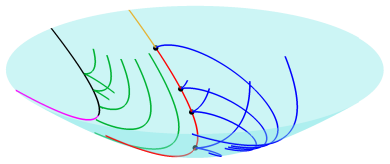
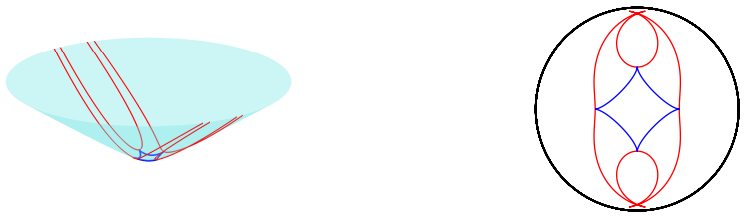
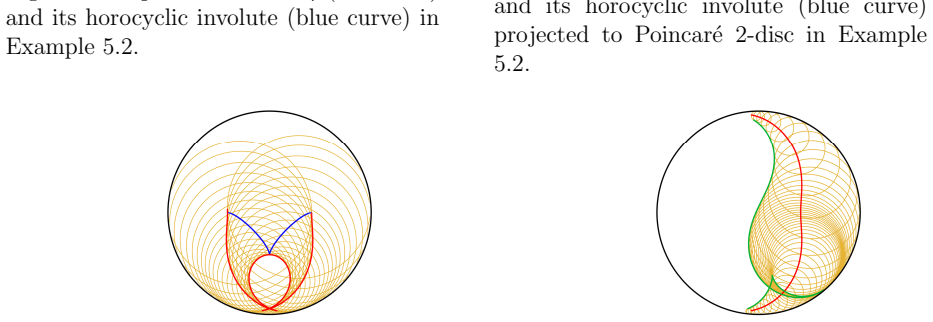
read the original abstract
The horocyclic evolutes of spacelike frontals in hyperbolic 2-space have already been defined. Using enveloid theorem, we now define the horocyclic parallel and involute of a spacelike frontal in hyperbolic 2-space as the normal envelopes of its normal and tangent horocycles, respectively. Meanwhile, we investigate the relations among horocyclic evolutes, parallels and involutes.
Editorial analysis
A structured set of objections, weighed in public.
Referee Report
Summary. The paper defines the horocyclic parallel and horocyclic involute of a spacelike frontal in hyperbolic 2-space as the normal envelopes of its normal and tangent horocycles, respectively, via the enveloid theorem. Building on prior definitions of horocyclic evolutes, the authors derive relations among the evolutes, parallels, and involutes.
Significance. If the definitions and relations hold, the work completes a triad of associated objects (evolute, parallel, involute) for spacelike frontals in H^2, mirroring classical Euclidean constructions and providing tools for analyzing envelopes and singularities in hyperbolic differential geometry.
major comments (2)
- [§3] §3 (or the section containing the definitions): the claim that the horocyclic parallel is the normal envelope of the normal horocycles rests on direct application of the enveloid theorem, but the manuscript does not explicitly verify that the theorem's hypotheses (regularity of the family, non-vanishing curvature, etc.) hold for general spacelike frontals, which may possess singularities; this verification is load-bearing for the new definitions.
- [§4] §4 (relations among evolutes, parallels and involutes): the stated relations (e.g., how the involute of the parallel recovers the evolute) are not accompanied by explicit domain restrictions or checks at singular points of the frontal; without these, the relations may fail to hold globally.
minor comments (2)
- [Abstract] The abstract states that relations are investigated but does not indicate which relations are the main results; a single sentence summarizing the principal relations would improve readability.
- [Notation] Notation for horocycles (normal vs. tangent) and for the frontal should be introduced once with a clear table or list of symbols to avoid ambiguity in later sections.
Simulated Author's Rebuttal
We thank the referee for the detailed and constructive report. The comments highlight important points about the applicability of the enveloid theorem to singular frontals and the precise domains of the derived relations. We address each major comment below and will incorporate revisions to strengthen the manuscript.
read point-by-point responses
-
Referee: §3 (or the section containing the definitions): the claim that the horocyclic parallel is the normal envelope of the normal horocycles rests on direct application of the enveloid theorem, but the manuscript does not explicitly verify that the theorem's hypotheses (regularity of the family, non-vanishing curvature, etc.) hold for general spacelike frontals, which may possess singularities; this verification is load-bearing for the new definitions.
Authors: We agree that an explicit verification of the enveloid theorem hypotheses is necessary, particularly given the possible singularities of spacelike frontals. In the revised manuscript we will add a dedicated subsection in §3 that checks the regularity of the normal horocycle family, confirms non-vanishing curvature away from isolated singular points, and clarifies that the definitions are understood on the regular locus with continuous extension where possible. revision: yes
-
Referee: §4 (relations among evolutes, parallels and involutes): the stated relations (e.g., how the involute of the parallel recovers the evolute) are not accompanied by explicit domain restrictions or checks at singular points of the frontal; without these, the relations may fail to hold globally.
Authors: We concur that domain restrictions and checks at singular points are required for the relations to be stated rigorously. In the revision of §4 we will insert explicit statements specifying that all relations hold on the open dense regular set of the frontal, note the behavior at isolated singularities, and provide brief verification that the involute-of-parallel construction recovers the evolute on this regular locus. revision: yes
Circularity Check
No significant circularity identified
full rationale
The paper extends prior definitions of horocyclic evolutes by introducing horocyclic parallels and involutes as normal envelopes of normal and tangent horocycles via the enveloid theorem, then derives relations among the three objects. No equation or definitional step reduces a claimed result to its own inputs by construction, nor does any load-bearing premise collapse to an unverified self-citation chain. The cited enveloid theorem and prior evolutes serve as external starting points for a self-contained definitional and relational investigation in hyperbolic differential geometry.
Axiom & Free-Parameter Ledger
axioms (1)
- domain assumption The enveloid theorem applies to normal and tangent horocycles of spacelike frontals in hyperbolic 2-space
Reference graph
Works this paper leans on
-
[1]
V. I. Arnol’d, Singularities of Caustics and Wave Fronts , Mathematics and Its Applications, 62, Kluwer Academic Publishers (1990)
work page 1990
-
[2]
V. I. Arnol’d, Topological properties of Legendre proje ctions in contact geometry of wave fronts, St. Petersb. Math. J. 6, 439–452 (1995)
work page 1995
-
[3]
V. I. Arnol’d, S. M. Gusein-Zade, A. N. Varchenko, Singul arities of differentiable maps, vol. I, Birkh¨ auser (1986)
work page 1986
- [4]
-
[5]
J. W. Bruce, T. J. Gaffney, Simple singularities of mapping s C,0 → C 2,0, J. London Math. Soc. (2). 26(3), 465–474 (1982)
work page 1982
-
[6]
J. W. Bruce, P. J. Giblin, Curves and Singularities: A Geo metrical Introduction to Singularity Theory, Second edition. Cambridge University Press, Cambr idge (1992)
work page 1992
- [7]
-
[8]
L. Chen, S. Izumiya, M. Takahashi, Duality and geometry o f horocyclic evolutes in hyperbolic plane, Res. Math. Sci. 11(1), Paper No. 17, 18 pp (2024)
work page 2024
-
[9]
L. Chen, D. Pei, M. Takahashi, Dualities and envelopes of one-parameter families of frontals in hyperbolic and de Sitter 2-spaces, Math. Nachr. 293(5), 893 –909 (2020)
work page 2020
-
[10]
L. Chen, M. Takahashi, Dualities and evolutes of fronts in hyperbolic and de-Sitter space, J. Math. Anal. Appl. 437(1), 133–159 (2016)
work page 2016
- [11]
-
[12]
R. Ferreira, J. dos Reis Junior, C. H. Grossi, On the geom etry of the kinematic space in special relativity, J. Geom. Phys. 180, Paper No. 104629, 13 pp (2022 )
work page 2022
-
[13]
T. Fukunaga, M. Takahashi, Existence and uniqueness fo r Legendre curves, J. Geom. 104(2), 297–307 (2013)
work page 2013
-
[14]
T. Fukunaga, M. Takahashi, Evolutes of fronts in the Euc lidean plane, J. Singul. 10, 92–107 (2014)
work page 2014
-
[15]
T. Fukunaga, M. Takahashi, Evolutes and involutes of fr ontals in the Euclidean plane, Demonstr. Math. 48(2), 147–166 (2015)
work page 2015
-
[16]
T. Fukunaga, M. Takahashi, Involutes of fronts in the Eu clidean plane, Beitr. Algebra Geom. 57(3), 637–653 (2016). 25
work page 2016
- [17]
-
[18]
Izumiya, Horospherical geometry in the hyperbolic s pace, Adv
S. Izumiya, Horospherical geometry in the hyperbolic s pace, Adv. Stud. Pure Math. 55, 31–49 (2009)
work page 2009
-
[19]
S. Izumiya, D. Pei, M. Romero-Fuster, M. Takahashi, The horospherical geometry of submanifolds in hyperbolic space, J. Lond. Math. Soc. 71(3), 779–800 (200 5)
-
[20]
S. Izumiya, D. Pei, T. Sano, E. Torii. Evolutes of Hyperb olic Plane Curves, Acta Math. Sin. (Engl. Ser.) 20(3), 543–550 (2004)
work page 2004
-
[21]
Y. Li, O. O. Tuncer, On (contra)pedals and (anti)orthot omics of frontals in de Sitter 2-space, Math. Methods Appl. Sci. 46(9), 11157–11171 (2023)
work page 2023
-
[22]
N. Nakatsuyama, M. Takahashi, On vertices of frontals i n the Euclidean plane, Bull. Braz. Math. Soc. (N.S.) 55(3), Paper No. 35, 21 pp (2024)
work page 2024
-
[23]
I. R. Porteous, Geometric differentiation for the intell igence of curves and surfaces, Second edition. Cambridge University Press, Cambridge (2001)
work page 2001
-
[24]
O. O. Tuncer, I. Gok, Hyperbolic caustics of light rays r eflected by hyperbolic front mirrors, Eur. Phys. J. Plus. 138, 266 (2023)
work page 2023
-
[25]
A. Ungar, Analytic hyperbolic geometry and Albert Eins tein’s special theory of relativity, World Scientific. (2008)
work page 2008
-
[26]
Vari´ cak, Anwendung der lobatschefskijschen geometrie in der relativtheorie, Phys
V. Vari´ cak, Anwendung der lobatschefskijschen geometrie in der relativtheorie, Phys. Z. 11, 93–96 (1910)
work page 1910
-
[27]
A. Zhou, D. Pei, Enveloids of spacelike frontals in hype rbolic 2-space, To appear in Hacet. J. Math. Stat. (2026). Nozomi Nakatsuyama, Muroran Institute of Technology, Muroran 050-8585, Japan, E-mail address: 25096009b@muroran-it.ac.jp Masatomo Takahashi, Muroran Institute of Technology, Muroran 050-8585, Japan, E-mail address: masatomo@muroran-it.ac.jp ...
work page 2026
discussion (0)
Sign in with ORCID, Apple, or X to comment. Anyone can read and Pith papers without signing in.