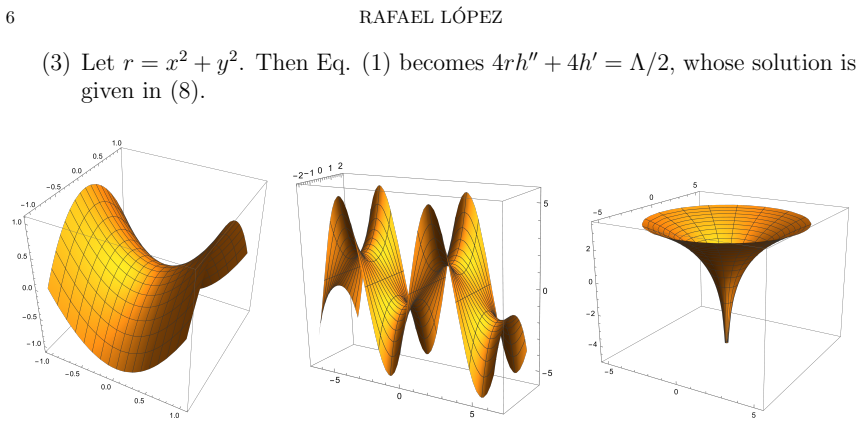
In this paper, we study surfaces $z=\varphi(x,y)$ in Euclidean space that satisfy the equation $\varphi_{xx}+\varphi_{yy}=\frac{\Lambda}{2}$ where $\Lambda\in\r$ is a real constant. We classify these surfaces when they are the zero level sets of an implicit equation of the type $f(x)+g(y)+h(z)=0$, where $f$, $g$ and $h$ are smooth functions of one variable. If $\Lambda=0$, we find a large family of surfaces with interesting symmetry properties. However, if $\Lambda\not=0$, we show that the surfaces must be either surfaces of revolution or of the type $z=f(x)+g(y)$; furthermore, explicit parametrizations of these surfaces are obtained.
Necessary condition reduces cylinder inclusion to one differential equation using only κ and τ.
abstractclick to expand
We establish necessary conditions for a regular curve to lie on a circular cylinder in terms of its curvature $\kappa$ and torsion $\tau$. By identifying a fundamental function $\psi = \sin^2 \alpha$, representing the squared sine of the angle between the tangent vector and the axis of the cylinder, we reduce the geometric inclusion problem to a compatibility condition between an explicit eighth-degree polynomial equation and a differential equation for $\psi$. This approach yields a single ODE involving only $\kappa$ and $\tau$ that governs the inclusion of the curve in the cylinder. The robustness of this framework is demonstrated through specific examples of cylindrical curves. Furthermore, we analyze the case of curves with constant curvature $\kappa_0$, obtaining an explicit ODE for the torsion. Remarkably, we prove that if $\kappa_0 = 1/\rho$, this equation admits an explicit, exact solution for $\tau$.
We extend an energy introduced by Mather to the setting of Almgren-Pitts min-max theory and obtain a parametric, higher-dimensional analogue of Mather's variational barrier theory for twist maps and geodesics on tori. We use this energy to establish several criteria for the existence of foliations of the $n$-torus by minimal hypersurfaces. We show that for a generic metric, whenever a lamination by area-minimizing hypersurfaces of the $n$-torus contains a gap, there exists a minimal hypersurface inside the gap that is not area-minimizing. As an application, we derive a recurrence property for totally irrational minimal foliations.
The same volume and ends data also produce escaping geodesics and recover classical theorems for Ricci, scalar, and Kähler curvature without
abstractclick to expand
In this paper, we investigate two curvature-free effects from volume growth and ends-counting, respectively. Motivated by generalizing classical results from Ricci curvature to other common curvatures, we establish two main theorems. First, any complete non-compact manifold with lower sublinear volume growth admits a smooth bounded mean-concave exhaustion. Second, any complete manifold with infinitely many ends contains escaping geodesic lines outside every compact subset. As applications, we provide new proofs of the Calabi--Yau minimal volume growth theorem and the Cai--Li--Tam finite-ends theorem for nonnegative Ricci curvature, without relying on the Bishop--Gromov volume comparison theorem or analytic tools specific to Ricci curvature. We further extend these results to Riemannian manifolds with nonnegative scalar curvature and K\"ahler manifolds with positive holomorphic sectional curvature.
The lower bound equals the instanton mass plus conical defect terms, with equality only for the instanton itself.
abstractclick to expand
We establish sharp lower bounds for the mass of asymptotically locally Euclidean (ALE) and asymptotically locally flat (ALF) toric 4-manifolds, in terms of equilibrium geometries consisting of gravitational instantons. More precisely, the mass of a complete ALE or ALF toric 4-manifold with nonnegative scalar curvature is bounded below by a sum comprised of the following quantities: the mass of the corresponding toric gravitational instanton having the same orbit space (rod) structure as the original ALE/ALF manifold, and an expression determined by the conical angle defects of totally geodesic 2-spheres within the instanton that serve as generators for its second homology. The inequality may be generalized to the situation in which the ALE/ALF manifold also possesses conical singularities as well as orbifold singularities, and it suggests a refined notion of `total mass' in which the result simply states that the total mass of the ALE/ALF manifold is not less than that of the corresponding gravitational instanton. Furthermore, we prove rigidity for these statements, namely the inequality is saturated only when the ALE/ALF manifold is Ricci flat and in fact agrees with the corresponding instanton. These results may be viewed in the context of positive mass theorems, providing an explanation of how positivity can fail in the ALE/ALF setting. Moreover, the main theorem may be interpreted as yielding a variational characterization of the relevant toric gravitational instantons.
Singularly transitive distributions in the real analytic category have finite-dimensional symmetry algebras, settling a 2013 open problem.
abstractclick to expand
We generalize the classical Tanaka result on the finiteness of symmetry algebra for non-degenerate pseudo-product structures to the case when the completely-integrable distributions defining the pseudo-product structure are no longer concentrated in the degree $-1$. In order to do this, we modify the notion of universal prolongation of graded nilpotent Lie algebras and generalize the original finiteness criterion of Tanaka. Using this result, we demonstrate that in real analytic category, distributions that are controllable by regular abnormal extremal trajectories, also known as singularly transitive, have finite-dimensional symmetries. This result settles Problem V in the affirmative from the 2013 list of open problems by Andrei Agrachev. Additionally, we discuss applications to symmetries and natural equivalence problems for systems of ODEs of mixed order.
We characterize all compact embedded stable minimal capillary surfaces with capillary angle close to either $0$ or $\pi$ that are supported on a complete embedded minimal surface with finite total curvature that is not an affine plane. Moreover, we characterize all compact embedded weakly stable minimal capillary surfaces with capillary angle close to either $0$ or $\pi$ that are supported on a closed surface whose mean curvature is positive and has no degenerate maxima. An important ingredient in our work are curvature estimates for sequences of weakly stable minimal capillary surfaces with capillary angles tending to $0$ or $\pi$ that enable us to analyze the tangential limits of such sequences at suitable scales.
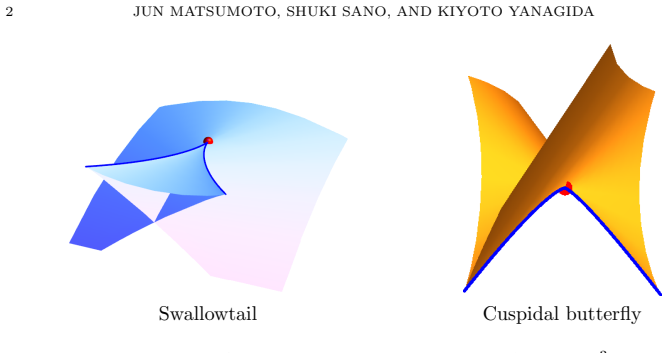
First, this paper presents a systematic procedure for constructing criteria for singularities of curves of finite multiplicities in $\boldsymbol{R}^N$. Based on this method, we provide explicit criteria for singularities of multiplicities two, three, and four, including specific cusps appearing only in dimensions three or higher. Furthermore, we generalize the normalized curvature functions and the cuspidal curvature to singular curves in $\boldsymbol{R}^N$. Using these generalized curvatures, we reinterpret the existence and uniqueness theorem given by Fukui for curves in $\boldsymbol{R}^N$ of finite multiplicities.
The rigidity bounds the first Betti number and excludes such curvature on leaves for Koszul-type affine manifolds.
abstractclick to expand
We study Ricci curvature properties of Hessian metrics on the leaves of the codimension-one foliation $\mathcal{F}_\omega = \ker\,\omega$ generated by the first Koszul form $\omega$ of a closed oriented Hessian manifold. Our main result reveals a striking rigidity phenomenon: non-negative Ricci curvature on a single leaf of $\mathcal{F}_\omega$ compels the Hessian metric to be flat, yields sharp bounds on the first Betti number in terms of the dimension of the Hessian manifold and the topology of the leaves. This rigidity also shows that Koszul-type and radiant affine manifolds admit no leaf carrying non-negative Ricci curvature, reflecting a fundamental incompatibility between affine hyperbolicity and leafwise curvature positivity. In dimension three, we obtain a complete classification of the underlying manifold, extended to the non-orientable setting via the orientation double cover.
We classify all homothetical surfaces with constant mean curvature $H$ in the hyperbolic space $\mathbb{H}^3$. Using the upper half-space model with standard coordinates $(x,y,z)$, these surfaces are defined by the relation $z = \phi(x)\psi(y)$, where $\phi$ and $\psi$ are smooth functions of one variable. We demonstrate that any such surface is necessarily parabolic, meaning that either $\phi$ or $\psi$ is a constant function. Our results cover the minimal case ($H=0$), the case $H^2 \neq 1$, and the critical case $H^2=1$, thereby extending the existing classification of parabolic surfaces in hyperbolic space.
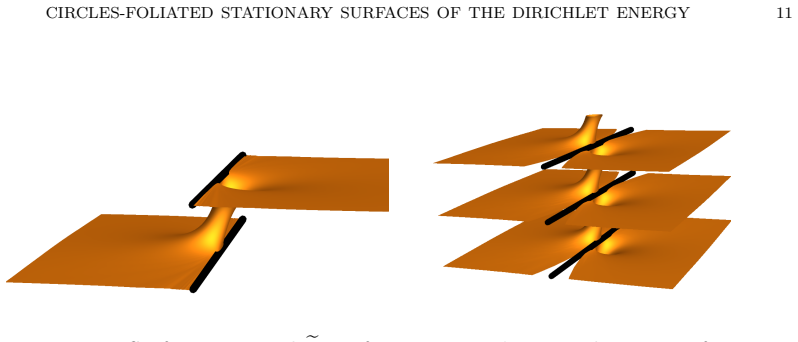
In Euclidean space we study surfaces with constant anisotropic mean curvature $\Lambda$ of the Dirichlet energy $\int_\Omega( |Du|^2+\Lambda u)$. We prove the existence of non-rotational surfaces with $\Lambda=0$ and foliated by a one-parameter family of circles contained in horizontal planes obtaining a geometric description of them. These surfaces extend the known Riemann examples of the theory of minimal surfaces to the anisotropic context of the Dirichlet energy. More general, we classify all surfaces with zero anisotropic mean curvature foliated by circles proving that either the surface is axially symmetric about the $z$-axis or the surface belongs to one of the above examples. We also study the case that the anisotropic mean curvature is a non-zero constant.
When b1 difference equals dimension difference, such bundles over closed bases become classifiable and splitting conditions appear.
abstractclick to expand
We study torus bundles with affine structure groups. First, we establish a rigidity result under constraints on the first Betti numbers: If $ \text{b}_{1}(M)-\text{b}_{1}(N)=\dim M-\dim N $ holds for a torus bundle $M$ with an affine structure group over a closed manifold $N$, then $M$ can be classified. Second, we obtain some necessary and sufficient conditions for the topological splitting of principal torus bundles. These results improve the understanding of the geometry of collapsing sequences under the first Betti number constraints, thereby extending the prior work by Huang-Wang.
We study Riemannian manifolds $(M^n,g)$ with mean-convex boundary whose Ricci curvature is nonnegative in a spectral sense. Our first main result is a sharp spectral extension of a rigidity theorem by Kasue: we prove that under the conditions \[ \lambda_1(-\gamma\Delta+\mathrm{Ric})\geq 0,\qquad H_{\partial M}\geq 0, \] and in the sharp range $0\leq \gamma<4$ if $n=2$, and $0\leq\gamma<\frac{n-1}{n-2}$ if $n\geq3$, a (possibly noncompact) complete manifold with disconnected boundary, with at least one compact boundary component, must split isometrically as a product $[0,L]\times \Sigma$.
Our second main contribution is a topological rigidity result for the relative fundamental group $\pi_1(M,\partial M)$, combined with a deep theorem of Lawson--Michelsohn. We prove that, in dimensions $n\neq4$, any compact manifold with boundary satisfying the two inequalities above, with at least one of them strict, admits a metric with positive sectional curvature and strictly mean-convex boundary, provided $\gamma\geq0$ if $n=2$, and $0\leq\gamma\leq\frac{n-1}{n-2}$ if $n\geq3$. This range of $\gamma$ is sharp for the latter result to hold.
Generalized Lorentzian cones inherit sharp timelike curvature and CD bounds when bases and fibers converge in GH sense and warping functions
abstractclick to expand
The goal of this article is twofold. We introduce a notion of convergence for Lorentzian pre-length spaces, $\ell$-convergence, that extends previous convergence notions in this context. We show that timelike curvature and timelike curvature-dimension bounds are stable under (measured) $\ell$-convergence. Then, we show that $\ell$-convergence is well adapted for generalized Lorentzian cones: a sequence of generalized cones $-I_i\times_{f_i}X_i$ converges in $\ell$ sense if the base $I_i$ and the fiber $X_i$ converge in GH sense and the functions $f_i$ converge uniformly. We use this to show sharp timelike curvature and timelike curvature-dimension bounds for such cones. Finally, we obtain a pre-compactness theorem for $\ell$-convergence in the class of smooth generalized cones that have a uniform lower bound on the full Ricci (or Riemann) curvature tensor.
Its boundary radius grows as (3/2) log a plus a Gamma-function constant and shrinks as square root near the lower limit.
abstractclick to expand
For each parameter $a>1/2$, the critical hyperbolic catenoid $\Sigma_a$ is a rotationally symmetric, free boundary minimal annulus in a geodesic ball $B^3(r(a))\subset\mathbb{H}^3$, in the family of Mori, do Carmo--Dajczer, and Medvedev. We establish three analytic results about $\Sigma_a$.
(I) Robin nullity and index in mode $|k|=1$. The Robin nullity of the Jacobi operator $L_{\Sigma_a}=\Delta_g+(|II|^2-2)$ in angular Fourier mode $|k|=1$ equals $2$, with kernel spanned by the Killing--Jacobi fields associated to the rotations $L_{12},L_{13}\in\mathfrak{so}(3,1)$ that fix the geodesic axis of $\Sigma_a$ and send $\partial B^3(r(a))$ to itself. The radial profile admits the closed form $f_*(s)=\partial_s\Phi_a^0(s,0)=\frac{d}{ds}[A(s)\cosh\varphi(s)]=\sinh r(s)\cdot r'(s)$, where $r(s)$ is the geodesic distance from $p_0=(1,0,0,0)$. By Sturm--Liouville theory, the Robin Morse index of $\Sigma_a$ in mode $|k|=1$ also equals $2$, refining the lower bound $\mathrm{ind}(\Sigma_a)\geq 4$ of Medvedev.
(II) Asymptotic radius. The boundary radius satisfies $r(a)=\tfrac{3}{2}\log a+d_\infty+o(1)$ as $a\to\infty$, with $d_\infty=\log[\sqrt{2}\,\Gamma(1/4)^2/\pi^{3/2}]=\log[2\sqrt{2\pi}/\Gamma(3/4)^2]$. The closed form for $d_\infty$ follows from a Beta-function evaluation of $I_\infty=\int_0^{\infty}\cosh(2t)^{-3/2}\,dt$.
(III) Degenerate limit. As $a\to(1/2)^+$, $r(a)=c_*\sqrt{a-1/2}\,(1+o(1))$ with $c_*=\sigma_*\cosh\sigma_*$, where $\sigma_*$ is the unique positive fixed point of $\sigma=\coth\sigma$.
The proof of (I) follows the mode-by-mode strategy of Devyver for the Euclidean critical catenoid, with $\mathfrak{so}(3,1)$ replacing $\mathfrak{so}(3)$, supplemented by the closed-form identification $f_*=\partial_s\Phi^0$ specific to the hyperbolic ambient. The proof of (II) is a Laplace-type asymptotic analysis of the implicit free boundary condition.
Representation-theoretic method with generalized metric variations gives all eigenvalues and multiplicities for classical families.
abstractclick to expand
We present a unified representation-theoretic method to compute the Laplace-Beltrami spectrum on homogeneous principal bundles. For this setting, we introduce a multi-parameter family of metric deformations called generalized canonical variations. Building upon the geometric realization of such fibrations as naturally reductive spaces, we establish a simplified spectral branching criterion. We apply this method to derive the full spectra (yielding all eigenvalues and multiplicities) for several prominent geometric families. Specifically, we compute the full spectra for the entire classical series of homogeneous 3-$(\alpha,\delta)$-Sasaki manifolds (Types A, B, C, and D) and for real and complex Stiefel manifolds over Grassmannians. These explicit formulas provide the analytical data to investigate related problems in geometric analysis. As an application, we classify the scalar stability of these spaces under Perelman's $\nu$-entropy and, for the 3-$(\alpha,\delta)$-Sasaki manifolds, determine the exact thresholds for Yamabe bifurcations.
The contact structure forces every non-geodesic unit-speed Legendre curve to be a contact whirl curve with τ = 1.
abstractclick to expand
We introduce and study \emph{contact whirl curves} in three-dimensional Lorentzian contact manifolds, with emphasis on the Sasakian setting. This notion refines the concept of whirl curves by encoding the interaction between the adapted frame of a curve and the ambient contact structure through the Reeb vector field. For non-geodesic unit-speed contact whirl curves, we derive a differential equation governing the torsion in terms of the Frenet invariants and the contact data. In the Lorentzian Sasakian setting, this leads to rigidity phenomena of Lancret type. In particular, we prove that every non-geodesic Legendre Frenet curve is automatically a contact whirl curve, and consequently has constant torsion $\tau=1$.
We also investigate the interaction between contact whirl curves and magnetic trajectories associated with the canonical contact magnetic field. We show that every non-geodesic curve which is simultaneously magnetic and contact whirl must be Legendre, and we obtain an explicit expression for its torsion in terms of the tensor $h=\frac12\mathcal L_\xi\Phi$. In the Sasakian case, this reduces to the universal law $\tau=1$. Finally, in the Lorentzian Heisenberg group endowed with its standard Sasakian structure, we derive a coordinate form of the whirl condition and use it to produce explicit examples, including a construction by quadratures of non-Legendre contact whirl curves and a horizontal helicoidal Legendre family.
PDE method in annuli shows planar ends for finite Morse index minimal hypersurfaces with Euclidean growth.
abstractclick to expand
We present a short and flexible improvement-of-flatness argument adapted to the setting of exterior domains, where one is naturally led to work with annuli instead of balls.
As a model application in the classical setting of minimal surfaces, we give an alternative proof of the end-structure and asymptotics for finite Morse index minimal hypersurfaces with Euclidean area growth in low dimensions.
The method is largely PDE-based and general in its application. Suitable variants have been employed in Bernoulli and Allen--Cahn settings.
Complete non-compact manifolds of maximal volume growth are topologically and geometrically constrained; Gromov-Hausdorff limits of non-coll
abstractclick to expand
In this paper, we study 4-dimensional complete non-compact manifold with its curvature operator in $\mathfrak{C}_{\eta,\mu}$ via Ricci flow. We obtain topological and geometric gap theorems assuming such manifold has maximal volume growth. We also study 4-dimensional complete manifold with lower bound of $\mathfrak{C}_{\eta,\mu}$ and obtain regularity results for Gromov-Hausdorff limit of complete volume non-collapsed manifolds with lower bound of $\mathfrak{C}_{\eta,\mu}$.
Noncompact version of parabolic gap theorem shows flow reaches Yang-Mills connection.
abstractclick to expand
We prove a sharp convergence theorem for the Yang-Mills flow on an $\mathrm{S}\mathrm{U}(r)$-bundle over a locally hyperK\"ahler ALE 4-manifold. Our main result is a noncompact version of the "parabolic gap theorem" previously established by the authors.
The isomorphism classifies all Hessian metrics on such products and on products with hyperbolic or flat Riemannian manifolds.
abstractclick to expand
We study Dolbeault--Koszul cohomology $H^{p,q}(M)$ of flat affine manifolds. We proove a K\"unneth formula \[ H^{p,q}(M\times N) \cong \bigoplus_{i,j} H^{i,j}(M)\otimes H^{p-i,q-j}(N) \] for flat affine manifolds $M,N$ with at least one compact. For compact manifolds we also give a proof via Hodge theory on flat affine manifolds, analogous to the classical K\"unneth formula for Dolbeault cohomology.
We apply this formula to Hessian manifolds. A Hessian metric $g$ defines a class $[g]\in H^{1,1}(M)$, and metrics in the same class differ by $D\alpha$ for a closed $1$-form $\alpha$. Using the K\"unneth formula we describe all Hessian metrics on products, on products with hyperbolic manifolds, and on manifolds admitting a flat Riemannian metric.
The distance acts as a viscosity supersolution and produces local Harnack inequalities when one surface evolves by mean curvature flow.
abstractclick to expand
We will show that the distance between two minimal hypersurfaces is a Lipschitz continuous supersolution, in the viscosity sense, of a natural elliptic partial differential equation. This not only recovers several well-known properties of minimal hypersurfaces, but also encodes substantially richer information.
Moreover, if the reference hypersurface is allowed to evolve by mean curvature flow, one obtains comparably strong estimates for a corresponding parabolic PDE, leading in particular to local Harnack inequalities for the distance. There is even a fully parabolic extension in which both hypersurfaces evolve. The problem of tracking the distance between two evolving hypersurfaces arises naturally in a wide range of settings.
A unified framework covers maximal space-like surfaces, alternating curves, and A-surfaces, including non-compact cases with L^p variations.
abstractclick to expand
We study the infinitesimal rigidity of equivariant minimal maps from the universal cover of a smooth oriented surface (possibly non-compact) into a Riemannian symmetric space, focusing on representations arising from cyclic harmonic bundles. By developing a unified Lie-theoretic framework that connects cyclic surfaces and cyclic harmonic bundles over Riemann surfaces, we prove the infinitesimal rigidity for irreducible cyclic surfaces under admissible smooth variations, including both compactly supported deformations and $L^p$-integrable variations on non-compact surfaces. As a geometric application, we introduce $n$-alternating surfaces in $\mathbb H^{p,q}$ and establish their correspondence with a special class of cyclic surfaces. This yields an infinitesimal rigidity theorem that conceptually unifies and extends known rigidity results for maximal space-like surfaces, alternating holomorphic curves, and $A$-surfaces in certain $\mathbb H^{p,q}$.
A functional on metrics vanishes exactly when geodesics match any given unparametrized paths, with existence shown via its Yamabe-type Euler
abstractclick to expand
Given a prescription of unparametrised paths on a manifold $M$, one path for each tangent direction, we may ask whether these paths agree with the geodesics of a Riemannian metric on $M$. Generically, this is not the case. Motivated by this fact, we introduce a non-negative functional $\mathcal{E}$ on the space of Riemannian metrics on $M$ so that $\mathcal{E}(g)=0$ if and only if the geodesics of the metric $g$ agree with the prescribed paths. We compute the variational equations for $\mathcal{E}$ and show that the conformal variational equation is, perhaps surprisingly, of Yamabe type. This allows us to obtain existence results for conformally critical points of $\mathcal{E}$. In particular, in the surface case, every conformal class contains a conformally critical metric, unique up to homothety. As a by-product, we establish that the Blaschke metric of a properly convex projective surface is a critical point for $\mathcal{E}$.
We construct new expanders for mean curvature flow that are smoothly asymptotic to cones arising from certain shrinkers. For each such cone, we prove the existence of expanders of arbitrarily large genus. Thus, for a fixed incoming shrinker, the genus of the outgoing expander can be chosen much larger than the genus before the singularity, contrary to Ilmanen's genus-reduction conjecture.
ODE analysis of the profile curve excludes all non-minimal cases.
abstractclick to expand
In this paper, we show that any biharmonic rotational surface in the four-dimensional Euclidean space is minimal. The proof is based on reducing the biharmonic equation to a system of ordinary differential equations for the profile curve and then excluding all possible non-minimal branches. This is a partial affirmative answer to Chen's conjecture.
In this paper, we introduce the notion of a prescribed angle hypersurface in a Riemannian manifold associated with a pair $(\mathcal{V},\theta)$, where $\mathcal{V}$ is a unit vector field along the hypersurface and $\theta$ denotes the angle between $\mathcal{V}$ and the unit normal vector field of the hypersurface. We study such hypersurfaces in case $\mathcal{V}$ is a torse-forming vector field. In the particular $3$-dimensional case, we determine the intrinsic and extrinsic curvatures of these hypersurfaces in terms of the prescribed angle and the potential function of $\mathcal{V}$. Using this, we classify prescribed angle surfaces under suitable assumptions.
A curvature-oscillation threshold depending on turning number makes every relaxed m-ideal flow immortal and exponentially convergent to the圈
abstractclick to expand
For each integer $m\ge0$ we study the $m$-ideal energy \[ E_m[\gamma]:=\frac12\int_\gamma k_{s^m}^2\,ds \] on closed immersed planar curves, where $k$ is signed curvature and $s$ is arclength; $k^2_{s^m} := (k_{s^m})^2$. The $m$-ideal energies contain Euler's elastic energy and the Dirichlet energy for the curvature scalar as special cases ($m=0,1$).
We completely classify the closed smooth critical points of $E_m$ for all $m\ge1$: they are precisely the round multiply-covered circles. For the steepest descent $L^2(ds)$-gradient flow of $E_m$, the \emph{$m$-ideal flow}, we prove that for each nonzero turning number there is a curvature-oscillation threshold such that every canonical relaxed flow starting from $W^{2,2}$ initial data below this threshold is immortal and exponentially asymptotic in the smooth topology to a round multiply-covered circle. We also prove that every immortal canonical relaxed trajectory with bounded unnormalised length converges to the corresponding circle.
We furthermore treat rough initial data of class $W^{2,2}$; such data typically has infinite $E_m$ energy when $m\ge1$. In the small-curvature-oscillation basin, every such curve generates a unique canonical relaxed length-normalised flow, smooth for every positive time, continuously dependent on the initial data, and smoothly convergent to the multiply-covered circle. These results are known in the $m=0$ case, substantially strengthen existing work in the $m=1$ case, and are new for $m>1$.
Nilpotency of the Reeb vector's adjoint action pins down the only possibilities inside the DS-contact class.
abstractclick to expand
We provide an elementary proof that, in a (transversely) unimodular contact Lie algebra, the adjoint action of the Reeb vector is nilpotent except when the Lie algebra is isomorphic to either $\mathfrak{sl}(2,\mathbb{R})$ or $\mathfrak{su}(2)$. We introduce a class of contact Lie algebras, called \textit{DS-contact Lie algebras}, containing all K-contact Lie algebras, and deduce from the previous result that the only centerless unimodular examples in this class are precisely $\mathfrak{sl}(2,\mathbb{R})$ and $\mathfrak{su}(2)$. This gives an alternative proof of the previously known fact that centerless unimodular Sasakian Lie algebras are isomorphic to either $\mathfrak{sl}(2,\mathbb{R})$ or $\mathfrak{su}(2)$. Some other results known to hold for Sasakian Lie algebras are generalized as well. We investigate several properties of DS-contact Lie algebras in relation to Frobenius Lie algebras, and also classify them in dimension five. Some implications for the contact Lefschetz condition are explored.
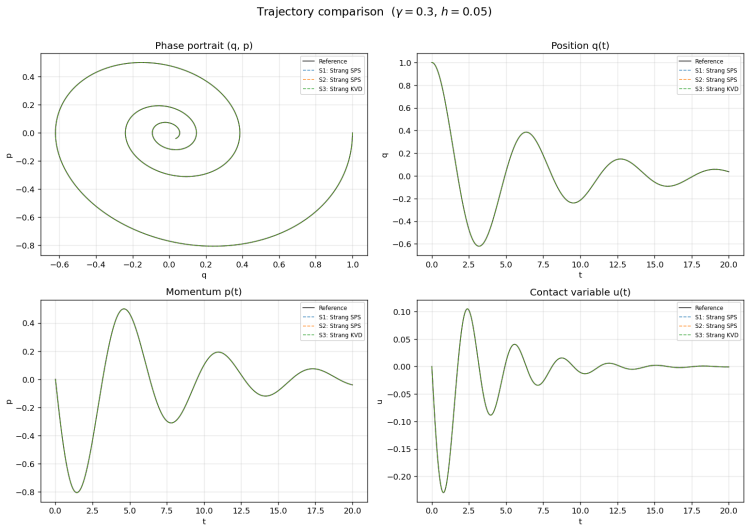
Contact Hamiltonian systems extend symplectic Hamiltonian mechanics to dissipative settings while retaining geometric structure. We develop a structure-preserving splitting framework for contact Hamiltonian systems on $J^1(\mathbb{R}^n)$ based on two tractable classes of exact-contact subflows: strict contactomorphisms and prolonged diffeomorphisms. Our main theoretical result is that the Lie algebra generated by the corresponding strict and prolonged Hamiltonians contains all polynomial-in-$p$ Hamiltonians and is therefore dense, in the $C^r$ topology on compact sets, in the Lie algebra of smooth contact Hamiltonians. This yields a local universality result and contact splitting integrators built from exact strict and prolonged subflows. We then show how these subflows can be realized numerically by lifting symplectic integrators on $T^*\mathbb{R}^n$ and ODE integrators on $\mathbb{R}^n\times\mathbb{R}$. Finally, we illustrate the framework on a sequence of low-dimensional examples.
In this paper we give a general family of conformal invariants associated to bordered Riemann surfaces endowed with boundary parametrizations, or equivalently compact surfaces endowed with conformal maps. Each invariant is specified by a field of one-forms over a Teichm\"uller space of infinite conformal type. The invariants are positive, and under certain conditions monotonic.
It is shown that these conformal invariants can be viewed as generalized modular invariants on Teichm\"uller space and as functions on the rigged moduli space of Segal and Vafa. The construction uses an identification of Teichm\"uller space and the rigged moduli space, as well as analytic work of the authors showing that the transfer or ``overfare'' of harmonic functions sharing boundary values on a quasicircle is bounded.
Demanding invariance under various subgroups of the modular group -- equivalently, under the group of quasisymmetric reparametrizations of a sub-collection of borders -- generates conformal invariants. We show that a wide variety of conformal invariants can be obtained through various choices of the field of one-forms. These include modules of doubly-connected domains, period mappings obtained from harmonic measures, inequalities for higher-order conformal invariants, and the Grunsky inequalities and their recent generalizations to Riemann surfaces.
In this paper we give a general family of conformal invariants associated to bordered Riemann surfaces endowed with boundary parametrizations, or equivalently compact surfaces endowed with conformal maps. Each invariant is specified by a field of one-forms over a Teichm\"uller space of infinite conformal type. The invariants are positive, and under certain conditions monotonic.
It is shown that these conformal invariants can be viewed as generalized modular invariants on Teichm\"uller space and as functions on the rigged moduli space of Segal and Vafa. The construction uses an identification of Teichm\"uller space and the rigged moduli space, as well as analytic work of the authors showing that the transfer or ``overfare'' of harmonic functions sharing boundary values on a quasicircle is bounded.
Demanding invariance under various subgroups of the modular group -- equivalently, under the group of quasisymmetric reparametrizations of a sub-collection of borders -- generates conformal invariants. We show that a wide variety of conformal invariants can be obtained through various choices of the field of one-forms. These include modules of doubly-connected domains, period mappings obtained from harmonic measures, inequalities for higher-order conformal invariants, and the Grunsky inequalities and their recent generalizations to Riemann surfaces.
We study the discrete graph-metric analogue of Gromov's filling area problem for the cycle graph \(C_n\). An abstract triangulation \(K\) is an isometric filling of \(C_n\) if \(\partial K=C_n\) and the graph distance between any two boundary vertices is not shortened inside the \(1\)-skeleton of \(K\). Let \(D(n;\epsilon)\) denote the minimum number of vertices in a \((1-\epsilon)\)-Lipschitz filling of \(C_n\), and set \[ D^*=\liminf_{\epsilon\to0^+}\liminf_{n\to\infty}\frac{D(n;\epsilon)}{n^2}. \] Previous work gives the general lower bound \(D^*\ge 1/8\), while discretizing the hemisphere gives the upper bound \[ D^*\le \frac{1}{\pi\sqrt3}. \] In this paper we give an explicit discrete construction which improves the hemispherical upper bound. More precisely, we construct isometric fillings \(K_n\) of \(C_n\) with \[ |V(K_n)|\le \left(\frac16+o(1)\right)n^2, \] and hence \[ D^*\le \frac16<\frac{1}{\pi\sqrt3}. \] This can directly illustrate the discrete filling area problem is a proper relaxation of Gromov's original filling area problem and cannot be used to settle Gromov's conjecture. The construction is a concentric annular filling.
The curvature and entropy bounds hold without global entropy data and give a local test for removable Type I singularities in Ricci flow.
abstractclick to expand
We prove local versions of the Ricci curvature and $\nu$-entropy gap theorems for Ricci shrinkers, which respectively generalize a previous result of Munteanu-Wang and a prior result of the authors with Ma. The key point is that these local gaps depend only on the dimension and not on the global entropy or any other geometric information of the Ricci shrinker. As an application, we provide a local criterion for removable Type~I singularities of the Ricci flow.
The weighted extremal notion lets a single YTD conjecture govern existence across these classical objects in Kähler geometry.
abstractclick to expand
The notion of weighted extremal K\"ahler metrics extends the classical notion of Calabi's extremal K\"ahler metrics, but includes many well-studied objects in K\"ahler geometry such as K\"ahler-Ricci solitons and Sasaki-Einstein metrics. In this paper, after explaining how this notion grew out, we will try to survey recent works concerning the YTD conjecture on weighted extremal K\"ahler metrics.
On Fano manifolds these metrics and weighted solitons exist precisely when generalized K-polystability holds, converting the geometric PDEs
abstractclick to expand
We consider coupled K\"ahler-Einstein metrics and weighted solitons on Fano manifolds. These are natural generalizations of K\"ahler-Einstein metrics. As in the case of K\"ahler-Einstein metrics, the existence is known to be equivalent to algebraic conditions which generalize the K-polystability. In this survey, we outline recent developments for these two cases.
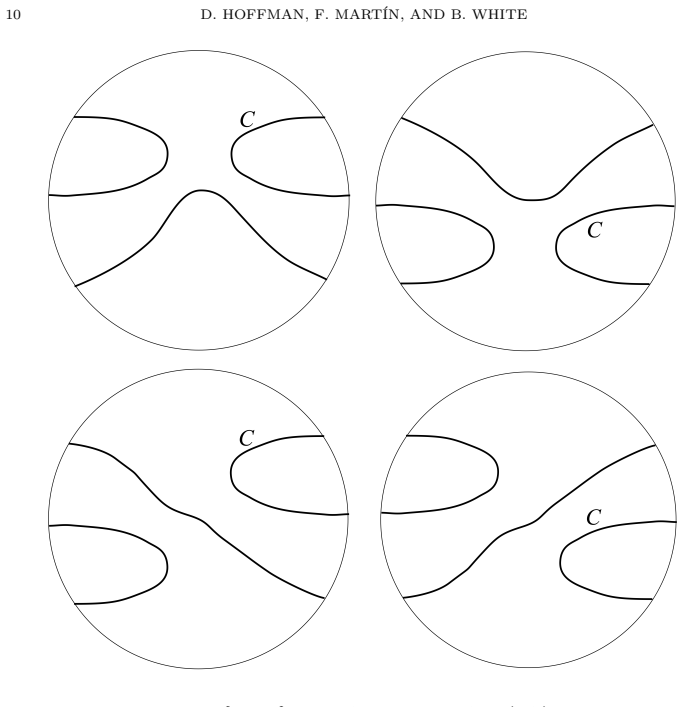
We investigate complete non-orientable minimal surfaces of finite total curvature in $\mathbb{R}^3$ such that their ends are foliated by closed lines of curvature. This condition on the ends is necessary if they have a piece inside some Euclidean ball that is free boundary. It turns out this is a rigid situation, and we are able to show, among further obstructions, that there are no such surfaces with one end.
Canonical parameters reduce the usual seven-function data to a PDE system on three functions, with local existence and uniqueness up to isom
abstractclick to expand
Marginally trapped surfaces are spacelike surfaces in the Minkowski space whose mean curvature vector is lightlike at each point. In general, the marginally trapped surfaces are determined by seven functions satisfying several conditions (differential equations). In the present paper, we introduce special principal parameters, called canonical, and prove that every marginally trapped surface of general type admits (at least locally) canonical principal parameters which allow us to reduce the number functions. We prove a Fundamental existence and uniqueness theorem formulated in terms of canonical parameters, which states that every marginally trapped surface is determined up to a motion by three smooth functions satisfying a system of partial differential equations.
The asymptotics hold in higher dimensions and for reducible singular fibers through uniform potential-theoretic estimates.
abstractclick to expand
We derive the exact asymptotic rates of the small eigenvalues of the Laplacian on one-parameter degenerations of compact K\"ahler manifolds equipped with induced background metrics. This generalizes a recent result of Dai and Yoshikawa to higher dimensions. To achieve this, we combine Li's uniform Skoda inequality with the method of auxiliary Monge-Amp\`ere equations, introduced by Guo--Phong--Song--Sturm--Tong and adapted by Guedj--T\^o. As an application, we establish estimates for degenerations of compact K\"ahler manifolds with reducible singular fibers.
When the Dirac current vanishes on a manifold of dimension three or higher, the geometry must be that of real hyperbolic space; otherwise a
abstractclick to expand
A non-trivial spinor field $\psi$ is called a generalized imaginary $\mathrm{Spin}^c$-Killing spinor if $\nabla^{g,A} _X \psi = i\mu X \cdot \psi$ for all vector fields $X$, where $\mu$ is a real function that is not identically zero and $\nabla^{g,A}$ is the $\mathrm{Spin}^c$ Levi-Civita connection with $\mathrm{U}(1)$-connection $A$. Associated with $\psi$ is a vector field $V$, the Dirac current, defined by $g(V,X) = i \langle X\cdot \psi, \psi \rangle$. We prove that if $V$ vanishes somewhere and $\operatorname{dim} M \geq 3$, the manifold is locally isometric to real hyperbolic space. When $V$ never vanishes and $\operatorname{dim} M \geq 3$, we obtain a global geometric description of all $\mathrm{Spin}^c$-Riemannian manifolds carrying such spinors, under the assumption that either the normalized Dirac current $\xi = \frac{V}{|V|}$ is complete or the leaves of $\mathcal{D} = \ker(\xi^\flat)$ are complete. Finally, we reinterpret the case of type~I generalized imaginary $\mathrm{Spin}^c$-Killing spinors in terms of parallel spinors for a suitable connection with vectorial torsion.
We provide a rigorous construction of I.M. Singer's universal connection, a natural connection on a bundle of paths associated to any manifold, using the theory of diffeology. Furthermore, we generalize the universal connection to the diffeological setting, which enables the reconstruction of diffeological principal bundles with connections from their holonomy representations. We show that any two diffeological bundle-connection pairs with conjugate holonomy representations must be equivalent in a certain sense. These constructions are functorial in that, ultimately, our results can be summarized as an equivalence of categories between the so-called holonomy category and the category of diffeological bundle-connection pairs.
The groupoid of circle maps smooth except at n points carries a nontrivial central extension recovering the classical Virasoro group for the
abstractclick to expand
We study homeomorphisms of the circle that are smooth diffeomorphisms away from a finite set of $n$ points. These "broken diffeomorphisms" do not form a Lie group, but instead naturally assemble into a Lie groupoid. We construct an explicit nontrivial $n$-dimensional central extension of this groupoid, which restricts to the classical Virasoro group when confined to smooth diffeomorphisms. We further describe the associated "broken Virasoro" algebroid, defined as a nontrivial $n$-dimensional central extension of the Lie algebroid of vector fields on the circle that are smooth except at $n$ points. This construction generalizes the Virasoro algebra.
As a byproduct, we analyze a related setting on an interval: we construct a nontrivial central extension of the Lie algebra of vector fields vanishing at the endpoints, together with the corresponding central extension of the group of diffeomorphisms fixing the endpoints. We also describe the associated Lie algebroid and groupoid obtained by allowing the endpoints to vary.
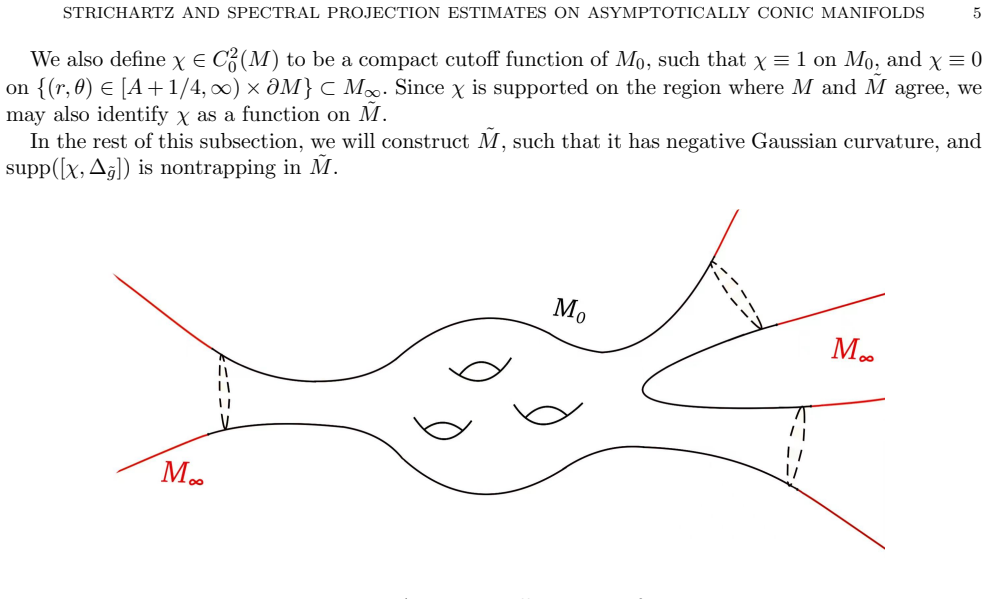
We prove the lossless unit interval Strichartz theorem on asymptotically conic surfaces, assuming that a large enough neighborhood of its trapped set has negative curvature.
We also prove the spectral projection theorem on surfaces with Euclidean ends and nonpositive curvature, assuming a large enough neighborhood of its trapped set has negative curvature. We also discuss the spectral projection theorem on asymptotically Euclidean manifolds with dimension greater than or equal to 3, assuming some local smoothing estimates.
If this quantity tends to zero at high energy, eigenvalue counts match phase-space volume without bounded geometry or doubling assumptions.
abstractclick to expand
We establish a criterion for the validity of the classical (non-semiclassical) Weyl law for Schr\"odinger operators $ H=\Delta+V $ on complete Riemannian manifolds. In contrast to existing results, our approach does not rely on standard geometric assumptions such as bounded geometry, nor on analytic assumptions such as the doubling condition on the potential. Instead, we identify a geometric-analytic invariant that encodes the precise balance between the geometry of the manifold, the growth of $V$, and the oscillation scale of $V$. This intrinsic quantity, denoted $c_{\delta}(\lambda)$ admits effective quantitative estimates. We prove that the Weyl asymptotic holds provided $\lim_{\lambda\to\infty} c_\delta(\lambda)=0 .$ The sharpness of this criterion is demonstrated through explicit examples showing that the Weyl law can fail when the criterion is violated.
For costs that are strictly convex functions of geodesic distance, the averaged measure stays absolutely continuous whenever every input is.
abstractclick to expand
Consider a complete Riemannian manifold $(M, g)$ and optimal transport problems on it with cost functions of the form $c(x,y) = h(d_{{g}}(x,y))$. We study the absolute continuity of the corresponding generalized Wasserstein barycenters of finitely many marginal measures. For general strictly convex profiles $h$ lacking $\mathcal{C}^2$-smoothness, such as $h(d)= d^p / p$ with $1 < p < 2$ that defines the $p$-Wasserstein space, the singularity at $d=0$ prevents the barycenter from inheriting absolute continuity from a single marginal measure as the quadratic case. To overcome this singularity, recent Euclidean results necessitate the absolute continuity of all marginals. Building upon the approximation framework toward absolute continuity in arXiv:2310.13832, we extend the Euclidean advancements to the manifold setting. Stripping away the implicit reliance on flat translational symmetry and local coordinate calculations of their Euclidean proofs, our work handles the singularity in a geometrically transparent way, revealing the precise analytic condition on the cost profile that governs the necessary assumptions.
Complete smooth minimal immersions in Euclidean space have matching density bounds in every dimension and codimension, extending curvature控制
abstractclick to expand
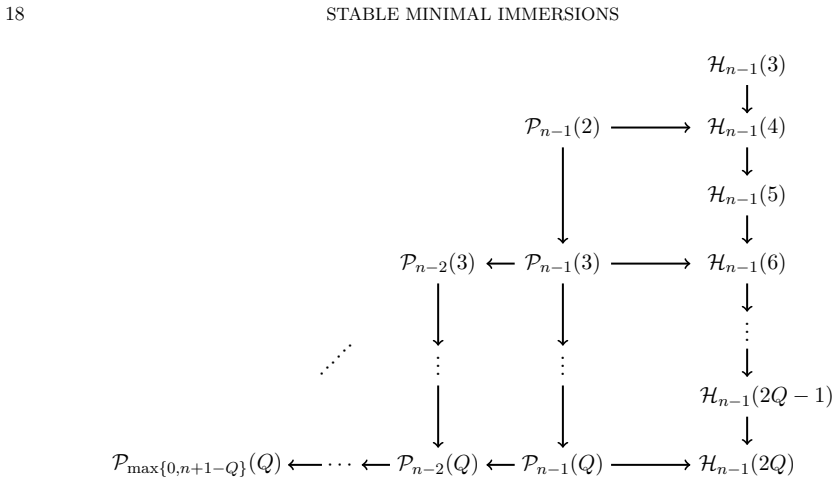
We show that intrinsic and extrinsic area density bounds are equivalent, with matching asymptotic values, for complete, connected, smooth minimal immersions $i:\Sigma^d\to\mathbb{R}^N$ of any dimension and codimension. Combining our results with a recent breakthrough by Bellettini, we extend the Schoen--Simon--Yau curvature estimates for smoothly immersed, two-sided, stable minimal hypersurfaces $i:\Sigma^n\to\mathbb{R}^{n+1}$ with bounded intrinsic area density to the missing case $n=6$, which had remained open since.
A factor-of-two equality connects two versions of heat dispersion for Lipschitz conductors inside compact Riemannian spaces.
abstractclick to expand
Given a Lipschitz conductor $K$ in the smooth compact Riemannian $2\le n$-manifold $(M,g)$, such a half generic heat dispersion law
$$
{\rm H^d}_{p,\varPhi,\varPsi}(K,M)=2^{-1} {\rm H^d}_{\Delta_p,\varPhi,\varPsi}(K,M) $$ is not only newly-established via Theorem 1.1 but also deeply-explored through not only Proposition 3.1 (a comparison law for the generic heat dispersion) but also Proposition 3.2 (a recycling law for the quasilinear Laplace-Robin eigenvalue).
This produces Fenchel-Borsuk-Chern-Lashof and Willmore-Chen type inequalities for closed submanifolds in noncompact manifolds with Euclidean
abstractclick to expand
Inspired by the work of Cordero-Erausquin, McCann and Schmuckenschl\"ager [{\it Invent. Math.,} 2001], we derive an explicit expression for the Jacobian determinant of the normal exponential map on a submanifold, establishing a relationship with its ambient counterpart. This formula leads to a new comparison theorem which is closely related to the comparison theorem of Heintze-Karcher [{\it Ann. Sci. \'Ecole Norm. Sup.,} 1978] and the esitimate of Brendle [{\it Comm. Pure Appl. Math.,} 2023]. As applications, inspired by Wang [{\it Ann. Fac. Sci. Toulouse Math.,} 2023] (and hence also by Heintze-Karcher), we obtain a Fenchel-Borsuk-Chern-Lashof-type inequality and a Willmore-Chen-type inequality on closed submanifolds in complete noncompact manifolds with nonnegative curvature and Euclidean volume growth.
An ansatz adjusts G2-structures and gauge data on nilmanifolds and 3-Sasakian spaces while leaving the metric unchanged.
abstractclick to expand
In this note, we construct new solutions to the heterotic $\mathrm{G}_2$-system with non-abelian gauge group, both compact and non-compact, on certain $2$-step nilmanifolds and $3$-Sasakian manifolds. Our approach is based on an ansatz that allows us to vary both the $\mathrm{G}_2$-structure and the gauge data while keeping the underlying metric and orientation fixed. This leads, in particular, to distinct isometric solutions on the same manifold but with different gauge groups, and in some cases the resulting connection coincides with the characteristic connection of the $\mathrm{G}_2$-structure. We also investigate an $S^1$-invariant construction that yields further isometric solutions and with varying cosmological constant. Our results recover and extend several known examples solving the heterotic $\mathrm{G}_2$-system within a unified framework.
The Ruh-Vilms theorem extends from Euclidean space to flat geometries that include torsion.
abstractclick to expand
A well-known theorem by Ruh and Vilms states that the Laplacian of the Gauss map for a smooth immersion into Euclidean space is given by the covariant derivative of the mean curvature vector field. For hypersurfaces, this implies that the Gauss map is harmonic iff the mean curvature is constant. In this paper, we extend this result to hypersurfaces in Weitzenb\"ock geometry. While Riemannian geometry corresponds to the curved geometry without torsion, Weitzenb\"ock geometry is a flat geometry with torsion. They represent two opposite extremes of Riemann-Cartan geometry.
Curvature formulas involving base Riemannian curvature and skewness tensor yield necessary and sufficient conditions for constant sectional,
abstractclick to expand
In this paper, we investigate the geometry of the tangent bundle $TM$ of a statistical manifold $(M,g,\nabla)$ endowed with a two-parameter family of generalized Cheeger--Gromoll metrics $g_{p,q}$. We compute the associated the Levi--Civita connection $\nabla^{p,q}$ and express its curvature in terms of the Riemannian curvature and the skewness tensor $K$ of the base statistical manifold.
We further analyze the behavior of geodesics, identify conditions under which the fibers of $TM$ are totally geodesic, and determine when the geodesic flow associated with $g_{p,q}$ is incompressible. Moreover, we establish necessary and sufficient conditions for the tangent bundle to admit constant sectional curvature. Several examples are provided to illustrate the theory, including statistically deformed Euclidean spaces and information geometric models such as the manifold of normal distributions. The sectional curvature of $(TM, g_{p,q})$ is computed for horizontal, vertical, and mixed directions, leading to a concise expression for the corresponding scalar curvature.
Critical points on the quotient yield full trajectories by quadratures and obey the scaling analogue of the Lagrange-Poincaré equations.
abstractclick to expand
In this paper we show that a variational reduction procedure can be defined for Lagrangian systems subject to scaling symmetries (i.e. Lagrangian systems defined by a homogenous Lagrangian function), in such a way that the trajectories of the system can be reconstructed up to quadratures from the critical points of the reduced variational principle. Also, we characterize the mentioned critical points in terms of a set of ordinary differential equations which are the scaling analogue of the Lagrange-Poincar\'e equations. Finally, we study if the homogeneous Lagrangian systems are naturally related or not with the Herglotz variational principle.
This extends Sharma's work and yields triviality results under sign conditions on the parameters.
abstractclick to expand
In this paper, we study generalized $m$-quasi-Einstein $(M^n,g,X,\lambda)$ under natural conditions on the potential vector field. We show that, under suitable integral assumptions, the potential vector field is Killing, extending earlier results of Sharma to the generalized setting. Moreover, we show that divergence-free vector fields are Killing in this context, and we derive consequences under sign conditions on $m$ and $\lambda$, including triviality results.
We also revisit a recent theorem of Ghosh \cite{ghosh}, discuss a subtle issue in the argument, and provide a new formulation and proof. Finally, we establish rigidity results for manifolds with geodesic potential vector fields.
On closed manifolds with Y1>0 and Y2>0 the infimum is attained by a conformal metric solving the constant σ2 curvature equation.
abstractclick to expand
In this paper we revisit the $\sigma_k$-Yamabe problem on $M^n$, namely, finding a conformal metric with constant $\sigma_k$-scalar curvature. We prove that on a closed manifold $\left(M,\left[g_0\right]\right)$ with positive Yamabe constant $Y_1\left(M,\left[g_0\right]\right)>0$, the $\sigma_2$-Yamabe constant
$$ Y_2\left(M,\left[g_0\right]\right):=\inf _{g \in\left[g_0\right], R_g>0} \frac{\int_M \sigma_2(g) d \operatorname{vol}(g)}{\operatorname{vol}(g)^{\frac{n-4}{n}}} $$
is achieved by a conformal metric $g \in\left[g_0\right]$, which in particular solves the $\sigma_2$-Yamabe problem, assuming $Y_2\left(M,\left[g_0\right]\right)>0$. As a consequence, for any $\left(M, g_0\right)$ with $Y_1\left(M,\left[g_0\right]\right)>$ 0 and $Y_2\left(M,\left[g_0\right]\right)>0$ one has
$$ \inf _{g \in\left[g_0\right], R_g>0} \frac{\int_M \sigma_2(g) d \operatorname{vol}(g)}{\operatorname{vol}(g)^{\frac{n-4}{n}}}=\inf _{g \in\left[g_0\right], R_g>0, \sigma_2(g)>0} \frac{\int_M \sigma_2(g) d \operatorname{vol}(g)}{\operatorname{vol}(g)^{\frac{n-4}{n}}} . $$
We also show that these conclusions can fail if the condition $R_g>0$ is removed.
We study the spectrum of the Hodge-Laplacian on $1$-forms for left-invariant metrics on the Lie group $\operatorname{SU}(2) \cong S^3$ and its quotient $\operatorname{SO}(3)\cong P^3(\mathbb{R})$. To the best of our knowledge, we provide the first explicit computation of the full spectrum of the Hodge-Laplacian for a canonical variation by determining the eigenvalues of Berger 3-spheres and analyzing their resulting splitting behavior. Furthermore, we propose and rigorously prove an explicit formula for the first eigenvalue of general homogeneous metrics on $\operatorname{SU}(2)$ and $\operatorname{SO}(3)$. The formal proof of this result was autonomously discovered by an advanced AI model, providing a notable case study for AI-driven mathematical research. Finally, leveraging this explicit formula, we apply these spectral results to the inverse problem, showing that the spectrum on $1$-forms determines the metric up to isometry. The source code for the symbolic computations, visualizations, and a Monte Carlo stress test is provided in the electronic supplementary material [He26].
We show that if $M^n$ is a properly immersed, two-sided, stable minimal hypersurface in $B^{n+1}_1(0)\setminus S$, where $S$ is closed with $\mathcal{H}^{n-2}(S)=0$, then $\text{dim}_{\mathcal{H}}\text{sing}(M)\leq n-7$, namely $\overline{M}\cap B^{n+1}_1(0)$ is represented by a smooth minimal immersion outside a closed set of generally unavoidable singularities which has Hausdorff dimension at most $n-7$. This provides the optimal a priori size assumption on the non-immersed singular set in order to guarantee optimal regularity. Consequently, such objects form a compact class under mass upper bounds.
The construction holds for every convex f whose derivative stays between two positive constants.
abstractclick to expand
We generalize Angenent's shrinking tori \cite{Angenent1992} to minimal $n$-dimensional tori embedded in $\mathbb{R}^{n+1}$ equipped with the metric $$g=e^{-\frac{f(\sum^{n+1}_{i=1}x_{i}^{2})}{2n}}\sum^{n+1}_{i=1}dx^{2}_{i},$$ where $f$ is a convex function and $f'$ is bounded above and below by positive constants.
Geometric variation of the full SM action on hyperbolic spacetimes produces a tensor whose sign properties can be tested against classicalGR
abstractclick to expand
The Standard Model of elementary particle physics is one of the most successful models of contemporary physics, its predictions being in full agreement with experiments. In this manuscript we consider the Lagrangian of the Standard Model as a geometric variational problem on a globally hyperbolic manifold and derive the associated energy-momentum tensor in a geometric invariant way. As an application, we investigate the validity of various energy conditions that arise in general relativity.
In products of hyperbolic surfaces the number of fixed-genus k examples up to area A has explicit leading term from the Mirzakhani function,
abstractclick to expand
We show that for $k>1$ the number of genus $k$ minimal Lagrangians with area at most $A$ in a product of hyperbolic surfaces grows on the order of $A^{6(k-1)}$, with an explicit leading constant given in terms of the Mirzakhani function. We also prove rigidity of the Lagrangian area spectrum, and obtain analogous counting results for products of a higher genus surface with a circle.
Weighted L2 cohomology yields vanishing results and a full Hodge theorem for a large class of these manifolds.
abstractclick to expand
This paper proves several topological results for smooth gradient Ricci shrinkers. We establish upper bounds for the Betti numbers, a vanishing theorem for cohomology, and a dichotomy for the number of ends. We also prove a full Hodge theorem for a large class of shrinkers. The methods are based on weighted $L^2$ cohomology and extend to self-shrinkers of the mean curvature flow.
A variation method yields the equivalence without assuming finite total curvature or completeness.
abstractclick to expand
We prove that a (branched) minimal immersion from $\mathbb{C}$ to $\mathbb{R}^n$ is stable if and only if it lives in an even dimensional affine subspace and is holomorphic for some orthogonal complex structure on the subspace. More generally, we prove that the same result holds for a class of genus $0$ surfaces that can have infinite total curvature. This contributes to an inquiry initiated by Micallef, who previously proved the equivalence in genus $0$ assuming completeness and finite total curvature. As a corollary, we prove a holomorphicity result for covering stable minimal surfaces of genus $0$ and $1$, recovering a theorem of Fraser and Schoen as a particular case.
Our approach is new, based on a method of constructing variations developed by the first named author and Markovi\'c. For unstable surfaces, we get explicit destabilizations and destabilization radii that can be read from the Weierstrass-Enneper data.
Upper bound is uniform across all genera and a positive lower bound holds on Gothen components.
abstractclick to expand
We study the volume of maximal representations from a surface group into $\mathrm{SO}_0(2,3)$. We show that it is bounded from above, uniformly in the genus of the surface. We also prove that on the Gothen components, it is bounded from below by a strictly positive constant.
Non-left-invariant complex structures on this solvmanifold support balanced metrics while ruling out strong Kähler with torsion ones.
abstractclick to expand
We investigate the existence of strong K\"ahler with torsion metrics along deformations of the Iwasawa manifold and of the holomorphically parallelizable Nakamura manifold. We also show that the class of deformations of the holomorphically parallelizable Nakamura manifold yielding a non-left-invariant complex structure admits a balanced metric but does not admit any strong K\"ahler with torsion metric. We then construct the Kuranishi space of a $4$-dimensional holomorphically parallelizable solvmanifold and study whether small deformations of such a manifold admit SKT metrics. Finally, we provide some results concerning the existence of metrics satisfying $\partial \bar{\partial} \omega = 0$, $\partial \bar{\partial} \omega^2 = 0$ on a particular class of $2$-step nilpotent nilmanifolds.
Stable stationary harmonic maps into compact simple Lie groups (excluding Sp(n) for n≥8, E8, F4, G2) have singular sets of Hausdorff…
abstractclick to expand
Let $M$ be a compact Riemannian manifold, and let $G$ be a compact simple Lie group with bi-invariant metric that is not $\operatorname{Sp}(n)$ for $n \geq 8$, $E_{8}$, $F_{4}$, or $G_{2}$. We show that the singular set of any stable stationary harmonic map $u : M \to G$ has Hausdorff codimension at least four. We also find examples of maps into these manifolds with codimension four singularities to show that we cannot reduce the dimension of the singular set any further.
In Euclidean space, the generalised Minkowski problem asks, for a given finite Radon measure $\mu$ on the unit sphere $\mathbb{S}^d$, to find a compact convex set $K$ with area measure $\mu$. For convex sets in the Minkowski space invariant under an affine deformation of a uniform lattice of $\mathrm{SO}_0(d,1)$, the analogous Minkowski problem was considered and solved by Barbot--B\'eguin--Zeghib (partially) and Bonsante--Fillastre. By a theorem of Mess--Barbot--Bonsante, that also solves the Minkowski problem in flat Lorentzian spacetimes with compact hyperbolic Cauchy surface.
We consider convex domains of the oriented real affine space $\mathbb{R}^{d+1}$ which are invariant under a subgroup of affine transformations obtained by adding translation parts to a discrete subgroup of $\mathrm{SL} (\mathbb{R}^{d+1})$ dividing a convex cone. We prove that those convex domains satisfy a local Steiner Formula, allowing to introduce natural area measures and define an affine invariant Minkowski problem. We then solve that Minkowski problem through a variational method using the convexity of a covolume functional. We also give an interpretation of those results in some "affine spacetimes", which were introduced by the author in a preceding work.
Non-holomorphic complete codimension-two examples appear in odd-dimensional complex and quaternionic spaces and their hyperbolic duals.
abstractclick to expand
In this work we construct non-holomorphic, complete and minimal submanifolds of the odd-dimensional complex projective spaces $\cn P^{2n-1}$ and their dual complex hyperbolic spaces $\cn H^{2n-1}$. We then provide complete minimal submanifolds of the quaternionic projective spaces $\hn P^{n-1}$ and their dual quaternionic hyperbolic spaces $\hn H^{n-1}$. All the constructed minimal submanifolds are of codimension two. Our main tools are complex-valued harmonic morphisms from the above mentioned ambient spaces.
Complex-valued maps produce complete codimension-two submanifolds in complex and quaternionic spaces of constant curvature.
abstractclick to expand
In this work we construct non-holomorphic, complete and minimal submanifolds of the odd-dimensional complex projective spaces $\cn P^{2n-1}$ and their dual complex hyperbolic spaces $\cn H^{2n-1}$. We then provide complete minimal submanifolds of the quaternionic projective spaces $\hn P^{n-1}$ and their dual quaternionic hyperbolic spaces $\hn H^{n-1}$. All the constructed minimal submanifolds are of codimension two. Our main tools are complex-valued harmonic morphisms from the above mentioned ambient spaces.
Rotationally symmetric maps from balls to spheres solve the r-energy equation for select n and prove unstable, with biharmonic and tri-hormo
abstractclick to expand
The main aim of this paper is to prove the existence of certain proper weakly $r$-harmonic ($ES-r$-harmonic) maps. We construct critical points which belong to a family of rotationally symmetric maps $\varphi_a : B^n \to \mathbb{S}^n$, where $B^n$ and $\mathbb{S}^n$ denote the Euclidean $n$-dimensional unit ball and sphere respectively. We find that the existence of solutions within this family is restricted to specific dimensions $n$. Next, we prove that our critical points are \textit{unstable}. In the course of this analysis we point out some specific differences between the $r$-harmonic and the $ES-r$-harmonic cases when $r \geq 4$. Next, we analyse two variants of the problem. First, we replace the target manifold $\mathbb{S}^n$ with a rotationally symmetric ellipsoid $E^n(b)$ and establish the existence of proper weakly biharmonic maps for all $n \geq 5$, as well as proper weakly triharmonic maps for all $n \geq 7$. Finally, we study a similar problem replacing the domain $B^n$ with a suitable warped product manifold.
The bijection yields a stacky Gauss lemma and a smooth Palais isotopy theorem for proper Lie groupoids
abstractclick to expand
Using Morita type stratifications, we establish a one-to-one correspondence between geometric vector fields on a separated differentiable stack and stratified vector fields on its orbit space. This correspondence enables us to derive a stacky version of the generalized Gauss lemma and to prove a smooth version of Palais' covering isotopy theorem for a class of proper Lie groupoids, thereby extending the classical result for proper Lie group actions.
Nearly 1-Lipschitz surjective maps with converging volumes ensure the limit inherits the lower bound.
abstractclick to expand
We show that scalar curvature lower bounds are preserved under certain weak convergence of smooth three manifolds to a smooth limit. More precisely, suppose that $M_k$ and $M$ are smooth, closed, Riemannian three manifolds. Assume that there are smooth, surjective, $\lambda_k$-Lipschitz maps $f_k\colon M_k \to M$ and that $\text{Vol}(M_k)\to \text{Vol}(M)$ and $\lambda_k\to 1$. Then if each $M_k$ has scalar curvature bounded below by $\kappa$ so does $M$. This result answers questions of Gromov, Sormani, Allen, and others. The proof relies on a delicate comparison between $\mu$-bubbles in $M_k$ and $\mu$-bubbles in $M$.
Complete simply-connected examples are classified by combining compact, semisimple and nilpotent geometries.
abstractclick to expand
We investigate Bismut--Ambrose--Singer (BAS) manifolds, namely Hermitian manifolds whose Bismut connection has parallel torsion and parallel curvature. We first establish a canonical reduction theorem for complete, simply-connected BAS manifolds. We then classify simply-connected BAS manifolds in the three fundamental homogeneous settings: the compact case, the non-compact semisimple case, and the nilpotent case. Building on this, we construct BAS manifolds in which these three geometries are combined, generalizing all previously known examples. Finally we classify complete, simply-connected, pluriclosed BAS manifolds.
Riemannian geometry provides the fundamental framework for optimization on nonlinear spaces such as matrix manifolds, which arise in machine learning, signal processing, and robotics. While the underlying theory is classical, existing literature often presents results at a high level of abstraction, omitting the detailed coordinate-level derivations required for implementation and algorithm development.
This work provides a self-contained and rigorous treatment of the foundations of Riemannian geometry, with a focus on explicit derivations tailored to Riemannian optimization. We systematically develop the key geometric structures -- including tangent and cotangent spaces, tensor calculus, metric tensors, Levi-Civita connections, curvature, and geodesics -- emphasizing step-by-step derivations in coordinates and matrix form.
Building on these foundations, we derive the Riemannian gradient, Hessian, exponential map, and retraction in a form suitable for numerical computation. We further specialize these constructions to important matrix manifolds, including the Stiefel, Grassmann, and SPD (Symmetric Positive Definite) manifolds, providing explicit formulas widely used in optimization and geometric machine learning.
This monograph develops a unified and implementation-oriented treatment of Riemannian geometry for optimization on manifolds. Its main contribution is the systematic organization and detailed derivation of classical geometric constructions in forms directly usable for algorithm design and numerical implementation. By connecting coordinate-level differential geometry with matrix-manifold formulas, the monograph bridges the gap between abstract theory and practical computation, and provides a reference for researchers and practitioners working in Riemannian optimization and related fields.
The conditions yield torus fibrations and explicit SYZ mirrors that are not diffeomorphic.
abstractclick to expand
We determine purely algebraic equations to identify \textit{SLags} generated by invariant distributions in a class of non-K\"ahler Calabi-Yau manifolds. We determine SLag distributions, determine which leaves integrate to compact submanifolds and study the deformation theory, which we find to be unobstructed. We apply our results to the Iwasawa manifold, the completely solvable 6-dimensional Nakamura manifold and the complex parallelizable Nakamura manifold. Through these examples we find families of topologically distinct \textit{SLags}, including the existence of SLag torus fibrations. Following the proposal of Lau-Tseng-Yau, we compute the non-K\"ahler SYZ mirrors of Nakamura manifolds, together with their refined symplectic Bott-Chern cohomologies. As a consequence, we find the existence of semi-flat non-K\"ahler mirror pairs which are not diffeomorphic.
The principle yields helical motif families and twist-grain-boundary models in lamellar systems.
abstractclick to expand
We study harmonic surfaces in $\mathbb{R}^3$ through the framework of harmonic Enneper immersions and prove a superposition principle for such surfaces. We prove that minimal and maximal surfaces admit a decomposition into harmonic components. Applications include the construction of finite and infinite configurations of helical motifs, an asymptotic analysis via multipole expansions, and the modelling of twist grain boundary phases in lamellar systems.
Reductions via constant fiber-length and varying-length ansatze show stationary points require flat connections on scalar-flat bases.
abstractclick to expand
In this paper, we study critical points and gradient flows of the $G_2$--Hilbert functional on a manifolds with free $\mathbb S^1$--actions. We analyze $\mathbb S^1$--invariant $G_2$--structures under the constant fiber-length non-K\"ahler transverse ansatz, reducing the variational problem to the $6$--dimensional quotient and we also consider a Gibbons--Hawking-type ansatz with varying fiber length and derive the formal negative $L^2$--gradient flow. We conclude that the unnormalized flow admits only trivial stationary configurations: flat connection, scalar-flat base metric, and constant fiber length.
Hölder and Sobolev spaces on compact sets suffice to prove existence and to equate two descriptions of the model space.
abstractclick to expand
We prove the existence of a Ricci flat metric on the Kummer K3 surface. The proof follows the general strategy of Donaldson's gluing construction. However, we tackle the analysis without appealing to weighted norms or conformal transformations to model spaces, instead relying solely on compact elliptic theory on usual H\"older and Sobolev spaces. As the Eguchi-Hanson space plays a central role in the construction, we also present and compare different descriptions of this space, showing explicitly that it is isometric to a suitable Gibbons-Hawking ansatz.
 full image