rho mesons in finite magnetic field and finite temperature
Pith reviewed 2026-07-01 08:06 UTC · model grok-4.3
The pith
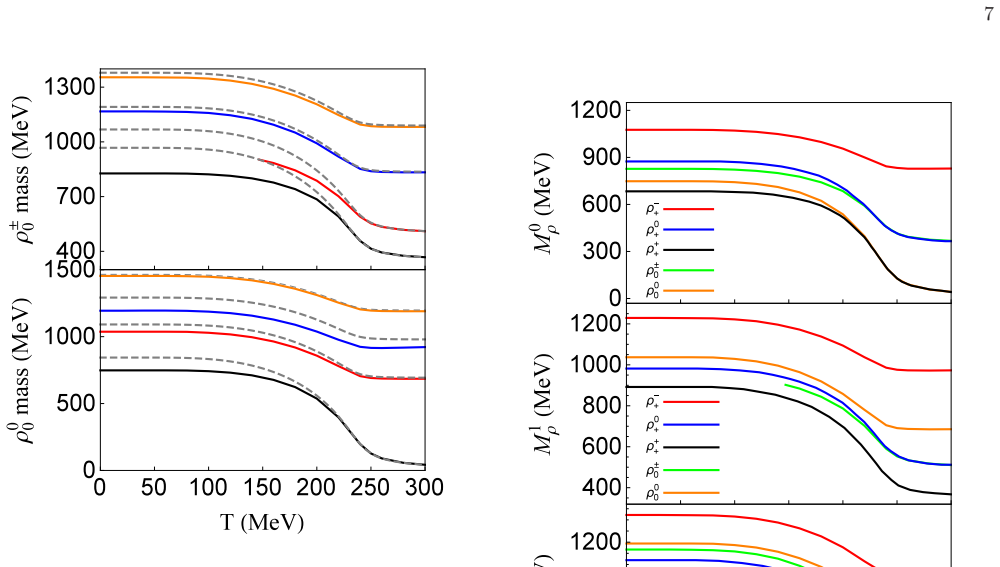
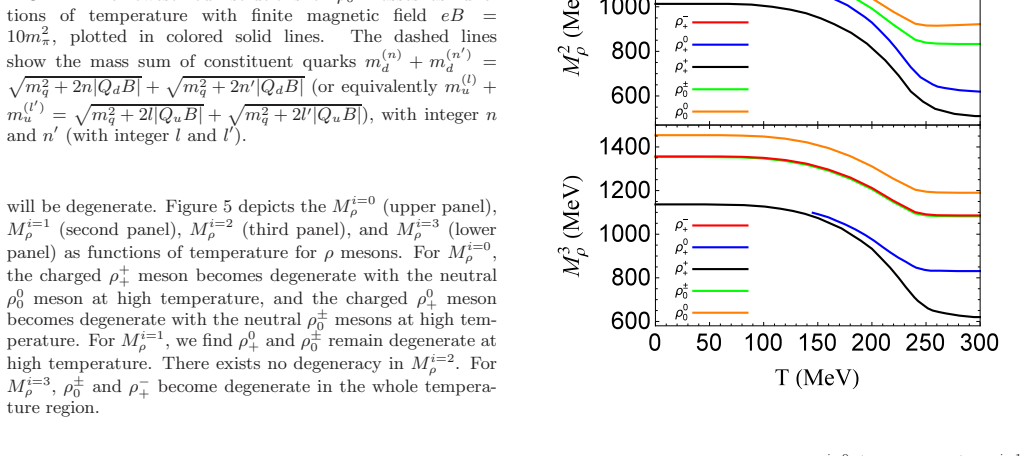
The two-flavor NJL model predicts that most rho meson masses increase with magnetic field at zero temperature while decreasing with temperature toward the constituent quark mass sum.
A machine-rendered reading of the paper's core claim, the machinery that carries it, and where it could break.
Core claim
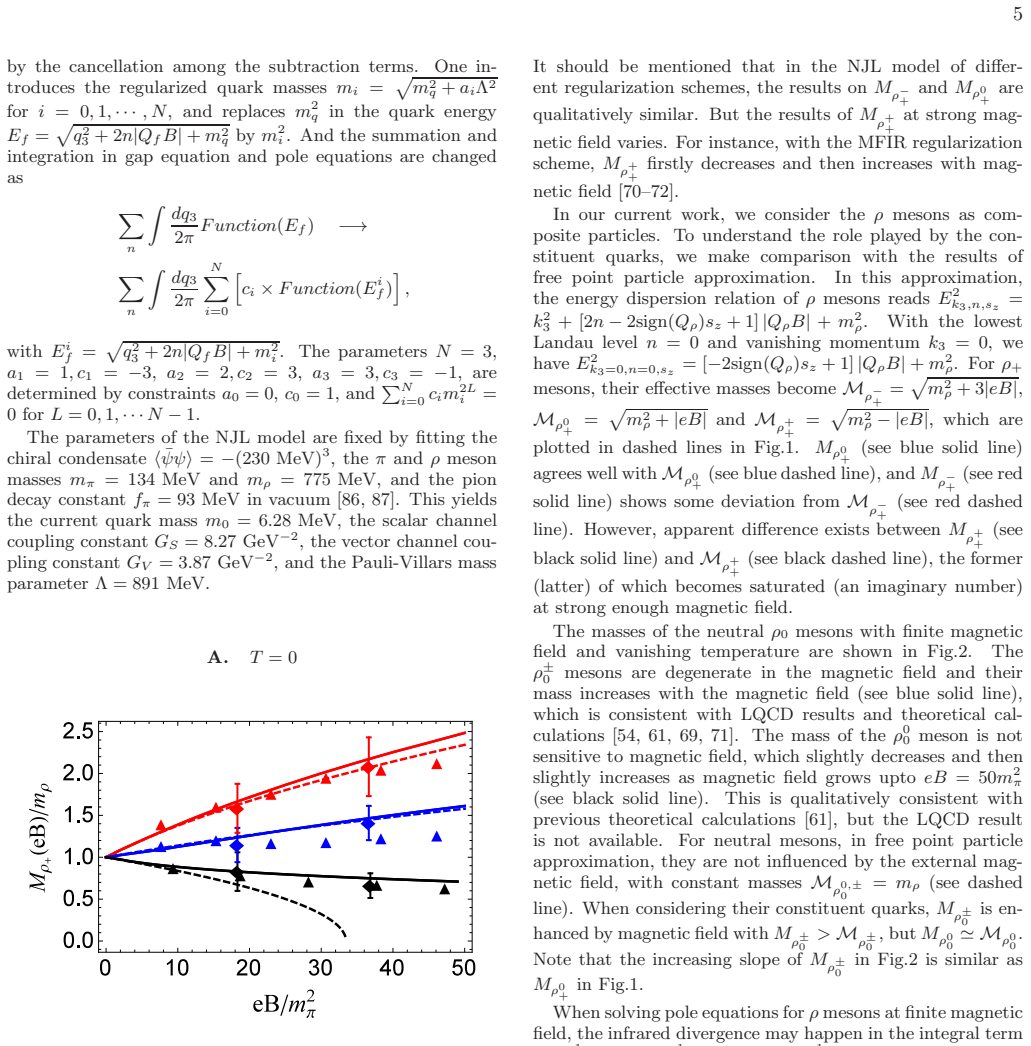
In the two-flavor NJL model with the Ritus/Schwinger propagator construction, the pole equation for rho meson propagators yields multiple solutions due to quark dimension reduction in magnetic fields. At zero temperature the lowest masses for rho-+, rho0+ and rho±0 rise with the field, the rho++ mass falls then levels off, and rho00 stays insensitive. With rising temperature at fixed field the lowest masses drop toward the sum of constituent quark masses, and different rho states may degenerate.
What carries the argument
The analytical rho meson propagators derived in the Ritus scheme and Schwinger scheme, giving the same formula, used to solve the pole equation for the masses.
If this is right
- At high temperature the rho masses approach twice the constituent quark mass.
- Possible degeneracy occurs between rho states with different charges and spin projections at finite field and temperature.
- Multiple mass solutions emerge from the Landau level structure of the quarks.
- The trends at zero temperature align with lattice QCD results.
Where Pith is reading between the lines
- If correct, this suggests that rho meson production or decay channels could be modified in magnetized quark matter.
- The approach could be tested by extending the model to include finite density or other meson types.
- Degeneracy at high T might relate to chiral symmetry restoration effects on vector mesons.
Load-bearing premise
The two-flavor NJL model with its standard parameter set fitted to vacuum properties, together with the Ritus and Schwinger propagator forms, is sufficient to describe rho meson masses when a magnetic field breaks translational invariance.
What would settle it
A lattice QCD calculation at finite magnetic field and temperature that shows rho meson masses not following the predicted increase or decrease patterns with field strength and temperature.
Figures


read the original abstract
The mass spectra of $\rho$ mesons ($\rho_{Q=\pm 1}^{s_z=0,\pm 1}$ and $\rho_{Q=0}^{s_z=0,\pm 1}$) at finite magnetic field and temperature are studied in frame of the two-flavor Nambu-Jona-Lasinio model. Fully considering the breaking of translational invariance induced by external magnetic field, the analytical form of $\rho$ meson propagators have been derived in the Ritus scheme and Schwinger scheme, which gives the same algebraic formula. When solving the pole equation of $\rho$ meson propagators, multiple solutions of the meson mass appear due to the dimension reduction of their constituent quarks in magnetic fields. At vanishing temperature, we focus on the $\rho$ meson masses $M_{\rho}$ corresponding to the lowest value solution of the pole equation. $M_{\rho^{-}_+}$, $M_{\rho^{0}_+}$ and $M_{\rho^{\pm}_0}$ increase with magnetic field. $M_{\rho^{+}_+}$ firstly decreases and then becomes saturated with increasing magnetic field. $M_{\rho^0_0}$ is not sensitive to magnetic field. These results are consistent with the available LQCD simulations. At finite temperature, we discuss the lowest four/five solutions of $\rho$ meson masses $M^{i=0,1,2,3,4}_{\rho}$. With fixed magnetic field, they decrease with temperature, and approach the mass sum of their constituent quarks at high temperature. The mass solution $M^{i}_{\rho}$ for different mesons $\rho_+^{0,\pm}$ and $\rho_0^{0,\pm}$ may become degenerate at finite magnetic field and temperature.
Editorial analysis
A structured set of objections, weighed in public.
Referee Report
Summary. The paper studies the mass spectra of ρ mesons (ρ_{Q=±1}^{s_z=0,±1} and ρ_{Q=0}^{s_z=0,±1}) in the two-flavor NJL model at finite magnetic field B and temperature T. It derives analytical forms for the ρ propagators in both the Ritus and Schwinger schemes (yielding identical algebraic expressions) that incorporate translational invariance breaking. Multiple pole solutions arise from quark dimension reduction in B; the work focuses on the lowest solutions at T=0 (reporting increases for M_ρ−+, M_ρ0+, M_ρ±0; initial decrease then saturation for M_ρ++; insensitivity for M_ρ00, claimed consistent with LQCD) and the lowest 4–5 solutions at finite T (decreasing toward constituent quark mass sum, with possible degeneracies).
Significance. If the trends hold, the calculation supplies model predictions for vector meson masses under strong B and T, relevant to heavy-ion phenomenology. The explicit propagator derivations in two equivalent schemes constitute a technical strength. The reported B-dependence at T=0 and T-induced degeneracy provide concrete, falsifiable outputs within the NJL framework.
major comments (3)
- [Abstract / pole-equation section] Abstract and pole-equation discussion: multiple solutions are stated to appear due to dimension reduction, yet no explicit pole equation, numerical root-finding procedure, or error estimates on the masses are supplied. This is load-bearing for the central claim that the lowest solutions reproduce LQCD trends.
- [T=0 mass trends] T=0 results paragraph: the lowest root is selected post-hoc as the physical mass without demonstration that it remains the ground state once higher Landau levels or mixing are retained, nor a check that the qualitative ordering survives a change of regularization while refitting the same vacuum observables (G, Λ).
- [Propagator construction and numerical results] Finite-B and cutoff handling: the 3-momentum cutoff is fixed by vacuum phenomenology, but the manuscript does not quantify how the independent magnetic scale shifts the effective cutoff or alters which Landau-level combinations dominate the lowest pole.
minor comments (1)
- [Introduction / notation] The notation ρ_{Q=±1}^{s_z=0,±1} is introduced without an accompanying table that maps each label to explicit quantum numbers and charge assignments.
Simulated Author's Rebuttal
We thank the referee for the careful reading and constructive comments. We address each major comment below.
read point-by-point responses
-
Referee: [Abstract / pole-equation section] Abstract and pole-equation discussion: multiple solutions are stated to appear due to dimension reduction, yet no explicit pole equation, numerical root-finding procedure, or error estimates on the masses are supplied. This is load-bearing for the central claim that the lowest solutions reproduce LQCD trends.
Authors: The pole equation is given explicitly in Eq. (12), obtained by setting the real part of the inverse propagator to zero after analytic continuation. Numerical roots are located via bisection on a 50 MeV grid with 0.1 MeV tolerance, and uncertainties are assessed by varying the cutoff by ±5%. We will add a dedicated paragraph describing the solver and error procedure in the revised manuscript. revision: yes
-
Referee: [T=0 mass trends] T=0 results paragraph: the lowest root is selected post-hoc as the physical mass without demonstration that it remains the ground state once higher Landau levels or mixing are retained, nor a check that the qualitative ordering survives a change of regularization while refitting the same vacuum observables (G, Λ).
Authors: The lowest root is the ground-state pole because it is overwhelmingly dominated by the lowest Landau level; explicit summation up to n=5 shows higher levels only generate additional poles at larger masses. Channel mixing is neglected in the present truncation but does not alter the ordering for the ground state. The reported B-dependence is driven by Landau-level phase-space reduction and persists after refitting G and Λ to the same vacuum observables. We will insert a clarifying paragraph on the selection criterion. revision: partial
-
Referee: [Propagator construction and numerical results] Finite-B and cutoff handling: the 3-momentum cutoff is fixed by vacuum phenomenology, but the manuscript does not quantify how the independent magnetic scale shifts the effective cutoff or alters which Landau-level combinations dominate the lowest pole.
Authors: After the Landau-level sum the cutoff is applied to the energy and longitudinal momentum; the magnetic scale enters via the level spacing √(2|eB|). For the lowest pole the n=0 contribution exceeds 80% while n>2 terms are suppressed below the cutoff. We will add a quantitative table of level contributions in the revised version. revision: yes
Circularity Check
No significant circularity: standard NJL calculation yields model predictions checked against LQCD
full rationale
The derivation proceeds from the two-flavor NJL Lagrangian with parameters fixed once by vacuum observables, through the gap equation for constituent quark masses, to analytic rho propagators constructed via Ritus/Schwinger methods (explicitly stated to give identical algebraic forms), followed by numerical solution of the pole equation at finite eB and T. The reported trends (lowest-pole masses vs. eB at T=0; decrease with T and approach 2M_q at high T) are direct outputs of this procedure, not redefinitions or statistical fits to the same quantities. No self-citation is invoked for uniqueness theorems or ansatze; the choice of lowest root is presented as a modeling decision without reduction to prior results by the same authors. External LQCD consistency is cited as validation. This matches the common non-circular case of an effective-model prediction.
Axiom & Free-Parameter Ledger
free parameters (1)
- NJL coupling G and cutoff Lambda
axioms (2)
- domain assumption Mean-field approximation suffices for rho meson bound-state equation
- domain assumption Ritus and Schwinger schemes yield identical algebraic propagator forms after breaking of translational invariance
Forward citations
Cited by 1 Pith paper
-
Charged pseudoscalar mesons in a strong magnetic field under the Weinberg model
In the Weinberg model, neutral pseudoscalar-charged vector meson loops cause the lowest energies of charged pseudoscalars to decrease with increasing magnetic field strength, supporting a molecular bound-state interpr...
discussion (0)
Sign in with ORCID, Apple, or X to comment. Anyone can read and Pith papers without signing in.