Charged pseudoscalar mesons in a strong magnetic field under the Weinberg model
Pith reviewed 2026-07-01 02:57 UTC · model grok-4.3
The pith
In the Weinberg model, neutral pseudoscalar-charged vector loops cause the lowest energies of charged pions and kaons to decrease with increasing magnetic field strength.
A machine-rendered reading of the paper's core claim, the machinery that carries it, and where it could break.
Core claim
Incorporating modifications from neutral pseudoscalar-charged vector loops in the Weinberg model makes the lowest energies of π± and K± decrease with stronger magnetic fields in both lowest- and full-Landau-level calculations. This outcome holds even though the quasiparticle picture predicts an increase. The results back the conjecture that a charged pseudoscalar meson behaves as a molecular bound state of a neutral pseudoscalar meson and a charged vector meson in the strong magnetic field regime, in contrast to quark-antiquark descriptions used in models such as the NJL model.
What carries the argument
Neutral pseudoscalar-charged vector meson loops that modify the charged pseudoscalar propagator within the Weinberg model.
If this is right
- The lowest energies of both π± and K± decrease with rising magnetic field strength.
- Instabilities appear under fixed coupling when the model is adjusted to match lattice peak structures.
- Charged pseudoscalars are better described as molecular bound states than as quark-antiquark pairs.
- The same loop mechanism applies across both lowest-Landau-level and full-Landau-level regimes.
Where Pith is reading between the lines
- The molecular bound-state picture may alter predictions for meson decay widths or scattering lengths in magnetic fields compared with standard quark models.
- Similar loop corrections could be examined in other effective theories that include vector mesons to test consistency with the energy decrease.
- Lattice simulations that resolve the internal structure of the charged mesons at strong fields could distinguish molecular from quark-antiquark configurations.
Load-bearing premise
A fixed mesonic coupling constant can be retained while still reproducing the lattice peak structures without instabilities.
What would settle it
A calculation in the Weinberg model that includes the neutral pseudoscalar-charged vector loops yet finds the lowest energies rising with magnetic field strength, or a stable reproduction of the observed peaks with fixed coupling.
Figures

read the original abstract
Recent lattice QCD simulations have further validated their earlier unusual findings: The lowest energies of charged pseudoscalar mesons $\pi^\pm$ and $K^\pm$ decrease at stronger magnetic field, though quasiparticle approximation assumes an increasing feature. We address this long-standing puzzle by employing the chiral effective Weinberg model, in which pseudoscalar and vector mesons exhibit intrinsic mutual couplings. Under this framework, charged pseudoscalar mesons deviate from pure quasiparticle behavior due to their interactions with neutral pseudoscalar and charged vector mesons. By incorporating the modifications induced by neutral pseudoscalar-charged vector loops, we demonstrate that the lowest energies of $\pi^\pm$ and $K^\pm$ indeed decrease at stronger magnetic field in both the lowest- and full-Landau-level calculations. However, instabilities emerge under a fixed mesonic coupling constant, and appear unavoidable when attempting to reproduce the observed peak structures. In contrast to the quark-antiquark meson description in models such as the NJL model, our results support the conjecture that a charged pseudoscalar meson could effectively form a molecular bound state of a neutral pseudoscalar meson and a charged vector meson in the strong magnetic field regime.
Editorial analysis
A structured set of objections, weighed in public.
Referee Report
Summary. The paper employs the Weinberg chiral effective model to study charged pseudoscalar mesons (π± and K±) in strong magnetic fields. It incorporates loop corrections from neutral pseudoscalar–charged vector meson interactions and reports that the lowest energies decrease with increasing B-field strength in both lowest-Landau-level and full-Landau-level calculations. This is presented as resolving a discrepancy with quasiparticle expectations and lattice results, while supporting a molecular bound-state interpretation (neutral pseudoscalar + charged vector) rather than a simple quark-antiquark picture. The abstract explicitly notes that a fixed mesonic coupling produces instabilities that appear unavoidable when attempting to reproduce the lattice peak structures.
Significance. If the central result on energy decrease can be placed on a controlled footing, the work would provide a concrete effective-theory mechanism for the lattice-observed decrease in charged-meson energies and would lend support to molecular interpretations of mesons in strong fields. The explicit acknowledgment of instabilities under fixed coupling, however, limits the immediate impact until that tension is resolved.
major comments (2)
- [Abstract] Abstract: The central claim that neutral-PS–charged-vector loops produce a decreasing lowest energy rests on a fixed mesonic coupling constant. The same paragraph states that instabilities emerge under this fixed coupling and “appear unavoidable when attempting to reproduce the observed peak structures.” Because the lattice data the model aims to explain consist precisely of those peak structures, the reported energy decrease cannot be made consistent with the data without the instabilities the authors themselves flag. This is a load-bearing internal inconsistency for the conjecture.
- [Abstract / main results] The manuscript does not provide an explicit demonstration that the energy decrease survives when the coupling is allowed to vary in a manner that removes the instabilities while still matching the lattice peaks. Without such a controlled comparison (e.g., a scan of the coupling or an alternative regularization), the support for the molecular bound-state picture remains conditional on an unresolved parameter choice.
minor comments (1)
- Notation for Landau levels and the precise definition of the “lowest energy” (pole position versus real part of the propagator) should be stated unambiguously in the main text.
Simulated Author's Rebuttal
We thank the referee for the careful reading and constructive comments on our manuscript. We respond point by point to the major comments below.
read point-by-point responses
-
Referee: [Abstract] Abstract: The central claim that neutral-PS–charged-vector loops produce a decreasing lowest energy rests on a fixed mesonic coupling constant. The same paragraph states that instabilities emerge under this fixed coupling and “appear unavoidable when attempting to reproduce the observed peak structures.” Because the lattice data the model aims to explain consist precisely of those peak structures, the reported energy decrease cannot be made consistent with the data without the instabilities the authors themselves flag. This is a load-bearing internal inconsistency for the conjecture.
Authors: The abstract presents both findings transparently: the loop corrections from neutral pseudoscalar–charged vector interactions produce a decrease in the lowest energies of charged pseudoscalars under the fixed coupling of the Weinberg model, while instabilities appear when the same fixed coupling is used to match the lattice peak structures. The explicit calculations in the manuscript (lowest-Landau-level and full-Landau-level) demonstrate that the loop mechanism reverses the quasiparticle trend, aligning with the direction of the lattice results. We view the instabilities as a limitation of the fixed-coupling effective theory rather than an inconsistency that invalidates the molecular bound-state conjecture; the decrease itself is a direct consequence of the loops and supports the interpretation even if quantitative reproduction of peaks requires further model development. revision: no
-
Referee: [Abstract / main results] The manuscript does not provide an explicit demonstration that the energy decrease survives when the coupling is allowed to vary in a manner that removes the instabilities while still matching the lattice peaks. Without such a controlled comparison (e.g., a scan of the coupling or an alternative regularization), the support for the molecular bound-state picture remains conditional on an unresolved parameter choice.
Authors: We agree that an explicit scan over coupling strength or alternative regularization would provide a more controlled test. The current work is restricted to the fixed-coupling Weinberg model as stated, where the energy decrease is shown to arise from the loops. We will add a brief discussion of this limitation and outline possible extensions (such as a coupling scan) in the revised manuscript to clarify the conditional nature of the support for the molecular picture. revision: yes
Circularity Check
No significant circularity detected
full rationale
The paper's central demonstration—that neutral pseudoscalar-charged vector loops in the Weinberg model cause the lowest energies of π± and K± to decrease with stronger B, in both LLL and full LL regimes—arises from explicit incorporation of those loop modifications into the model's equations. This is presented as a calculational outcome, not a redefinition or statistical fit of the target quantity itself. The abstract flags instabilities under fixed coupling when matching lattice peak structures, but this is an acknowledged limitation rather than evidence that the energy decrease reduces to its own inputs by construction. No self-citations, uniqueness theorems, or ansatz smuggling appear in the provided text, and the derivation remains independent of the target lattice result.
Axiom & Free-Parameter Ledger
free parameters (1)
- mesonic coupling constant
axioms (1)
- domain assumption Chiral effective theory framework of the Weinberg model with mutual pseudoscalar-vector couplings holds in strong magnetic fields
invented entities (1)
-
molecular bound state of neutral pseudoscalar and charged vector meson
no independent evidence
Reference graph
Works this paper leans on
-
[1]
, 7) the Gell-Mann matrices
with λ i(i = 1 , . . . , 7) the Gell-Mann matrices. The interaction terms are effectively the same as that when we introduc e the vector mesons as handed or handless SU (3) gauge fields in the flavor space [42]. As the lowest energies of charged pseudoscalars increase with mag netic field when the latter is not large [33], the contributions from exchanging ne...
-
[2]
9 tanh eB Λ ) (blue solid for π ± and red dotted for K ± ) and g2 ρ 2(eB) = 6
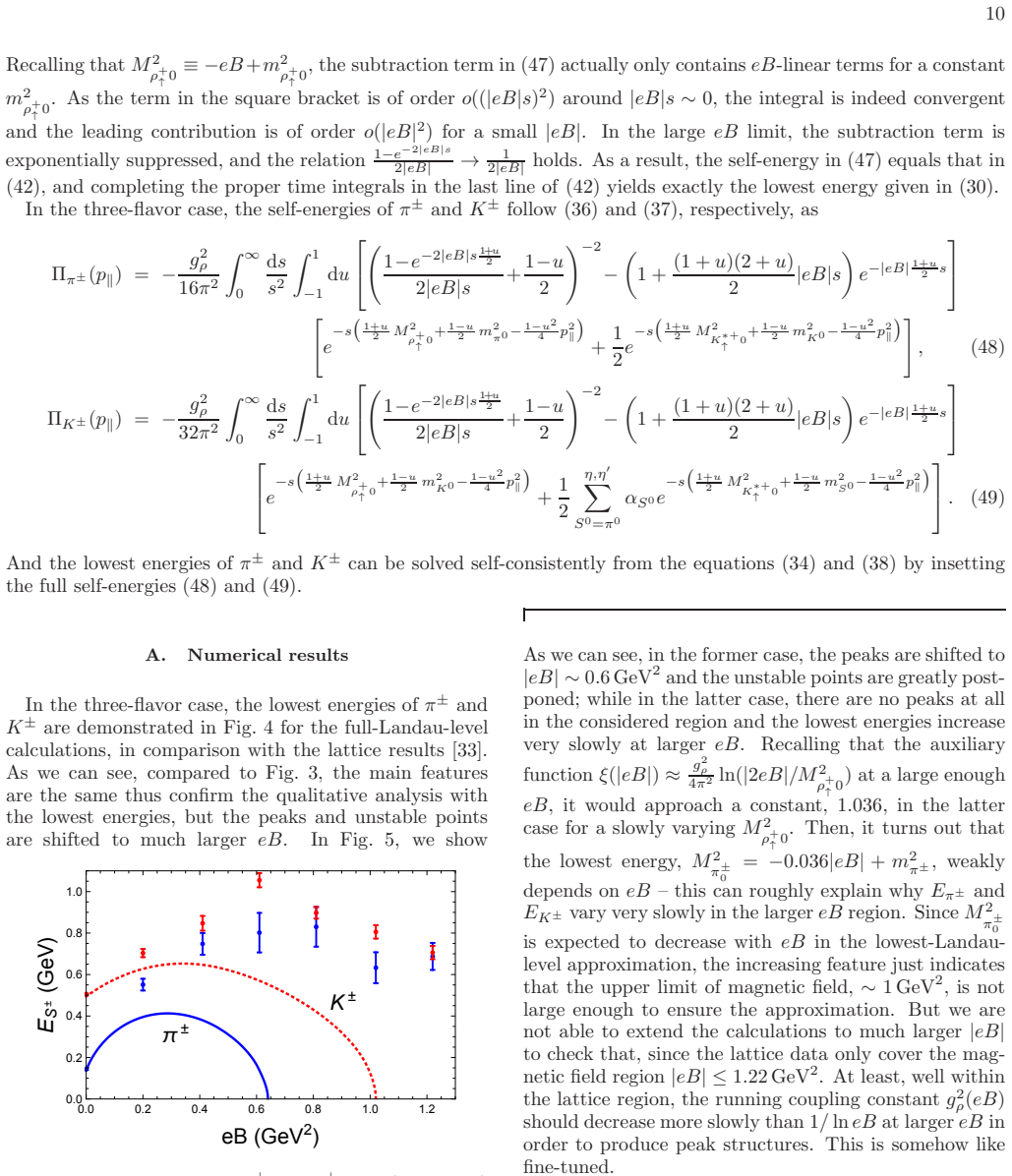
072/ (1 + 0. 9 tanh eB Λ ) (blue solid for π ± and red dotted for K ± ) and g2 ρ 2(eB) = 6 . 072/ (1 + 0. 9 ln(1 + eB Λ )) (cyan dashed for π ± and pink dashdotted for K ± ) with Λ = 0 . 3 GeV2. The blue and red biased lattice data are for π ± and K ± , respec- tively [33]. choose to work within the two- and three-flavor Wein- berg models, where intrinsica...
-
[3]
Why does the peak structure of K ± exhibit a much steeper profile compared with that of π ± in lattice QCD simulations ? The former peak even signifi- cantly exceeds the free-particle result. This might in- dicate that the enhancement originating from quark- antiquark loops plays a critical role for charged pseu- doscalars across the peak region, which is n...
-
[4]
Since π ± or K ± superfluidity is not physically ex- pected to emerge in a pure magnetic field, this incon- sistency constitutes a severe theoretical issue
Even with a properly tuned running coupling constant, it remains impossible to simultaneously reproduce the observed peak structures and eliminate the unphysi- cal instabilities within the Weinberg model framework. Since π ± or K ± superfluidity is not physically ex- pected to emerge in a pure magnetic field, this incon- sistency constitutes a severe theore...
-
[5]
Estimate of the magnetic field strength in heavy-ion collisions,
V. Skokov, A. Y. Illarionov and V. Toneev, “Estimate of the magnetic field strength in heavy-ion collisions,” Int. J. Mod. Phys. A 24, 5925-5932 (2009)
2009
-
[6]
Event-by-event gener- ation of electromagnetic fields in heavy-ion collisions,
W. T. Deng and X. G. Huang, “Event-by-event gener- ation of electromagnetic fields in heavy-ion collisions,” Phys. Rev. C 85, 044907 (2012)
2012
-
[7]
A Review of Intense Electromagnetic Fields in Heavy-Ion Collisions: Theoretical Predictions and Ex- perimental Results,
D. Shen, J. Chen, X. G. Huang, Y. G. Ma, A. Tang and G. Wang, “A Review of Intense Electromagnetic Fields in Heavy-Ion Collisions: Theoretical Predictions and Ex- perimental Results,” Research 8, 0726 (2025)
2025
-
[8]
Anomalous transport effects and possible envi- ronmental symmetry ‘violation’ in heavy-ion collisions,
J. Liao, “Anomalous transport effects and possible envi- ronmental symmetry ‘violation’ in heavy-ion collisions,” Pramana 84, no.5, 901-926 (2015)
2015
-
[9]
Topology, magnetic field, and strongly interacting matter,
D. E. Kharzeev, “Topology, magnetic field, and strongly interacting matter,” Ann. Rev. Nucl. Part. Sci. 65, 0000 (2015)
2015
-
[10]
Electromagnetic fields and anomalous transports in heavy-ion collisions — A pedagogical re- view,
X. G. Huang, “Electromagnetic fields and anomalous transports in heavy-ion collisions — A pedagogical re- view,” Rept. Prog. Phys. 79, no. 7, 076302 (2016)
2016
-
[11]
Elec- tromagnetic fields in ultra-peripheral relativistic heavy - ion collisions,
J. Zhao, J. H. Chen, X. G. Huang and Y. G. Ma, “Elec- tromagnetic fields in ultra-peripheral relativistic heavy - ion collisions,” Nucl. Sci. Tech. 35, no.2, 20 (2024) doi:10.1007/s41365-024-01374-9 [arXiv:2211.03968 [nuc l- th]]
-
[12]
Global Λ polarization in heavy-ion collisions from a transport model,
H. Li, L. G. Pang, Q. Wang and X. L. Xia, “Global Λ polarization in heavy-ion collisions from a transport model,” Phys. Rev. C 96, no.5, 054908 (2017)
2017
-
[13]
Spin Hydrodynamic Gen- eration in the Charged Subatomic Swirl,
X. Guo, J. Liao and E. Wang, “Spin Hydrodynamic Gen- eration in the Charged Subatomic Swirl,” Sci. Rep. 10, no.1, 2196 (2020)
2020
-
[14]
Global Λ-hyperon po- larization in Au+Au collisions at √ sN N=3 GeV,
M. S. Abdallah et al. [STAR], “Global Λ-hyperon po- larization in Au+Au collisions at √ sN N=3 GeV,” Phys. Rev. C 104, no.6, L061901 (2021)
2021
-
[15]
Global polarization of Λ and Λ /macron.ts1hyperons in Au+Au collisions at sNN=19.6 and 27 GeV,
M. I. Abdulhamid et al. [STAR], “Global polarization of Λ and Λ /macron.ts1hyperons in Au+Au collisions at sNN=19.6 and 27 GeV,” Phys. Rev. C 108, no.1, 014910 (2023)
2023
-
[16]
Quantifying the strength of magnetic fields using baryon electric charge correlation,
X. G. Huang, “Quantifying the strength of magnetic fields using baryon electric charge correlation,” Nucl. Sci . Tech. 35, no.8, 138 (2024)
2024
-
[17]
Observation of the electromagnetic field effect via charge-dependent directed flow in heavy-ion collisions at the Relativistic Heavy Ion Collider,
M. I. Abdulhamid et al. [STAR], “Observation of the electromagnetic field effect via charge-dependent directed flow in heavy-ion collisions at the Relativistic Heavy Ion Collider,” Phys. Rev. X 14, no.1, 011028 (2024)
2024
-
[18]
The QCD phase diagram for external magnetic fields,
G. S. Bali, F. Bruckmann, G. Endrodi, Z. Fodor, S. D. Katz, S. Krieg, A. Schafer and K. K. Szabo, “The QCD phase diagram for external magnetic fields,” JHEP 02, 044 (2012)
2012
-
[19]
QCD quark condensate in ex- ternal magnetic fields,
G. S. Bali, F. Bruckmann, G. Endrodi, Z. Fodor, S. D. Katz and A. Schafer, “QCD quark condensate in ex- ternal magnetic fields,” Phys. Rev. D 86, 071502 (2012)
2012
-
[20]
Quark Anti- screening at Strong Magnetic Field and Inverse Magnetic Catalysis,
E. J. Ferrer, V. de la Incera and X. J. Wen, “Quark Anti- screening at Strong Magnetic Field and Inverse Magnetic Catalysis,” Phys. Rev. D 91, no.5, 054006 (2015)
2015
-
[21]
Recent progresses on QCD phases in a strong magnetic field: views from Nambu–Jona-Lasinio model,
G. Cao, “Recent progresses on QCD phases in a strong magnetic field: views from Nambu–Jona-Lasinio model,” Eur. Phys. J. A 57, no.9, 264 (2021)
2021
-
[22]
The Nambu-Jona-Lasinio model of quantum chromodynamics,
S. P. Klevansky, “The Nambu-Jona-Lasinio model of quantum chromodynamics,” Rev. Mod. Phys. 64, 649- 708 (1992)
1992
-
[23]
Dimensional reduction and dynamical chiral symmetry breaking by a magnetic field in (3+1)-dimensions,
V. P. Gusynin, V. A. Miransky and I. A. Shovkovy, “Dimensional reduction and dynamical chiral symmetry breaking by a magnetic field in (3+1)-dimensions,” Phys. Lett. B 349, 477-483 (1995)
1995
-
[24]
Quantum field the- ory in a magnetic field: From quantum chromodynamics to graphene and Dirac semimetals,
V. A. Miransky and I. A. Shovkovy, “Quantum field the- ory in a magnetic field: From quantum chromodynamics to graphene and Dirac semimetals,” Phys. Rept. 576, 1-209 (2015)
2015
-
[25]
Superconductivity of QCD vacuum in strong magnetic field,
M. N. Chernodub, “Superconductivity of QCD vacuum in strong magnetic field,” Phys. Rev. D 82, 085011 (2010)
2010
-
[26]
Charged vector mesons in a strong magnetic field,
Y. Hidaka and A. Yamamoto, “Charged vector mesons in a strong magnetic field,” Phys. Rev. D 87, no.9, 094502 (2013)
2013
-
[27]
Meson masses in electromagnetic fields with Wilson fermions,
G. S. Bali, B. B. Brandt, G. Endr˝ odi and B. Gl¨ aßle, “Meson masses in electromagnetic fields with Wilson fermions,” Phys. Rev. D 97, no.3, 034505 (2018)
2018
-
[28]
Magnetic catalysis effect prevents vacuum su- perconductivity in strong magnetic fields,
G. Cao, “Magnetic catalysis effect prevents vacuum su- perconductivity in strong magnetic fields,” Phys. Rev. D 100, no.7, 074024 (2019)
2019
-
[29]
$\rho$ mesons in finite magnetic field and finite temperature
Z. Liu, M. Zhou, Y. Tian, R. Zhou, G. Shao and S. Mao, “ρ mesons in finite magnetic field and finite tempera- ture,” [arXiv:2605.00561 [nucl-th]]
work page internal anchor Pith review Pith/arXiv arXiv
-
[30]
Pion Condensation by Rotation in a Magnetic field,
Y. Liu and I. Zahed, “Pion Condensation by Rotation in a Magnetic field,” Phys. Rev. Lett. 120, no.3, 032001 (2018)
2018
-
[31]
Rotation induced charged pion con- densation in a strong magnetic field: A Nambu–Jona- Lasino model study,
G. Cao and L. He, “Rotation induced charged pion con- densation in a strong magnetic field: A Nambu–Jona- Lasino model study,” Phys. Rev. D 100, no.9, 094015 (2019)
2019
-
[32]
Do charged- pions condense in a magnetic field with rotation?,
H. L. Chen, X. G. Huang and K. Mameda, “Do charged- pions condense in a magnetic field with rotation?,” JHEP 02, 216 (2024)
2024
-
[33]
Charged rho superconductor in the presence of magnetic field and rotation,
G. Cao, “Charged rho superconductor in the presence of magnetic field and rotation,” Eur. Phys. J. C 81, no.2, 148 (2021)
2021
-
[34]
Effects of chiral imbalance and magnetic field on pion superfluidity and color supercon- ductivity,
G. Cao and P. Zhuang, “Effects of chiral imbalance and magnetic field on pion superfluidity and color supercon- ductivity,” Phys. Rev. D 92, no.10, 105030 (2015)
2015
-
[35]
QCD phase transition at finite isospin density and magnetic field
C. Ke and G. Cao, “QCD phase transition at finite isospin density and magnetic field,” [arXiv:2603.01061 [nucl-th]]
work page internal anchor Pith review Pith/arXiv arXiv
-
[36]
Chiral properties of (2+1)-flavor QCD in strong magnetic fields at zero temperature,
H. T. Ding, S. T. Li, A. Tomiya, X. D. Wang and Y. Zhang, “Chiral properties of (2+1)-flavor QCD in strong magnetic fields at zero temperature,” Phys. Rev. D 104, no.1, 014505 (2021)
2021
-
[37]
Chiral properties of (2+1)- flavor QCD in magnetic fields at zero temperature,
H. T. Ding and D. Zhang, “Chiral properties of (2+1)- flavor QCD in magnetic fields at zero temperature,” Phys. Rev. D 113, no.9, 094503 (2026)
2026
-
[38]
pion-rho Mixing as a mechanism for non-monotonic charged pion behavior in magnetic fields
Z. Wang, “pion-rho Mixing as a mechanism for non- monotonic charged pion behavior in magnetic fields,” [arXiv:2602.15410 [hep-ph]]
work page internal anchor Pith review Pith/arXiv arXiv
-
[39]
T. Kojo, “Meson molecules in strong magnetic fields: non-monotonic evolution of the charged pion and kaon energies,” [arXiv:2606.14017 [hep-ph]]
-
[40]
Nonlinear realizations of chiral symmet ry,
S. Weinberg, “Nonlinear realizations of chiral symmet ry,” Phys. Rev. 166, 1568 (1968)
1968
-
[41]
Phenomenological Lagrangians,
S. Weinberg, “Phenomenological Lagrangians,” Physic a A 96, no.1-2, 327-340 (1979)
1979
-
[42]
Chiral Perturbation Theor y to One Loop,
J. Gasser and H. Leutwyler, “Chiral Perturbation Theor y to One Loop,” Annals Phys. 158, 142 (1984)
1984
-
[43]
Theory of Charged Vec- tor Mesons Interacting with the Electromagnetic Field,
T. D. Lee and C. N. Yang, “Theory of Charged Vec- tor Mesons Interacting with the Electromagnetic Field,” 13 Phys. Rev. 128, 885 (1962)
1962
-
[44]
METHOD OF EIGENFUNCTIONS AND MASS OPERATOR IN QUANTUM ELECTRODY- NAMICS OF A CONSTANT FIELD,
V. I. Ritus, “METHOD OF EIGENFUNCTIONS AND MASS OPERATOR IN QUANTUM ELECTRODY- NAMICS OF A CONSTANT FIELD,” Sov. Phys. JETP 48, 788 (1978)
1978
-
[45]
Introduction to chiral perturbation theo ry,
S. Scherer, “Introduction to chiral perturbation theo ry,” Adv. Nucl. Phys. 27, 277 (2003)
2003
-
[46]
Where does the rho go? Chirally sym- metric vector mesons in the quark - gluon plasma,
R. D. Pisarski, “Where does the rho go? Chirally sym- metric vector mesons in the quark - gluon plasma,” Phys. Rev. D 52, R3773-R3776 (1995)
1995
-
[47]
Vector dominance model at finite temperature,
C. Gale and J. I. Kapusta, “Vector dominance model at finite temperature,” Nucl. Phys. B 357, 65-89 (1991)
1991
-
[48]
Dilepton emission as a novel probe of QCD critical point,
G. Cao, X. Luo and W. Fu, “Dilepton emission as a novel probe of QCD critical point,” [arXiv:2512.24646 [nucl- th]]
-
[49]
Propagators of charged particles in an external mag- netic field, expanded over Landau levels,
A. V. Kuznetsov, A. A. Okrugin and A. M. Shitova, “Propagators of charged particles in an external mag- netic field, expanded over Landau levels,” Int. J. Mod. Phys. A 30, no.24, 1550140 (2015)
2015
-
[50]
QCD phase structure at finite temperature and density,
W. j. Fu, J. M. Pawlowski and F. Rennecke, “QCD phase structure at finite temperature and density,” Phys. Rev. D 101, no.5, 054032 (2020)
2020
-
[51]
Chiral phase structure and critical end point in QCD,
F. Gao and J. M. Pawlowski, “Chiral phase structure and critical end point in QCD,” Phys. Lett. B 820, 136584 (2021)
2021
discussion (0)
Sign in with ORCID, Apple, or X to comment. Anyone can read and Pith papers without signing in.