Experimental Evidence of Fractional Entropy in Critical Kondo Systems
Pith reviewed 2026-05-09 18:49 UTC · model grok-4.3
The pith
Experiments measure fractional entropy in Kondo critical points matching non-Abelian anyon predictions.
A machine-rendered reading of the paper's core claim, the machinery that carries it, and where it could break.
Core claim
In metal-semiconductor quantum circuits realizing two-channel and three-channel Kondo critical points, the low-temperature entropy associated with the emergent anyons takes the fractional values Delta S = kB ln(sqrt(2)) and Delta S = kB ln((1 + sqrt(5))/2), respectively, consistent with theoretical predictions for a Majorana zero mode and a Fibonacci anyon.
What carries the argument
The Maxwell relation that extracts entropy from the temperature dependence of the measured island charge at the tuned Kondo critical points.
If this is right
- Thermodynamic measurements via charge provide a route to characterize non-Abelian anyons independent of transport signatures.
- The scaling dimensions extracted align with those required for protected non-local encoding in topological quantum computing.
- Critical states in multi-channel Kondo systems offer a controllable platform for studying anyonic thermodynamics.
Where Pith is reading between the lines
- Charge-based entropy extraction could be applied to other candidate anyonic platforms to test consistency across different realizations.
- The method may reduce reliance on difficult transport measurements that have so far hindered unambiguous anyon detection.
- If the fractional entropy persists under additional gating or lead configurations, it would strengthen the case for using these circuits in anyon-based information processing.
Load-bearing premise
The entropy change extracted from charge measurements is assumed to be dominated by the anyonic contribution at the critical points, with negligible interference from background or lead effects.
What would settle it
Observation of entropy values that are integer multiples of kB ln(2) or that deviate substantially from the predicted fractional amounts in the same two- and three-lead setups.
Figures


read the original abstract
Unconventional quantum states defying the ubiquitous Fermi-liquid paradigm can emerge in the presence of strong electronic correlations. Among these, non-Abelian anyons - such as Majorana zero modes and Fibonacci anyons - are of particular interest for topological quantum computing due to their non-integer quantum dimensions d>1, which allows for protected non-local encoding and processing of quantum information. However, despite considerable efforts, the unambiguous characterisation of such anyons via transport measurements has proved challenging. Instead, here we provide experimental evidence for the low-temperature fractional entropy Delta S associated with a single anyon, which directly implies its non-Abelian character through the relation Delta S = kB ln(d). This thermodynamic signature is measured in metal-semiconductor quantum circuits engineered to realize quantum-critical states from frustrated interactions. Using a micrometre-scale metallic island coupled to two or three electronic leads, we tune the system to two-channel and three-channel Kondo critical points. By measuring the island charge and exploiting a thermodynamic Maxwell relation, we estimate the entropy associated with the anyons that emerge in these critical states. Our observations reveal fractional values, exposing non-Abelian anyons. The corresponding scaling dimensions are consistent with theoretical predictions for a Majorana zero mode Delta S = kB ln(sqrt(2)) and a Fibonacci anyon Delta S = kB ln(1 +sqrt(5))/2 for two and three channels. These findings establish entropy measurements as a powerful tool for characterizing exotic quantum states.
Editorial analysis
A structured set of objections, weighed in public.
Referee Report
Summary. The manuscript reports experimental measurements of fractional entropy changes Delta S in a micrometre-scale metallic island coupled to two or three electronic leads, tuned to two-channel and three-channel Kondo critical points. By measuring the island charge Q(V_g, T) and applying a thermodynamic Maxwell relation, the authors extract entropy values that match k_B ln(sqrt(2)) for Majorana zero modes (2CK) and k_B ln((1 + sqrt(5))/2) for Fibonacci anyons (3CK), claiming this provides direct evidence of non-Abelian anyons via their quantum dimensions.
Significance. If the entropy extraction reliably isolates the anyonic contribution, this would be a significant result as it supplies a thermodynamic signature complementary to transport measurements for characterizing non-Abelian statistics. The approach of using a Maxwell relation on charge data to access fractional entropy is a strength, offering a potentially falsifiable test of theoretical predictions for the scaling dimensions without requiring direct braiding operations.
major comments (2)
- [Entropy extraction and background discussion (near the Maxwell-relation application and Fig. 3 or equivalent)] The central attribution of the observed fractional Delta S to anyons requires that lead density-of-states, charging-energy fluctuations, and non-critical Kondo channels contribute negligibly (<< 0.2 k_B) at the critical points. The manuscript states this assumption but provides no quantitative bound, subtraction protocol, or temperature-dependence analysis demonstrating suppression of these terms relative to the reported values ~0.35 k_B and ~0.48 k_B.
- [Methods and results on thermodynamic relation] The Maxwell relation converts the measured charge response into total system entropy; without an explicit error budget or control measurements (e.g., off-critical detuning or lead-only devices) showing that background terms do not shift integer/zero entropy into the observed fractions, the isolation of the anyonic Delta S = k_B ln(d) remains unverified and load-bearing for the non-Abelian claim.
minor comments (3)
- [Methods] Clarify the precise integral form of the Maxwell relation employed (e.g., whether Delta S = integral (partial Q / partial T)_V dV_g with explicit limits) and any assumptions about equilibrium or integration cutoffs.
- [Figures presenting Q(V_g, T) data] Add error bars, raw data traces, and fitting details to the charge-vs-gate-voltage plots at multiple temperatures to allow assessment of the precision of the extracted fractional values.
- [Results summary] Include a short table comparing the measured Delta S values with the exact theoretical predictions, including uncertainties, to strengthen the consistency claim.
Simulated Author's Rebuttal
We thank the referee for their careful reading and constructive comments on the entropy extraction and its attribution to anyonic contributions. We agree that explicit quantitative bounds and controls are needed to robustly isolate the fractional entropy and will incorporate these in the revision.
read point-by-point responses
-
Referee: The central attribution of the observed fractional Delta S to anyons requires that lead density-of-states, charging-energy fluctuations, and non-critical Kondo channels contribute negligibly (<< 0.2 k_B) at the critical points. The manuscript states this assumption but provides no quantitative bound, subtraction protocol, or temperature-dependence analysis demonstrating suppression of these terms relative to the reported values ~0.35 k_B and ~0.48 k_B.
Authors: We agree that the manuscript would benefit from explicit quantitative bounds on background contributions. While the original text relies on the dominance of the critical Kondo physics at the tuned points, we will add in revision a dedicated error-budget section. This will include temperature-scaling analysis, off-critical detuning data, and estimates showing that lead DOS, charging fluctuations, and non-critical channels contribute <0.1 k_B, well below the reported fractional values. revision: yes
-
Referee: The Maxwell relation converts the measured charge response into total system entropy; without an explicit error budget or control measurements (e.g., off-critical detuning or lead-only devices) showing that background terms do not shift integer/zero entropy into the observed fractions, the isolation of the anyonic Delta S = k_B ln(d) remains unverified and load-bearing for the non-Abelian claim.
Authors: We concur that an explicit error budget and control measurements are required to verify isolation of the anyonic term. In the revised manuscript we will include additional data from off-critical detuning and lead-only reference devices, together with a full propagation of uncertainties through the Maxwell relation, demonstrating that background shifts cannot produce the observed fractional entropies. revision: yes
Circularity Check
No significant circularity; entropy extraction is independent of anyonic interpretation
full rationale
The derivation proceeds by measuring island charge Q(Vg,T) as a function of gate voltage and temperature, then applying the Maxwell relation (∂S/∂Vg)T = −(∂Q/∂T)Vg to obtain the entropy change ΔS at the two- and three-channel Kondo critical points. This thermodynamic step is a direct consequence of the measured charge data and does not presuppose the value of ΔS or the anyonic character. The resulting fractional ΔS values are subsequently compared to independent theoretical predictions (kB ln√2 for Majorana, kB ln((1+√5)/2) for Fibonacci) rather than being fitted or defined to equal those numbers. No self-definitional equations, fitted-input predictions, load-bearing self-citations, or ansatz smuggling appear in the chain; the central claim rests on experimental data plus external theory comparison and is therefore self-contained against external benchmarks.
Axiom & Free-Parameter Ledger
axioms (1)
- domain assumption Entropy can be obtained from charge via a thermodynamic Maxwell relation at the Kondo critical points.
Reference graph
Works this paper leans on
-
[1]
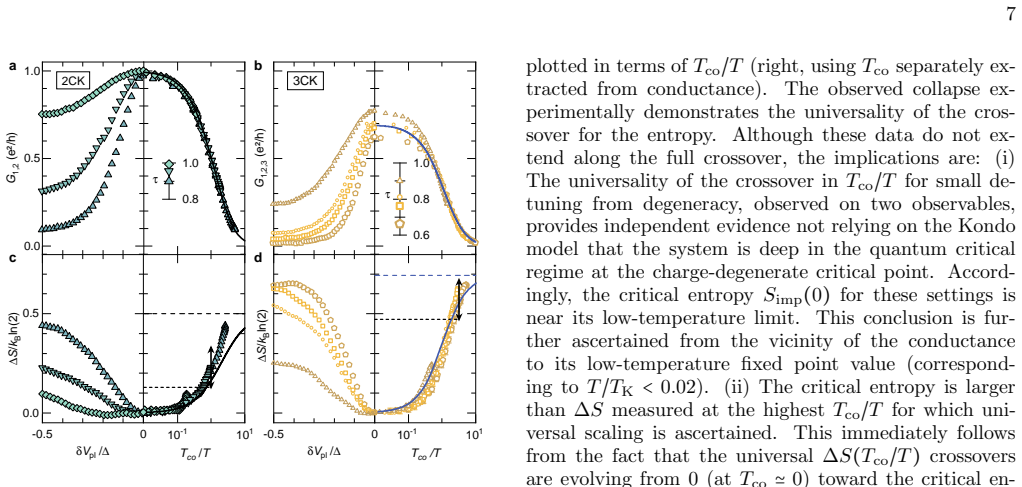
However, this is shown only as a self-consistent check; our key result for the upper bound on the critical Kondo entropy is ob- tained directly from the experimental data and does not rely on model predictions. Having obtained conservative upper bounds on the 2CK and 3CK ground state entropies by examining the universal entropy flows to their respective c...
-
[2]
Accordingly the theor- etical yellow lines in Fig. 2a are obtained from Eq. (11) fitting GSET(0, T)and using a reducedE ∗ C =28µeV. The universal evolution of the peak height due to Kondo renormalization has also been predicted in the limit of T/T K ≫1 (τ≪1) to scale as 8,42: GSET(0, T)=G τ≪1 1,2(,3)∝e2 h π2/log 2(αT/T K)(12) This asymptotic power law is ...
-
[3]
We emphasize that this procedure relies on a theoretical model that predicts Kondo criticality. Therefore, this comparison strengthen our conclusion and shows that the observed ∆Sbehavior follows theoretical predictions, but it - 0.50 .00 .5- 0.040 .000 .04- 0.50 .00 .5- 10 1 0.00 .10 .2δ V p l/Δδ G s ens / δG 1 esensa b c τ = 0.954Δ N / ΔT (K- 1)ΔS / kB ...
-
[4]
Nayak, C., Simon, S. H., Stern, A., Freedman, M. & Das Sarma, S. Non-Abelian anyons and topological quantum computation.Reviews of Modern Physics80, 1083–1159 (2008)
work page 2008
-
[5]
Yazdani, A., von Oppen, F., Halperin, B. I. & Yacoby, A. Hunting for Majoranas.Science380, eade0850 (2023)
work page 2023
-
[6]
Yang, K. & Halperin, B. I. Thermopower as a possible probe of non-Abelian quasiparticle statistics in fractional quantum Hall liquids.Physical Review B79, 115317 (2009)
work page 2009
-
[7]
Sela, E.et al.Detecting the Universal Fractional Entropy of Majorana Zero Modes.Phys. Rev. Lett.123, 147702 (2019)
work page 2019
-
[8]
Kleeorin, Y.et al.How to measure the entropy of a mesoscopic system via thermoelectric transport.Nature Communications10(2019)
work page 2019
-
[9]
Matveev, K. A. Quantum fluctuations of the charge of a metal particle under the Coulomb blockade conditions. Sov. Phys. JETP72, 892–899 (1991)
work page 1991
-
[10]
Matveev, K. A. Coulomb blockade at almost perfect transmission.Phys. Rev. B51, 1743–1751 (1995)
work page 1995
-
[11]
Iftikhar, Z.et al.Two-channel Kondo effect and renor- malization flow with macroscopic quantum charge states. Nature526, 233–236 (2015)
work page 2015
-
[12]
Iftikhar, Z.et al.Tunable quantum criticality and super- ballistic transport in a ‘charge’ Kondo circuit.Science 360, 1315–1320 (2018)
work page 2018
-
[13]
Hartman, N.et al.Direct entropy measurement in a mesoscopic quantum system.Nat. Phys.14, 1083–1086 (2018). 15
work page 2018
-
[14]
Affleck, I. & Ludwig, A. W. Universal noninteger “ground-state degeneracy” in critical quantum systems. Physical Review Letters67, 161 (1991)
work page 1991
-
[15]
Emery, V. J. & Kivelson, S. Mapping of the two-channel Kondo problem to a resonant-level model.Phys. Rev. B 46, 10812–10817 (1992)
work page 1992
-
[16]
Lopes, P. L., Affleck, I. & Sela, E. Anyons in multichannel Kondo systems.Physical Review B101, 085141 (2020)
work page 2020
-
[17]
Cooper, N. R. & Stern, A. Observable Bulk Signatures of Non-Abelian Quantum Hall States.Physical Review Letters102, 176807 (2009)
work page 2009
-
[18]
Saito, Y.et al.Isospin Pomeranchuk effect in twisted bilayer graphene.Nature592, 220–224 (2021)
work page 2021
-
[19]
Rozen, A.et al.Entropic evidence for a Pomeranchuk effect in magic-angle graphene.Nature592, 214–219 (2021)
work page 2021
-
[20]
Kitaev, A. & Preskill, J. Topological Entanglement En- tropy.Physical Review Letters96, 110404 (2006)
work page 2006
-
[21]
Fendley, P., Fisher, M. P. A. & Nayak, C. Topological Entanglement Entropy from the Holographic Partition Function.Journal of Statistical Physics126, 1111–1144 (2007)
work page 2007
- [22]
-
[23]
Rowell, E. C. & Wang, Z. Degeneracy and non-Abelian statistics.Physical Review A93, 030102 (2016)
work page 2016
-
[24]
Wilson, K. G. The renormalization group: critical phe- nomena and the Kondo problem.Rev. Mod. Phys.47, 773–840 (1975)
work page 1975
-
[25]
Impurity quantum phase transitions.Phil
Vojta, M. Impurity quantum phase transitions.Phil. Mag.86, 1807–1846 (2006)
work page 2006
-
[26]
Child, T.et al.Entropy Measurement of a Strongly Coupled Quantum Dot.Physical Review Letters129, 227702 (2022)
work page 2022
-
[27]
Adam, C.et al.Entropy Spectroscopy of a Bilayer Graphene Quantum Dot.Physical Review Letters135, 126202 (2025)
work page 2025
-
[28]
Cox, D. L. & Zawadowski, A. Exotic Kondo effects in metals: Magnetic ions in a crystalline electric field and tunnelling centres.Adv. Phys.47, 599–942 (1998)
work page 1998
-
[29]
Nozi` eres, P. & Blandin, A. Kondo effect in real metals. J. Phys.41, 193–211 (1980)
work page 1980
-
[30]
Karki, D.et al.Z3 parafermion in the double charge Kondo model.Physical Review Letters130, 146201 (2023)
work page 2023
-
[31]
Potok, R. M., Rau, I. G., Shtrikman, H., Oreg, Y. & Goldhaber-Gordon, D. Observation of the two-channel Kondo effect.Nature446, 167–171 (2007)
work page 2007
-
[32]
Keller, A. J.et al.Universal Fermi liquid crossover and quantum criticality in a mesoscopic system.Nature526, 237–240 (2015)
work page 2015
-
[33]
Mebrahtu, H.et al.Quantum phase transition in a reson- ant level coupled to interacting leads.Nature488, 61–64 (2012)
work page 2012
-
[34]
Mebrahtu, H.et al.Observation of Majorana Quantum Critical Behaviour in a Resonant Level Coupled to a Dis- sipative Environment.Nat. Phys.9, 732–737 (2013)
work page 2013
-
[35]
Pouse, W.et al.Quantum simulation of an exotic quantum critical point in a two-site charge Kondo cir- cuit.Nature Physics19, 492–499 (2023)
work page 2023
-
[36]
Coulomb Blockade of a Noisy Metallic Box: A Realization of Bose-Fermi Kondo Models.Phys
Le Hur, K. Coulomb Blockade of a Noisy Metallic Box: A Realization of Bose-Fermi Kondo Models.Phys. Rev. Lett.92, 196804 (2004)
work page 2004
-
[37]
Nguyen, T. K. T. & Kiselev, M. N. Seebeck effect on a weak link between Fermi and non-Fermi liquids.Phys. Rev. B97, 085403 (2018)
work page 2018
-
[38]
Piquard, C.et al.Observing the universal screening of a Kondo impurity.Nature Communications14, 7263 (2023)
work page 2023
-
[39]
Han, C.et al.Fractional Entropy of Multichannel Kondo Systems from Conductance-Charge Relations.Physical Review Letters128, 146803 (2022)
work page 2022
-
[40]
Cronenwett, S. M., Oosterkamp, T. H. & Kouwenhoven, L. P. A Tunable Kondo Effect in Quantum Dots.Science 281, 540–544 (1998)
work page 1998
-
[41]
Goldhaber-Gordon, D.et al.Kondo effect in a single- electron transistor.Nature391, 156–159 (1998)
work page 1998
-
[42]
Nygard, J., Cobden, D. H. & Lindelof, P. E. Kondo phys- ics in carbon nanotubes.Nature408, 342–346 (2000)
work page 2000
-
[43]
Glazman, L. I. & Raikh, M. E. Resonant Kondo trans- parency of a barrier with quasilocal impurity states. Journal of Experimental and Theoretical Physics Letters 47, 452–455 (1988)
work page 1988
-
[44]
Ng, T. K. & Lee, P. A. On-Site Coulomb Repulsion and Resonant Tunneling.Physical Review Letters61, 1768– 1771 (1988)
work page 1988
-
[45]
Furusaki, A. & Matveev, K. A. Theory of strong inelastic cotunneling.Phys. Rev. B52, 16676–16695 (1995)
work page 1995
-
[46]
Field, M.et al.Measurements of Coulomb blockade with a noninvasive voltage probe.Phys. Rev. Lett.70, 1311 (1993)
work page 1993
-
[47]
Jezouin, S.et al.Controlling charge quantization with quantum fluctuations.Nature536, 58–62 (2016)
work page 2016
-
[48]
Mitchell, A. K., Landau, L. A., Fritz, L. & Sela, E. Uni- versality and Scaling in a Charge Two-Channel Kondo Device.Phys. Rev. Lett.116, 157202 (2016)
work page 2016
-
[49]
Grabert, H. Charge fluctuations in the single-electron box: Perturbation expansion in the tunneling conduct- ance.Phys. Rev. B50, 17364–17377 (1994)
work page 1994
- [50]
- [51]
-
[52]
Affleck, I. & Ludwig, A. W. W. Exact conformal- field-theory results on the multichannel Kondo effect: Single-fermion Green’s function, self-energy, and resistiv- ity.Phys. Rev. B48, 7297–7321 (1993)
work page 1993
-
[53]
Mitchell, A. K. & Sela, E. Universal low-temperature crossover in two-channel Kondo models.Physical Review B85, 235127 (2012)
work page 2012
-
[54]
Lotem, M., Sela, E. & Goldstein, M. Manipulating Non- Abelian Anyons in a Chiral Multichannel Kondo Model. Phys. Rev. Lett.129, 227703 (2022)
work page 2022
-
[55]
Iftikhar, Z.et al.Primary thermometry triad at 6 mK in mesoscopic circuits.Nat. Commun.7, 12908 (2016)
work page 2016
-
[56]
Jezouin, S.et al.Quantum Limit of Heat Flow Across a Single Electronic Channel.Science342, 601–604 (2013)
work page 2013
-
[57]
Sriram, P.et al.Hybrid metal-semiconductor quantum dots in InAs as a platform for quantum simulation. arXiv:2504.20145(2025)
-
[58]
Nazarov, Y. V. & Blanter, Y. M.Quantum Trans- port: Introduction to Nanoscience(Cambridge Univer- sity Press, 2009)
work page 2009
-
[59]
Mitchell, A. K., Galpin, M. R., Wilson-Fletcher, S., Lo- gan, D. E. & Bulla, R. Generalized Wilson chain for 16 solving multichannel quantum impurity problems.Phys. Rev. B89, 121105 (2014)
work page 2014
-
[60]
Minarelli, E. L., Rigo, J. B. & Mitchell, A. K. Linear response quantum transport through interacting multi- orbital nanostructures.arXiv:2209.01208(2022). Acknowledgments.This work was supported by the European Research Council (ERC-2020-SyG-951451). Nan- ofabrication was done within the C2N micro nanotechnologies platform and partly supported by the Fre...
discussion (0)
Sign in with ORCID, Apple, or X to comment. Anyone can read and Pith papers without signing in.