A Novel Preprocessing-Driven Approach to Remaining Useful Life (RUL) Prediction Using Temporal Convolutional Networks (TCN)
Pith reviewed 2026-05-08 19:11 UTC · model grok-4.3
The pith
A novel preprocessing pipeline using complete temporal sequences improves accuracy and robustness of aero-engine remaining useful life predictions with temporal convolutional networks.
A machine-rendered reading of the paper's core claim, the machinery that carries it, and where it could break.
Core claim
The central claim is that applying a preprocessing pipeline which preserves complete temporal sequences and generates remaining useful life targets at each individual timestep, before feeding the data into a temporal convolutional network, produces higher accuracy and more robust predictions of aero-engine remaining useful life than standard approaches that focus mainly on architecture design.
What carries the argument
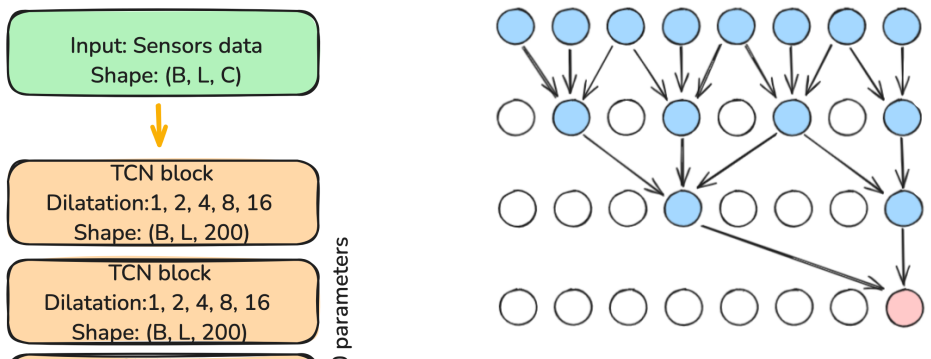
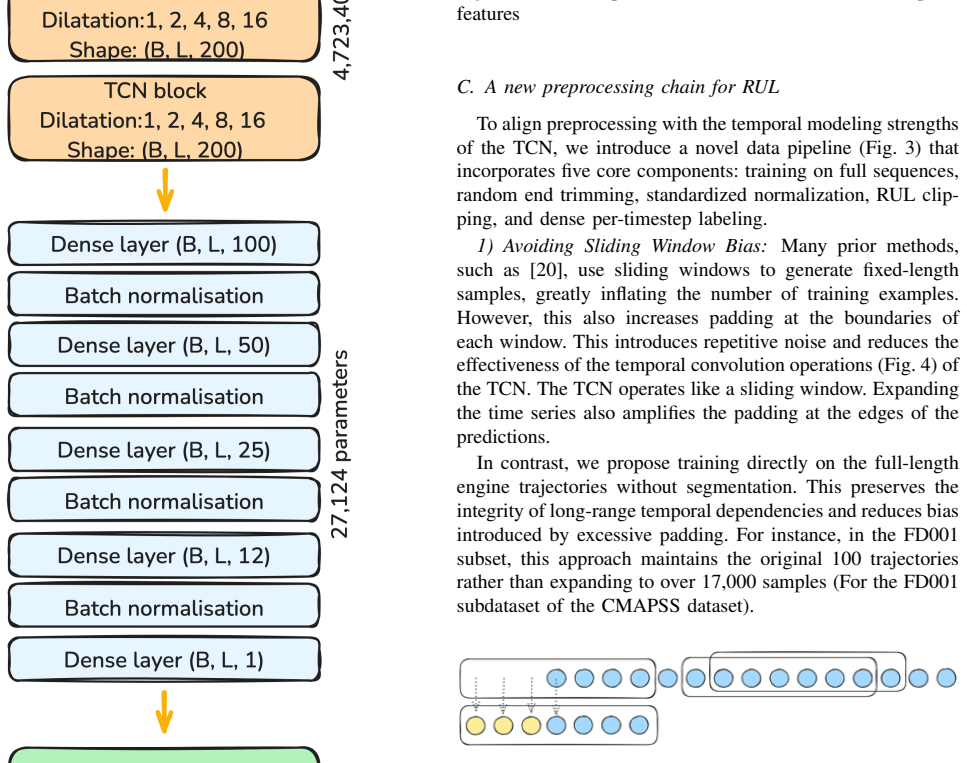
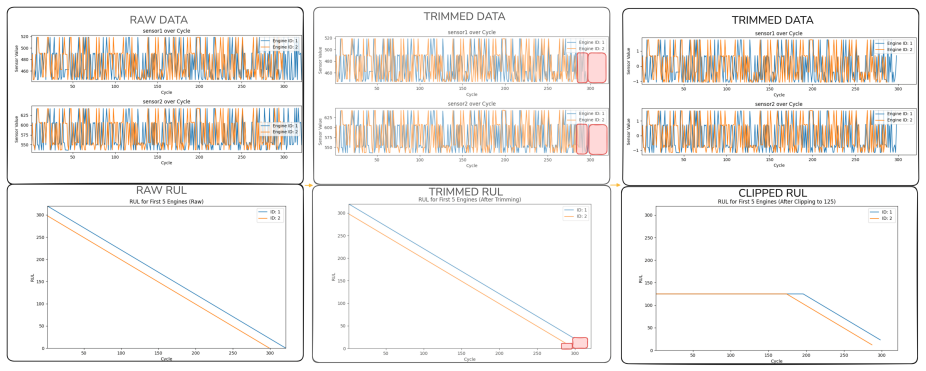
The novel preprocessing pipeline that converts raw sensor sequences into full-length temporal inputs with per-timestep RUL targets to improve data quality and temporal representation before model training.
If this is right
- The model learns fine-grained degradation dynamics across the full operational life of each engine.
- Remaining useful life estimates become available continuously at every timestep instead of only at run end.
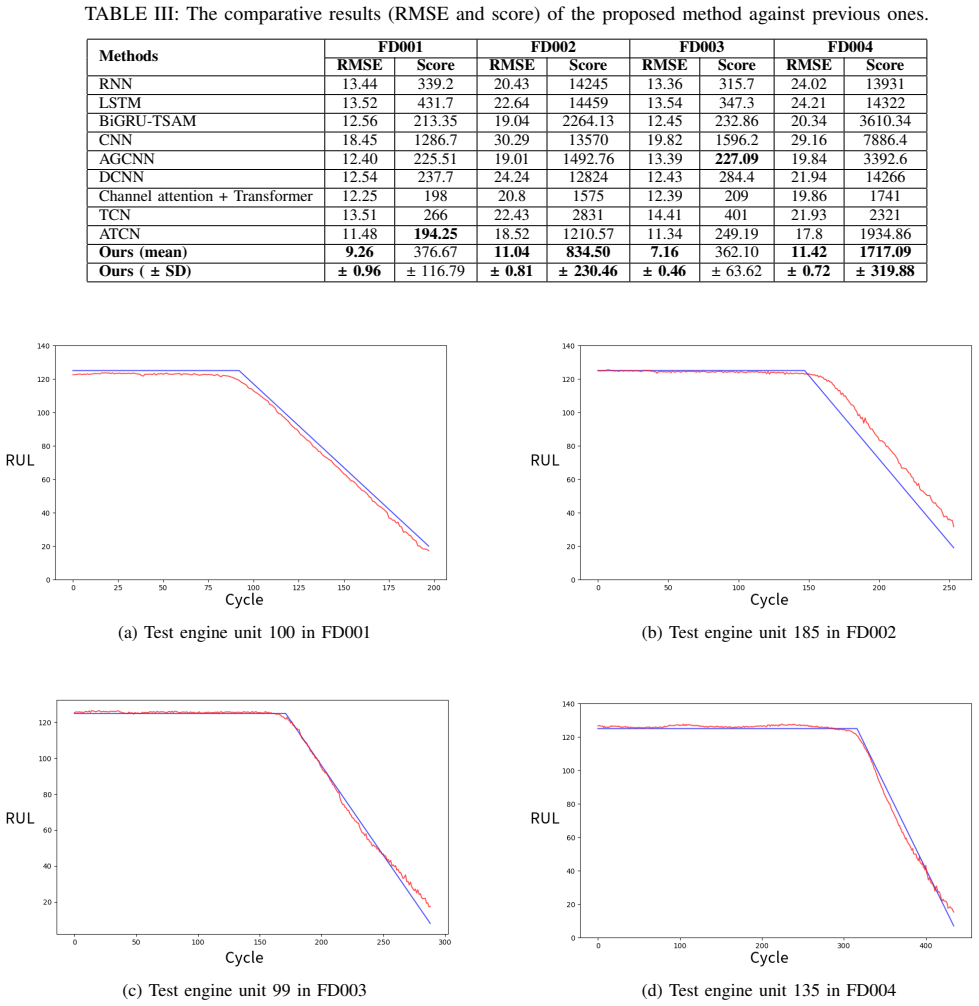
- The approach yields higher accuracy and robustness than the compared neural baselines on the C-MAPSS dataset.
- Predictive maintenance decisions for aero-engines can be informed by higher-quality continuous prognostics.
Where Pith is reading between the lines
- Preprocessing decisions may contribute as much or more to performance than the choice of neural architecture in sensor-based prognosis tasks.
- The same pipeline could be tested on other industrial sensor datasets to check whether the benefit generalizes beyond aero-engines.
- Controlled ablation studies that isolate each preprocessing component would clarify which elements drive the reported gains.
Load-bearing premise
The observed gains in prediction accuracy are caused mainly by the new preprocessing steps rather than by differences in hyperparameter choices, data splits, or implementation details of the baseline models.
What would settle it
An independent re-run of the listed baseline models (CNN, RNN, LSTM, DCNN, TCN, BiGRU-TSAM, AGCNN, ATCN) that applies the identical preprocessing pipeline, data splits, and training protocol and achieves equal or higher accuracy on the same C-MAPSS test sets would show the gains are not attributable to the preprocessing.
Figures
read the original abstract
Accurate prediction of Remaining Useful Life (RUL) in aero-engines is vital for predictive maintenance, improved operational reliability, and reduced lifecycle costs. While deep learning approaches have demonstrated strong potential in this area, most existing methods focus primarily on model architecture design and treat input features uniformly, often neglecting the influence of data preprocessing. In this work, we propose a novel preprocessing pipeline that enhances RUL prediction by improving data quality and temporal representation before model training. Our approach leverages complete temporal sequences and generates RUL estimates at each timestep, enabling the model to capture fine-grained degradation dynamics and deliver continuous prognostic insights throughout the engine's operational life. To validate the effectiveness of the proposed pipeline, we conduct experiments on the NASA C-MAPSS dataset. Comparative evaluations against a suite of state-of-the-art neural models including CNN, RNN, LSTM, DCNN, TCN, BiGRU-TSAM, AGCNN, and ATCN, demonstrate that our approach consistently achieves superior accuracy and robustness in aero-engine RUL prediction. These results highlight the critical role of preprocessing in maximizing the effectiveness of neural prognostic models.
Editorial analysis
A structured set of objections, weighed in public.
Referee Report
Summary. The paper proposes a novel preprocessing pipeline for RUL prediction in aero-engines that processes complete temporal sequences and produces per-timestep RUL estimates, then feeds these into a TCN. Experiments on the NASA C-MAPSS dataset are claimed to show that this approach yields superior accuracy and robustness relative to CNN, RNN, LSTM, DCNN, TCN, BiGRU-TSAM, AGCNN, and ATCN.
Significance. If the performance gains can be shown to stem from the preprocessing pipeline under controlled conditions, the work would usefully draw attention to the impact of input preparation on neural prognostic models, an aspect that is frequently under-emphasized in the RUL literature.
major comments (2)
- [Experimental Results] The central claim attributes consistent outperformance to the novel preprocessing pipeline, yet the manuscript contains no ablation that applies the proposed preprocessing steps to the baseline architectures (including the authors' own TCN) while holding hyperparameters, data splits, and training protocol fixed. Without this control, the reported gains cannot be securely assigned to preprocessing rather than implementation differences.
- [Abstract and Results] The abstract asserts superior accuracy and robustness but supplies no quantitative metrics (RMSE, MAE, etc.), error bars, or details on baseline re-implementations and hyperparameter search. The full manuscript likewise lacks these controls, leaving the empirical comparison unverifiable.
minor comments (2)
- [Methodology] The description of the preprocessing pipeline would benefit from explicit pseudocode or a step-by-step algorithmic listing to allow exact reproduction.
- [Problem Formulation] Notation for the per-timestep RUL target and the temporal sequence construction should be defined once and used consistently throughout.
Simulated Author's Rebuttal
We thank the referee for the thoughtful and constructive report. The comments highlight important aspects of experimental rigor that we will address to strengthen the manuscript. We respond to each major comment below and indicate the planned revisions.
read point-by-point responses
-
Referee: The central claim attributes consistent outperformance to the novel preprocessing pipeline, yet the manuscript contains no ablation that applies the proposed preprocessing steps to the baseline architectures (including the authors' own TCN) while holding hyperparameters, data splits, and training protocol fixed. Without this control, the reported gains cannot be securely assigned to preprocessing rather than implementation differences.
Authors: We agree that an ablation study applying the preprocessing pipeline to the baseline architectures under fixed conditions would provide stronger causal evidence for the source of the performance gains. In the revised version, we will add these controlled experiments, applying the proposed preprocessing steps to CNN, RNN, LSTM, DCNN, and the authors' TCN baseline while keeping hyperparameters, data splits, and training protocols identical. This will allow clearer attribution of improvements to the preprocessing pipeline. revision: yes
-
Referee: The abstract asserts superior accuracy and robustness but supplies no quantitative metrics (RMSE, MAE, etc.), error bars, or details on baseline re-implementations and hyperparameter search. The full manuscript likewise lacks these controls, leaving the empirical comparison unverifiable.
Authors: We acknowledge that the abstract would be more informative with explicit quantitative support. We will revise the abstract to include key metrics (e.g., RMSE and MAE values on the C-MAPSS subsets) and direct comparisons to the listed baselines. In the full manuscript, we will expand the experimental details to document baseline re-implementations, the hyperparameter search procedure, and include error bars or standard deviations in the results tables to improve verifiability. revision: yes
Circularity Check
No circularity in empirical validation
full rationale
The manuscript proposes a preprocessing pipeline for TCN-based RUL prediction and validates it via direct experimental comparison on the public C-MAPSS dataset against listed external baselines. No equations, fitted parameters presented as predictions, or derivation steps appear that reduce to the inputs by construction. Claims rest on falsifiable empirical results rather than self-definition, self-citation load-bearing premises, or imported uniqueness theorems. The noted lack of ablations concerns experimental controls, not circularity in any claimed derivation chain.
Axiom & Free-Parameter Ledger
Reference graph
Works this paper leans on
-
[1]
Review and analysis of algorithmic approaches developed for prognostics on c-mapss dataset,
E. Ramasso and A. Saxena, “Review and analysis of algorithmic approaches developed for prognostics on c-mapss dataset,” inAnnual Conference of the Prognostics and Health Management Society 2014, vol. 5, no. 63, Fort Worth, TX, USA, 2014, pp. 1–11
work page 2014
-
[2]
P. Vrignat, F. Kratz, and M. Avila, “Sustainable manufacturing, mainte- nance policies, prognostics and health management: a literature review,” Reliability Engineering & System Safety, vol. 218, p. 108140, 2022
work page 2022
-
[3]
A hybrid framework for remaining useful life estimation of turbomachine rotor blades,
B. Ellis, P. Heyns, and S. Schmidt, “A hybrid framework for remaining useful life estimation of turbomachine rotor blades,”Mechanical Systems and Signal Processing, vol. 170, p. 108805, 2022
work page 2022
-
[4]
J. Sun, X. Zhang, and J. Wang, “Lightweight bidirectional long short- term memory based on automated model pruning with application to bearing remaining useful life prediction,”Engineering Applications of Artificial Intelligence, vol. 118, p. 105662, 2023
work page 2023
-
[5]
Research on fault diagnosis system based on aeroengine knowledge base,
Y . Wang, H. Ming, G. Zhang, X. Ai, F. Xu, and B. Li, “Research on fault diagnosis system based on aeroengine knowledge base,” in2022 Global Reliability and Prognostics and Health Management (PHM- Yantai). IEEE, 2022, pp. 1–5
work page 2022
-
[6]
Data-driven approach augmented in simulation for robust fault prognosis,
M. Djeziri, S. Benmoussa, and M. Benbouzid, “Data-driven approach augmented in simulation for robust fault prognosis,”Engineering Appli- cations of Artificial Intelligence, vol. 86, pp. 154–164, 2019
work page 2019
-
[7]
Multiscale convolutional attention network for predicting remaining useful life of machinery,
B. Wang, Y . Lei, N. Li, and W. Wang, “Multiscale convolutional attention network for predicting remaining useful life of machinery,” IEEE Transactions on Industrial Electronics, vol. 68, pp. 7496–7504, 2021
work page 2021
-
[8]
W. Yu, Y . Shao, J. Xu, and C. Mechefske, “An adaptive and generalized wiener process model with a recursive filtering algorithm for remaining useful life estimation,”Reliability Engineering & System Safety, vol. 217, p. 108099, 2022
work page 2022
-
[9]
M. Namar, O. Jahanian, and H. Koten, “The start of combustion prediction for methane-fueled hcci engines: traditional vs. machine learning methods,”Mathematical Problems in Engineering, vol. 2022, p. e4589160, 2022
work page 2022
-
[10]
Multiclass classification for predicting remaining useful life (rul) of the turbofan engine,
P. Soni, M. Anas Khan, M. Zubair, and S. Kumar Garg, “Multiclass classification for predicting remaining useful life (rul) of the turbofan engine,” in2021 11th International Conference on Cloud Computing, Data Science & Engineering (Confluence). IEEE, 2021, pp. 1023–1028
work page 2021
-
[11]
A two-stage gaussian process regression model for remaining useful prediction of bearings,
J. Cui, L. Cao, and T. Zhang, “A two-stage gaussian process regression model for remaining useful prediction of bearings,”Proceedings of the Institution of Mechanical Engineers, Part O: Journal of Risk and Reliability, vol. 1748006X2211417, 2023
work page 2023
-
[12]
Deep convolutional neural network based regression approach for estimation of remaining useful life,
G. Sateesh Babu, P. Zhao, and X.-L. Li, “Deep convolutional neural network based regression approach for estimation of remaining useful life,” inDatabase Systems for Advanced Applications, ser. Lecture Notes in Computer Science, S. Navathe, W. Wu, S. Shekhar, X. Du, X. Wang, and H. Xiong, Eds. Springer International Publishing, 2016, pp. 214– 228
work page 2016
-
[13]
Remaining useful life estimation in prognostics using deep convolution neural networks,
X. Li, Q. Ding, and J.-Q. Sun, “Remaining useful life estimation in prognostics using deep convolution neural networks,”Reliability Engineering & System Safety, vol. 172, pp. 1–11, 2018
work page 2018
-
[14]
Remaining useful life estimation based on a new convolutional and recurrent neural network,
X. Zhang, Y . Dong, L. Wen, F. Lu, and W. Li, “Remaining useful life estimation based on a new convolutional and recurrent neural network,” in2019 IEEE 15th International Conference on Automation Science and Engineering (CASE). IEEE, 2019, pp. 317–322
work page 2019
-
[15]
J. Wu, K. Hu, Y . Cheng, H. Zhu, X. Shao, and Y . Wang, “Data-driven remaining useful life prediction via multiple sensor signals and deep long short-term memory neural network,”ISA Transactions, vol. 97, pp. 241–250, 2020
work page 2020
-
[16]
Remaining useful life prediction for mechanical equipment based on temporal convolutional network,
W. Ji, C. Jian, and C. Yi, “Remaining useful life prediction for mechanical equipment based on temporal convolutional network,” in 2019 14th IEEE International Conference on Electronic Measurement Instruments (ICEMI). IEEE, 2019, pp. 1192–1199
work page 2019
-
[17]
A bidirectional recursive gated dual attention unit based rul prediction approach,
L. Yang, Y . Liao, R. Duan, T. Kang, and J. Xue, “A bidirectional recursive gated dual attention unit based rul prediction approach,” Engineering Applications of Artificial Intelligence, vol. 120, p. 105885, 2023
work page 2023
-
[18]
Remaining useful life prediction using a novel feature-attention-based end-to-end approach,
H. Liu, Z. Liu, W. Jia, and X. Lin, “Remaining useful life prediction using a novel feature-attention-based end-to-end approach,”IEEE Trans- actions on Industrial Informatics, vol. 17, pp. 1197–1207, 2021
work page 2021
-
[19]
L. Liu, X. Song, and Z. Zhou, “Aircraft engine remaining useful life estimation via a double attention-based data-driven architecture,” Reliability Engineering & System Safety, vol. 221, p. 108330, 2022
work page 2022
-
[20]
Q. Zhang, Q. Liu, and Q. Ye, “An attention-based temporal convolutional network method for predicting remaining useful life of aero-engine,” Engineering Applications of Artificial Intelligence, vol. 127, p. 107241, 2024
work page 2024
-
[21]
W. Swaileh, F. Imbert, Y . Soullard, R. Tavenard, and E. Anquetil, “On- line handwriting trajectory reconstruction from kinematic sensors using temporal convolutional network,”International Journal on Document Analysis and Recognition (IJDAR), vol. 26, no. 3, pp. 289–302, 2023
work page 2023
-
[22]
Mixture-of-experts for handwriting trajectory reconstruction from imu sensors,
F. Imbert, E. Anquetil, Y . Soullard, and R. Tavenard, “Mixture-of-experts for handwriting trajectory reconstruction from imu sensors,”Pattern Recognition, vol. 161, p. 111231, 2025
work page 2025
-
[23]
Damage propagation modeling for aircraft engine run-to-failure simulation,
A. Saxena, K. Goebel, D. Simon, and N. Eklund, “Damage propagation modeling for aircraft engine run-to-failure simulation,” in2008 Inter- national Conference on Prognostics and Health Management. IEEE, 2008, pp. 1–9
work page 2008
-
[24]
J. Zhang, Y . Jiang, S. Wu, X. Li, H. Luo, and S. Yin, “Prediction of remaining useful life based on bidirectional gated recurrent unit with temporal self-attention mechanism,”Reliability Engineering & System Safety, vol. 221, p. 108297, 2022
work page 2022
discussion (0)
Sign in with ORCID, Apple, or X to comment. Anyone can read and Pith papers without signing in.