Non-radial pulsations of gravitationally coupled two-fluid neutron stars in general relativity
Pith reviewed 2026-05-07 14:41 UTC · model grok-4.3
The pith
A fully relativistic framework now exists to compute polar pulsations of two-fluid neutron stars coupled only by gravity.
A machine-rendered reading of the paper's core claim, the machinery that carries it, and where it could break.
Core claim
We develop a fully relativistic framework for polar perturbations of gravitationally coupled two-fluid neutron stars, assuming that the two fluids interact only through the common spacetime and are not coupled by entrainment or direct microphysical interactions. We derive the coupled linear perturbation equations governing the metric and both fluid components, and complete the formulation by establishing the regularity, surface, and exterior matching conditions required for a well-posed oscillation eigenvalue problem. We then implement the resulting system numerically and compute representative polar mode spectra for gravitationally coupled two-fluid stellar models, allowing the fundamental,
What carries the argument
The coupled linear perturbation equations for the metric and the two independent fluid displacement fields, closed by regularity at the center, continuity across each fluid surface, and matching to the exterior vacuum spacetime.
If this is right
- The fundamental and pressure mode branches can be classified according to their dominant inner- or outer-fluid character through the associated eigenfunctions and their node structure.
- The implementation supplies a practical method for mode identification in gravitationally coupled two-fluid stars.
- The formalism provides a foundation for extending relativistic asteroseismology to multi-fluid compact stars.
- It enables systematic exploration of potential gravitational-wave signatures from such oscillations in a fully general relativistic setting.
Where Pith is reading between the lines
- The same matching conditions could be reused if entrainment is later introduced, provided the relative velocity between fluids is incorporated into the surface jump relations.
- Applying the framework to tabulated equations of state that include both nuclear and superfluid phases would produce concrete predictions for frequency shifts relative to single-fluid models.
- The derivation steps can be repeated for axial perturbations or for slowly rotating two-fluid configurations without changing the core structure of the boundary conditions.
Load-bearing premise
The two fluids interact solely through the shared gravitational field with no direct microphysical coupling or entrainment between them.
What would settle it
A numerical calculation in which the density of one fluid is reduced continuously to zero and the resulting mode frequencies and eigenfunctions are checked for smooth recovery of the known single-fluid polar-mode spectrum.
Figures




read the original abstract
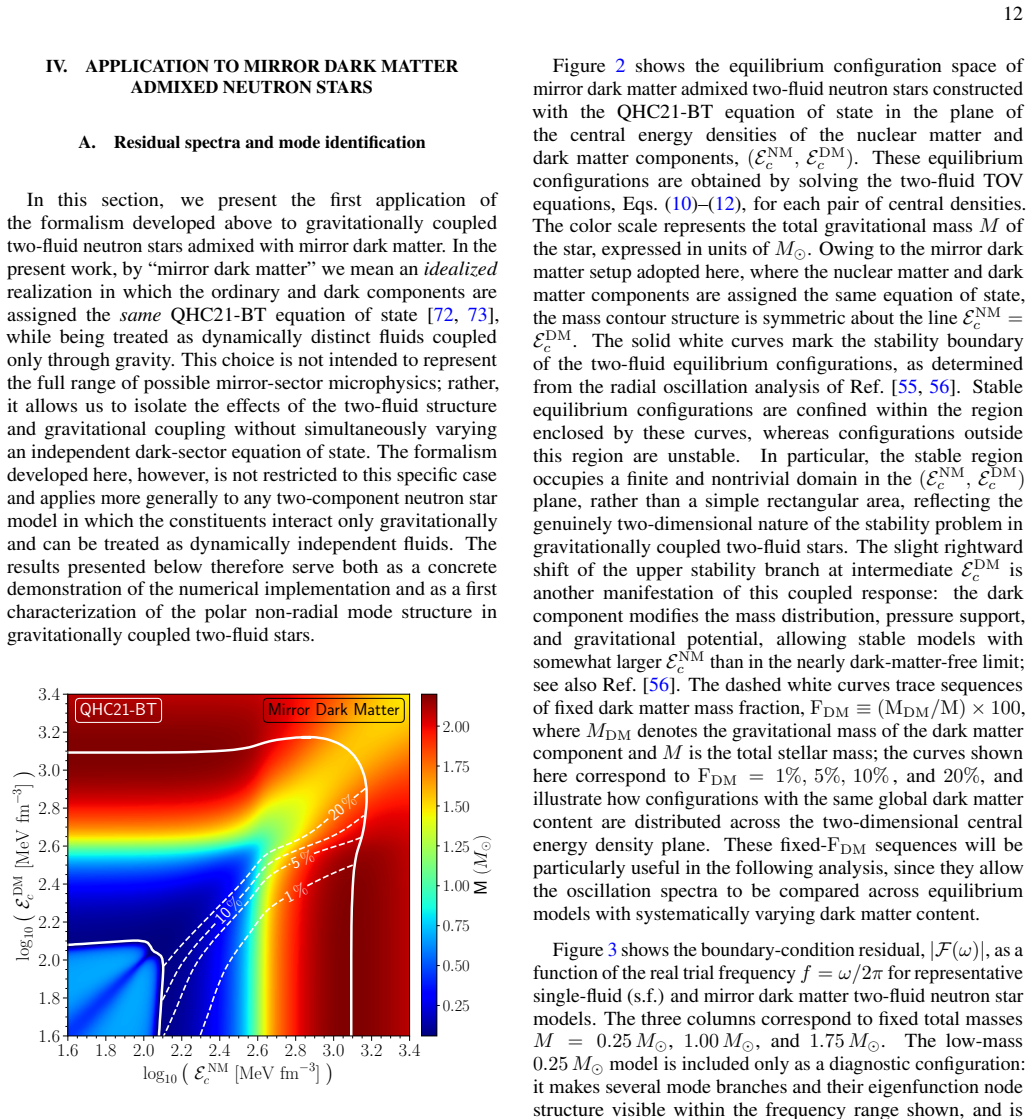
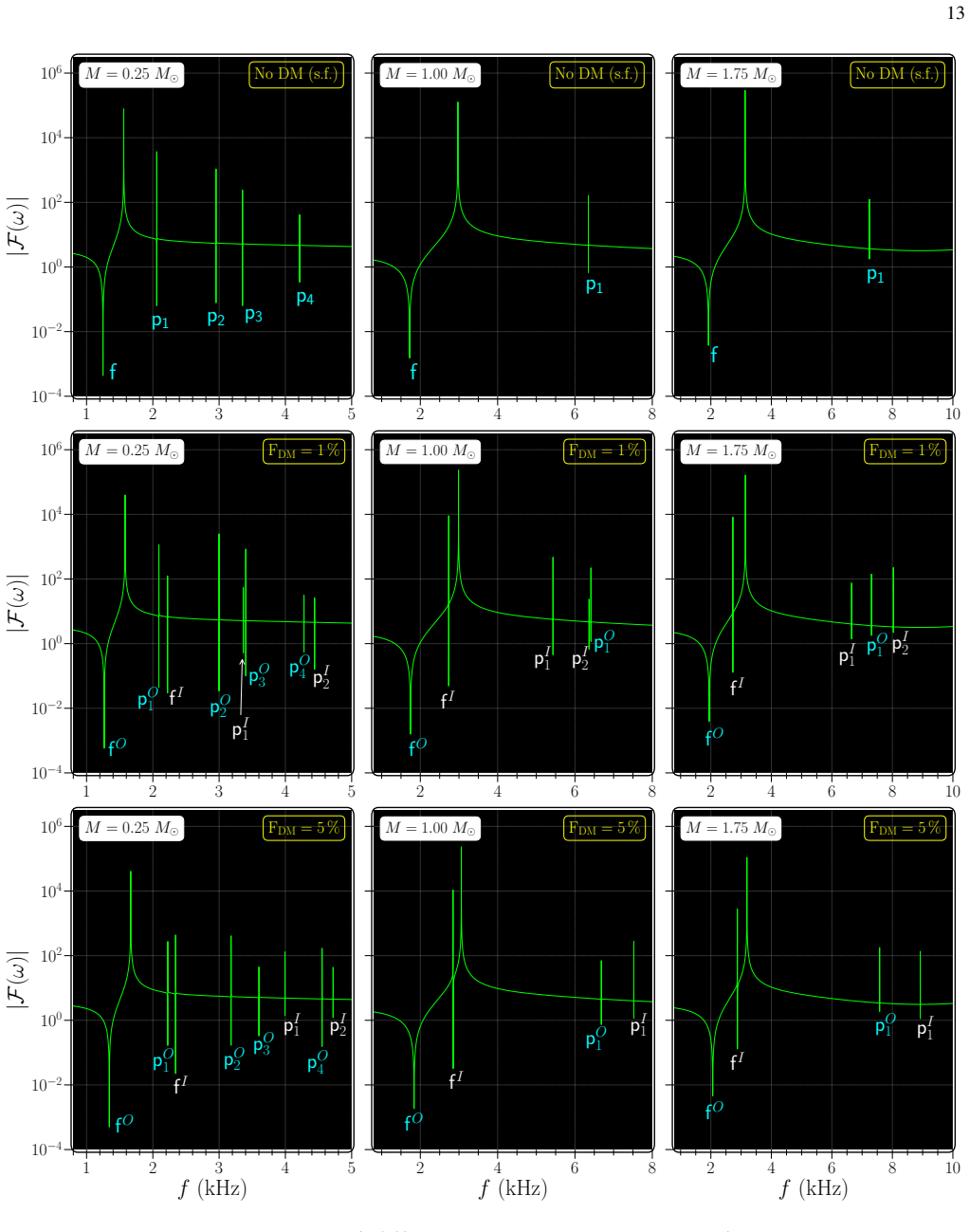
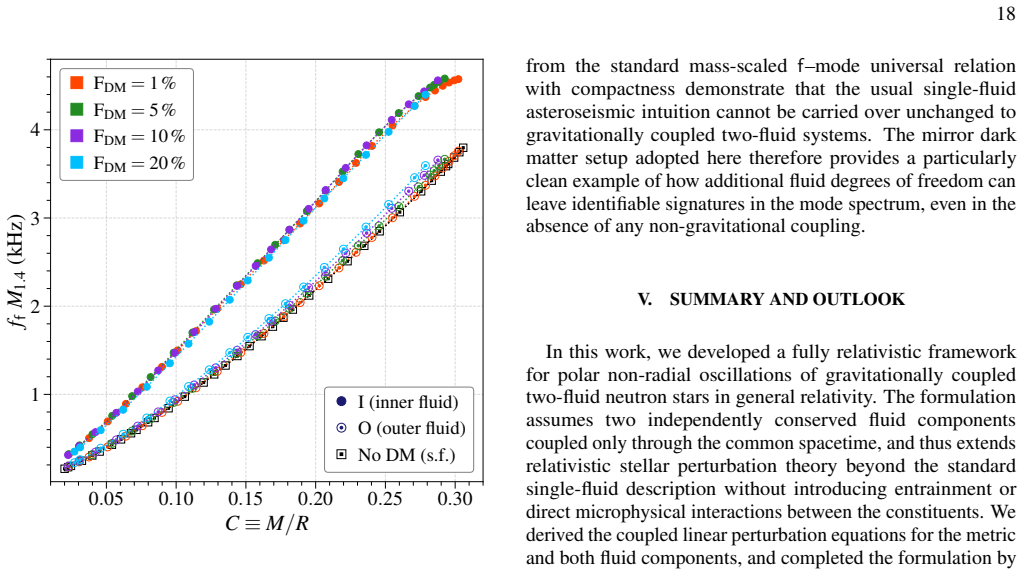
Non-radial oscillations of neutron stars provide a powerful probe of stellar structure and relativistic gravity, but a fully general relativistic treatment for gravitationally coupled two-fluid stars with independently conserved currents has so far been lacking. In this work, we develop a fully relativistic framework for polar perturbations of gravitationally coupled two-fluid neutron stars, assuming that the two fluids interact only through the common spacetime and are not coupled by entrainment or direct microphysical interactions. We derive the coupled linear perturbation equations governing the metric and both fluid components, and complete the formulation by establishing the regularity, surface, and exterior matching conditions required for a well-posed oscillation eigenvalue problem. We then implement the resulting system numerically and compute representative polar mode spectra for gravitationally coupled two-fluid stellar models. This implementation provides a practical way to address mode identification in gravitationally coupled two-fluid stars, allowing the fundamental ($\mathsf{f}$) and pressure ($\mathsf{p}$) mode branches of the spectrum to be classified according to their dominant inner- or outer-fluid character through the associated eigenfunctions and their node structure. The formalism developed here provides a foundation for extending relativistic asteroseismology to multi-fluid compact stars and for exploring their potential gravitational-wave signatures in a fully general relativistic setting.
Editorial analysis
A structured set of objections, weighed in public.
Referee Report
Summary. The manuscript develops a fully relativistic framework for polar non-radial pulsations of gravitationally coupled two-fluid neutron stars, deriving the coupled linear perturbation equations for the metric and both fluid components under the explicit assumption of no entrainment or direct microphysical interactions (only gravitational coupling via the shared spacetime). It completes the formulation with regularity, surface, and exterior matching conditions to yield a well-posed eigenvalue problem, implements the system numerically, and computes representative polar mode spectra while classifying f- and p-mode branches according to their dominant inner- or outer-fluid character via eigenfunctions and node structure.
Significance. If the derivation and implementation hold, this supplies the first complete GR treatment of polar perturbations for two-fluid stars with independently conserved currents, filling a clear gap in relativistic asteroseismology. The provision of a closed linear system, explicit boundary conditions, and numerical mode spectra offers a practical foundation for studying multi-fluid compact objects and their potential gravitational-wave signatures, with the mode-classification approach providing a concrete tool for interpretation.
minor comments (2)
- The numerical implementation and resulting spectra would benefit from explicit statements of the discretization scheme, convergence tests, and error estimates (e.g., in the section describing the code or results), as these are essential for reproducibility of the eigenvalue spectra.
- Notation for the two fluids (e.g., labels for inner/outer or fluid 1/2) should be introduced consistently at first use and maintained throughout the equations and figures to avoid ambiguity when discussing dominant character of modes.
Simulated Author's Rebuttal
We thank the referee for their positive and constructive assessment of our manuscript. We are pleased that the work is recognized as supplying the first complete general-relativistic treatment of polar perturbations for gravitationally coupled two-fluid neutron stars with independently conserved currents. The recommendation for minor revision is noted; however, no specific major comments were raised in the report.
Circularity Check
No significant circularity; derivation self-contained from standard GR linearization
full rationale
The paper constructs the polar perturbation equations by applying the standard linearized Einstein equations and baryon current conservation laws to two perfect fluids that share only the metric, with the no-entrainment assumption stated explicitly as an input rather than derived. Regularity, surface, and exterior matching conditions are obtained from the same linearized system and asymptotic flatness, without reduction to fitted parameters or prior self-citations that carry the central claim. Numerical implementation and mode classification follow directly from the resulting eigenvalue problem. No step equates a prediction to its own input by construction.
Axiom & Free-Parameter Ledger
axioms (2)
- standard math Linearized Einstein equations and conservation laws for two independently conserved fluid currents govern the perturbations.
- domain assumption The two fluids interact only gravitationally, with no entrainment or direct microphysical coupling.
Reference graph
Works this paper leans on
-
[1]
Vertical dashed lines mark the radius of the inner-fluid component. Insets zoom into the neighborhood of Wnorm ≃0 to make node structure and sign changes visible, enabling an unambiguous identification of which spectral feature corresponds to an outer- or inner-led mode. 16 this mode does not belong to the outer-fluid-led branch. This also clarifies why t...
- [2]
-
[3]
B. F. Schutz, Classical and Quantum Gravity6, 1761 (1989)
work page 1989
-
[4]
T. G. Cowling, Monthly Notices of the Royal Astronomical Society101, 367 (1941)
work page 1941
-
[5]
K. D. Kokkotas and B. G. Schmidt, Living Reviews in Relativity 2, 2 (1999)
work page 1999
- [6]
-
[7]
K. S. Thorne and A. Campolattaro, Non-Radial Pulsation of General-Relativistic Stellar Models. I. Analytic Analysis for L >=2 (1967)
work page 1967
- [8]
-
[9]
K. D. Kokkotas, mnras268, 1015 (1994)
work page 1994
- [10]
- [11]
-
[12]
N. Andersson and K. D. Kokkotas, Monthly Notices of the Royal Astronomical Society299, 1059 (1998)
work page 1998
-
[13]
L. S. Finn, Monthly Notices of the Royal Astronomical Society 222, 393 (1986)
work page 1986
-
[14]
A. Torres-Forn´e, P. Cerd´a-Dur´an, A. Passamonti, and J. A. Font, Monthly Notices of the Royal Astronomical Society474, 5272 (2017)
work page 2017
- [15]
- [16]
-
[17]
P. Jaikumar, A. Semposki, M. Prakash, and C. Constantinou, Phys. Rev. D103, 123009 (2021), arXiv:2101.06349 [nucl-th]
- [18]
- [19]
-
[20]
B. K. Pradhan, D. Chatterjee, M. Lanoye, and P. Jaikumar, Phys. 23 Rev. C106, 015805 (2022)
work page 2022
-
[21]
L. S. Finn, Monthly Notices of the Royal Astronomical Society 227, 265 (1987)
work page 1987
- [22]
-
[23]
K. D. Kokkotas and B. F. Schutz, Monthly Notices of the Royal Astronomical Society255, 119 (1992)
work page 1992
- [24]
-
[25]
A new class of unstable modes of rotating relativistic stars
N. Andersson, Astrophys. J.502, 708 (1998), arXiv:gr-qc/9706075 [gr-qc]
work page Pith review arXiv 1998
- [26]
-
[27]
R. I. Epstein, Astrophys. J.333, 880 (1988)
work page 1988
-
[28]
G. BAYM, C. PETHICK, and D. PINES, Nature224, 673 (1969)
work page 1969
-
[29]
U. Lombardo and H.-J. Schulze, Superfluidity in neutron star matter, in Physics of Neutron Star Interiors, edited by D. Blaschke, A. Sedrakian, and N. K. Glendenning (Springer Berlin Heidelberg, Berlin, Heidelberg, 2001) pp. 30–53
work page 2001
-
[30]
Chamel, Monthly Notices of the Royal Astronomical Society 388, 737 (2008)
N. Chamel, Monthly Notices of the Royal Astronomical Society 388, 737 (2008)
work page 2008
- [31]
-
[32]
G. L. Comer, D. Langlois, and L. M. Lin, Phys. Rev. D60, 104025 (1999)
work page 1999
-
[33]
N. Andersson, G. L. Comer, and D. Langlois, Phys. Rev. D66, 104002 (2002)
work page 2002
- [34]
-
[35]
L.-M. Lin, N. Andersson, and G. L. Comer, Phys. Rev. D78, 083008 (2008)
work page 2008
-
[36]
C. Biesdorf, J. Schaffner-Bielich, and L. Tolos, Phys. Rev. D 111, 083038 (2025)
work page 2025
-
[37]
I. Goldman, R. Mohapatra, S. Nussinov, D. Rosenbaum, and V . Teplitz, Physics Letters B725, 200 (2013)
work page 2013
-
[38]
Kain,Dark matter admixed neutron stars,Phys
B. Kain, Phys. Rev. D103, 043009 (2021), arXiv:2102.08257 [gr-qc]
- [39]
- [40]
-
[41]
M. Hippert, E. Dillingham, H. Tan, D. Curtin, J. Noronha-Hostler, and N. Yunes, Phys. Rev. D107, 115028 (2023)
work page 2023
-
[42]
P. N. McDermott, H. M. van Horn, and C. J. Hansen, Astrophys. J.325, 725 (1988)
work page 1988
- [43]
-
[44]
A. Stavridis, A. Passamonti, and K. Kokkotas, Phys. Rev. D75, 064019 (2007), arXiv:gr-qc/0701122
-
[45]
G. Pratten, P. Schmidt, and T. Hinderer, Nature Communications 11, 2553 (2020)
work page 2020
-
[46]
W. C. G. Ho, D. I. Jones, N. Andersson, and C. M. Espinoza, Phys. Rev. D101, 103009 (2020)
work page 2020
- [47]
- [48]
- [49]
-
[50]
V . Tran, S. Ghosh, N. Lozano, D. Chatterjee, and P. Jaikumar, Phys. Rev. C108, 015803 (2023)
work page 2023
- [51]
-
[52]
N. Andersson, K. Glampedakis, and L. Samuelsson, Monthly Notices of the Royal Astronomical Society396, 894 (2009)
work page 2009
-
[53]
A. Passamonti and N. Andersson, Monthly Notices of the Royal Astronomical Society419, 638 (2011)
work page 2011
-
[54]
L. Samuelsson and N. Andersson, Classical and Quantum Gravity26, 155016 (2009)
work page 2009
- [55]
- [56]
-
[57]
A. Kumar and H. Sotani, Phys. Rev. D112, 063030 (2025), arXiv:2509.03862 [astro-ph.HE]
-
[58]
T. Gleason, B. Brown, and B. Kain, Phys. Rev. D105, 023010 (2022), arXiv:2201.02274 [gr-qc]
-
[59]
N. Rutherford, C. Prescod-Weinstein, and A. Watts, Phys. Rev. D111, 123034 (2025)
work page 2025
- [60]
-
[61]
H. Sotani and A. Kumar, Eur. Phys. J. C85, 1438 (2025), arXiv:2512.07105 [astro-ph.HE]
- [62]
-
[63]
H. Sotani and A. Kumar, Phys. Rev. D111, 123013 (2025), arXiv:2505.18800 [astro-ph.HE]
-
[64]
P. N. McDermott, H. M. van Horn, and J. F. Scholl, Astrophys. J.268, 837 (1983)
work page 1983
- [65]
-
[66]
J. L. Friedman, Communications in Mathematical Physics62, 247 (1978)
work page 1978
- [67]
-
[68]
F. J. Zerilli, Phys. Rev. Lett.24, 737 (1970)
work page 1970
-
[69]
S. Chandrasekhar and S. Detweiler, Proceedings of the Royal Society of London Series A344, 441 (1975)
work page 1975
- [70]
-
[71]
Beyond Three Terms: Continued Fractions for Rotating Black Holes in Modified Gravity
G. Karikos, J. A. Saes, P. Wagle, and N. Yunes, Beyond three terms: Continued fractions for rotating black holes in modified gravity (2026), arXiv:2604.18680 [gr-qc]
work page internal anchor Pith review Pith/arXiv arXiv 2026
-
[72]
E. W. Leaver, Phys. Rev. D41, 2986 (1990)
work page 1990
-
[73]
T. Kojo, G. Baym, and T. Hatsuda, The Astrophysical Journal 934, 46 (2022)
work page 2022
-
[74]
H. Togashi, K. Nakazato, Y . Takehara, S. Yamamuro, H. Suzuki, and M. Takano, Nuclear Physics A961, 78 (2017)
work page 2017
-
[75]
Sotani, The European Physical Journal C82, 477 (2022)
H. Sotani, The European Physical Journal C82, 477 (2022)
work page 2022
discussion (0)
Sign in with ORCID, Apple, or X to comment. Anyone can read and Pith papers without signing in.