Quantitative cavity-enhanced photothermal dynamics in TMDC-integrated ultrahigh-Q microcavities
Pith reviewed 2026-05-07 15:08 UTC · model grok-4.3
The pith
Tuning a laser across resonance in an ultrahigh-Q microcavity heats an integrated monolayer TMDC, shifting its photoluminescence peak in a way matched by a temperature-dependent bandgap model.
A machine-rendered reading of the paper's core claim, the machinery that carries it, and where it could break.
Core claim
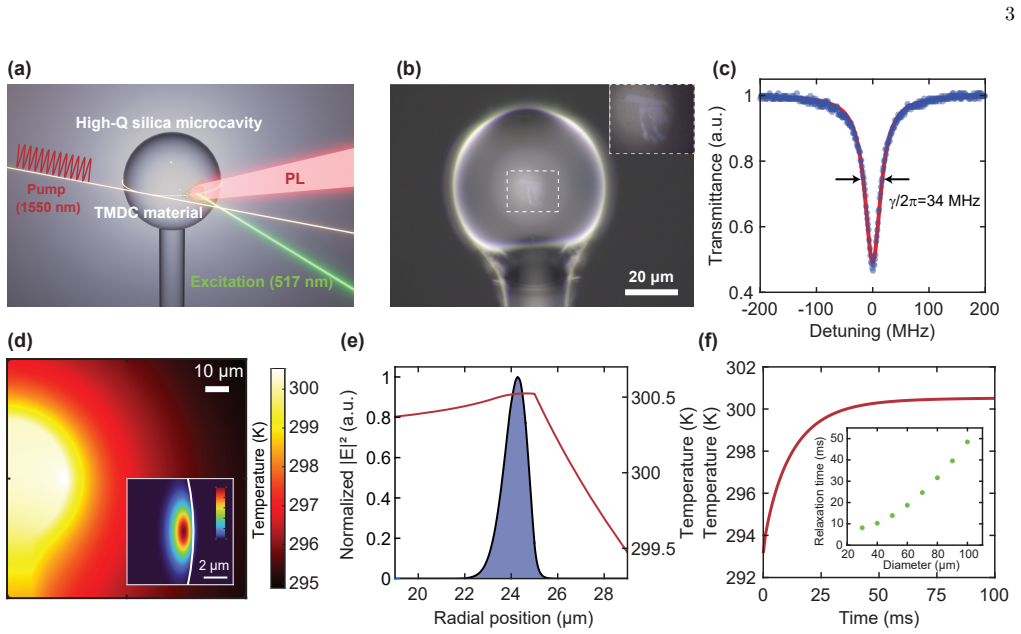
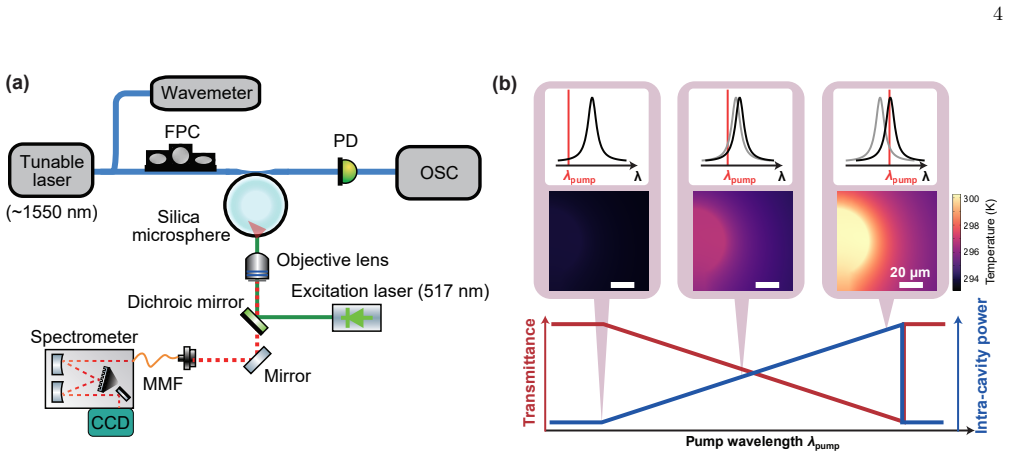
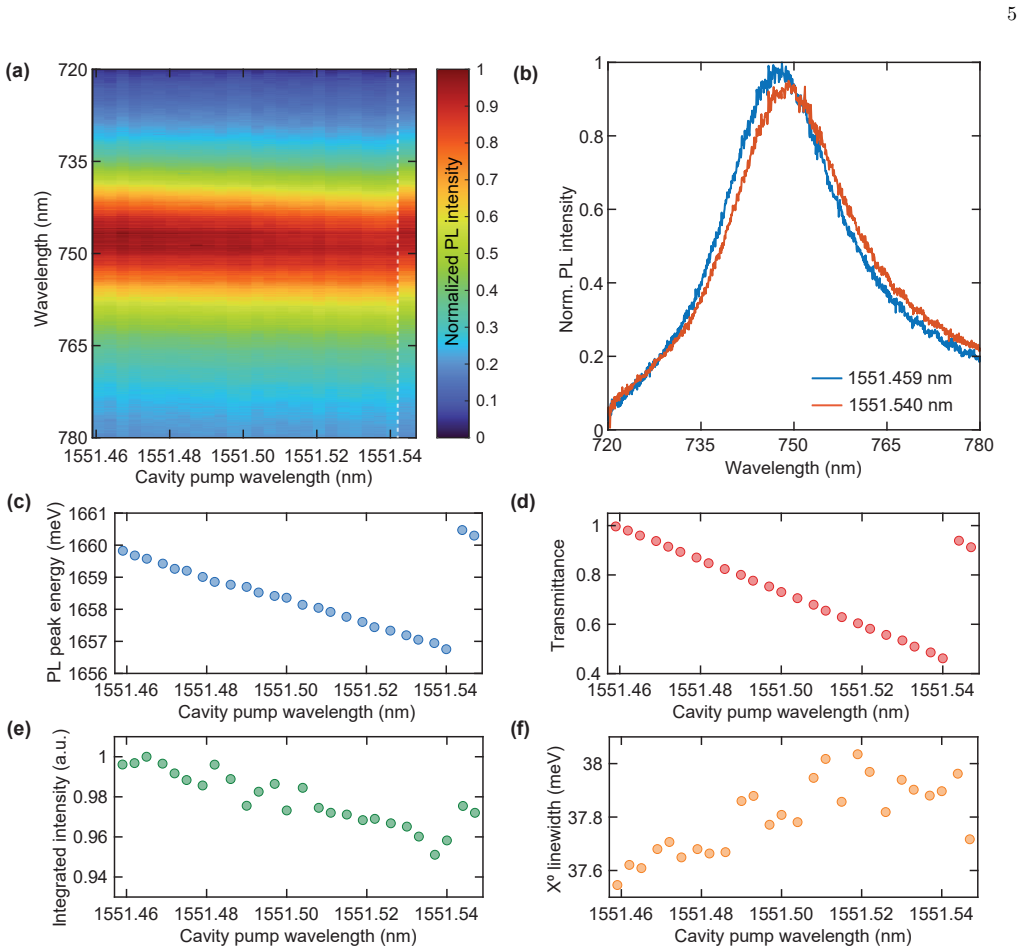
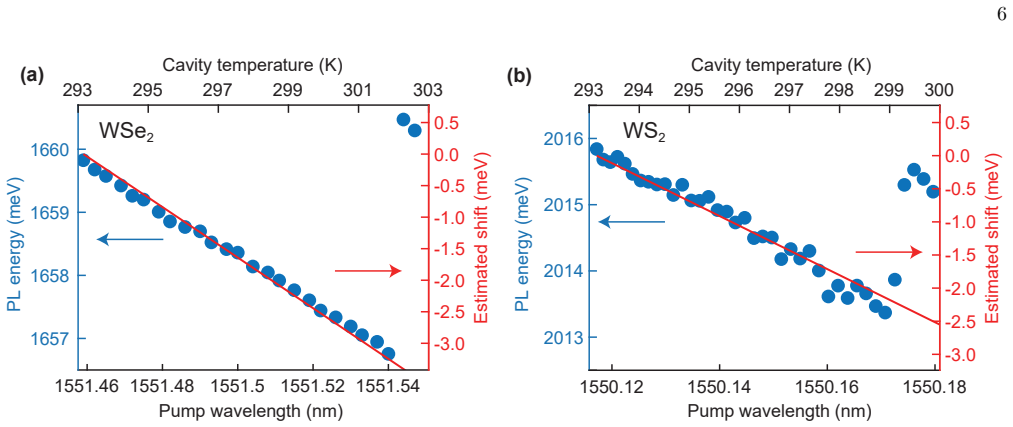
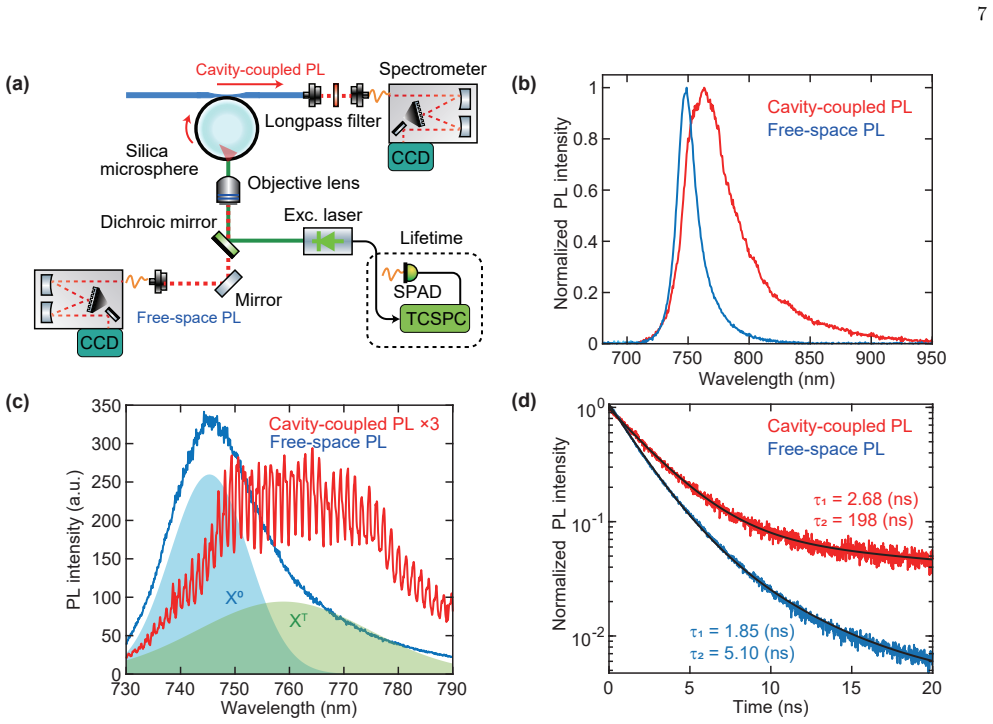
Launching a continuous-wave laser into resonance with an ultrahigh-Q microcavity integrated with a monolayer TMDC produces a distinct redshift of the photoluminescence peak energy as the pump wavelength is tuned across the resonance. This redshift is quantitatively reproduced by a temperature-dependent bandgap model that combines the Varshni relation with the thermo-optic response of the microcavity, permitting an estimate of the local temperature rise. Fiber-collected photoluminescence exhibits markedly different spectral and temporal characteristics, indicating selective coupling to specific excitonic channels.
What carries the argument
The temperature-dependent bandgap model that combines the Varshni empirical relation for bandgap variation with temperature and the thermo-optic coefficient of the silica microcavity to explain the observed photoluminescence redshift and to extract the local temperature rise.
If this is right
- The magnitude of the photoluminescence redshift directly gives an estimate of the local temperature rise inside the TMDC layer.
- All-optical control and probing of thermal states is possible in TMDC-integrated nanophotonic devices without electrodes.
- Photoluminescence collected through a fiber waveguide shows distinct spectral and temporal features, enabling selective coupling to chosen excitonic channels.
- The approach supplies a quantitative framework for photothermal dynamics in TMDC-microcavity hybrid systems.
Where Pith is reading between the lines
- The same resonance-tuning method could be used to map local temperature in other 2D-material devices by tracking emission shifts in real time.
- The observed difference between fiber and free-space collection suggests a route to devices that thermally address only selected exciton modes.
- Combining this optical heating with separate thermometry techniques on identical samples would test whether competing effects are truly negligible.
Load-bearing premise
The redshift of the photoluminescence peak is produced mainly by heating of the TMDC rather than by photo-induced carrier density changes, thermal-expansion strain, or cavity detuning effects.
What would settle it
An independent temperature measurement, for example via Raman spectroscopy on the same TMDC layer, that yields a temperature rise inconsistent with the value inferred from the photoluminescence redshift under the Varshni-plus-thermo-optic model would falsify the central claim.
Figures
read the original abstract
We investigate photothermal effects in monolayer transition metal dichalcogenides (TMDCs) integrated with an ultrahigh-Q silica microcavity. Launching a continuous-wave laser into a cavity resonance enables controlled intracavity heating, allowing direct observation of excitonic photoluminescence (PL) modulation. A distinct redshift of the PL peak energy is observed as the pump wavelength is tuned across resonance. This behavior is quantitatively reproduced by a temperature-dependent bandgap model that combines the Varshni relation with the thermo-optic response of the microcavity, from which the local temperature rise can be estimated. We further find that PL collected through a fiber waveguide exhibits spectral and temporal characteristics markedly different from free-space emission, indicating selective coupling of the microcavity to specific excitonic channels. These results provide a quantitative framework for understanding photothermal effects in TMDC-microcavity hybrid systems and offer a versatile approach for all-optical control and probing of thermal states in integrated nanophotonic devices.
Editorial analysis
A structured set of objections, weighed in public.
Referee Report
Summary. The manuscript investigates photothermal effects in monolayer TMDCs integrated with ultrahigh-Q silica microcavities. Resonant CW pumping induces intracavity heating, producing an observed redshift in excitonic PL peak energy as the pump is tuned across resonance. This shift is claimed to be quantitatively reproduced by a temperature-dependent bandgap model combining the Varshni relation with the cavity thermo-optic response, from which local temperature rise is estimated. Fiber-collected PL shows distinct spectral and temporal traits from free-space emission, attributed to selective excitonic channel coupling.
Significance. If the central attribution holds, the work supplies a quantitative framework for cavity-enhanced photothermal dynamics in TMDC-nanophotonic hybrids and a route to all-optical thermal control and probing. The high-Q enhancement for controlled heating and the reported selective coupling are strengths that could impact integrated 2D-material devices.
major comments (2)
- [§3] §3 (Results and modeling): The central claim that the PL redshift is quantitatively reproduced by the Varshni-plus-thermo-optic model and arises primarily from photothermal heating is load-bearing, yet the manuscript provides no explicit exclusion of competing mechanisms (photo-induced carrier renormalization, thermal-expansion strain, or cavity detuning artifacts). No power-law scaling, carrier-density estimates, or time-resolved decay comparisons are shown to demonstrate that the observed shift rate matches heating alone rather than a linear combination of effects.
- [§4] §4 (Discussion): The estimation of local temperature rise relies on fitting the combined model to the redshift data, but without reported error bars, covariance on the single free parameter (temperature rise), or sensitivity analysis to Varshni coefficients and thermo-optic constants, the quantitative aspect of the reproduction cannot be assessed for uniqueness.
minor comments (3)
- Figure captions should explicitly label the pump detuning axis and indicate the resonance linewidth for direct comparison with the observed redshift width.
- The abstract states 'quantitatively reproduced' but the main text should include the explicit functional form of the combined model (Varshni(T) + thermo-optic shift) as an equation to allow reproduction.
- A brief comparison table of fiber vs. free-space PL decay times and peak shifts would clarify the selective-coupling claim.
Simulated Author's Rebuttal
We thank the referee for the detailed and constructive review. The comments on alternative mechanisms and the robustness of the temperature estimation are well taken. We have revised the manuscript to strengthen the discussion of competing effects and to include statistical details on the fits. Point-by-point responses follow.
read point-by-point responses
-
Referee: [§3] §3 (Results and modeling): The central claim that the PL redshift is quantitatively reproduced by the Varshni-plus-thermo-optic model and arises primarily from photothermal heating is load-bearing, yet the manuscript provides no explicit exclusion of competing mechanisms (photo-induced carrier renormalization, thermal-expansion strain, or cavity detuning artifacts). No power-law scaling, carrier-density estimates, or time-resolved decay comparisons are shown to demonstrate that the observed shift rate matches heating alone rather than a linear combination of effects.
Authors: The strict correlation between the PL redshift and the cavity resonance condition (observed only when the pump is tuned onto resonance) provides direct evidence against mechanisms independent of intracavity intensity enhancement, such as direct photo-induced carrier renormalization or pure cavity detuning artifacts. Thermal-expansion strain contributes secondarily and is subsumed in the effective temperature dependence of the bandgap. While the original text did not contain explicit power-law plots or carrier-density calculations, the linear scaling of the shift with intracavity power (inferred from the resonance lineshape) is consistent with photothermal heating. In the revision we add a paragraph in §3 that estimates the intracavity carrier density from the known absorption cross-section and Q-factor, showing it lies well below the threshold for significant many-body renormalization, and briefly discusses why time-resolved comparisons, though desirable, are not required to establish the dominant thermal origin given the steady-state resonance specificity. revision: yes
-
Referee: [§4] §4 (Discussion): The estimation of local temperature rise relies on fitting the combined model to the redshift data, but without reported error bars, covariance on the single free parameter (temperature rise), or sensitivity analysis to Varshni coefficients and thermo-optic constants, the quantitative aspect of the reproduction cannot be assessed for uniqueness.
Authors: We agree that the quantitative claim benefits from explicit uncertainty quantification. In the revised manuscript we now report error bars on the extracted local temperature rises, obtained from the covariance matrix of the least-squares fit to the redshift data. A sensitivity analysis has been added to the supplementary information in which the Varshni coefficients and thermo-optic constant are varied over their literature-reported ranges; the resulting temperature estimates remain consistent within approximately 12 %, confirming that the central value is robust and the reproduction is not an artifact of a single parameter choice. revision: yes
Circularity Check
No circularity: standard model applied to independent experimental observation
full rationale
The paper reports an experimental observation of PL peak redshift as pump wavelength is tuned across cavity resonance. It then applies a pre-existing temperature-dependent bandgap model (Varshni relation plus known thermo-optic cavity response) to reproduce the shift and extract local temperature rise. No equations or steps in the provided text reduce the claimed temperature estimate to a tautology, a fit renamed as prediction, or a self-citation chain. The model inputs are external (standard Varshni parameters and cavity thermo-optic coefficients), not derived from the same dataset in a load-bearing loop. Competing mechanisms are a separate validity question, not a circularity issue.
Axiom & Free-Parameter Ledger
free parameters (1)
- local temperature rise
axioms (2)
- standard math Varshni relation accurately describes the temperature dependence of the TMDC bandgap energy in the relevant range
- domain assumption Thermo-optic response of the silica microcavity is known and can be added linearly to the bandgap shift
Reference graph
Works this paper leans on
-
[1]
X. Cao, H. Yang, Z.-L. Wu, and B.-B. Li, Ultrasound sensing with optical microcavities, Light Sci. Appl.13, 159 (2024)
work page 2024
- [2]
-
[3]
G. Lin, A. Coillet, and Y. K. Chembo, Nonlinear pho- tonics with high-Q whispering-gallery-mode resonators, Adv. Opt. Photon., AOP9, 828 (2017)
work page 2017
-
[4]
T. J. Kippenberg, S. M. Spillane, and K. J. Vahala, Kerr-nonlinearity optical parametric oscillation in an ultrahigh-Q toroid microcavity, Phys. Rev. Lett.93, 083904 (2004)
work page 2004
-
[5]
M. Aspelmeyer, T. J. Kippenberg, and F. Marquardt, Cavity optomechanics, Rev. Mod. Phys.86, 1391 (2014)
work page 2014
-
[6]
S. Barzanjeh, A. Xuereb, S. Gr¨ oblacher, M. Paternostro, C. A. Regal, and E. M. Weig, Optomechanics for quan- tum technologies, Nat. Phys.18, 15 (2022)
work page 2022
-
[7]
D. V. Strekalov, C. Marquardt, A. B. Matsko, H. G. L. Schwefel, and G. Leuchs, Nonlinear and quantum optics with whispering gallery resonators, J. Opt.18, 123002 (2016)
work page 2016
- [8]
-
[9]
K. D. Heylman and R. H. Goldsmith, Photothermal map- ping and free-space laser tuning of toroidal optical micro- cavities, Appl. Phys. Lett.103, 211116 (2013)
work page 2013
-
[10]
J. Liao and L. Yang, Optical whispering-gallery mode barcodes for high-precision and wide-range temperature measurements, Light Sci. Appl.10, 32 (2021)
work page 2021
-
[11]
C.-H. Dong, L. He, Y.-F. Xiao, V. R. Gaddam, S. K. Ozdemir, Z.-F. Han, G.-C. Guo, and L. Yang, Fabrication of high-Q polydimethylsiloxane optical microspheres for thermal sensing, Appl. Phys. Lett.94, 231119 (2009)
work page 2009
-
[12]
J. Zhu, S. K. Ozdemir, and L. Yang, Infrared light detec- tion using a whispering-gallery-mode optical microcavity, Appl. Phys. Lett.104, 171114 (2014)
work page 2014
-
[13]
M. R. Watts, M. J. Shaw, and G. N. Nielson, Micropho- tonic thermal imaging, Nat. Photonics1, 632 (2007)
work page 2007
-
[14]
K. F. Mak, C. Lee, J. Hone, J. Shan, and T. F. Heinz, Atomically thin MoS 2: a new direct-gap semiconductor, Phys. Rev. Lett.105, 136805 (2010)
work page 2010
-
[15]
J. You, S. Bongu, Q. Bao, and N. Panoiu, Nonlinear op- tical properties and applications of 2D materials: the- oretical and experimental aspects, Nanophotonics8, 63 (2018)
work page 2018
-
[16]
S. Wu, S. Buckley, J. R. Schaibley, L. Feng, J. Yan, D. G. Mandrus, F. Hatami, W. Yao, J. Vuˇ ckovi´ c, A. Majumdar, and X. Xu, Monolayer semiconductor nanocavity lasers with ultralow thresholds, Nature520, 69 (2015)
work page 2015
-
[17]
O. Salehzadeh, M. Djavid, N. H. Tran, I. Shih, and Z. Mi, Optically pumped two-dimensional MoS 2 lasers operat- ing at room-temperature, Nano Lett.15, 5302 (2015)
work page 2015
- [18]
- [19]
-
[20]
N. Liu, Q. Liu, Y. Lin, Z. Zhu, and K. Liu, Second- harmonic generation in NbOI 2-integrated silicon nitride microdisk resonators, Nanophotonics14, 5337 (2025)
work page 2025
-
[21]
O. Kovalchuk, S. Lee, H. Moon, A. M. Armani, and Y.- W. Song, Non-planar graphene directly synthesized on in- tracavity optical microresonators for GHz repetition rate mode-locked lasers, npj 2D Mater. Appl.8, 3 (2024)
work page 2024
- [22]
-
[23]
X. Yang, D. H. Shin, K. Watanabe, T. Taniguchi, P. G. Steeneken, and S. Caneva, Microsphere-assisted genera- tion of localized optical emitters in 2D hexagonal boron nitride, Nanophotonics14, 2419 (2025)
work page 2025
-
[24]
J. C. Reed, S. C. Malek, F. Yi, C. H. Naylor, A. T. Char- lie Johnson, and E. Cubukcu, Photothermal characteri- zation of MoS 2 emission coupled to a microdisk cavity, Appl. Phys. Lett.109, 193109 (2016)
work page 2016
-
[25]
Y. Gao, W. Zhou, X. Sun, H. K. Tsang, and C. Shu, Cavity-enhanced thermo-optic bistability and hysteresis in a graphene-on-Si 3N4 ring resonator, Opt. Lett.42, 1950 (2017)
work page 1950
-
[26]
C. Yuan, W. Zhang, and Y. Huang, Photothermal effect in graphene-coated microsphere resonators, Appl. Phys. Express11, 072503 (2018)
work page 2018
- [27]
-
[28]
S. Fujii and T. Tanabe, Dispersion engineering and mea- surement of whispering gallery mode microresonator for Kerr frequency comb generation, Nanophotonics9, 1087 (2020)
work page 2020
-
[29]
C. Javerzac-Galy, A. Kumar, R. D. Schilling, N. Piro, S. Khorasani, M. Barbone, I. Goykhman, J. B. Khurgin, A. C. Ferrari, and T. J. Kippenberg, Excitonic emission of monolayer semiconductors near-field coupled to high- Q microresonators, Nano Lett.18, 3138 (2018)
work page 2018
-
[30]
C. Shakespeare, A. S. Kumar, and J. T. Muhonen, Ther- mal relaxation time and photothermal optomechanical force in sliced photonic crystal silicon nanobeams, Opt. Express32, 36824 (2024)
work page 2024
-
[31]
W. Chen, J. Zhu, S. K. ¨Ozdemir, B. Peng, and L. Yang, A simple method for characterizing and engineering ther- mal relaxation of an optical microcavity, Appl. Phys. Lett.109, 061103 (2016)
work page 2016
-
[32]
H. Zhou, B. Xiao, N. Yang, S. Yuan, S. Zhu, Y. Duan, L. Shi, C. Zhang, and X. Zhang, Real-time observation of the thermo-optical and heat dissipation processes in microsphere resonators, Opt. Express29, 2402 (2021)
work page 2021
-
[33]
L. Yang, R. Sugano, R. Takabayashi, H. Kanzawa, H. Ku- mazaki, Y. Zhuang, X. Wei, T. Tanabe, and S. Fu- jii, Record-high-Q AMTIR-1 microresonators for mid- to long-wave infrared nonlinear photonics, Opt. Lett.50, 6554 (2025)
work page 2025
- [34]
-
[35]
T. G. McRae, K. H. Lee, M. McGovern, D. Gwyther, and W. P. Bowen, Thermo-optic locking of a semiconductor laser to a microcavity resonance, Opt. Express17, 21977 (2009)
work page 2009
-
[36]
X. Zhang, Q.-T. Cao, Z. Wang, Y.-x. Liu, C.-W. Qiu, L. Yang, Q. Gong, and Y.-F. Xiao, Symmetry-breaking- induced nonlinear optics at a microcavity surface, Nat. Photon.13, 21 (2019)
work page 2019
- [37]
- [38]
-
[39]
X. Jiang and L. Yang, Optothermal dynamics in whispering-gallery microresonators, Light Sci. Appl.9, 24 (2020)
work page 2020
-
[40]
Y. P. Varshni, Temperature dependence of the energy gap in semiconductors, Physica34, 149 (1967)
work page 1967
-
[41]
J. Kopaczek, S. Zelewski, K. Yumigeta, R. Sailus, S. Ton- gay, and R. Kudrawiec, Temperature dependence of the indirect gap and the direct optical transitions at the high- symmetry point of the brillouin zone and band nesting in MoS2, MoSe2, MoTe2, WS2, and WSe2 crystals, J. Phys. Chem. C Nanomater. Interfaces126, 5665 (2022)
work page 2022
-
[42]
D. Yamashita, H. Machiya, K. Otsuka, A. Ishii, and Y. K. Kato, Waveguide coupled cavity-enhanced light emission from individual carbon nanotubes, APL Photonics6, 031302 (2021)
work page 2021
-
[43]
J. He, I. Paradisanos, T. Liu, A. R. Cadore, J. Liu, M. Churaev, R. N. Wang, A. S. Raja, C. Javerzac-Galy, P. Roelli, D. D. Fazio, B. L. T. Rosa, S. Tongay, G. Soavi, A. C. Ferrari, and T. J. Kippenberg, Low-loss integrated nanophotonic circuits with layered semiconductor mate- rials, Nano Lett.21, 2709 (2021)
work page 2021
-
[44]
P. Tonndorf, O. Del Pozo-Zamudio, N. Gruhler, J. Kern, R. Schmidt, A. I. Dmitriev, A. P. Bakhtinov, A. I. Tar- takovskii, W. Pernice, S. Michaelis de Vasconcellos, and R. Bratschitsch, On-chip waveguide coupling of a layered semiconductor single-photon source, Nano Lett.17, 5446 (2017)
work page 2017
-
[45]
R. Khelifa, P. Back, N. Fl¨ ory, S. Nashashibi, K. Malchow, T. Taniguchi, K. Watanabe, A. Jain, and L. Novotny, Coupling interlayer excitons to whispering gallery modes in van der waals heterostructures, Nano Lett.20, 6155 (2020)
work page 2020
-
[46]
D. Andres-Penares, M. K. Habil, A. Molina-S´ anchez, C. J. Zapata-Rodr´ ıguez, J. P. Mart´ ınez-Pastor, and J. F. S´ anchez-Royo, Out-of-plane trion emission in monolayer WSe2 revealed by whispering gallery modes of dielectric microresonators, Commun. Mater.2(2021)
work page 2021
-
[47]
C. F. Fong, D. Yamashita, N. Fang, Y.-R. Chang, S. Fujii, T. Taniguchi, K. Watanabe, and Y. K. Kato, Dielectric environment engineering via 2D material heterostructure formation on a hybrid photonic crystal nanocavity, Opt. Mater. Express16, 646 (2026)
work page 2026
discussion (0)
Sign in with ORCID, Apple, or X to comment. Anyone can read and Pith papers without signing in.