Recognition: unknown
Measurement of γ using B^{pm}rightarrow DK^{pm} and B^{pm}rightarrow Dπ^{pm} decays with Drightarrow K_{rm S}⁰π⁺π⁻ and Drightarrow K_{rm S}⁰K⁺K⁻
Pith reviewed 2026-05-07 04:00 UTC · model grok-4.3
The pith
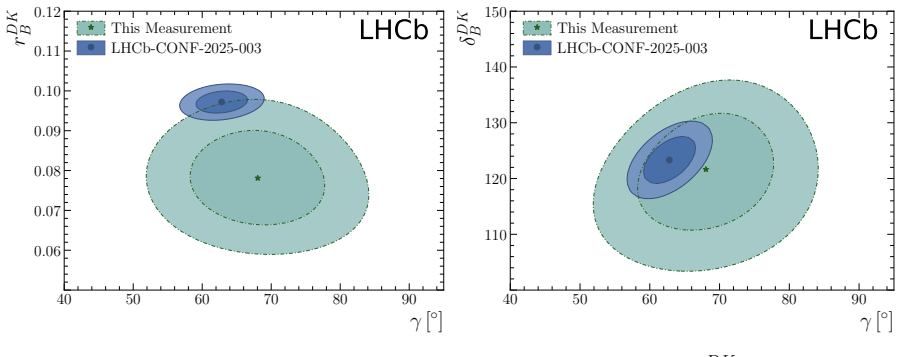
LHCb measures the CKM angle γ to (68.1 ± 6.7)° from B± → DK± and B± → Dπ± decays with D → KS0 π+π− and D → KS0 K+K−.
A machine-rendered reading of the paper's core claim, the machinery that carries it, and where it could break.
Core claim
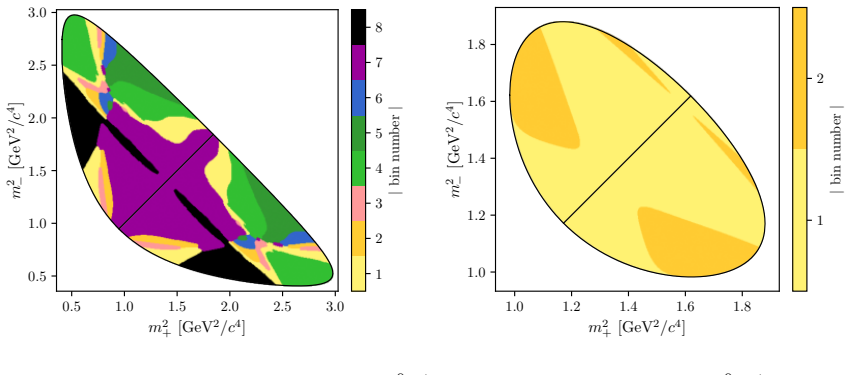
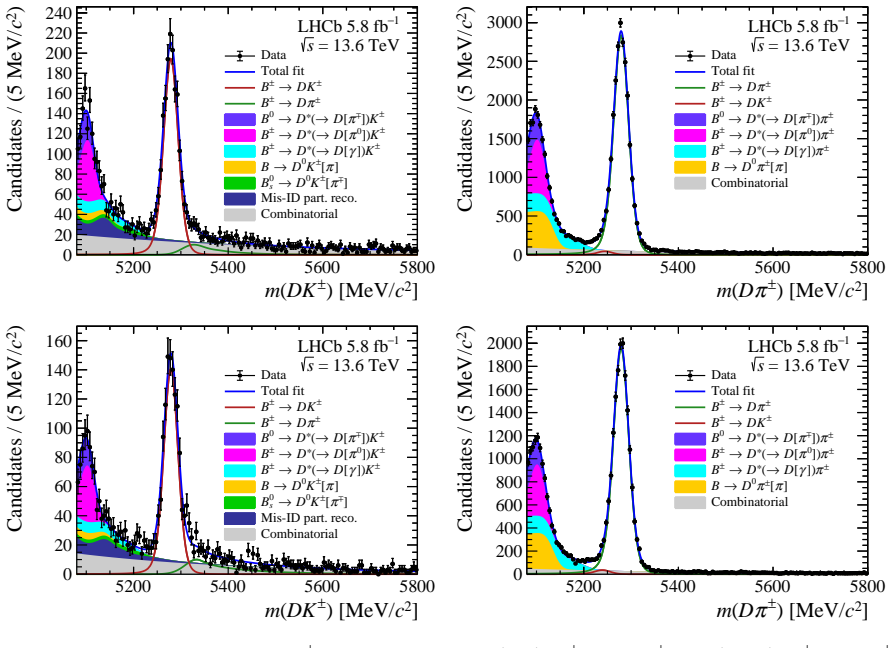
Using a data sample corresponding to 5.8 fb−1 collected in 2024 by the upgraded LHCb experiment, the collaboration observes CP violation through differences in the Dalitz plot distributions of D → KS0 π+π− and D → KS0 K+K− decays between B+ and B− mesons. The CKM angle γ is determined to be (68.1 ± 6.7)°. Additional parameters describing the B± → DK± and B± → Dπ± amplitudes are measured simultaneously.
What carries the argument
The Dalitz-plot amplitude models for D → KS0 π+π− and D → KS0 K+K−, which map the strong-phase variation across the three-body phase space and thereby convert the observed B+ versus B− asymmetry into a value for the weak phase γ.
If this is right
- The measured γ supplies a new constraint on the apex of the CKM unitarity triangle.
- The fitted values of the amplitude ratios r_B and strong phases δ_B for the DK and Dπ modes can be used in global fits of CKM parameters.
- The result serves as a benchmark for the performance of the upgraded LHCb detector in precision flavor-physics measurements.
- The analysis framework can be applied to future data sets with higher integrated luminosity to reduce the uncertainty on γ.
Where Pith is reading between the lines
- Averaging this result with independent γ determinations from other decay channels would tighten the overall world constraint on the CKM unitarity triangle.
- Improved external constraints on the D decay amplitudes, for example from larger charm-factory data sets, would directly reduce the dominant systematic uncertainty on γ.
- The same interference technique could be extended to related modes such as B → D* K to cross-check the extracted strong phases.
Load-bearing premise
The amplitude models used to describe the D meson Dalitz plots are accurate enough that any mismatch with reality does not shift the extracted value of γ.
What would settle it
An independent analysis of the same B decay modes but with an alternative, data-driven parameterization of the D decay amplitudes that yields a central value for γ outside the interval 55°–81° would indicate that the reported result is biased by the model choice.
Figures



read the original abstract
A measurement of the CKM angle $\gamma$ using the decay channels $B^{\pm}\rightarrow DK^{\pm}$ and $B^{\pm}\rightarrow D\pi^{\pm}$, where the $D$ meson decays to $D\rightarrow K_{\rm S}^{0}\pi^{+}\pi^{-}$ or $D\rightarrow K_{\rm S}^{0}K^{+}K^{-}$, is performed with a data sample corresponding to an integrated luminosity of 5.8 fb$^{-1}$, collected during 2024 by the upgraded LHCb experiment. $C\!P$ violation is observed through a difference in the distributions of the Dalitz plot of the $D$ decay between the $B^{+}$ and $B^{-}$ mesons. The CKM angle $\gamma$ is determined to be $\gamma=(68.1\pm 6.7)^{\circ}$. Other parameters related to the examined $B$ meson decay modes are also measured. This is the first measurement of the CKM angle $\gamma$ using the upgraded LHCb detector.
Editorial analysis
A structured set of objections, weighed in public.
Referee Report
Summary. The manuscript reports a measurement of the CKM angle γ using B±→DK± and B±→Dπ± decays where the D meson decays to KS0π+π− or KS0K+K−. With a data sample of 5.8 fb−1 collected in 2024 by the upgraded LHCb detector, the analysis observes CP violation through differences in the Dalitz-plot distributions between B+ and B− and extracts γ=(68.1±6.7)°. Additional hadronic parameters for the B decays are measured, and the result is presented as the first γ determination with the upgraded detector.
Significance. If the result holds, this provides a competitive, independent determination of γ at the ~10% level that contributes to the world average and to tests of CKM unitarity. The explicit observation of CP violation in these modes and the deployment of the upgraded LHCb data set are clear strengths, demonstrating improved detector performance for Dalitz-plot analyses in flavor physics.
major comments (1)
- [§5 (Results)] §5 (Results): The central value of γ is obtained from a fit that fixes the D-decay amplitude models imported from prior experiments. No dedicated variation study (e.g., alternative resonance parametrizations or strong-phase adjustments) is reported that quantifies the shift in γ; because this model accuracy is the weakest assumption for an unbiased extraction, the quoted ±6.7° uncertainty may be underestimated without such a check.
minor comments (1)
- [Abstract] The abstract would be clearer if the uncertainty on γ were explicitly separated into statistical and systematic components.
Simulated Author's Rebuttal
We thank the referee for the positive evaluation of the significance of our measurement and for the constructive comment on the treatment of the D-decay amplitude model. We address this point in detail below and will revise the manuscript to strengthen the presentation of the associated systematic uncertainty.
read point-by-point responses
-
Referee: The central value of γ is obtained from a fit that fixes the D-decay amplitude models imported from prior experiments. No dedicated variation study (e.g., alternative resonance parametrizations or strong-phase adjustments) is reported that quantifies the shift in γ; because this model accuracy is the weakest assumption for an unbiased extraction, the quoted ±6.7° uncertainty may be underestimated without such a check.
Authors: We agree that the D-decay amplitude model constitutes one of the leading sources of systematic uncertainty in this class of analyses. The model parameters are fixed to the values determined by previous experiments (primarily CLEO and BESIII), which is the standard approach to avoid introducing an unmanageable number of free parameters in the fit. The uncertainty arising from this choice is evaluated by propagating the published uncertainties on the model parameters and is already included in the total ±6.7° uncertainty quoted in the paper. However, we acknowledge that an explicit variation study using alternative resonance parametrizations or adjusted strong phases would provide additional transparency and allow a direct quantification of any shift in the central value of γ. In the revised manuscript we will add such a dedicated study in Section 5, reporting the observed variation in γ as an explicit component of the systematic uncertainty. This will confirm or, if necessary, adjust the robustness of the quoted error. revision: yes
Circularity Check
No significant circularity: data-driven fit to Dalitz plots extracts γ independently
full rationale
The paper performs a maximum-likelihood fit directly to the observed Dalitz-plot distributions in the 2024 LHCb data sample for B± → DK± and B± → Dπ± decays (with D → KS0π+π− and KS0K+K−). The central value γ = (68.1 ± 6.7)° is obtained from the interference parameters (x±, y±) in this fit. D-decay amplitude models are fixed external inputs (from CLEO, BaBar or prior independent analyses), efficiencies come from simulation, and backgrounds are modeled separately; none of these steps reduce the output γ to the input data or to a self-citation by construction. No self-definitional equations, no 'prediction' that is statistically forced by a prior fit, and no load-bearing uniqueness theorem imported from the same authors. The measurement is self-contained and falsifiable against external γ benchmarks.
Axiom & Free-Parameter Ledger
free parameters (2)
- γ
- hadronic parameters
axioms (2)
- domain assumption The Standard Model CKM matrix governs quark flavor mixing and CP violation.
- domain assumption The chosen amplitude models accurately describe the D → KS0π+π− and D → KS0K+K− decays over the Dalitz plot.
Reference graph
Works this paper leans on
-
[1]
Cabibbo,Unitary symmetry and leptonic decays, Phys
N. Cabibbo,Unitary symmetry and leptonic decays, Phys. Rev. Lett.10(1963) 531
1963
-
[2]
Kobayashi and T
M. Kobayashi and T. Maskawa, C P-violation in the renormalizable theory of weak interaction, Prog. Theor. Phys.49(1973) 652
1973
-
[3]
J. Brod and J. Zupan,The ultimate theoretical error on γ from B→DK decays, JHEP01(2014) 051,arXiv:1308.5663
-
[4]
M. Blanke and A. J. Buras,Emerging∆ Md-anomaly from tree-level determinations of|V cb|and the angleγ, Eur. Phys. J.C79(2019) 159,arXiv:1812.06963
-
[5]
LHCb collaboration,Simultaneous determination of the CKM angle γ and parameters related to mixing and C P violation in the charm sector, LHCb-CONF-2025-003, 2025
2025
-
[6]
CKMfitter group, J. Charleset al., C P violation and the CKM matrix: Assessing the impact of the asymmetric B factories, Eur. Phys. J.C41 (2005) 1, arXiv:hep-ph/0406184, updated results and plots available at http://ckmfitter.in2p3.fr/
-
[7]
CKMfitter group, J. Charleset al.,Current status of the standard model CKM fit and constraints on ∆F= 2 new physics, Phys. Rev.D91 (2015) 073007, arXiv:1501.05013, updated results and plots available at http://ckmfitter.in2p3.fr/
-
[8]
UTfit collaboration, M. Bonaet al.,The unitarity triangle fit in the standard model and hadronic parameters from lattice QCD: A reappraisal after the measurements of∆ ms and BR(B→τ ν τ), JHEP10(2006) 081, arXiv:hep-ph/0606167, updated results and plots available athttp://www.utfit.org/
-
[9]
UTfit collaboration, M. Bonaet al.,New UTfit analysis of the unitarity triangle in the Cabibbo-Kobayashi-Maskawa scheme, Rend. Lincei Sci. Fis. Nat.34(2023) 37, arXiv:2212.03894
-
[10]
Bondar,Proceedings of BINP special analysis meeting on Dalitz analysis, 24-26 Sep
A. Bondar,Proceedings of BINP special analysis meeting on Dalitz analysis, 24-26 Sep. 2002, unpublished
2002
- [11]
-
[12]
Poluektovet al.,Measurement of ϕ(3)with Dalitz plot analysis ofB + →D (∗)K ± decay, Phys
Belle collaboration, A. Poluektovet al.,Measurement of ϕ(3)with Dalitz plot analysis ofB + →D (∗)K ± decay, Phys. Rev.D70(2004) 072003,arXiv:hep-ex/0406067
-
[13]
LHCb collaboration, R. Aaijet al.,Measurement of the CKM angle γ in B± →DK ± andB ± →Dπ ± decays with D→K 0 Sh+h−, JHEP02(2021) 0169, arXiv:2010.08483
-
[14]
LHCb collaboration, M. Ablikimet al.,Measurement of the CKM angle γ in B± →D(→K 0 Sh′+h′−)h± decays with a novel approach, arXiv:2604.05701, Sub- mitted to Phys. Rev. D. 21
work page internal anchor Pith review Pith/arXiv arXiv
-
[15]
Precise measurement of the CKM angle $\gamma$ with a novel approach
BESIII and LHCb collaborations, M. Ablikimet al.,Precise measurement of the CKM angleγwith a novel approach,arXiv:2604.05712, Submitted to Phys. Rev. Lett
work page internal anchor Pith review Pith/arXiv arXiv
-
[16]
J. Garra Tic´ oet al.,A study of the sensitivity to CKM angle γ under simultaneous determination from multiple B meson decay modes, Phys. Rev.D102(2020) 053003, arXiv:1909.00600
-
[17]
CLEO collaboration, J. Libbyet al.,Model-independent determination of the strong- phase difference between D0 and D0 →K 0 S,Lh+h− (h = π, K) and its impact on the measurement of the CKM angle γ/ϕ3, Phys. Rev.D82(2010) 112006, arXiv:1010.2817
- [18]
-
[19]
M. Bjørn and S. Malde,CP violation and material interaction of neutral kaons in measurements of the CKM angle γ using B± →DK ± decays where D→K 0 Sπ+π−, JHEP07(2019) 106,arXiv:1904.01129
-
[20]
BESIII collaboration, M. Ablikimet al.,Model-independent determination of the relative strong-phase difference between D0 and ¯D0 →K 0 S,Lπ+π− and its impact on the measurement of the CKM angle γ/ϕ3, Phys. Rev.D101(2020) 112002, arXiv:2003.00091
-
[21]
Ablikimet al.,Determination of strong-phase parameters inD→K 0 S,Lπ+π−, Phys
BESIII collaboration, M. Ablikimet al.,Determination of strong-phase parameters inD→K 0 S,Lπ+π−, Phys. Rev. Lett.124(2020) 241802,arXiv:2002.12791
-
[22]
BESIII collaboration, M. Ablikimet al.,Updated model-independent measurement of the strong-phase differences between D0 and D0 →K 0 S/Lπ+π− decays, JHEP06 (2025) 086,arXiv:2503.22126
work page internal anchor Pith review Pith/arXiv arXiv 2025
-
[23]
BESIII collaboration, M. Ablikimet al.,Improved model-independent determination of the strong-phase parameters difference between D0 and ¯D0 →K 0 S,LK +K −, Phys. Rev.D102(2020) 052008,arXiv:2007.07959
-
[24]
Aaijet al.,The LHCb Upgrade I, JINST19(2024) P05065, arXiv:2305.10515
LHCb collaboration, R. Aaijet al.,The LHCb Upgrade I, JINST19(2024) P05065, arXiv:2305.10515
-
[25]
LHCb collaboration, A. A. Alves Jr.et al.,The LHCb detector at the LHC, JINST3 (2008) S08005
2008
-
[26]
LHCb collaboration,LHCb Trigger and Online Upgrade Technical Design Report, CERN-LHCC-2014-016, 2014
2014
-
[27]
LHCb collaboration,LHCb Upgrade Software and Computing, CERN-LHCC-2018- 007, 2018
2018
-
[28]
LHCb collaboration,Computing Model of the Upgrade LHCb experiment, CERN- LHCC-2018-014, 2018
2018
-
[29]
LHCb collaboration,LHCb Upgrade GPU High Level Trigger Technical Design Report, CERN-LHCC-2020-006, 2020. 22
2020
-
[30]
O. Kitouni, N. Nolte, and M. Williams,Robust and provably monotonic networks, Mach. Learn. Sci. Tech.4(2023) 035020,arXiv:2112.00038
-
[31]
Ahmedet al.,The LHCb sprucing and analysis productions, Comput
A. Ahmedet al.,The LHCb sprucing and analysis productions, Comput. Softw. Big Sci.9(2025) 15,arXiv:2506.20309
-
[32]
A. Mathadet al.,FunTuple: A new N-tuple component for offline data processing at the LHCb experiment, Comput. Softw. Big Sci.8(2024) 6,arXiv:2310.02433
-
[33]
A Brief Introduction to PYTHIA 8.1
T. Sj¨ ostrand, S. Mrenna, and P. Skands,A brief introduction to PYTHIA 8.1, Comput. Phys. Commun.178(2008) 852, arXiv:0710.3820; T. Sj¨ ostrand, S. Mrenna, and P. Skands,PYTHIA 6.4 physics and manual, JHEP05(2006) 026, arXiv:hep-ph/0603175
work page internal anchor Pith review arXiv 2008
-
[34]
Belyaevet al.,Handling of the generation of primary events in Gauss, the LHCb simulation framework, J
I. Belyaevet al.,Handling of the generation of primary events in Gauss, the LHCb simulation framework, J. Phys. Conf. Ser.331(2011) 032047
2011
-
[35]
D. J. Lange,The EvtGen particle decay simulation package, Nucl. Instrum. Meth. A462(2001) 152
2001
-
[36]
N. Davidson, T. Przedzinski, and Z. Was,PHOTOS interface in C++: Technical and physics documentation, Comput. Phys. Commun.199(2016) 86, arXiv:1011.0937
-
[37]
Allisonet al.,Geant4 developments and applications, IEEE Trans
Geant4 collaboration, J. Allisonet al.,Geant4 developments and applications, IEEE Trans. Nucl. Sci.53(2006) 270; Geant4 collaboration, S. Agostinelliet al.,Geant4: A simulation toolkit, Nucl. Instrum. Meth.A506(2003) 250
2006
-
[38]
Clemencicet al.,The LHCb simulation application, Gauss: Design, evolution and experience, J
M. Clemencicet al.,The LHCb simulation application, Gauss: Design, evolution and experience, J. Phys. Conf. Ser.331(2011) 032023
2011
- [39]
-
[40]
Navaset al.,Review of particle physics, Phys
Particle Data Group, S. Navaset al.,Review of particle physics, Phys. Rev.D110 (2024) 030001
2024
- [41]
-
[42]
Particle Data Group, P. A. Zylaet al.,Review of particle physics, Prog. Theor. Exp. Phys.2020(2020) 083C01
2020
-
[43]
Breiman, J
L. Breiman, J. H. Friedman, R. A. Olshen, and C. J. Stone,Classification and regression trees, Wadsworth international group, Belmont, California, USA, 1984
1984
-
[44]
Freund and R
Y. Freund and R. E. Schapire,A decision-theoretic generalization of on-line learning and an application to boosting, J. Comput. Syst. Sci.55(1997) 119
1997
-
[45]
A. Blum, A. Kalai, and J. Langford,Beating the hold-out: bounds for K-fold and progressive cross-validation, inProceedings of the Twelfth Annual Conference on Computational Learning Theory (COLT ’99): Santa Cruz, California, USA, July 7-9, 1999, 203, 1999. 23
1999
-
[46]
M. Pivk and F. R. Le Diberder,sPlot: A statistical tool to unfold data distributions, Nucl. Instrum. Meth.A555(2005) 356,arXiv:physics/0402083
-
[47]
Skwarnicki,A study of the radiative cascade transitions between the Upsilon-prime and Upsilon resonances, PhD thesis, Institute of Nuclear Physics, Krakow, 1986, DESY-F31-86-02
T. Skwarnicki,A study of the radiative cascade transitions between the Upsilon-prime and Upsilon resonances, PhD thesis, Institute of Nuclear Physics, Krakow, 1986, DESY-F31-86-02
1986
-
[48]
Aaijet al.,Measurement of C P observables in B± →D (∗)K ± andB ± →D (∗)π± decays, Phys
LHCb collaboration, R. Aaijet al.,Measurement of C P observables in B± →D (∗)K ± andB ± →D (∗)π± decays, Phys. Lett.B777(2018) 16,arXiv:1708.06370
-
[49]
Aaijet al.,Dalitz plot analysis of B0 s → D0K −π+ decays, Phys
LHCb collaboration, R. Aaijet al.,Dalitz plot analysis of B0 s → D0K −π+ decays, Phys. Rev.D90(2014) 072003,arXiv:1407.7712
-
[50]
Aaijet al.,Amplitude analysis of B0 → D0K +π− decays, Phys
LHCb collaboration, R. Aaijet al.,Amplitude analysis of B0 → D0K +π− decays, Phys. Rev.D92(2015) 012012,arXiv:1505.01505
-
[51]
Belle collaboration, H. Aiharaet al.,First measurement of ϕ3 with a model- independent Dalitz plot analysis of B± →DK ± , D→K 0 Sπ+π− decay, Phys. Rev. D85(2012) 112014,arXiv:1204.6561
-
[52]
LHCb collaboration,Simultaneous determination of the CKM angle γ and parameters related to mixing and C P violation in the charm sector, LHCb-CONF-2024-004, 2024
2024
-
[53]
BaBar and Belle collaborations, I. Adachiet al.,First Evidence for cos2β > 0 and resolution of the Cabibbo-Kobayashi-Maskawa quark-mixing unitarity triangle ambiguity, Phys. Rev. Lett.121(2018) 261801,arXiv:1804.06152
-
[54]
BaBar, Belle collaborations, I. Adachiet al.,Measurement of cos 2β in B0 →D (∗)h0 with D→K 0 Sπ+π− decays by a combined time-dependent Dalitz plot analysis of BaBar and Belle data, Phys. Rev.D98(2018) 112012,arXiv:1804.06153
-
[55]
BaBar collaboration, P. del Amo Sanchezet al.,Evidence for direct CP violation in the measurement of the Cabibbo-Kobayashi-Maskawa angle γ with B∓ →D (∗)K (∗)∓ decays, Phys. Rev. Lett.105(2010) 121801,arXiv:1005.1096
-
[56]
doi: XXXX/hepdata.XXX
LHCb collaboration,HEPData for this analysis, 2026. doi: XXXX/hepdata.XXX
2026
-
[57]
LHCb collaboration, R. Aaijet al.,Measurement of the CKM angle γ from a combi- nation of LHCb results, JHEP12(2016) 087,arXiv:1611.03076
-
[58]
LHCb collaboration, R. Aaijet al.,Simultaneous determination of CKM angle γ and charm mixing parameters, JHEP12(2021) 141,arXiv:2110.02350. 24 LHCb collaboration R. Aaij38 , M. Abdelfatah 69, A.S.W. Abdelmotteleb 57 , C. Abellan Beteta 51 , F. Abudin´ en59 , T. Ackernley61 , A.A. Adefisoye69 , B. Adeva47 , M. Adinolfi 55 , P. Adlarson87,42 , C. Agapopoulo...
discussion (0)
Sign in with ORCID, Apple, or X to comment. Anyone can read and Pith papers without signing in.