A Note on the Laplacian Eigenvectors of Threshold Graphs
Pith reviewed 2026-05-08 19:00 UTC · model grok-4.3
The pith
Threshold graphs are characterized by sharing a common integer Laplacian eigenbasis with all other graphs of the same order.
A machine-rendered reading of the paper's core claim, the machinery that carries it, and where it could break.
Core claim
Threshold graphs have the property that all graphs of the same order share a common integer Laplacian eigenbasis, and this property characterizes threshold graphs. The note supplies a different proof of the same characterization.
What carries the argument
The common integer Laplacian eigenbasis shared by all threshold graphs on a fixed number of vertices.
If this is right
- All threshold graphs on n vertices admit Laplacian eigenvectors that can be taken from one fixed set of integer vectors.
- The shared eigenbasis supplies an alternative, spectral definition that exactly matches the forbidden-subgraph definition.
- Integer eigenvectors become a combinatorial tool available uniformly for the entire class of threshold graphs of given order.
Where Pith is reading between the lines
- The result suggests that algorithms for recognizing threshold graphs could check compatibility with a precomputed integer basis rather than searching for induced subgraphs.
- Similar shared-basis phenomena might be investigated for the adjacency or other matrices on the same graph class.
- The new proof technique may adapt to yield spectral characterizations of related hereditary graph families.
Load-bearing premise
The structural definition of threshold graphs via forbidden subgraphs or integer sequences is equivalent to the shared integer eigenbasis property.
What would settle it
A single counterexample graph that is not threshold yet shares an integer Laplacian eigenbasis with every other graph on its vertex count, or a threshold graph that fails to share such a basis.
Figures
read the original abstract
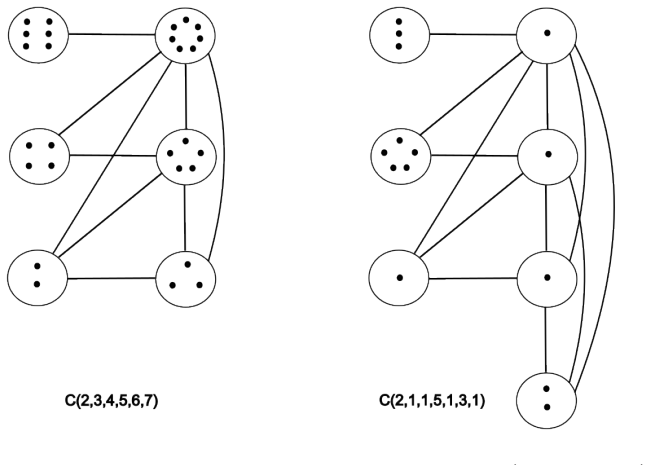
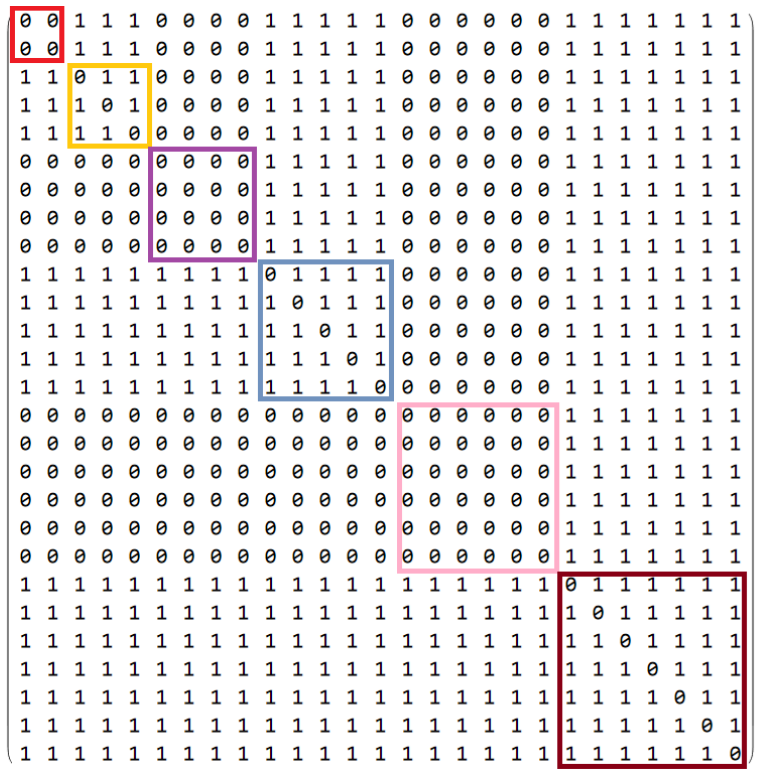
Threshold graphs are graphs that can be characterized in a number of different ways. For example, they are graphs that are $P_4,\ C_4,\ 2K_2$--free. They may also be characterized by a finite sequence of positive integers $a_1, \ldots, a_r$, such that $a_1\geqslant 2$ and $a_1 + a_2 + \cdots + a_r = |V(G)|$. Threshold graphs have the remarkable property that all graphs of the same order share a common integer Laplacian eigenbasis. This property characterizes threshold graphs. This result was proved in \cite{MachareteDelVecchio}. We give a different proof of the same result.
Editorial analysis
A structured set of objections, weighed in public.
Referee Report
Summary. The paper supplies an alternative proof of the known characterization that, for fixed order n, the graphs sharing a common integer Laplacian eigenbasis are precisely the threshold graphs. Threshold graphs are defined either as the P4-, C4-, 2K2-free graphs or via an integer sequence a1 ≥ 2 with sum ai = n. The forward direction constructs the eigenbasis explicitly as indicator vectors of the nested neighborhoods determined by the sequence; the converse shows that any graph outside the forbidden-subgraph class forces at least one eigenvector to have a non-integer entry or to fail to be common across the family.
Significance. The manuscript delivers an independent re-proof that relies only on the Laplacian matrix entries and the degree-sequence properties of threshold graphs, without circular appeal to the Macharete–Del Vecchio argument. The explicit construction from the integer sequence provides a concrete, verifiable link between the combinatorial definition and the spectral property, which may aid further work on eigenvector bases for other hereditary graph classes.
minor comments (3)
- [Section 3] In the construction of the basis vectors from the sequence (a1,…,ar), the paper should explicitly verify that the resulting vectors are orthogonal with respect to the standard inner product and that their eigenvalues match the Laplacian spectrum for each graph in the family.
- [Section 4] The converse argument would benefit from a short table or diagram illustrating, for a small non-threshold graph such as P4, which eigenvector entry becomes non-integer.
- [Introduction] A brief comparison paragraph noting the main technical difference from the earlier proof would help readers assess the novelty of the approach.
Simulated Author's Rebuttal
We thank the referee for their careful reading of the manuscript and for the positive assessment. We are pleased with the recommendation to accept.
Circularity Check
No significant circularity
full rationale
The paper explicitly constructs the common integer Laplacian eigenbasis for threshold graphs from the integer-sequence definition by taking indicator vectors of the nested neighborhoods determined by the sequence (a1 ≥ 2, sum ai = n). It then proves the converse by direct verification that any graph containing a forbidden subgraph (P4, C4, or 2K2) forces at least one eigenvector to have a non-integer coordinate or to fail to be shared across all graphs of order n. Both directions operate solely from the definition of the Laplacian matrix and the degree-sequence properties of the graphs; the citation to MachareteDelVecchio is used only to identify the known result being reproved, not as a load-bearing step inside the derivations. No equation reduces a claimed prediction or uniqueness statement to a quantity defined only by the prior paper or by a fitted parameter.
Axiom & Free-Parameter Ledger
axioms (2)
- domain assumption Threshold graphs are exactly the P4-, C4-, 2K2-free graphs
- domain assumption Threshold graphs are exactly those admitting a sequence a1 ≥ 2, …, ar with sum equal to the number of vertices
Reference graph
Works this paper leans on
-
[1]
Bai, The Grone-Merris conjecture,Trans
H. Bai, The Grone-Merris conjecture,Trans. Amer. Math. Soc., 4463–4474. MR2792996↑2
-
[2]
A. Brandst¨ adt, V. B. Le and J. P. Spinrad,Graph classes: a survey, SIAM Monographs on Discrete Mathematics and Applications, SIAM, Philadelphia, PA, 1999
work page 1999
-
[3]
V. Chv´ atal and P. L. Hammer, Aggregation of inequalities in inte- ger programming, inStudies in integer programming (Proc. Workshop, Bonn, 1975), pp. 145–162, Ann. Discrete Math., Vol. 1, North-Holland, Amsterdam-New York-Oxford
work page 1975
-
[4]
D. G. Corneil, H. Lerchs and L. S. Burlingham, Complement reducible graphs,Discrete Appl. Math.3(1981), no. 3, 163–174
work page 1981
-
[5]
R. Grone and R. Merris, The Laplacian spectrum of a graph II, SIAM Journal on Discrete Mathematics 7 (1994), 221-229
work page 1994
-
[6]
P. Hammer and A. Kelmans, Laplacian spectra and spanning trees in threshold graphs, Discrete Applied Mathematics 65 (1996), 255-273
work page 1996
-
[7]
Which graphs have integral spectra?
F. Harary and A. J. Schwenk, “Which graphs have integral spectra?” inGraphs and Combinatorics: Proceedings of the Capital Conference on 15 Graph Theory and Combinatorics at the George Washington University June 18–22, 1973, R. A. Bari and F. Harary, Eds., vol. 406 of Lecture Notes in Mathematics, pp.45–51, Springer, Berlin, Germany, 1974
work page 1973
-
[8]
H. A. Jung, On a class of posets and the corresponding comparability graphs,J. Combinatorial Theory, Ser. B24(1978), no. 2, 125–133
work page 1978
-
[9]
Kirkland, Constructably Laplacian integral graphs,Linear Algebra and Its Applications, vol
S. Kirkland, Constructably Laplacian integral graphs,Linear Algebra and Its Applications, vol. 423, no. 1, pp. 3–21, 2007
work page 2007
-
[10]
ISSN: 1077-8926 The Electronic Journal of Combinatorics (E-JC) Volume 16, Issue 1 (2009)
Near Threshold Graphs Steve Kirkland. ISSN: 1077-8926 The Electronic Journal of Combinatorics (E-JC) Volume 16, Issue 1 (2009)
work page 2009
-
[11]
Lerchs, H.,On cliques and kernels, Tech. Report, Dept. of Comp. Sci., Univ. of Toronto (1971)
work page 1971
-
[12]
R. Macharete, R. Del-Vecchio, H. Teixeira, and L. de Lima. A Laplacian eigenbasis for threshold graphs,Special Matrices, vol. 12, no. 1, 2024, pp. 20240029. https://doi.org/10.1515/spma-2024-0029
-
[13]
N.V.R. Mahadev and U.N. Peled,Threshold Graphs and Related Topics, Annals of Discrete Mathematics, (1995). Elsevier, M09 13, ISBN: 978- 0-444-89287-4
work page 1995
-
[14]
R. Merris, Degree maximal graphs are Laplacian integral.Linear Algebra and its Applications,199(1994), 381–389. https://doi.org/10.1016/0024-3795(94)90361-1
-
[15]
Merris, Laplacian Graph Eigenvectors,Linear algebra and its appli- cations,278(1998), 221-–236
R. Merris, Laplacian Graph Eigenvectors,Linear algebra and its appli- cations,278(1998), 221-–236
work page 1998
-
[16]
R. Merris,Graph theory, Wiley-Interscience Series in Discrete Mathe- matics and Optimization, Wiley-Interscience, New York, 2001. Threshold Graphs and Related Topics Edited by N.V.R. Mahadev - Northeastern University, Boston, MA, USA U.N. Peled - University of Illinois at Chicago, Chicago, IL, USA Pages 1-543
work page 2001
-
[17]
Rosa, On certain valuations of the vertices of a graph,Theory of Graphs (Internat
A. Rosa, On certain valuations of the vertices of a graph,Theory of Graphs (Internat. Symposium, Rome, July 1966), Gordon and Breach, N. Y. and Dunod Paris (1967) 349-355
work page 1966
-
[18]
E. Ruch and I. Gutman, The branching extent of graphs, J. Combin. Inform. System Sci. 4(1979) 285-295. 16
work page 1979
-
[19]
I. Sciriha, J. L. Borg and Z. Sherman, Distinct Vertex-Edge Spectral Labelling for Antiregular Graphs, to appear
-
[20]
I. Sciriha, J. A. Briffa and M. Debono, Fast algorithms for indices of nested split graphs approximating real complex networks,Discrete Appl. Math.247(2018), 152–164
work page 2018
-
[21]
Irene Sciriha and Stephanie Farrugia, On the Spectrum of Threshold Graphs,ISRN Discrete Mathematics, 2011. DOI: 10.5402/2011/108509
-
[22]
W. So, Rank one perturbation and its application to the Laplacian spectrum of a graph,Linear and Multilinear Algebra,vol. 46, no. 3, pp. 193–198, 1999
work page 1999
-
[23]
Strang,Introduction to Linear Algebra, 6th edition, Wellesley- Cambridge Press (2022)
G. Strang,Introduction to Linear Algebra, 6th edition, Wellesley- Cambridge Press (2022)
work page 2022
-
[24]
D. P. Sumner, Dacey graphs,J. Austral. Math. Soc.18(1974), 492–502. 17
work page 1974
discussion (0)
Sign in with ORCID, Apple, or X to comment. Anyone can read and Pith papers without signing in.