Unifying Transport Models of Thermohaline Convection in Stars
Pith reviewed 2026-05-07 04:07 UTC · model grok-4.3
The pith
The full spectrum of unstable modes lets thermohaline diffusion interpolate between competing stellar mixing models.
A machine-rendered reading of the paper's core claim, the machinery that carries it, and where it could break.
Core claim
By accounting for the complete set of linearly unstable modes in thermohaline convection, the associated turbulent diffusion coefficient can be shown to transition continuously between the different scalings advanced in earlier work as the controlling parameters vary.
What carries the argument
The effective turbulent diffusion coefficient D_μ constructed by integrating contributions across the spectrum of linear growth rates and wavelengths of both slow large-scale and fast small-scale modes.
If this is right
- Stellar models gain a single formula for thermohaline mixing that automatically selects the appropriate scaling based on local conditions.
- The dominant contribution to mixing shifts from slow to fast modes or vice versa as parameters change.
- Predicted chemical profiles in stars become more reliable across different evolutionary stages.
- Discrepancies between theory and observations of surface abundances can be addressed by using the interpolated value.
Where Pith is reading between the lines
- High-resolution simulations could test whether the actual nonlinear transport follows the linear-mode prediction or requires additional saturation mechanisms.
- The same mode-spectrum approach might apply to analogous double-diffusive instabilities in planetary oceans or atmospheres.
- Observational tests could involve comparing models with and without the unified D_μ against asteroseismic or abundance data from specific stars.
Load-bearing premise
The actual turbulent transport rate is determined directly by the properties of the linearly unstable modes without needing to resolve nonlinear saturation or inter-mode coupling.
What would settle it
Numerical experiments that compute the mixing rate in the regime where both slow and fast modes are unstable and check whether the measured diffusion matches the interpolated expression or reverts to one of the limiting scalings.
Figures

read the original abstract
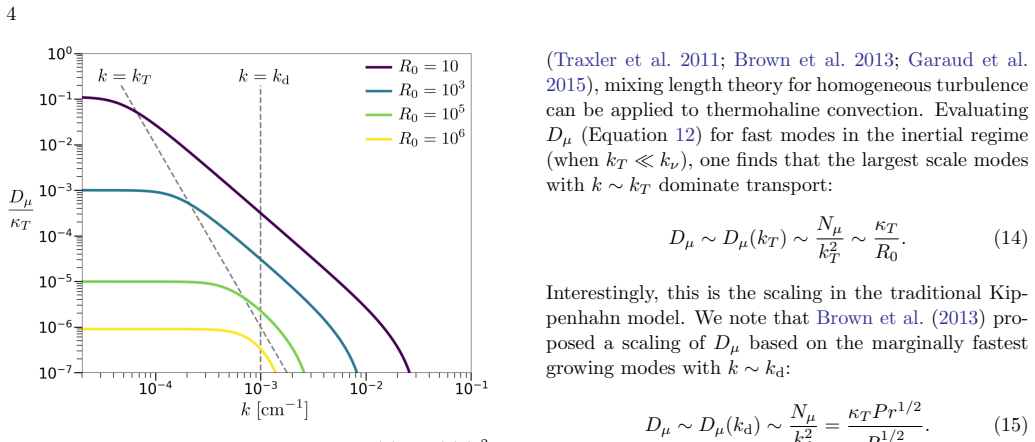
Thermohaline convection is a standard chemical mixing process in stellar interiors, yet its mixing efficiency is not fully settled. Competing theories predict turbulent diffusion coefficients, $D_\mu$, that can differ by orders of magnitude, leading to uncertainties in stellar models and interpretations of observations. This paper explores a potential resolution to existing discrepancies. We first complete the linear stability theory and identify two types of unstable modes: slow growing modes at large length scales and fast growing modes at small length scales. We then reevaluate $D_\mu$ considering the full spectrum of unstable modes and find that it can self-consistently interpolate between previously proposed theoretical scalings across the instability parameter space. The question of thermohaline mixing efficiency in stars may be settled by future simulations that quantify the scale-dependent contributions of fast and slow modes to $D_\mu$ and determine how the modes dominating the transport change across parameter space.
Editorial analysis
A structured set of objections, weighed in public.
Referee Report
Summary. The manuscript completes the linear stability analysis of thermohaline convection in stellar interiors, identifying two classes of unstable modes: slow-growing modes at large scales and fast-growing modes at small scales. It then reevaluates the turbulent diffusion coefficient D_μ over the full spectrum of these modes and claims that the resulting expression self-consistently interpolates between previously proposed theoretical scalings for mixing efficiency across the relevant instability parameter space. The paper concludes that the question of thermohaline mixing efficiency may be settled by future simulations that determine the scale-dependent contributions of the modes.
Significance. If the interpolation is shown to follow rigorously from the linear mode spectrum, the result would unify disparate predictions for D_μ that currently differ by orders of magnitude, thereby reducing systematic uncertainties in stellar evolution calculations of chemical transport and surface abundance anomalies.
major comments (2)
- [abstract and section on reevaluation of D_μ] The explicit mapping from the linear growth rates σ(k) and wavenumbers k of the unstable modes to the turbulent diffusivity D_μ is not derived or stated. The abstract and the reevaluation section assert that considering the full spectrum yields an interpolating D_μ, but no functional form (e.g., a weighted integral ∫ σ(k)/k² dk over the unstable band or a dominant-mode selection rule) is supplied. Without this step the interpolation claim cannot be verified and remains an extrapolation rather than a closed derivation. This is load-bearing for the central result.
- [concluding paragraph] The manuscript acknowledges that nonlinear saturation, mode interactions, and secondary instabilities are not treated, yet proceeds to equate linear quantities directly to turbulent transport. The concluding paragraph states that future simulations are required to quantify which modes dominate D_μ, confirming that the interpolation rests on an untested assumption that the linear spectrum sets the effective diffusivity scaling across parameter space. This assumption is central to the unification claim and requires either an explicit closure or a demonstration that nonlinear effects do not alter the scaling.
minor comments (2)
- [abstract] The abstract would be strengthened by including the explicit expression (or at least the functional dependence) for the interpolated D_μ rather than describing the procedure only in words.
- [linear stability section] Notation for the instability parameter space and the definitions of the slow and fast mode branches should be introduced with a single equation reference early in the linear-stability section to aid readability.
Simulated Author's Rebuttal
We thank the referee for the careful and constructive review of our manuscript. The comments correctly identify areas where the connection between the linear mode spectrum and the turbulent diffusivity requires greater explicitness, and where the limitations of the linear analysis should be emphasized. We address each major comment below and describe the revisions that will be incorporated in the next version of the manuscript.
read point-by-point responses
-
Referee: [abstract and section on reevaluation of D_μ] The explicit mapping from the linear growth rates σ(k) and wavenumbers k of the unstable modes to the turbulent diffusivity D_μ is not derived or stated. The abstract and the reevaluation section assert that considering the full spectrum yields an interpolating D_μ, but no functional form (e.g., a weighted integral ∫ σ(k)/k² dk over the unstable band or a dominant-mode selection rule) is supplied. Without this step the interpolation claim cannot be verified and remains an extrapolation rather than a closed derivation. This is load-bearing for the central result.
Authors: We agree that the explicit mapping from the linear growth rates and wavenumbers to D_μ was not stated with sufficient detail in the submitted manuscript. The reevaluation of D_μ in the paper follows the standard mixing-length approach used in prior thermohaline transport models, in which the contribution of each mode is estimated as proportional to σ(k)/k² and the effective diffusivity is obtained by integrating over the spectrum of unstable modes (both slow large-scale and fast small-scale). In the revised manuscript we will add a dedicated subsection that derives this functional form explicitly, shows the integral expression, and demonstrates analytically how the resulting D_μ interpolates between the previously discrepant scalings across the relevant range of the instability parameter. This addition will make the central claim directly verifiable from the linear analysis. revision: yes
-
Referee: [concluding paragraph] The manuscript acknowledges that nonlinear saturation, mode interactions, and secondary instabilities are not treated, yet proceeds to equate linear quantities directly to turbulent transport. The concluding paragraph states that future simulations are required to quantify which modes dominate D_μ, confirming that the interpolation rests on an untested assumption that the linear spectrum sets the effective diffusivity scaling across parameter space. This assumption is central to the unification claim and requires either an explicit closure or a demonstration that nonlinear effects do not alter the scaling.
Authors: We acknowledge that the present work is a linear stability analysis and does not treat nonlinear saturation or mode coupling. The manuscript unifies existing transport models, all of which themselves rest on linear-based estimates of D_μ; it does not claim to have derived a nonlinear closure. The concluding paragraph already states that future simulations are needed to determine the scale-dependent contributions of the fast and slow modes. In the revision we will strengthen this language to make explicit that the interpolation result holds within the linear framework and provides a consistent reference against which nonlinear simulations can be compared. We do not provide a nonlinear closure, as that lies outside the scope of the present study. revision: partial
Circularity Check
No significant circularity detected in the derivation
full rationale
The paper completes the linear stability analysis to identify slow large-scale and fast small-scale unstable modes, then reevaluates D_μ over the full spectrum using standard linear growth-rate and wavenumber inputs. This produces an interpolation between prior scalings as a direct consequence of including both mode classes rather than by presupposing the target result in the inputs. No self-definitional equations, fitted parameters renamed as predictions, load-bearing self-citations, or ansatz smuggling are present; the mapping from linear quantities to diffusivity is an independent closure assumption common to the field, not a tautology. The derivation chain is therefore self-contained against external linear-analysis benchmarks.
Axiom & Free-Parameter Ledger
axioms (2)
- domain assumption The governing equations of incompressible, Boussinesq double-diffusive convection apply to thermohaline mixing in stellar interiors.
- domain assumption The turbulent diffusion coefficient D_μ is determined by the spectrum of linearly unstable modes.
Reference graph
Works this paper leans on
- [1]
- [2]
- [3]
-
[4]
Bauer, E. B., & Bildsten, L. 2018, ApJL, 859, L19 —. 2019, ApJ, 872, 96
work page 2018
- [5]
-
[6]
M., Garaud, P., & Stellmach, S
Brown, J. M., Garaud, P., & Stellmach, S. 2013, ApJ, 768, 34
work page 2013
- [7]
- [8]
- [9]
- [10]
-
[11]
Cresswell, I. G., Fraser, A. E., Bauer, E. B., Anders, E. H., & Brown, B. P. 2025, ApJL, 986, L10
work page 2025
-
[12]
Currie, L. K., Barker, A. J., Lithwick, Y., & Browning, M. K. 2020, MNRAS, 493, 5233
work page 2020
-
[13]
Wachlin, F. C. 2013, A&A, 557, L12
work page 2013
-
[14]
Woodward, P. R. 2024, MNRAS, 535, 1243
work page 2024
-
[15]
Fraser, A. E. 2026, ApJL, 1001, L22
work page 2026
- [16]
-
[17]
Fraser, A. E., Reifenstein, S. A., & Garaud, P. 2024, ApJ, 964, 184
work page 2024
-
[18]
E., van Kan, A., Knobloch, E., Julien, K., & Liu, C
Fraser, A. E., van Kan, A., Knobloch, E., Julien, K., & Liu, C. 2025, JFM, 1020, R1
work page 2025
-
[19]
Fuentes, J., Castro-Tapia, M., & Cumming, A. 2024, ApJL, 964, L15
work page 2024
- [20]
- [21]
- [22]
-
[23]
Gratton, R., Sneden, C., Carretta, E., & Bragaglia, A. 2000, A&A, 354, 169
work page 2000
- [24]
-
[25]
Kippenhahn, R., Ruschenplatt, G., & Thomas, H.-C. 1980, A&A, 91, 175
work page 1980
-
[26]
1990, Stellar structure and evolution, Vol
Kippenhahn, R., Weigert, A., & Weiss, A. 1990, Stellar structure and evolution, Vol. 192 (Springer)
work page 1990
- [27]
-
[28]
Lattanzio, J. C., Siess, L., Church, R. P., et al. 2015, MNRAS, 446, 2673 Ligni` eres, F. 1999, A&A, 348, 933
work page 2015
-
[29]
Magrini, L., Lagarde, N., Charbonnel, C., et al. 2021, A&A, 651, A84
work page 2021
-
[30]
Montgomery, M., & Dunlap, B. H. 2024, ApJ, 961, 197
work page 2024
-
[31]
Placco, V. M., Frebel, A., Beers, T. C., & Stancliffe, R. J. 2014, ApJ, 797, 21
work page 2014
-
[32]
2013, Double-diffusive convection (Cambridge University Press)
Radko, T. 2013, Double-diffusive convection (Cambridge University Press)
work page 2013
- [33]
- [34]
-
[35]
Schneider, F. 2025, arXiv preprint arXiv:2509.18421
- [36]
- [37]
- [38]
- [39]
-
[40]
Skoutnev, V. A. 2023, JFM, 956, A7
work page 2023
- [41]
-
[42]
Stancliffe, R. J. 2010, MNRAS, 403, 505 7
work page 2010
-
[43]
Stancliffe, R. J., Glebbeek, E., Izzard, R. G., & Pols, O. R. 2007, A&A, 464, L57
work page 2007
-
[44]
Stern, M. E. 1960, Tellus, 12, 172
work page 1960
-
[45]
Stevenson, D. J. 1979, GAFD, 12, 139
work page 1979
-
[46]
2022, ApJL, 935, L30 Th´ eado, S., & Vauclair, S
Tayar, J., & Joyce, M. 2022, ApJL, 935, L30 Th´ eado, S., & Vauclair, S. 2012, ApJ, 744, 123
work page 2022
- [47]
-
[48]
Ulrich, R. K. 1972, ApJ, 172, 165
work page 1972
- [49]
-
[50]
C., Vauclair, G., Vauclair, S., & Althaus, L
Wachlin, F. C., Vauclair, G., Vauclair, S., & Althaus, L. G. 2022, A&A, 660, A30
work page 2022
-
[51]
C., Vauclair, S., & Althaus, L
Wachlin, F. C., Vauclair, S., & Althaus, L. G. 2014, A&A, 570, A58
work page 2014
- [52]
- [53]
-
[54]
Xie, J.-H., Miquel, B., Julien, K., & Knobloch, E. 2017, Fluids, 2, 6
work page 2017
-
[55]
Zemskova, V., Garaud, P., Deal, M., & Vauclair, S. 2014, ApJ, 795, 118
work page 2014
discussion (0)
Sign in with ORCID, Apple, or X to comment. Anyone can read and Pith papers without signing in.