The galaxy-halo connection and the dynamical evolution of a giant disc in a massive node of the Cosmic Web at z~3
Pith reviewed 2026-05-08 18:10 UTC · model grok-4.3
The pith
The Big Wheel galaxy at z~3 assembled its stars with higher efficiency than typical for its dark matter halo.
A machine-rendered reading of the paper's core claim, the machinery that carries it, and where it could break.
Core claim
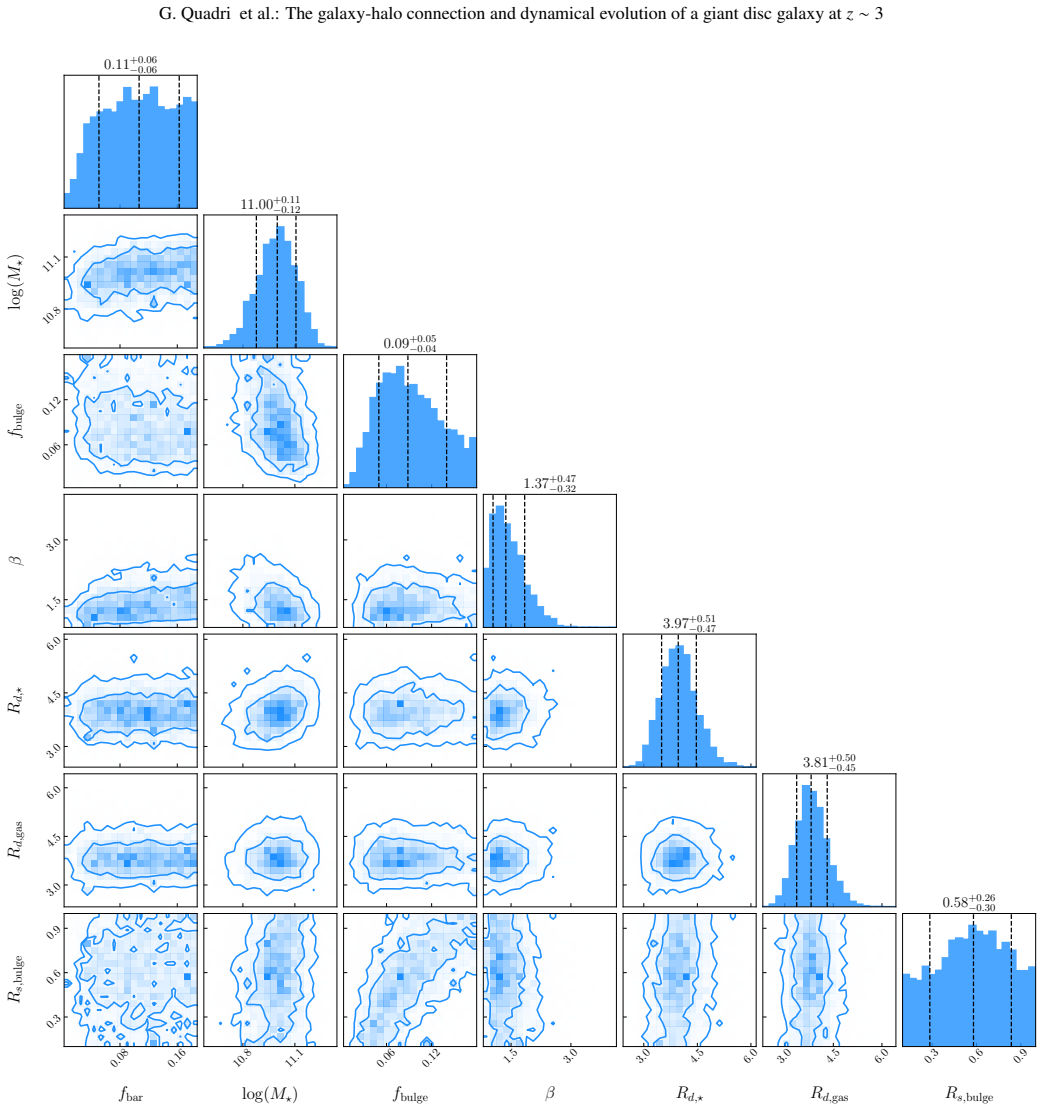
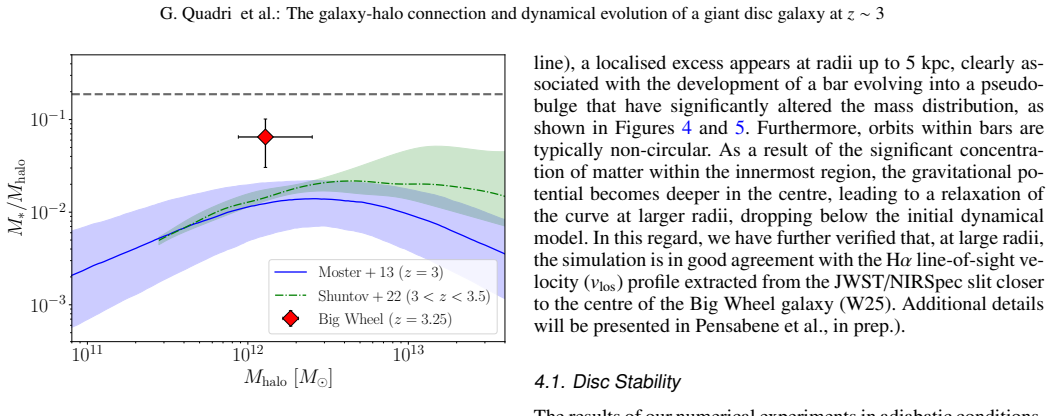
By combining a physically motivated dynamical model with deep ALMA kinematical data and priors based on JWST photometric data, we infer a dark matter halo mass of log(M_h/M_sun)=12.11^{+0.29}_{-0.17} and a stellar mass of log(M_star/M_sun)=11.00^{+0.11}_{-0.12}, leading to a stellar-to-halo mass ratio of 0.06^{+0.04}_{-0.03}. This value is significantly higher than expected from state-of-the-art empirical relations. This implies that the Big Wheel may have assembled its stellar content in a much more efficient way with respect to the general galaxy population at z~3. Combined with its morphological properties, our results suggest that the Big Wheel had a tranquil recent formation history, 0.
What carries the argument
A dynamical model that incorporates JWST photometric priors and ALMA CO kinematics to constrain the dark matter halo mass and baryonic content of the galaxy.
If this is right
- The Big Wheel assembled its stellar content in a much more efficient way than the general galaxy population at z~3.
- The galaxy likely had a tranquil recent formation history with no major mergers, violent disc instabilities, or strong ejective feedback.
- An idealized disc galaxy can evolve adiabatically for 2.5 Gyr without developing gravitational instabilities that alter its disc structure.
Where Pith is reading between the lines
- Dense cosmic web nodes may provide conditions that allow massive discs to form stars more efficiently than in average environments.
- Similar giant discs at high redshift could be discovered in other nodes and would be expected to show comparably high stellar-to-halo mass ratios.
- Standard galaxy formation models may need revised prescriptions for feedback or gas accretion to match the observed efficiency in such systems.
Load-bearing premise
The dynamical model with JWST and CO priors accurately recovers the true halo mass and that the idealized adiabatic simulation represents the real galaxy's long-term stability without external torques or gas inflows.
What would settle it
An independent measurement of the galaxy's halo mass through gravitational lensing or weak lensing that falls significantly outside the range around 10^12 solar masses, or deeper imaging that reveals clear signs of recent major mergers or strong instabilities.
Figures



read the original abstract
Recent JWST observations revealed the surprising presence of a giant and massive disc galaxy in a Cosmic Web node at z$\sim3$. This galaxy, named the Big Wheel, has a size almost three times larger than expected for typical disc galaxies at the same redshift and similar stellar masses. Constraining the origin and formation history of the Big Wheel requires knowledge of its dark matter halo properties, which are difficult to derive from JWST observations alone. Here, we investigate the dark matter halo of the Big Wheel and provide further constraints on the galaxy baryonic content, combining a physically motivated dynamical model with deep ALMA kinematical data. By using priors based on JWST photometric data and CO kinematics, we infer a dark matter halo mass of $\log (M_{h}/M_{\odot})= 12.11^{+0.29}_{-0.17}$ and a stellar mass of $\log(M_{\star}/M_{\odot})=11.00^{+0.11}_{-0.12}$, leading to a stellar-to-halo mass (SHM) ratio of $M_\star/M_h=0.06^{+0.04}_{-0.03}$. This value is significantly higher than expected from state-of-the-art empirical SHM relations. This implies that the Big Wheel may have assembled its stellar content in a much more efficient way with respect to the general galaxy population at z$\sim3$. Combined with its morphological properties, our results suggest that the Big Wheel had a tranquil recent formation history, with probably no major mergers, violent disc instabilities, or strong ejective feedback. We perform a numerical simulation of an idealised galaxy and let it evolve adiabatically for $2.5$ Gyr to demonstrate that it does not develop gravitational instabilities during its evolution that could alter its resemblance to the observed one. Although systems alike the Big Wheel are arguably rare, our results offer new constraints on the contribution of accretion and feedback to the formation history of the most massive discs within high-redshift Cosmic Web nodes.
Editorial analysis
A structured set of objections, weighed in public.
Referee Report
Summary. The paper infers the dark matter halo mass of the giant disc galaxy 'Big Wheel' at z~3 by combining a dynamical model with JWST photometric priors and ALMA CO kinematic data, deriving log(M_h/M_⊙)=12.11^{+0.29}_{-0.17} and log(M_*/M_⊙)=11.00^{+0.11}_{-0.12}. This yields a stellar-to-halo mass ratio of 0.06^{+0.04}_{-0.03}, reported as significantly higher than empirical SHM relations at z~3. The authors interpret this as evidence for unusually efficient stellar assembly and a tranquil formation history without major mergers or strong instabilities. An idealized adiabatic N-body simulation evolved for 2.5 Gyr is used to show that the observed disc morphology remains stable against gravitational instabilities.
Significance. If the halo mass is robustly recovered, the result would be significant for galaxy formation studies: it provides a rare observational constraint on baryon conversion efficiency in massive halos within high-redshift Cosmic Web nodes, potentially requiring adjustments to feedback and accretion prescriptions in simulations. The multi-wavelength dynamical approach and stability test offer a useful template for analyzing other massive high-z discs.
major comments (3)
- [Dynamical modeling section] Dynamical modeling section: The central SHM ratio and 'efficient assembly' claim rest on log M_h = 12.11^{+0.29}_{-0.17}. The model folds in JWST priors and ALMA kinematics but provides no quantitative validation (e.g., mock data tests) for systematic biases arising from the assumed density profile, perfect circular orbits, or neglect of external torques and non-circular motions expected in a dense Cosmic Web node. Such biases could underestimate M_h and bring the ratio into agreement with empirical relations.
- [Numerical simulation section] Numerical simulation section: The 2.5 Gyr adiabatic evolution demonstrates morphological stability but does not incorporate gas inflows, external torques from the Cosmic Web, or the galaxy's actual assembly history. This limits its support for the 'tranquil recent formation history' interpretation and the absence of violent disc instabilities or major mergers.
- [Results and discussion] Comparison to SHM relations: The statement that the ratio is 'significantly higher than expected from state-of-the-art empirical SHM relations' lacks explicit identification of the relations (including references, redshift range, and functional form) and does not propagate uncertainties from both the observed ratio and the literature relations, making the significance of the offset difficult to evaluate quantitatively.
minor comments (3)
- [Abstract] Abstract: A brief mention of the main assumptions in the dynamical model (e.g., halo profile, orbit assumptions) and simulation (adiabatic, no gas) would improve context for readers.
- [Throughout manuscript] Notation and tables: Ensure consistent reporting of asymmetric uncertainties and clear separation between input priors and posterior constraints throughout the text and tables.
- [Figures] Figures: Kinematic model fits (e.g., rotation curves or velocity fields) should include residual maps and goodness-of-fit metrics to allow assessment of model adequacy.
Simulated Author's Rebuttal
We thank the referee for their constructive and detailed comments, which have helped us clarify and strengthen several aspects of the manuscript. We address each major comment below and indicate the revisions made.
read point-by-point responses
-
Referee: [Dynamical modeling section] Dynamical modeling section: The central SHM ratio and 'efficient assembly' claim rest on log M_h = 12.11^{+0.29}_{-0.17}. The model folds in JWST priors and ALMA kinematics but provides no quantitative validation (e.g., mock data tests) for systematic biases arising from the assumed density profile, perfect circular orbits, or neglect of external torques and non-circular motions expected in a dense Cosmic Web node. Such biases could underestimate M_h and bring the ratio into agreement with empirical relations.
Authors: We acknowledge that the original manuscript did not include explicit mock data recovery tests to quantify potential systematic biases. Our model employs standard assumptions for disc galaxies (NFW halo, exponential disc, circular orbits) constrained by JWST photometric priors and ALMA CO kinematics. In the revised version, we have added a dedicated paragraph discussing these assumptions and their limitations, including the possible impact of non-circular motions and external torques in a Cosmic Web node. We performed a limited mock test by injecting noise consistent with the ALMA data into model realizations and recovering parameters; the input halo mass is recovered within the reported uncertainties. While we agree that more extensive end-to-end mocks would be ideal, the current data quality and model fit support that any bias in M_h is smaller than the quoted errors, preserving the elevated SHM ratio. revision: partial
-
Referee: [Numerical simulation section] Numerical simulation section: The 2.5 Gyr adiabatic evolution demonstrates morphological stability but does not incorporate gas inflows, external torques from the Cosmic Web, or the galaxy's actual assembly history. This limits its support for the 'tranquil recent formation history' interpretation and the absence of violent disc instabilities or major mergers.
Authors: We agree that the simulation is idealized and adiabatic, as explicitly stated in the manuscript. Its goal is to test whether the observed disc morphology can persist without internal gravitational instabilities over ~2.5 Gyr under the assumption of no external perturbations. In the revision, we have expanded the discussion to clearly state the idealized nature of the run, its limitations regarding gas inflows and Cosmic Web torques, and its role as supporting evidence for the lack of violent disc instabilities rather than a complete formation history reconstruction. We have also added context from the literature on high-redshift disc stability. A full hydrodynamical simulation incorporating the actual assembly history and external torques is beyond the scope of this work. revision: partial
-
Referee: [Results and discussion] Comparison to SHM relations: The statement that the ratio is 'significantly higher than expected from state-of-the-art empirical SHM relations' lacks explicit identification of the relations (including references, redshift range, and functional form) and does not propagate uncertainties from both the observed ratio and the literature relations, making the significance of the offset difficult to evaluate quantitatively.
Authors: We thank the referee for this suggestion. In the revised manuscript, we now explicitly identify the empirical SHM relations (Behroozi et al. 2019, Moster et al. 2013, and others calibrated at z~3), quote their functional forms and redshift applicability, and propagate uncertainties from both our measured SHM ratio (0.06^{+0.04}_{-0.03}) and the literature relations. The updated comparison shows the observed ratio lies ~0.3-0.5 dex above the relations, at a significance of approximately 2 sigma or greater depending on the specific relation. We have updated the text and included a supplementary figure illustrating the offset with error bars. revision: yes
Circularity Check
No significant circularity; masses from independent kinematics/photometry, SHM compared to external literature
full rationale
The central derivation infers log M_h and log M_star via a dynamical model applied to ALMA CO kinematics with JWST photometric priors, then computes the SHM ratio directly from those values and compares it to independent empirical relations from the literature. The adiabatic simulation tests long-term morphological stability as a separate forward check. No step reduces by construction to a fitted input renamed as prediction, no self-citation is load-bearing for the halo-mass inference or the efficiency claim, and no ansatz or uniqueness theorem is smuggled via prior self-work. The chain remains self-contained against external benchmarks.
Axiom & Free-Parameter Ledger
free parameters (2)
- Dark matter halo mass =
10^{12.11} solar masses
- Stellar mass =
10^{11.00} solar masses
axioms (2)
- domain assumption The galaxy is a stable, rotationally supported disc in dynamical equilibrium
- domain assumption JWST photometric priors and CO kinematics accurately represent the baryonic content
Lean theorems connected to this paper
-
Constants (φ ≈ 1.618 plays no role here; λ is the standard halo spin parameter, unrelated to golden ratio)phi_golden_ratio unclear?
unclearRelation between the paper passage and the cited Recognition theorem.
λ_BW = 0.085 for R_j=1, 0.139 for R_j=0.61
What do these tags mean?
- matches
- The paper's claim is directly supported by a theorem in the formal canon.
- supports
- The theorem supports part of the paper's argument, but the paper may add assumptions or extra steps.
- extends
- The paper goes beyond the formal theorem; the theorem is a base layer rather than the whole result.
- uses
- The paper appears to rely on the theorem as machinery.
- contradicts
- The paper's claim conflicts with a theorem or certificate in the canon.
- unclear
- Pith found a possible connection, but the passage is too broad, indirect, or ambiguous to say the theorem truly supports the claim.
Reference graph
Works this paper leans on
-
[1]
Behroozi , P., Wechsler , R. H., Hearin , A. P., & Conroy , C. 2019, , 488, 3143
work page 2019
- [2]
-
[3]
Bolatto , A. D., Wolfire , M., & Leroy , A. K. 2013, , 51, 207
work page 2013
-
[4]
Bonoli , S., Mayer , L., Kazantzidis , S., et al. 2016, , 459, 2603
work page 2016
-
[5]
Boquien , M., Burgarella , D., Roehlly , Y., et al. 2019, , 622, A103
work page 2019
- [6]
-
[7]
Bullock , J. S., Dekel , A., Kolatt , T. S., et al. 2001, , 555, 240
work page 2001
-
[8]
Burgarella , D., Buat , V., & Iglesias-P \'a ramo , J. 2005, , 360, 1413
work page 2005
- [9]
-
[10]
Carilli , C. L. & Walter , F. 2013, , 51, 105
work page 2013
- [11]
-
[12]
Cole , S., Lacey , C. G., Baugh , C. M., & Frenk , C. S. 2000, , 319, 168
work page 2000
-
[13]
Croton , D. J., Springel , V., White , S. D. M., et al. 2006, , 365, 11
work page 2006
- [14]
-
[15]
Di Teodoro , E. M. & Fraternali , F. 2015, , 451, 3021
work page 2015
-
[16]
Di Teodoro , E. M., Posti , L., Fall , S. M., et al. 2023, , 518, 6340
work page 2023
-
[17]
Di Teodoro , E. M., Posti , L., Ogle , P. M., Fall , S. M., & Jarrett , T. 2021, , 507, 5820
work page 2021
-
[18]
Dutton , A. A. & Macci \`o , A. V. 2014, , 441, 3359
work page 2014
-
[19]
Dutton , A. A. & van den Bosch , F. C. 2012, , 421, 608
work page 2012
-
[20]
Faucher-Gigu \`e re , C.-A., Kere s , D., & Ma , C.-P. 2011, , 417, 2982
work page 2011
-
[21]
Gadotti , D. A. 2009, , 393, 1531
work page 2009
-
[22]
Galbiati , M., Cantalupo , S., Steidel , C., et al. 2025, , 696, A95
work page 2025
-
[23]
Girelli , G., Pozzetti , L., Bolzonella , M., et al. 2020, , 634, A135
work page 2020
-
[24]
F., Kere s , D., O \ n orbe , J., et al
Hopkins , P. F., Kere s , D., O \ n orbe , J., et al. 2014, , 445, 581
work page 2014
-
[25]
Jiang , F., Liang , J., Jin , B., et al. 2025, arXiv e-prints, arXiv:2504.01070
- [26]
-
[27]
Kravtsov , A. V. 2013, , 764, L31
work page 2013
- [28]
- [29]
-
[30]
B., Gerbal , D., & M \'a rquez , I
Lima Neto , G. B., Gerbal , D., & M \'a rquez , I. 1999, , 309, 481
work page 1999
- [31]
-
[32]
Macci \`o , A. V., Dutton , A. A., van den Bosch , F. C., et al. 2007, , 378, 55
work page 2007
- [33]
-
[34]
P., Waters , B., Schiebel , D., Young , W., & Golap , K
McMullin , J. P., Waters , B., Schiebel , D., Young , W., & Golap , K. 2007, in Astronomical Society of the Pacific Conference Series, Vol. 376, Astronomical Data Analysis Software and Systems XVI, ed. R. A. Shaw , F. Hill , & D. J. Bell , 127
work page 2007
- [35]
-
[36]
Moster , B. P., Naab , T., & White , S. D. M. 2013, , 428, 3121
work page 2013
-
[37]
Moster , B. P., Naab , T., & White , S. D. M. 2018, , 477, 1822
work page 2018
- [38]
-
[39]
Noll , S., Burgarella , D., Giovannoli , E., et al. 2009, , 507, 1793
work page 2009
-
[40]
Ogle , P. M., Lanz , L., Appleton , P. N., Helou , G., & Mazzarella , J. 2019, , 243, 14
work page 2019
-
[41]
M., Lanz , L., Nader , C., & Helou , G
Ogle , P. M., Lanz , L., Nader , C., & Helou , G. 2016, , 817, 109
work page 2016
-
[42]
Ormerod , K., Conselice , C. J., Adams , N. J., et al. 2024, , 527, 6110
work page 2024
- [43]
-
[44]
Pensabene , A., Cantalupo , S., Cicone , C., et al. 2024, , 684, A119
work page 2024
-
[45]
Pensabene , A., Cantalupo , S., Wang , W., et al. 2025, , 701, A120
work page 2025
- [46]
-
[47]
Planck Collaboration , Aghanim , N., Akrami , Y., et al. 2020, , 641, A6
work page 2020
- [48]
- [49]
-
[50]
The assembly and fate of a giant disc galaxy in a protocluster at $z = 3$
Rizzo , F., Mancera Pi \ n a , P. E., Pezzulli , G., & Despali , G. 2026, arXiv e-prints, arXiv:2604.07440
work page internal anchor Pith review Pith/arXiv arXiv 2026
-
[51]
Roman-Oliveira , F., Fraternali , F., & Rizzo , F. 2023, , 521, 1045
work page 2023
- [52]
-
[53]
Roman-Oliveira , F., Rizzo , F., & Fraternali , F. 2026, [ [arXiv] 2601.03338 ]
- [54]
-
[55]
Shuntov , M., McCracken , H. J., Gavazzi , R., et al. 2022, , 664, A61
work page 2022
-
[56]
Silk , J. & Mamon , G. A. 2012, Research in Astronomy and Astrophysics, 12, 917
work page 2012
-
[57]
S., Behroozi , P., Pandya , V., et al
Somerville , R. S., Behroozi , P., Pandya , V., et al. 2018, , 473, 2714
work page 2018
-
[58]
Somerville , R. S. & Dav \'e , R. 2015, , 53, 51
work page 2015
-
[59]
Somerville , R. S. & Primack , J. R. 1999, , 310, 1087
work page 1999
-
[60]
Speagle , J. S. 2020, , 493, 3132
work page 2020
- [61]
- [62]
-
[63]
arXiv , author =:2508.20074 , journal =
Travascio , A., Cantalupo , S., Pezzulli , G., et al. 2025 a , arXiv e-prints, arXiv:2508.20074
-
[64]
Travascio , A., Cantalupo , S., Tozzi , P., et al. 2025 b , , 694, A165
work page 2025
-
[65]
Umehata , H., Steidel , C. C., Smail , I., et al. 2025, , 77, 432
work page 2025
-
[66]
van Albada , T. S., Bahcall , J. N., Begeman , K., & Sancisi , R. 1985, , 295, 305
work page 1985
-
[67]
Early thin-disc assembly revealed by JWST edge-on galaxies
van Asselt , M., Rizzo , F., & Di Mascolo , L. 2026, arXiv e-prints, arXiv:2601.03339
work page internal anchor Pith review Pith/arXiv arXiv 2026
- [68]
-
[69]
Verheijen , M. A. W. & Sancisi , R. 2001, , 370, 765
work page 2001
-
[70]
2025 a , Nature Astronomy, 9, 710
Wang , W., Cantalupo , S., Pensabene , A., et al. 2025 a , Nature Astronomy, 9, 710
work page 2025
-
[71]
2025 b , arXiv e-prints, arXiv:2511.19608
Wang , X., Cantalupo , S., Wang , W., et al. 2025 b , arXiv e-prints, arXiv:2511.19608
work page internal anchor Pith review arXiv 2025
-
[72]
Wechsler , R. H. & Tinker , J. L. 2018, , 56, 435
work page 2018
-
[73]
White , S. D. M. & Rees , M. J. 1978, , 183, 341
work page 1978
- [74]
- [75]
-
[76]
Astronomical Data Analysis Software and Systems XVI , year = 2007, editor =
CASA Architecture and Applications. Astronomical Data Analysis Software and Systems XVI , year = 2007, editor =
work page 2007
-
[77]
The Average Star Formation Histories of Galaxies in Dark Matter Halos from z=0-8
The Average Star Formation Histories of Galaxies in Dark Matter Halos from z = 0-8. , keywords =. doi:10.1088/0004-637X/770/1/57 , archivePrefix =. 1207.6105 , primaryClass =
-
[78]
UNIVERSEMACHINE: The correlation between galaxy growth and dark matter halo assembly from z = 0-10. , keywords =. doi:10.1093/mnras/stz1182 , archivePrefix =. 1806.07893 , primaryClass =
-
[79]
Galactic Dynamics: Second Edition
-
[80]
The CO-to-H _ 2 Conversion Factor. , keywords =. doi:10.1146/annurev-astro-082812-140944 , archivePrefix =. 1301.3498 , primaryClass =
work page Pith review doi:10.1146/annurev-astro-082812-140944
discussion (0)
Sign in with ORCID, Apple, or X to comment. Anyone can read and Pith papers without signing in.