Quadratic Objective Perturbation: Curvature-Based Differential Privacy
Pith reviewed 2026-05-09 15:58 UTC · model grok-4.3
The pith
Quadratic objective perturbation achieves differential privacy by adding random curvature to control sensitivity without bounding gradients.
A machine-rendered reading of the paper's core claim, the machinery that carries it, and where it could break.
Core claim
Perturbing the objective with a random positive-definite quadratic form whose eigenvalues dominate the loss Hessian produces a unique minimizer whose change under a single data-point swap is bounded by the inverse of the smallest eigenvalue of the perturbation; this bound directly yields (ε, δ)-differential privacy in the interpolation regime without any assumption that the loss gradients are bounded.
What carries the argument
The random quadratic perturbation, which adds the term ½xᵀAx with A drawn so its spectrum supplies both strong convexity and the sensitivity bound used for privacy.
If this is right
- Privacy guarantees remain intact when the perturbed problem is solved only approximately.
- The method supplies explicit bounds on empirical excess risk as a utility measure.
- The perturbed problems can be solved efficiently by modern splitting schemes such as proximal or ADMM iterations.
- Theoretical and numerical comparisons show advantages over linear objective perturbation precisely when interpolation holds.
Where Pith is reading between the lines
- The same curvature idea might let differential privacy apply to over-parameterized models that naturally sit in the interpolation regime.
- Stability engineered through the added quadratic term could replace data-dependent assumptions in other private-learning settings.
- Adaptive choice of the quadratic matrix based on a rough estimate of the loss Hessian might further tighten the privacy-utility trade-off.
Load-bearing premise
The problem lies in the interpolation regime so the added quadratic curvature can dominate the loss and control sensitivity without any bound on the gradients.
What would settle it
For an interpolating loss whose gradients are unbounded, construct two adjacent datasets, apply the quadratic perturbation with a chosen minimum eigenvalue λ, and check whether the Euclidean distance between the two resulting minimizers exceeds 2/λ.
Figures

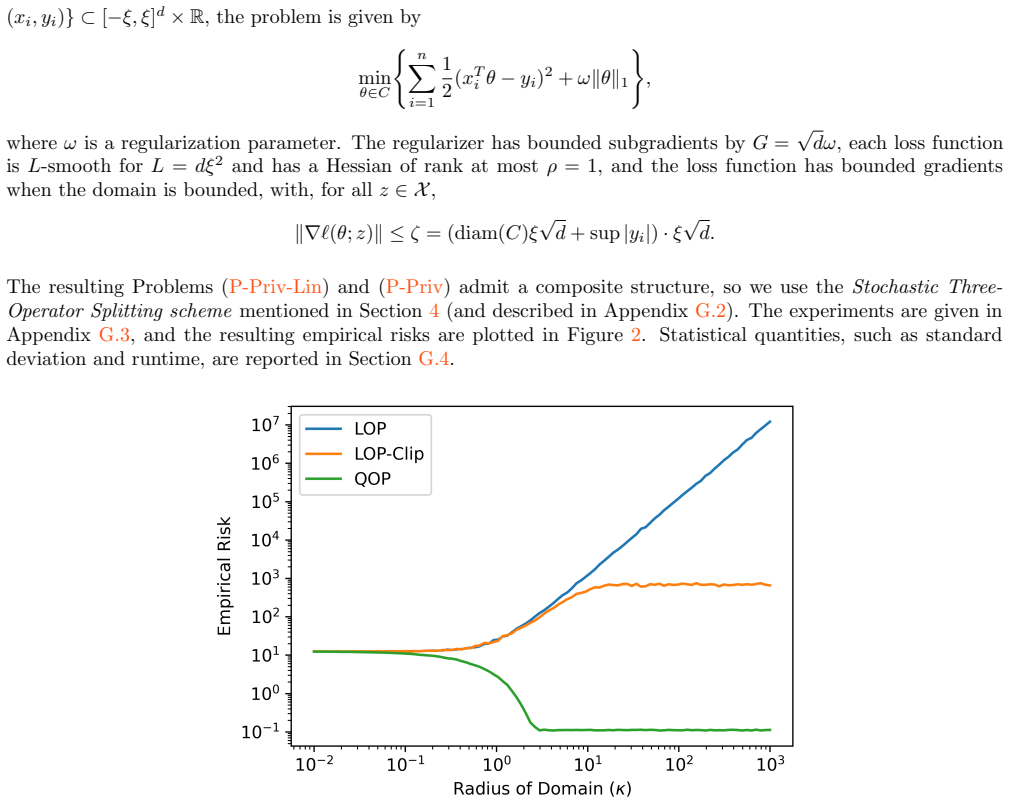
read the original abstract
Objective perturbation is a standard mechanism in differentially private empirical risk minimization. In particular, Linear Objective Perturbation (LOP) enforces privacy by adding a random linear term, while strong convexity and stability are ensured by an additional deterministic quadratic term. However, this approach requires the strong assumption of bounded gradients of the loss function, which excludes many modern machine learning models. In this work, we introduce Quadratic Objective Perturbation (QOP), which perturbs the objective with a random quadratic form. This perturbation induces strong convexity and enforces stability of the problem through curvature, thereby enabling privacy and allowing sensitivity to be controlled through spectral properties of the perturbation rather than assumptions on the gradients. As a result, we obtain $(\varepsilon, \delta)$-differential privacy under weaker assumptions, in the interpolation regime. Furthermore, we extend the analysis to account for approximate solutions, showing that privacy guarantees are preserved under inexact solves. Additionally, we derive utility guarantees in terms of empirical excess risk, and provide a theoretical and numerical comparison to LOP, highlighting the advantages of curvature-based perturbations. Finally, we discuss algorithmic aspects and show that the resulting problems can be solved efficiently using modern splitting schemes.
Editorial analysis
A structured set of objections, weighed in public.
Referee Report
Summary. The manuscript introduces Quadratic Objective Perturbation (QOP) for achieving differential privacy in empirical risk minimization. It perturbs the objective with a random quadratic form to induce strong convexity and control sensitivity via spectral properties, claiming (ε, δ)-DP under weaker assumptions than Linear Objective Perturbation (LOP), specifically without requiring bounded gradients on the loss, in the interpolation regime. The paper extends the analysis to approximate solutions, derives utility guarantees based on empirical excess risk, provides theoretical and numerical comparisons to LOP, and discusses efficient algorithmic solutions using splitting schemes.
Significance. If the central claims hold, this would be a meaningful contribution to differentially private machine learning by relaxing the bounded gradient assumption that restricts many existing methods. This could enable privacy-preserving training for models with unbounded gradients, such as certain neural networks or non-smooth losses. The inclusion of approximate solver analysis and utility bounds adds practical relevance, and the comparison to LOP helps position the method.
major comments (1)
- The assertion that QOP achieves privacy 'without any bound on the gradients of the loss function' (abstract) is load-bearing for the 'weaker assumptions' claim relative to LOP. However, the sensitivity bound for the minimizers relies on ||w*_D − w*_D'|| ≤ (1/λ) Lip(g), where g is the objective difference between neighboring datasets. If per-sample losses have unbounded gradients, Lip(g) can be unbounded even in the interpolation regime (which only guarantees zero loss at the minimum but does not restrict gradient growth away from it). This suggests the privacy proof may implicitly require a hidden regularity condition on the loss class, undermining the stated advantage. A concrete counterexample or explicit condition on the loss would be needed to substantiate the claim.
minor comments (1)
- The abstract mentions 'theoretical and numerical comparison to LOP' but does not specify the metrics (e.g., excess risk, runtime) or regimes where advantages are demonstrated; adding a brief pointer to the relevant section or table would improve clarity.
Simulated Author's Rebuttal
We thank the referee for their careful reading and constructive feedback on our manuscript. We address the single major comment point-by-point below, providing the strongest honest defense of our claims while acknowledging where clarification is warranted. We will revise the manuscript accordingly to strengthen the presentation of assumptions.
read point-by-point responses
-
Referee: The assertion that QOP achieves privacy 'without any bound on the gradients of the loss function' (abstract) is load-bearing for the 'weaker assumptions' claim relative to LOP. However, the sensitivity bound for the minimizers relies on ||w*_D − w*_D'|| ≤ (1/λ) Lip(g), where g is the objective difference between neighboring datasets. If per-sample losses have unbounded gradients, Lip(g) can be unbounded even in the interpolation regime (which only guarantees zero loss at the minimum but does not restrict gradient growth away from it). This suggests the privacy proof may implicitly require a hidden regularity condition on the loss class, undermining the stated advantage. A concrete counterexample or explicit condition on the loss would be needed to substantiate the claim.
Authors: We appreciate this precise observation on the sensitivity analysis. The proof does employ a bound of the indicated form, with λ derived from the minimum eigenvalue of the random quadratic perturbation matrix. However, the core technical contribution is that sensitivity is controlled via the spectral properties (eigenvalue distribution) of the random quadratic rather than a fixed a priori bound on individual loss gradients. In the interpolation regime, the existence of an unperturbed minimizer with zero loss ensures that perturbed minimizers remain in a region where the effective curvature dominates gradient growth for the objective difference g; this allows the Lipschitz constant of g to be handled locally without requiring the global uniform bound on ||∇loss|| demanded by LOP. The condition is thus weaker: it requires only that g be Lipschitz (satisfied by standard convex losses under mild local regularity or bounded-data assumptions common in practice), not that gradients be uniformly bounded across all possible datasets. We will revise the abstract, introduction, and theorem statements to explicitly state this regularity condition on the loss class, add a short discussion contrasting it with LOP, and include a remark on the interpolation regime's role in controlling relevant regions. No counterexample is needed under the clarified assumption, as the method applies precisely when Lip(g) is finite. revision: yes
Circularity Check
No circularity: claims rest on explicit definitions of new perturbation
full rationale
The paper defines QOP by adding a random quadratic perturbation whose minimum eigenvalue controls strong convexity and sensitivity directly via spectral properties. Privacy bounds, stability in the interpolation regime, and utility guarantees are derived from this construction plus standard DP arguments, without any reduction of the output bounds to fitted parameters, self-citations, or renamed inputs. The abstract and description contain no equations or steps where a claimed result is equivalent to its own inputs by construction; the derivation remains self-contained against the stated assumptions.
Axiom & Free-Parameter Ledger
free parameters (1)
- Quadratic perturbation strength / curvature parameter
axioms (1)
- domain assumption The added random quadratic term induces strong convexity and stability whose sensitivity is governed solely by its spectral properties when the model interpolates the data.
invented entities (1)
-
Random quadratic perturbation matrix
no independent evidence
Reference graph
Works this paper leans on
-
[1]
Brendan and Mironov, Ilya and Talwar, Kunal and Zhang, Li , year = 2016, month = oct, doi =
Abadi, Martín and Chu, Andy and Goodfellow, Ian and McMahan, H. Brendan and Mironov, Ilya and Talwar, Kunal and Zhang, Li , year = 2016, month = oct, doi =. Deep. Proceedings of the 2016
work page 2016
-
[2]
Backward–Forward Algorithms for Structured Monotone Inclusions in
Attouch, Hédy and Peypouquet, Juan and Redont, Patrick , year = 2018, month = jan, journal =. Backward–Forward Algorithms for Structured Monotone Inclusions in
work page 2018
-
[3]
Balle, Borja and Barthe, Gilles and Gaboardi, Marco , year = 2018, volume =. Privacy. Advances in
work page 2018
-
[4]
Bartlett, Peter L. and Long, Philip M. and Lugosi, Gábor and Tsigler, Alexander , year = 2020, month = dec, volume =. Benign. Proceedings of the
work page 2020
-
[5]
Bassily, Raef and Guzmán, Cristóbal and Menart, Michael , year = 2021, month = nov, number =. Differentially. doi:10.48550/arXiv.2107.05585 , archiveprefix =. 2107.05585 , primaryclass =
-
[6]
Bassily, Raef and Smith, Adam and Thakurta, Abhradeep , year = 2014, month = oct, doi =. Private. Proceedings of the 55th
work page 2014
-
[7]
Bassily, Raef and Feldman, Vitaly and Talwar, Kunal and Thakurta, Abhradeep Guha , year = 2019, month = sep, volume =. Private. Advances in
work page 2019
-
[8]
Bauschke, Heinz H. and Combettes, Patrick L. , year = 2017, series =. Convex. doi:10.1007/978-3-319-48311-5 , isbn =
-
[9]
Reconciling Modern Machine Learning Practice and the Bias-Variance Trade-Off , booktitle =
Belkin, Mikhail and Hsu, Daniel and Ma, Siyuan and Mandal, Soumik , year = 2019, month = aug, volume =. Reconciling Modern Machine Learning Practice and the Bias-Variance Trade-Off , booktitle =
work page 2019
-
[10]
, year = 2011, month = jul, journal =
Chaudhuri, Kamalika and Monteleoni, Claire and Sarwate, Anand D. , year = 2011, month = jul, journal =. Differentially
work page 2011
-
[11]
Stochastic Krasnoselskii-Mann Iterations: Convergence without Uniformly Bounded Variance
Cortild, Daniel and Cartis, Coralia , year = 2026, month = apr, number =. Stochastic. doi:10.48550/arXiv.2604.22581 , archiveprefix =. 2604.22581 , primaryclass =
work page internal anchor Pith review Pith/arXiv arXiv doi:10.48550/arxiv.2604.22581 2026
-
[12]
Cyffers, Edwige and Bellet, Aurélien and Basu, Debabrota , year = 2023, month = jul, pages =. From. Proceedings of the 40th
work page 2023
-
[13]
Davidson, Kenneth R. and Szarek, Stanislaw J. , year = 2001, month = jan, volume =. Local. Handbook of the
work page 2001
-
[14]
Davis, Damek and Yin, Wotao , year = 2017, month = dec, journal =. A
work page 2017
-
[15]
The Conjugate Gradient Algorithm on Well-Conditioned
Deift, Percy and Trogdon, Thomas , year = 2021, month = mar, journal =. The Conjugate Gradient Algorithm on Well-Conditioned
work page 2021
-
[16]
Devlin, Jacob and Chang, Ming-Wei and Lee, Kenton and Toutanova, Kristina , editor =. Proceedings of the 2019
work page 2019
-
[17]
Duchi, John C. and Jordan, Michael I. and Wainwright, Martin J. , year = 2013, month = oct, doi =. Local Privacy and Statistical Minimax Rates , booktitle =
work page 2013
-
[18]
Dwork, Cynthia and Roth, Aaron , year = 2014, month = aug, journal =. The
work page 2014
-
[19]
Dwork, Cynthia , editor =. Differential. Automata,. doi:10.1007/11787006_1 , isbn =
-
[20]
Transactions of the American Mathematical Society , volume =
Curvature Measures , author =. Transactions of the American Mathematical Society , volume =
-
[21]
Fukuchi, Kazuto and Tran, Quang Khai and Sakuma, Jun , year = 2017, doi =. Differentially. Proceedings of the
work page 2017
-
[22]
Gao, Fuchang and Han, Lixing , year = 2012, month = jan, journal =. Implementing the
work page 2012
-
[23]
González, Tomás and Guzmán, Cristóbal and Paquette, Courtney , year = 2026, month = mar, journal =. Mirror
work page 2026
-
[24]
Gupta, A. K. and Nagar, D. K. , year = 2000, publisher =. Matrix. doi:10.1201/9780203749289 , isbn =
- [25]
-
[26]
and Shen, Yelong and Wallis, Phillip and
Hu, Edward J. and Shen, Yelong and Wallis, Phillip and. International
-
[27]
doi:10.48550/arXiv.2601.21719 , archiveprefix =
Hu, Yaxi and Düngler, Johanna and Schölkopf, Bernhard and Sanyal, Amartya , year = 2026, month = jan, number =. doi:10.48550/arXiv.2601.21719 , archiveprefix =. 2601.21719 , primaryclass =
-
[28]
and Tople, Shruti , year = 2019, month = dec, number =
Hyland, Stephanie L. and Tople, Shruti , year = 2019, month = dec, number =. On the. doi:10.48550/arXiv.1912.02919 , archiveprefix =. 1912.02919 , primaryclass =
-
[29]
Iyengar, Roger and Near, Joseph P. and Song, Dawn and Thakkar, Om and Thakurta, Abhradeep and Wang, Lun , year = 2019, month = may, doi =. Towards. Proceedings of 2019
work page 2019
- [30]
-
[31]
Jiang, Wuxuan and Xie, Cong and Zhang, Zhihua , year = 2016, month = feb, volume =. Wishart. Proceedings of the
work page 2016
- [32]
-
[33]
Kuru, Nurdan and Birbil, Ş İlker and Gurbuzbalaban, Mert and Yildirim, Sinan , year = 2022, month = jun, journal =. Differentially. doi:10.1137/20M1355847 , archiveprefix =. 2008.01989 , primaryclass =
-
[34]
, year = 2025, month = jun, number =
Lev, Omri and Srinivasan, Vishwak and Shenfeld, Moshe and Ligett, Katrina and Sekhari, Ayush and Wilson, Ashia C. , year = 2025, month = jun, number =. The. doi:10.48550/arXiv.2505.24603 , archiveprefix =. 2505.24603 , primaryclass =
- [35]
- [36]
-
[37]
Marchis, Laurentiu Andrei and Loh, Po-Ling , year = 2025, month = jun, number =. On the. doi:10.48550/arXiv.2506.03044 , archiveprefix =. 2506.03044 , primaryclass =
-
[38]
In: 48th Annual IEEE Symposium on Foundations of Computer Science (FOCS ’07), pp
McSherry, Frank and Talwar, Kunal , year = 2007, month = oct, pages =. Mechanism. Proceedings of the 48th. doi:10.1109/FOCS.2007.66 , isbn =
-
[39]
Mukherjee, Amartya and Liu, Jun , year = 2025, month = nov, number =. Almost. doi:10.48550/arXiv.2511.16587 , archiveprefix =. 2511.16587 , primaryclass =
-
[40]
Narayanan, Arvind and Shmatikov, Vitaly , year = 2008, pages =. Robust. doi:10.1109/SP.2008.33 , isbn =
-
[41]
and Ravikumar, Pradeep and Wainwright, Martin J
Negahban, Sahand N. and Ravikumar, Pradeep and Wainwright, Martin J. and Yu, Bin , year = 2012, month = nov, journal =. A
work page 2012
-
[42]
Sample Distribution Theory Using
Negro, Luigi , year = 2021, month = dec, number =. Sample Distribution Theory Using. doi:10.48550/arXiv.2110.01441 , archiveprefix =. 2110.01441 , primaryclass =
-
[43]
, year = 2024, month = mar, journal =
Negro, L. , year = 2024, month = mar, journal =. Sample Distribution Theory Using
work page 2024
-
[44]
Multidimensional approximate agreement in byzan- tine asynchronous systems
Nikolov, Aleksandar and Talwar, Kunal and Zhang, Li , year = 2013, month = jun, series =. The Geometry of Differential Privacy: The Sparse and Approximate Cases , shorttitle =. Proceedings of the Forty-Fifth Annual. doi:10.1145/2488608.2488652 , isbn =
- [45]
-
[46]
Privately Publishable Per-Instance Privacy , booktitle =
Redberg, Rachel and Wang, Yu-Xiang , year = 2021, month = dec, isbn =. Privately Publishable Per-Instance Privacy , booktitle =
work page 2021
-
[47]
Rudelson, Mark and Vershynin, Roman , year = 2011, month = jun, pages =. Non-Asymptotic. Proceedings of the. doi:10.1142/9789814324359_0111 , isbn =
-
[48]
Sheffet, Or , year = 2019, month = mar, pages =. Old. Proceedings of the 30th
work page 2019
-
[49]
Song, Shuang and Chaudhuri, Kamalika and Sarwate, Anand , year = 2015, month = feb, pages =. Learning from. Proceedings of the
work page 2015
-
[50]
, year = 2013, month = dec, doi =
Song, Shuang and Chaudhuri, Kamalika and Sarwate, Anand D. , year = 2013, month = dec, doi =. Stochastic Gradient Descent with Differentially Private Updates , booktitle =
work page 2013
-
[51]
Journal of Soviet Mathematics , volume =
Extremal Properties of Half-Spaces for Spherically Invariant Measures , author =. Journal of Soviet Mathematics , volume =
-
[52]
Vershynin, Roman , year = 2018, series =. High-
work page 2018
-
[53]
Xie, Antai and Ren, Xiaoqiang and Yi, Xinlei and Yang, Tao and Wang, Xiaofan , year = 2026, month = mar, number =. Compressed. doi:10.48550/arXiv.2603.21640 , archiveprefix =. 2603.21640 , primaryclass =
-
[54]
Yuan, Yang and He, Wangli , year = 2024, month = nov, pages =. Distributed
work page 2024
-
[55]
Yurtsever, Alp and Vu, Bang Cong and Cevher, Volkan , year = 2016, volume =. Stochastic. Advances in
work page 2016
-
[56]
Yurtsever, Alp and Gu, Alex and Sra, Suvrit , year = 2021, volume =. Three. Advances in
work page 2021
- [57]
-
[58]
Functional Mechanism: Regression Analysis under Differential Privacy , shorttitle =
Zhang, Jun and Zhang, Zhenjie and Xiao, Xiaokui and Yang, Yin and Winslett, Marianne , year = 2012, month = jul, volume =. Functional Mechanism: Regression Analysis under Differential Privacy , shorttitle =. Proceedings of the
work page 2012
discussion (0)
Sign in with ORCID, Apple, or X to comment. Anyone can read and Pith papers without signing in.