Towards a unified framework for multiple stable states in ecological systems
Pith reviewed 2026-05-08 03:45 UTC · model grok-4.3
The pith
Positive feedback loops are required for multiple stable states in ecological systems and provide the basis for a unified mathematical framework.
A machine-rendered reading of the paper's core claim, the machinery that carries it, and where it could break.
Core claim
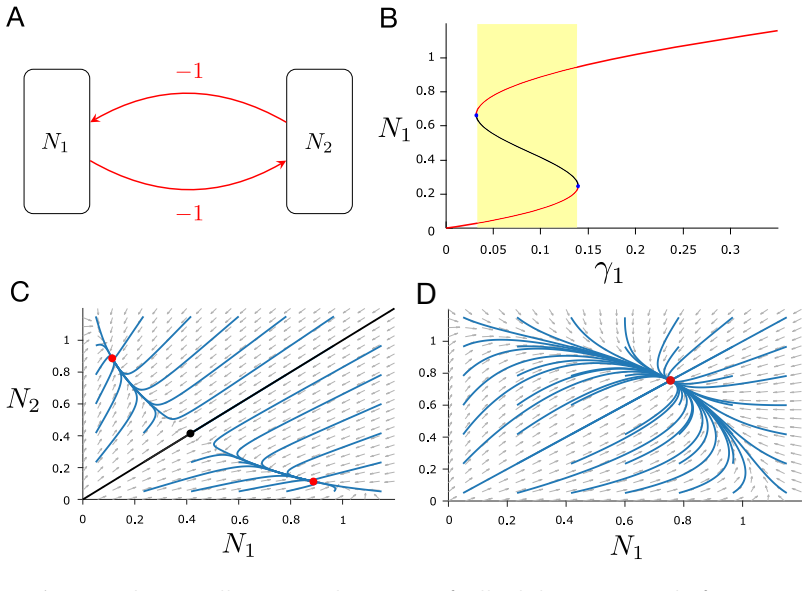
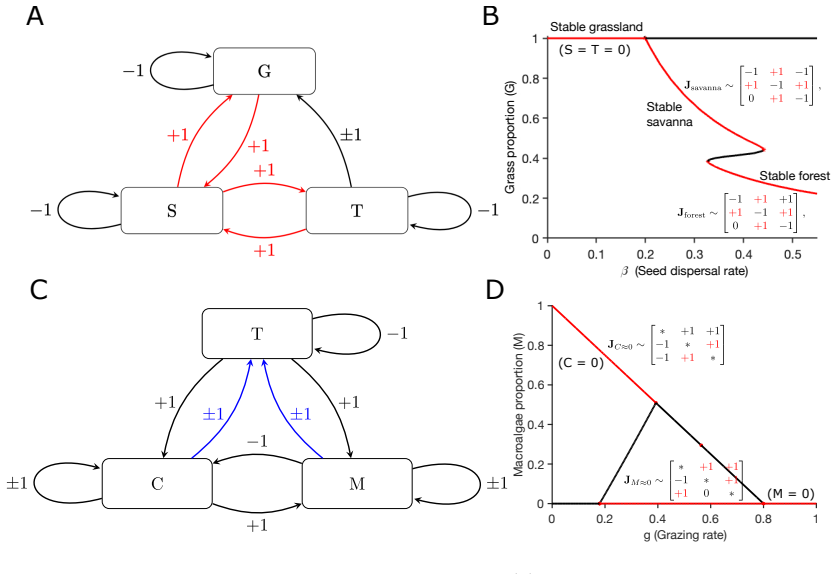
Multiple stable states emerge when positive feedback loops create thresholds that separate alternative equilibria; well-studied ecosystem models share this structure together with other common dynamical features such as hysteresis and the possibility of long transients, allowing these phenomena to be placed in a single mathematical setting.
What carries the argument
Positive feedback loops that amplify small changes until the system crosses a threshold into a different stable configuration.
If this is right
- Management actions that target positive feedbacks can steer systems toward desired states or prevent unwanted transitions.
- Restoration success depends on identifying and weakening or strengthening the relevant feedback loops at appropriate spatial and temporal scales.
- Transient dynamics must be considered alongside equilibria when predicting how long a system remains near one state before shifting.
- Data from new monitoring technologies can be used to detect and quantify feedback strength in real ecosystems.
Where Pith is reading between the lines
- The framework could be extended to couple ecological multistability with climate or socioeconomic feedbacks.
- Persistent-transient theory might replace strict equilibrium concepts when forecasting long-term ecosystem behavior under ongoing change.
- Testing the necessity of positive feedbacks would require systematic comparison of systems that do and do not exhibit multiple states.
Load-bearing premise
Diverse ecological models and field cases can be placed inside one common mathematical framework without losing essential system-specific mechanisms.
What would settle it
Documentation of multiple stable states in an ecological system whose governing equations contain no positive feedback loops.
Figures

read the original abstract
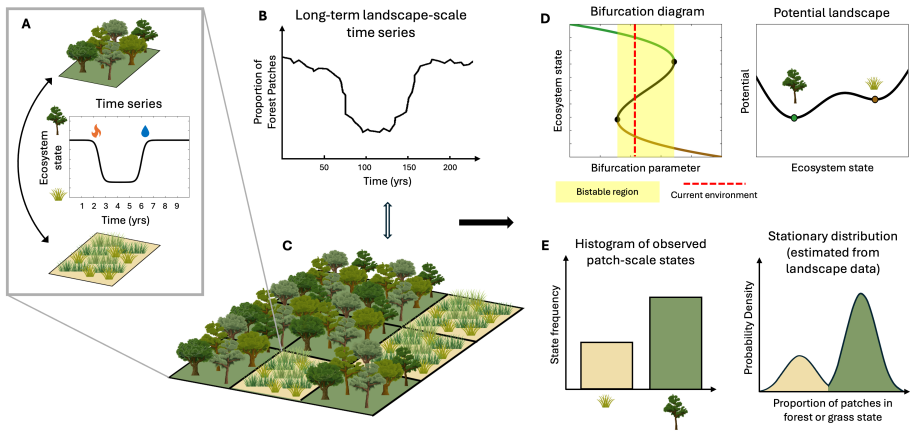
Multiple stable states - the coexistence of two or more distinct ecological configurations under identical environmental conditions - have attracted sustained interest in ecology, yet the field still lacks a unified framework connecting ecological mechanisms to dynamical models. Here, we review empirical and theoretical approaches to multiple stable states, synthesising perspectives on stability, tipping, hysteresis, and transient dynamics, and contextualise these within a common mathematical framework. Drawing on examples of well-known ecosystem models, we highlight the central and necessary role of positive feedback loops and identify other common, unifying features of ecological systems that exhibit multiple stable states. We further discuss the relationship between stable and transient dynamics, the roles of spatial and temporal scales in feedback identification, and the implications for ecological restoration and management. We conclude with open questions and challenges for the field, including extending multistability theory to persistent-transient frameworks and harnessing emerging data-collection technologies to sharpen empirical inference.
Editorial analysis
A structured set of objections, weighed in public.
Referee Report
Summary. The manuscript reviews empirical and theoretical approaches to multiple stable states in ecological systems, synthesizes perspectives on stability, tipping, hysteresis, and transient dynamics, and contextualizes these within a common mathematical framework. Drawing on examples of well-known ecosystem models, it highlights the central and necessary role of positive feedback loops along with other unifying features, discusses the relationship between stable and transient dynamics, the roles of spatial and temporal scales in feedback identification, and implications for ecological restoration and management, while concluding with open questions including extensions to persistent-transient frameworks.
Significance. If the synthesis holds without essential loss of system-specific details, the paper offers a valuable integrative reference that connects disparate models through shared dynamical features such as positive feedbacks. This could aid in identifying common mechanisms across ecosystems and inform management applications. Strengths include the explicit synthesis of stability concepts with transient dynamics and the forward-looking discussion of data-collection technologies for empirical inference.
major comments (2)
- [Abstract and synthesis sections] The central claim of contextualizing reviewed approaches 'within a common mathematical framework' (abstract) is load-bearing but remains underspecified in the synthesis; without a concrete mathematical structure (e.g., a generalized state-space representation or stability criterion) that demonstrably accommodates the cited models without contradiction or loss of detail, the unification risks being descriptive rather than operational.
- [Ecosystem models examples] The assertion that positive feedback loops are 'central and necessary' (abstract) for multiple stable states is standard in dynamical systems but requires explicit verification against the reviewed examples; if any counter-example model in the manuscript exhibits multistability without positive feedback, this would undermine the necessity claim.
minor comments (2)
- [Throughout] Clarify notation for feedback loops and stability metrics when transitioning between empirical and theoretical sections to avoid ambiguity for readers.
- [Conclusion] The open questions on extending multistability theory could include more specific testable predictions or suggested empirical protocols.
Simulated Author's Rebuttal
We thank the referee for their positive evaluation and constructive comments, which have helped clarify the operational aspects of our synthesis. We respond point by point to the major comments below and have revised the manuscript accordingly.
read point-by-point responses
-
Referee: [Abstract and synthesis sections] The central claim of contextualizing reviewed approaches 'within a common mathematical framework' (abstract) is load-bearing but remains underspecified in the synthesis; without a concrete mathematical structure (e.g., a generalized state-space representation or stability criterion) that demonstrably accommodates the cited models without contradiction or loss of detail, the unification risks being descriptive rather than operational.
Authors: We agree that greater specificity strengthens the claim. In the revised manuscript we have added a new subsection (Section 3.1) that presents an explicit generalized state-space form dx/dt = f(x, p) + g(x, p), where g encodes positive feedback terms that can produce multiple roots in the equilibrium condition. We map the three primary models (shallow-lake phosphorus recycling, savanna-forest fire-vegetation, and coral-algae grazing) onto this structure, showing the concrete f and g functions and confirming that the original dynamics are recovered without loss of detail. We also state the local stability criterion (sign of the Jacobian eigenvalues at equilibria) and apply it to each example. These additions make the unification operational while preserving system-specific features. revision: yes
-
Referee: [Ecosystem models examples] The assertion that positive feedback loops are 'central and necessary' (abstract) for multiple stable states is standard in dynamical systems but requires explicit verification against the reviewed examples; if any counter-example model in the manuscript exhibits multistability without positive feedback, this would undermine the necessity claim.
Authors: We have re-examined every model presented. In each case (lake eutrophication via nutrient recycling, savanna-forest via fire-vegetation, coral reefs via grazing-algae, dryland patterns via infiltration, and predator-prey with Holling type III) multistability is generated by at least one positive feedback loop whose removal collapses the system to a single equilibrium. No counter-example appears in the reviewed literature or our synthesis. We have added a verification table (new Table 2) that lists the positive feedback mechanism for each model, its mathematical representation, and the consequence of its removal. This explicit check confirms the necessity claim within the scope of the systems considered. revision: yes
Circularity Check
Review synthesis with no new derivations or load-bearing reductions
full rationale
The paper is explicitly a review that synthesizes existing empirical and theoretical approaches to multiple stable states, contextualizing them within a common mathematical framework without introducing original derivations, equations, or predictions. It draws on well-known ecosystem models and highlights features such as positive feedback loops as standard observations from dynamical systems theory. No steps reduce by construction to fitted parameters, self-definitions, or self-citation chains; the central claims are descriptive syntheses of prior literature rather than novel results forced by internal inputs. This is the expected non-finding for a review paper.
Axiom & Free-Parameter Ledger
Reference graph
Works this paper leans on
-
[1]
K. C. Abbott and V. Dakos. Mapping the distinct origins of bimodality in a classic model with alternative stable states.Theoretical Ecology, 14(4):673–684, Dec. 2021
work page 2021
-
[2]
K. C. Abbott and B. C. Nolting. Alternative (un)stable states in a stochastic predator–prey model.Ecological Complexity, 32:181–195, 2017
work page 2017
-
[3]
G. Aguad´ e-Gorgori´ o, J.-F. Arnoldi, M. Barbier, and S. K´ efi. A taxonomy of multiple stable states in complex ecological communities.Ecology Letters, 27(4):e14413, 2024
work page 2024
-
[4]
J. C. Aleman, A. Fayolle, C. Favier, A. C. Staver, K. G. Dexter, C. M. Ryan, A. F. Azihou, D. Bauman, M. te Beest, E. N. Chidumayo, et al. Floristic evidence for alternative biome states in tropical africa.Proceedings of the National Academy of Sciences, 117(45):28183– 28190, 2020
work page 2020
-
[5]
D. R. Amor, C. Ratzke, and J. Gore. Transient invaders can induce shifts between alternative stable states of microbial communities.Science Advances, 6(8):eaay8676, 2020. 23
work page 2020
- [6]
-
[7]
M. L. Baskett and A. K. Salomon. Recruitment facilitation can drive alternative states on temperate reefs.Ecology, 91(6):1763–1773, 2010
work page 2010
-
[8]
B. E. Beisner, D. T. Haydon, and K. Cuddington. Alternative stable states in ecology. Frontiers in Ecology and the Environment, 1(7):376–382, 2003
work page 2003
-
[9]
J. C. Blackwood, A. Hastings, and P. J. Mumby. The effect of fishing on hysteresis in caribbean coral reefs.Theoretical Ecology, 5(1):105–114, 2012
work page 2012
-
[10]
J. L. Blois, J. W. Williams, M. C. Fitzpatrick, S. T. Jackson, and S. Ferrier. Space can substitute for time in predicting climate-change effects on biodiversity.Proceedings of the National Academy of Sciences, 110(23):9374–9379, June 2013
work page 2013
- [11]
-
[12]
C. Boettiger and A. Hastings. Quantifying limits to detection of early warning for critical transitions.Journal of the Royal Society Interface, 9(75):2527–2539, 2012
work page 2012
-
[13]
C. Boettiger, N. Ross, and A. Hastings. Early warning signals: the charted and uncharted territories.Theoretical Ecology, 6(3):255–264, 2013
work page 2013
-
[14]
J. F. Bruno, H. Sweatman, W. F. Precht, E. R. Selig, and V. G. W. Schutte. Assess- ing evidence of phase shifts from coral to macroalgal dominance on coral reefs.Ecology, 90(6):1478–1484, 2009
work page 2009
-
[15]
G. Bunin. Ecological communities with lotka-volterra dynamics.Physical Review E, 95(4):042414, 2017
work page 2017
-
[16]
J. E. Byers, K. Cuddington, C. G. Jones, T. S. Talley, A. Hastings, J. G. Lambrinos, J. A. Crooks, and W. G. Wilson. Using ecosystem engineers to restore ecological systems.Trends in Ecology & Evolution, 21(9):493–500, 2006
work page 2006
-
[17]
M. K. Cameron. Finding the quasipotential for nongradient SDEs.Physica D: Nonlinear Phenomena, 241(18):1532–1550, 2012
work page 2012
-
[18]
S. R. Carpenter.Regime shifts in lake ecosystems: pattern and variation, volume 15. Inter- national Ecology Institute Oldendorf/Luhe, Germany, 2003
work page 2003
-
[19]
S. R. Carpenter, D. Ludwig, and W. A. Brock. Management of eutrophication for lakes subject to potentially irreversible change.Ecological Applications, 9(3):751–771, 1999
work page 1999
-
[20]
N. Chen, K. Yu, R. Jia, J. Teng, and C. Zhao. Biocrust as one of multiple stable states in global drylands.Science Advances, 6(39):eaay3763, 2020
work page 2020
-
[21]
G. Coco, S. F. Thrush, M. O. Green, and J. E. Hewitt. Feedbacks between bivalve density, flow, and suspended sediment concentration on patch stable states.Ecology, 87(11):2862– 2870, 2006. 24
work page 2006
-
[22]
J. H. Connell and W. P. Sousa. On the evidence needed to judge ecological stability or persistence.The American Naturalist, 121(6):789–824, June 1983
work page 1983
-
[23]
F. Courchamp, L. Berec, and J. Gascoigne.Allee Effects in Ecology and Conservation. Oxford University Press, 02 2008
work page 2008
-
[24]
G. Craciun and M. Feinberg. Multiple equilibria in complex chemical reaction networks: I. the injectivity property.SIAM Journal on Applied Mathematics, 65(5):1526–1546, 2005
work page 2005
-
[25]
K. Cuddington, W. G. Wilson, and A. Hastings. Ecosystem engineers: Feedback and popu- lation dynamics.The American Naturalist, 173(4):488–498, 2009
work page 2009
-
[26]
D. L. DeAngelis, W. M. Post, and C. C. Travis.Positive feedback in natural systems, vol- ume 15. Springer Science & Business Media, 1986
work page 1986
-
[27]
R. K. Didham, C. H. Watts, and D. A. Norton. Are systems with strong underlying abiotic regimes more likely to exhibit alternative stable states?Oikos, 110(2):409–416, 2005
work page 2005
-
[28]
P. Ditlevsen and S. Ditlevsen. Warning of a forthcoming collapse of the atlantic meridional overturning circulation.Nature Communications, 14(1):4254, 2023
work page 2023
-
[29]
V. Dubinkina, Y. Fridman, P. P. Pandey, and S. Maslov. Multistability and regime shifts in microbial communities explained by competition for essential nutrients.Elife, 8:e49720, 2019
work page 2019
-
[30]
S. Dudgeon, R. Aronson, J. Bruno, and W. Precht. Phase shifts and stable states on coral reefs.Marine Ecology Progress Series, 413:201–216, Aug. 2010
work page 2010
- [31]
-
[32]
P. J. S. Franks. Npz models of plankton dynamics: Their construction, coupling to physics, and application.Journal of Oceanography, 58(2):379–387, Apr. 2002
work page 2002
-
[33]
M. I. Freidlin and A. D. Wentzell.Random Perturbations of Dynamical Systems. Springer, New York, 1984
work page 1984
-
[34]
T. Fukami. Historical contingency in community assembly: integrating niches, species pools, and priority effects.Annual Review of Ecology, Evolution, and Systematics, 46(1):1–23, 2015
work page 2015
-
[35]
T. Fukami and M. Nakajima. Community assembly: alternative stable states or alternative transient states?Ecology Letters, 14(10):973–984, 2011
work page 2011
-
[36]
L. J. Gilarranz, A. Narwani, D. Odermatt, R. Siber, and V. Dakos. Regime shifts, trends, and variability of lake productivity at a global scale.Proceedings of the National Academy of Sciences, 119(35):e2116413119, 2022
work page 2022
- [37]
-
[38]
R. Graham and T. Tel. Existence of a potential for dissipative dynamical systems.Physical Review Letters, 52:9–12, 1984. 25
work page 1984
-
[39]
R. Graham and T. Tel. Nonequilibrium potentials for coexisting attractors.Physical Review A, 33:1322–1337, 1986
work page 1986
-
[40]
T. N. Grainger, K. Stark, C. Song, M. A. Barbour, and R. M. Germain. The equilibrium conundrum.Ecology Letters, 28(11):e70232, 2025
work page 2025
- [41]
- [42]
-
[43]
A. Hastings, K. C. Abbott, K. Cuddington, T. Francis, G. Gellner, Y.-C. Lai, A. Morozov, S. Petrovskii, K. Scranton, and M. L. Zeeman. Transient phenomena in ecology.Science, 361(6406):eaat6412, 2018
work page 2018
-
[44]
A. Hastings, S. Petrovskii, V. Lucarini, and A. Morozov. Tipping points in complex ecological systems.arXiv preprint arXiv:2602.20702, 2026
-
[45]
S. I. Higgins, S. Banerjee, M. Baudena, D. M. Bowman, T. Conradi, P. Couteron, L. M. Kruger, R. B. O’Hara, and G. J. Williamson. Reassessing the alternative ecosystem states proposition in the african savanna-forest domain.New Phytologist, 243(5):1660–1669, 2024
work page 2024
- [46]
-
[47]
C. Holling. Resilience and stability of ecological systems.Annual Review of Ecology and Systematics, 4(1):1–23, 1973
work page 1973
-
[48]
C. S. Holling. The components of predation as revealed by a study of small-mammal predation of the european pine sawfly.The Canadian Entomologist, 91(5):293–320, 1959
work page 1959
-
[49]
B. W. Ibelings, R. Portielje, E. H. Lammens, R. Noordhuis, M. S. van den Berg, W. Joosse, and M. L. Meijer. Resilience of alternative stable states during the recovery of shallow lakes from eutrophication: Lake veluwe as a case study.Ecosystems, 10(1):4–16, 2007
work page 2007
-
[50]
E. Jeppesen, M. Sondergaard, J. P. Jensen, K. E. Havens, O. Anneville, L. Carvalho, M. F. Coveney, R. Deneke, M. T. Dokulil, B. Foy, et al. Lake responses to reduced nutrient loading–an analysis of contemporary long-term data from 35 case studies.Freshwater Bi- ology, 50(10):1747–1771, 2005
work page 2005
- [51]
- [52]
-
[53]
T. Khazaei, R. L. Williams, S. R. Bogatyrev, J. C. Doyle, C. S. Henry, and R. F. Ismagilov. Metabolic multistability and hysteresis in a model aerobe-anaerobe microbiome community. Science Advances, 6(33):eaba0353, 2020
work page 2020
- [54]
-
[55]
M. A. Leibold, M. Holyoak, N. Mouquet, P. Amarasekare, J. M. Chase, M. F. Hoopes, R. D. Holt, J. B. Shurin, R. Law, D. Tilman, M. Loreau, and A. Gonzalez. The metacommunity concept: a framework for multi-scale community ecology.Ecology Letters, 7(7):601–613, 2004
work page 2004
-
[56]
T. M. Lenton, H. Held, E. Kriegler, J. W. Hall, W. Lucht, S. Rahmstorf, and H. J. Schellnhu- ber. Tipping elements in the earth’s climate system.Proceedings of the National Academy of Sciences, 105(6):1786–1793, 2008
work page 2008
-
[57]
S. A. Levin. The problem of pattern and scale in ecology: the robert h. macarthur award lecture.Ecology, 73(6):1943–1967, 1992
work page 1943
-
[58]
R. Levins. Some demographic and genetic consequences of environmental heterogeneity for biological control.Bulletin of the Entomological Society of America, 15(3):237–240, 09 1969
work page 1969
-
[59]
R. Levins. The qualitative analysis of partially specified systems.Annals of the New York Academy of Sciences, 231(1):123–138, 1974
work page 1974
-
[60]
R. C. Lewontin. The meaning of stability. InBrookhaven Symp Biol, volume 22, pages 13–24, 1969
work page 1969
-
[61]
S. D. Ling, R. E. Scheibling, A. Rassweiler, C. R. Johnson, N. Shears, S. D. Connell, A. K. Salomon, K. M. Norderhaug, A. P´ erez-Matus, J. C. Hern´ andez, S. Clemente, L. K. Blamey, B. Hereu, E. Ballesteros, E. Sala, J. Garrabou, E. Cebrian, M. Zabala, D. Fujita, and L. E. Johnson. Global regime shift dynamics of catastrophic sea urchin overgrazing.Philo...
work page 2015
- [62]
-
[63]
S. L. Maes, M. P. Perring, R. Cohen, F. Akinnifesi, A. Bargu´ es-Tobella, J.-F. Bastin, M. Bauters, P. N. Bernardino, P. H. Brancalion, J. M. Bullock, et al. Explore before you restore: Incorporating complex systems thinking in ecosystem restoration.Journal of Applied Ecology, 61(5):922–939, 2024
work page 2024
-
[64]
S. Manfreda, M. F. McCabe, P. E. Miller, R. Lucas, V. Pajuelo Madrigal, G. Mallinis, E. Ben Dor, D. Helman, L. Estes, G. Ciraolo, et al. On the use of unmanned aerial systems for environmental monitoring.Remote sensing, 10(4):641, 2018
work page 2018
-
[65]
D. C. Marvin, L. P. Koh, A. J. Lynam, S. Wich, A. B. Davies, R. Krishnamurthy, E. Stokes, R. Starkey, and G. P. Asner. Integrating technologies for scalable ecology and conservation. Global Ecology and Conservation, 7:262–275, 2016
work page 2016
-
[66]
R. M. May. Thresholds and breakpoints in ecosystems with a multiplicity of stable states. Nature, 269(5628):471–477, 1977
work page 1977
-
[67]
A. Morozov, K. Abbott, K. Cuddington, T. Francis, G. Gellner, A. Hastings, Y.-C. Lai, S. Petrovskii, K. Scranton, and M. L. Zeeman. Long transients in ecology: theory and applications.Physics of Life Reviews, 32:1–40, 2020
work page 2020
-
[68]
A. Morozov, U. Feudel, A. Hastings, K. C. Abbott, K. Cuddington, C. M. Heggerud, and S. Petrovskii. Long-living transients in ecological models: Recent progress, new challenges, and open questions.Physics of Life Reviews, 51:423–441, 2024. 27
work page 2024
-
[69]
P. J. Mumby, A. Hastings, and H. J. Edwards. Thresholds and the resilience of caribbean coral reefs.Nature, 450(7166):98–101, 2007
work page 2007
-
[70]
P. J. Mumby, R. S. Steneck, and A. Hastings. Evidence for and against the existence of alternate attractors on coral reefs.Oikos, 122(4):481–491, 2013
work page 2013
-
[71]
D. M. Mushet, O. P. McKenna, and K. I. McLean. Alternative stable states in inherently unstable systems.Ecology and Evolution, 10(2):843–850, Jan. 2020
work page 2020
-
[72]
B. C. Nolting and K. C. Abbott. Balls, cups, and quasi-potentials: quantifying stability in stochastic systems.Ecology, 97(4):850–864, 2016
work page 2016
-
[73]
J. E. Petersen and A. Hastings. Dimensional approaches to scaling experimental ecosystems: designing mousetraps to catch elephants.The American Naturalist, 157(3):324–333, 2001
work page 2001
-
[74]
C. H. Peterson. Does a rigorous criterion for environmental identity preclude the existence of multiple stable points?The American Naturalist, 124(1):127–133, 1984
work page 1984
-
[75]
Petraitis.Multiple stable states in natural ecosystems
P. Petraitis.Multiple stable states in natural ecosystems. OUP Oxford, 2013
work page 2013
-
[76]
P. S. Petraitis and S. R. Dudgeon. Experimental evidence for the origin of alternative com- munities on rocky intertidal shores.Oikos, 84(2):239–245, 1999
work page 1999
-
[77]
P. S. Petraitis and S. R. Dudgeon. Variation in recruitment and the establishment of alter- native community states.Ecology, 96(12):3186–3196, 2015
work page 2015
-
[78]
P. S. Petraitis, E. T. Methratta, E. C. Rhile, N. A. Vidargas, and S. R. Dudgeon. Experimental confirmation of multiple community states in a marine ecosystem.Oecologia, 161(1):139–148, 2009
work page 2009
- [79]
-
[80]
M. Rietkerk, R. Bastiaansen, S. Banerjee, J. van de Koppel, M. Baudena, and A. Doel- man. Evasion of tipping in complex systems through spatial pattern formation.Science, 374(6564):eabj0359, 2021
work page 2021
discussion (0)
Sign in with ORCID, Apple, or X to comment. Anyone can read and Pith papers without signing in.