Covert Signaling for Communication and Sensing over the Bosonic Channels
Pith reviewed 2026-05-11 02:11 UTC · model grok-4.3
The pith
The optimal signal state for minimizing detectability in covert communication and sensing over lossy bosonic channels is a mixture of two consecutive photon-number states.
A machine-rendered reading of the paper's core claim, the machinery that carries it, and where it could break.
Core claim
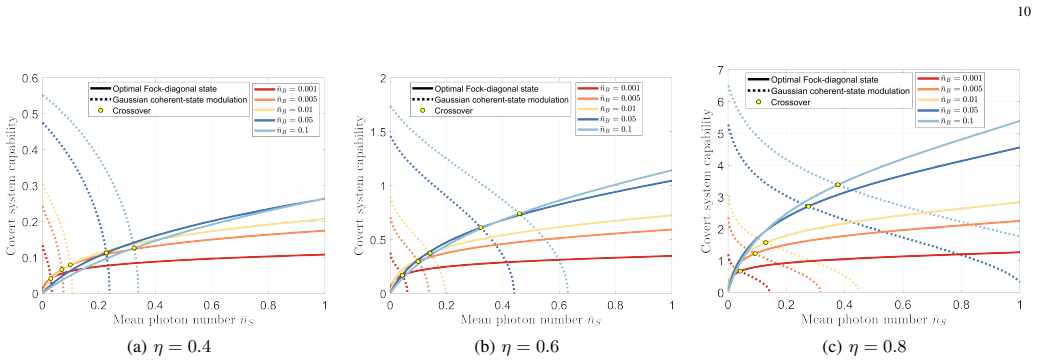
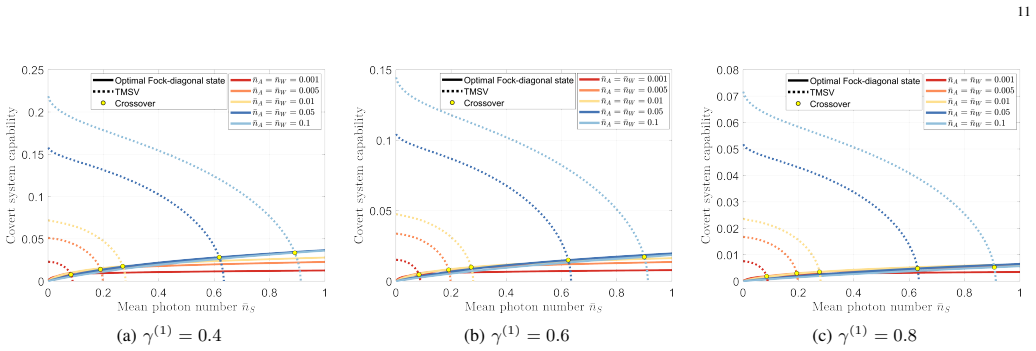
We characterize the input signal state that minimizes detectability. We find an unintuitive optimal quantum state structure: a mixture of just two consecutive photon-number states. In particular, in the low-brightness regime, the optimal signal state is a mixture of vacuum and a single photon. Since these states are generally suboptimal for both communication and active sensing, we explore the resulting trade-off and identify input-power thresholds for transitions between optimizing for covertness vs. performance in communication and sensing tasks.
What carries the argument
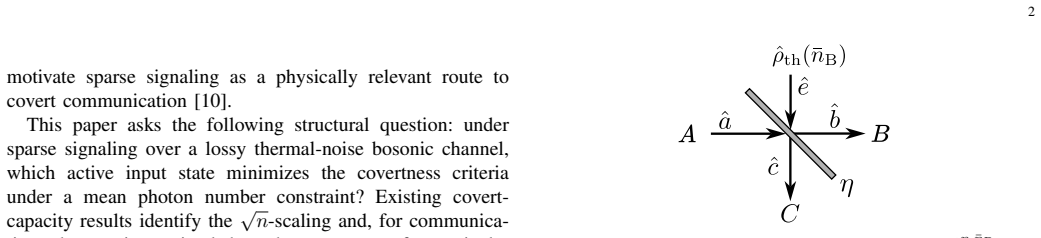
Sparse signaling under the square-root law on the lossy thermal-noise bosonic channel, where the optimal input density operator is the mixture of two consecutive Fock states that minimizes the adversary's detection probability.
Load-bearing premise
The eavesdropper's detection is governed by the standard square-root law applied to the lossy thermal-noise bosonic channel without additional side information or non-standard noise.
What would settle it
Compare the detection error probability achieved by a vacuum-plus-single-photon mixture against other states (such as coherent or thermal states) at identical average photon number over a calibrated lossy thermal channel and check whether the two-state mixture yields the lowest detection rate.
Figures
read the original abstract
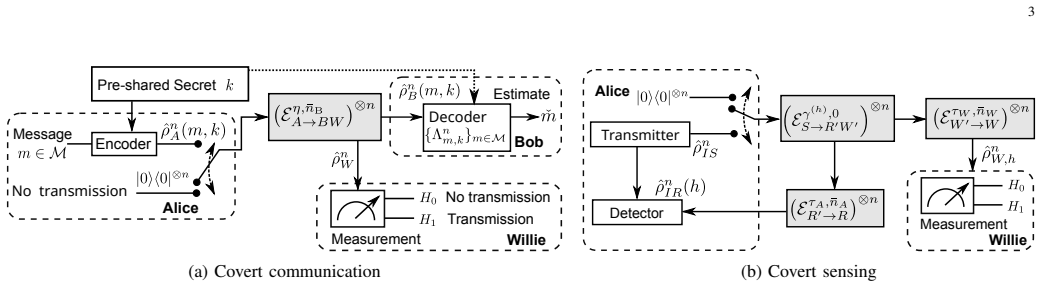
Preventing signal detection in communication and active sensing requires careful control of transmission power. In fact, the square-root laws (SRL) for covert classical and quantum communication and sensing prescribe that the average output energy per channel use scales as $1/\sqrt{n}$ for $n$ channel uses. \emph{Diffuse} and \emph{sparse} signaling achieve this. The former transmits signals whose energy decays as $1/\sqrt{n}$ over all $n$ channel uses, which is convenient for mathematical analysis. The latter transmits constant-energy signals only approximately $\propto\sqrt{n}$ times out of $n$ channel uses, remaining silent on the others. This offers significant practical advantages in compatibility with modern digital transmitters. Here, we study sparse signaling over the lossy thermal-noise bosonic channel, which is a quantum model of many practical channels (including optical, microwave, and radio-frequency). We characterize the input signal state that minimizes detectability. We find an unintuitive optimal quantum state structure: a mixture of just two consecutive photon-number states. In particular, in the low-brightness regime, the optimal signal state is a mixture of vacuum and a single photon. Since these states are generally suboptimal for both communication and active sensing, we explore the resulting trade-off and identify input-power thresholds for transitions between optimizing covertness and performance in communication and sensing tasks.
Editorial analysis
A structured set of objections, weighed in public.
Referee Report
Summary. The manuscript studies sparse signaling over lossy thermal-noise bosonic channels for covert classical and quantum communication and sensing. Under the square-root-law constraint on average output power, it characterizes the input quantum state minimizing eavesdropper detectability (via output-state distinguishability from thermal noise) and shows that the optimum is a mixture of two consecutive Fock states; in the low-brightness regime this reduces to a vacuum-plus-single-photon mixture. The work then examines the resulting trade-offs with communication rate and sensing performance, identifying input-power thresholds at which the optimum switches from covertness to task performance.
Significance. If the central characterization holds, the result supplies an explicit, practical optimal state for sparse covert bosonic signaling that is compatible with modern digital transmitters and directly applicable to optical, microwave, and RF channels. It advances the square-root-law literature by moving beyond diffuse signaling to a concrete quantum-state optimization and quantifies the covertness-performance frontier, providing both theoretical insight and guidance for experimental implementations.
minor comments (3)
- Abstract: the statement that the two-Fock mixture is 'unintuitive' would be strengthened by a one-sentence contrast with the classical Poisson or thermal-state expectation that readers might anticipate.
- The trade-off section would benefit from an explicit statement of the figure of merit used for the communication and sensing tasks (e.g., Holevo information or Fisher information) so that the power-threshold transitions can be reproduced without ambiguity.
- Notation for the bosonic channel parameters (transmissivity, thermal noise photon number) should be introduced once in the model section and used consistently thereafter.
Simulated Author's Rebuttal
We thank the referee for their positive assessment of our manuscript, accurate summary of the results on optimal sparse signaling states for covert bosonic channels, and recommendation for minor revision. We appreciate the recognition of the practical advantages of the two-consecutive-Fock-state structure.
Circularity Check
No significant circularity; direct optimization within standard model
full rationale
The paper derives the optimal input state (mixture of two consecutive Fock states, vacuum plus single photon in low brightness) by optimizing over states with fixed mean photon number to minimize output distinguishability from thermal noise on the lossy thermal-noise bosonic channel under the sparse-signaling square-root-law constraint. This is a self-contained mathematical characterization using the photon-number basis natural to the channel model; no step reduces by construction to a fitted parameter renamed as prediction, a self-citation chain, an ansatz smuggled via prior work, or a renamed empirical pattern. The square-root law and channel model are standard external references, and the result is obtained from the optimization rather than presupposed.
Axiom & Free-Parameter Ledger
axioms (2)
- domain assumption Lossy thermal-noise bosonic channel model governs the physical link
- domain assumption Square-root law governs the scaling of average power for covert operation
Forward citations
Cited by 1 Pith paper
-
Toward Practical Two-Way Covert Communication
Proof-of-concept experiment for two-way covert optical communication with narrowband laser and proposal of correlator receiver for quantum light sources without mode matching.
discussion (0)
Sign in with ORCID, Apple, or X to comment. Anyone can read and Pith papers without signing in.