Evaluating Developmental Cognition Capabilities of LLMs
Pith reviewed 2026-05-12 01:22 UTC · model grok-4.3
The pith
LLMs recover intended developmental stages from simulated text with high accuracy but only fair agreement on real human responses to a new sentence completion test.
A machine-rendered reading of the paper's core claim, the machinery that carries it, and where it could break.
Core claim
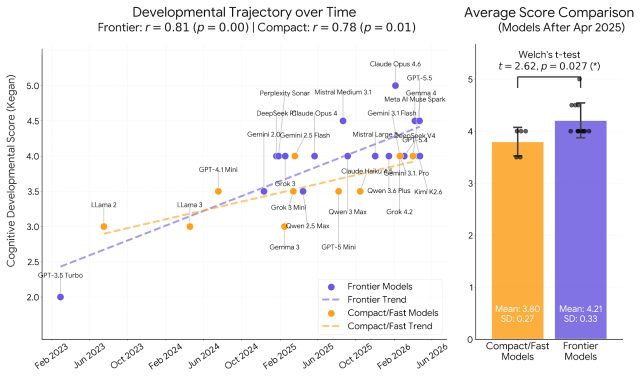
The central claim is that developmental signal recoverable by LLMs is substantially stronger and cleaner when the text is produced under controlled synthetic conditions than when it comes from real human respondents, and that unprompted model generations already carry stable stage-like signatures that rise with model scale and recency.
What carries the argument
The Developmental Sentence Completion Test (DSCT), a fixed set of 20 sentence stems that prompt completions whose stage-like structure is then labeled according to constructive-developmental criteria.
If this is right
- LLMs can function as reliable stage classifiers when the input text is generated from known personas.
- Real-world user text supplies only weak developmental signal, limiting the precision of any stage-aware adaptation in conversation.
- Model families differ systematically in the stage level of their default outputs, and this level increases with scale.
- Improving classifier accuracy alone will not suffice for stage-aware AI; richer elicitation of developmental signal is also required.
Where Pith is reading between the lines
- Integrating DSCT-style prompts into ongoing conversations could let models adjust explanation depth or perspective-taking to match a user's apparent meaning-making level.
- As models grow, their unprompted text may already align better with advanced adult developmental stages, reducing the need for explicit conditioning.
- The gap between synthetic and human signal suggests that training data volume or style may be shaping the apparent developmental maturity of generated text.
Load-bearing premise
That the chosen labeling method applied to DSCT responses captures genuine developmental differences rather than surface linguistic habits or artifacts of the labeling process itself.
What would settle it
Independent re-labeling of the same human DSCT responses by multiple trained experts produces low inter-rater agreement, or the LLM classifications fail to correlate with any separate behavioral measure of how respondents handle conflicting perspectives.
Figures


read the original abstract
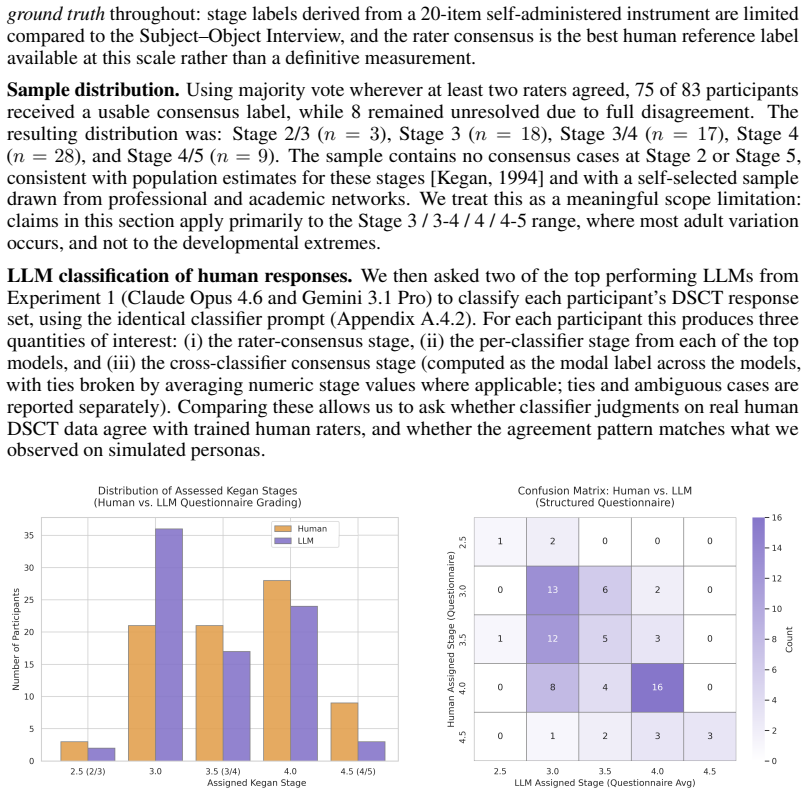
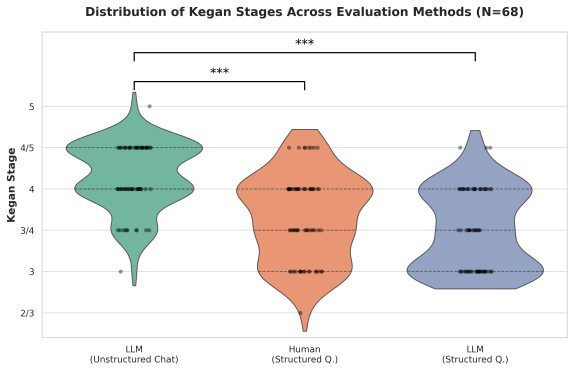
Conversational AI is increasingly personalized around users' preferences, histories, goals, and knowledge, but much less around how users interpret and take up model outputs to construct and understand their reality. We draw on Robert Kegan's constructive-developmental theory as a complementary lens on this dimension. Existing methods for assessing developmental stage in the Keganian tradition rely either on expert interviews that do not scale or on sentence-completion instruments that are proprietary, lengthy, or invasive. To make this perspective tractable for LLM evaluation, we introduce the Developmental Sentence Completion Test (DSCT), a 20-item instrument designed to elicit developmental signal in self-administered text. Throughout, we treat the resulting labels as characterizations of stage-like structure in elicited responses, not as validated person-level developmental stage. We then ask how much of that signal can be recovered by LLMs across three elicited response regimes: simulated personas, real human respondents, and default model-generated answers. On simulated personas, top frontier models recover simulator-intended labels with high accuracy. On real human DSCT responses, human-LLM agreement is fair, with much stronger within-neighborhood than exact agreement. Finally, when LLMs answer DSCT prompts without persona-conditioning, their responses exhibit stable stage-like differences across model families, with larger and newer models tending to generate higher-rated text. These results suggest that stage-conditioned signal is cleaner in synthetic responses than in human-written DSCT text, and that the core constraint for stage-aware conversational AI is not classifier accuracy alone, but the availability of developmental signal from elicited text.
Editorial analysis
A structured set of objections, weighed in public.
Referee Report
Summary. The paper introduces the Developmental Sentence Completion Test (DSCT), a 20-item self-administered instrument to elicit developmental signal based on Kegan's constructive-developmental theory. It evaluates frontier LLMs across three regimes: recovering simulator-intended stage labels from simulated personas (high accuracy), human-LLM agreement on real human DSCT responses (fair overall, stronger within-neighborhood), and stage-like structure in unconditioned model-generated answers (stable differences across families, with larger/newer models producing higher-rated text). The authors conclude that stage-conditioned signal is cleaner in synthetic responses than human-written DSCT text and that the core constraint for stage-aware conversational AI is availability of developmental signal from elicited text rather than classifier accuracy alone. Labels are explicitly treated as characterizations of stage-like structure in responses, not validated person-level stages.
Significance. If the DSCT labeling reliably isolates developmental structure beyond surface linguistic features, the work offers a scalable, non-proprietary method for probing and improving LLMs' handling of users' interpretive frameworks, complementing preference/history personalization. The three-regime comparison, explicit validation disclaimer, and parameter-free empirical design are strengths. The results on synthetic vs. human signal cleanliness could inform elicitation strategies for developmental awareness in AI, provided the labeling assumption holds.
major comments (2)
- [Abstract] Abstract: The abstract reports 'high accuracy' on simulated personas, 'fair' human-LLM agreement (stronger within-neighborhood), and model-size gradients on default responses, but supplies no sample sizes, number of human respondents, inter-rater reliability for the labels, statistical tests, or exclusion criteria. These details are required to assess whether the data support the claim that developmental signal is weaker in human-written text than in synthetic responses.
- [Abstract] Abstract: The central inference that 'the core constraint for stage-aware conversational AI is not classifier accuracy alone, but the availability of developmental signal from elicited text' rests on the assumption that DSCT labels on human responses capture meaningful stage-like structure. The paper disclaims person-level validation and reports no correlations with established instruments such as the Subject-Object Interview. If labels primarily track detectable linguistic markers (abstract vocabulary, sentence complexity, hedging) that LLMs already optimize for, the high simulated accuracy and model-size effects would follow by construction, undermining the distinction between classifier performance and signal availability.
minor comments (1)
- [Abstract] Abstract: Specify the exact agreement metric (e.g., Cohen's kappa or percentage) and the definition of 'neighborhood' agreement to improve precision.
Simulated Author's Rebuttal
We thank the referee for the careful reading and constructive comments. We address each major point below, with revisions indicated where they strengthen the manuscript without altering its core scope or claims.
read point-by-point responses
-
Referee: [Abstract] Abstract: The abstract reports 'high accuracy' on simulated personas, 'fair' human-LLM agreement (stronger within-neighborhood), and model-size gradients on default responses, but supplies no sample sizes, number of human respondents, inter-rater reliability for the labels, statistical tests, or exclusion criteria. These details are required to assess whether the data support the claim that developmental signal is weaker in human-written text than in synthetic responses.
Authors: We agree that the abstract would benefit from additional context on study scale. The full manuscript reports the relevant sample sizes (simulated personas and human respondents), inter-rater reliability for the DSCT labeling process, statistical tests, and exclusion criteria in the Methods and Results sections. In revision we will incorporate the key numerical details and reliability figures directly into the abstract so readers can immediately evaluate the comparative claim. The design difference between regimes remains informative: synthetic responses are generated from explicitly stage-conditioned personas, permitting direct accuracy against ground truth, while human responses are evaluated via agreement; this contrast is what supports the inference about relative signal availability in elicited text. revision: partial
-
Referee: [Abstract] Abstract: The central inference that 'the core constraint for stage-aware conversational AI is not classifier accuracy alone, but the availability of developmental signal from elicited text' rests on the assumption that DSCT labels on human responses capture meaningful stage-like structure. The paper disclaims person-level validation and reports no correlations with established instruments such as the Subject-Object Interview. If labels primarily track detectable linguistic markers (abstract vocabulary, sentence complexity, hedging) that LLMs already optimize for, the high simulated accuracy and model-size effects would follow by construction, undermining the distinction between classifier performance and signal availability.
Authors: The manuscript already states that labels are characterizations of stage-like structure observable in the responses themselves, not validated person-level stages. The central inference compares recoverability of that structure under identical labeling procedures across three regimes. High accuracy on synthetic data follows from the controlled embedding of stage-consistent content; fair agreement on human data indicates that the same structure is less consistently or less saliently present in naturalistic elicited text. Even if the labels partly reflect linguistic features that LLMs are sensitive to, the regime comparison still demonstrates a difference in the availability of such detectable structure in the elicited text. We did not include correlations with the Subject-Object Interview because the DSCT was developed as a scalable, self-administered alternative; we will add an explicit limitations paragraph acknowledging the lack of external interview-based validation while preserving the scoped, response-level framing of the claims. revision: partial
Circularity Check
No circularity: empirical evaluation with explicit disclaimers
full rationale
The paper introduces the DSCT as a text-elicitation instrument and reports direct empirical comparisons of LLM outputs against simulator intentions and human labels. No equations, fitted parameters, or derivations appear that would reduce any result to its inputs by construction. The abstract and text explicitly disclaim person-level validation of labels, framing them only as characterizations of stage-like structure in responses. All central claims follow from observed agreement rates and model-size gradients rather than self-referential definitions or load-bearing self-citations. This is a self-contained empirical study against external human and simulator benchmarks.
Axiom & Free-Parameter Ledger
axioms (1)
- domain assumption Kegan's constructive-developmental theory supplies a valid lens for characterizing stage-like structure in elicited text responses.
invented entities (1)
-
Developmental Sentence Completion Test (DSCT)
no independent evidence
Lean theorems connected to this paper
-
IndisputableMonolith/Foundation/RealityFromDistinction.leanreality_from_one_distinction unclear?
unclearRelation between the paper passage and the cited Recognition theorem.
We introduce the Developmental Sentence Completion Test (DSCT), a 20-item instrument... treat the resulting labels as characterizations of stage-like structure in elicited responses, not as validated person-level developmental stage.
-
IndisputableMonolith/Cost/FunctionalEquation.leanwashburn_uniqueness_aczel unclear?
unclearRelation between the paper passage and the cited Recognition theorem.
On simulated personas, top frontier models recover simulator-intended labels with high accuracy... human–LLM agreement is fair
What do these tags mean?
- matches
- The paper's claim is directly supported by a theorem in the formal canon.
- supports
- The theorem supports part of the paper's argument, but the paper may add assumptions or extra steps.
- extends
- The paper goes beyond the formal theorem; the theorem is a base layer rather than the whole result.
- uses
- The paper appears to rely on the theorem as machinery.
- contradicts
- The paper's claim conflicts with a theorem or certificate in the canon.
- unclear
- Pith found a possible connection, but the passage is too broad, indirect, or ambiguous to say the theorem truly supports the claim.
Reference graph
Works this paper leans on
-
[1]
When a promise is broken
-
[2]
When both choices feel right
-
[3]
When things don’t go as I hoped
-
[4]
When the hard work finally pays off
-
[5]
If I am asked to compromise
-
[6]
When I realized someone was paying atten- tion
-
[7]
Saying goodbye to something that mat- tered
-
[8]
When what used to work no longer works
-
[9]
When I have to choose what comes first
-
[10]
When I realize I cannot control what happens next. . . Abstracted Assessment
-
[11]
When a person feels they were treated un- fairly by their supervisor
-
[12]
If a person feels pulled between their own view and the expectations of others
-
[13]
A person works very hard on something im- portant, but it fails
- [14]
-
[15]
A person believes a decision their group sup- ports is wrong; they will
-
[16]
When a person sees someone make a sacri- fice for others
-
[17]
When a person has to leave a role or place that was important to them
-
[18]
This might affect their existing beliefs
A person realizes their plans need to change significantly. This might affect their existing beliefs
-
[19]
When a person must choose between two opportunities that both seem meaningful
-
[20]
A person must make an important decision and take on a new responsibility without complete information. . . A.2.2 Sentence Completion Test (SCT) For comparison, we also include the longer 36-item Loevinger Sentence Completion Test (SCT), which served as the reference instrument in the DSCT vs. SCT comparison reported in Appendix A.2.3. As in DSCT, respond...
-
[21]
When a child will not join in group activi- ties
-
[22]
When I am criticized
-
[23]
Being with other people
-
[24]
The thing I like about myself is
-
[25]
What gets me into trouble is
-
[26]
When people are helpless
-
[27]
Women are lucky because
- [28]
-
[29]
A girl/boy has a right to
-
[30]
When they talked about sex, I
-
[31]
A wife/husband should
-
[32]
A man/woman feels good when
-
[33]
Crime and delinquency could be halted if
-
[34]
Men are lucky because
-
[35]
I just can’t stand people who
-
[36]
At times she/he worried about. . . 11
-
[37]
A woman/man feels good when
-
[38]
Whenever she/he was with her/his mother, she/he
-
[39]
The worst thing about being a woman/man is
-
[40]
Sometimes she/he wished that
-
[41]
When I am with a man/woman
-
[42]
When she/he thought of her/his mother, she/he
-
[43]
If I can’t get what I want
-
[44]
Usually she/he felt that sex
-
[45]
For a woman/man, a career is
-
[46]
My conscience bothers me if
-
[47]
A woman/man should always. . . A.2.3 DSCT vs. SCT comparison DSCT was designed as a shorter, less invasive successor to the Loevinger SCT [Loevinger et al., 1998] (see Section 2). To check that DSCT preserves enough developmental signal for computational stage classification, we ran a parallel comparison on the simulated-persona set used in Experiment 1. ...
work page 1998
-
[48]
Justification: Our human annotation is innocuous and thus does not require IRB approval
Institutional review board (IRB) approvals or equivalent for research with human subjects 25 Question: Does the paper describe potential risks incurred by study participants, whether such risks were disclosed to the subjects, and whether Institutional Review Board (IRB) approvals (or an equivalent approval/review based on the requirements of your country ...
discussion (0)
Sign in with ORCID, Apple, or X to comment. Anyone can read and Pith papers without signing in.