Rook theory, normal ordering in the q-deformed Ore algebra and the polynomial generalization
Pith reviewed 2026-05-20 22:13 UTC · model grok-4.3
The pith
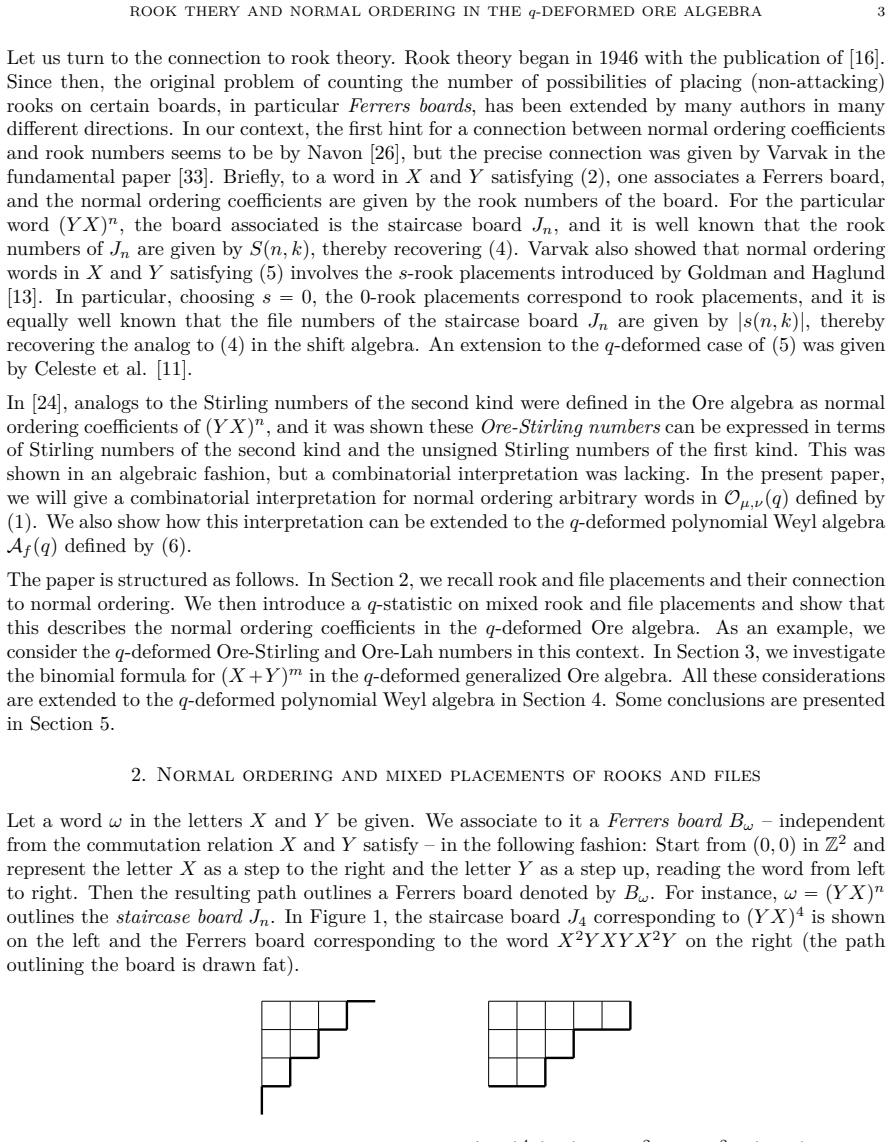
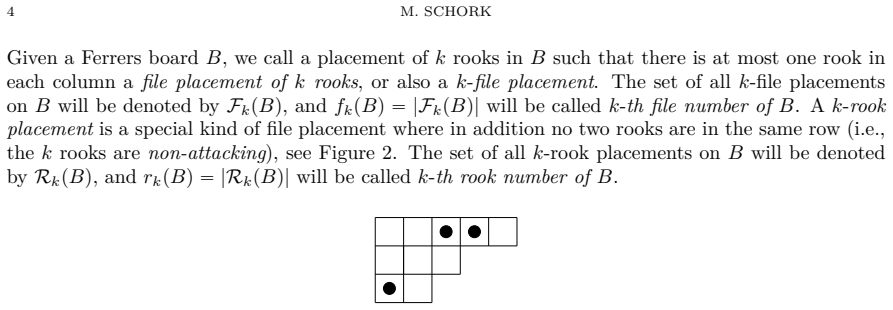
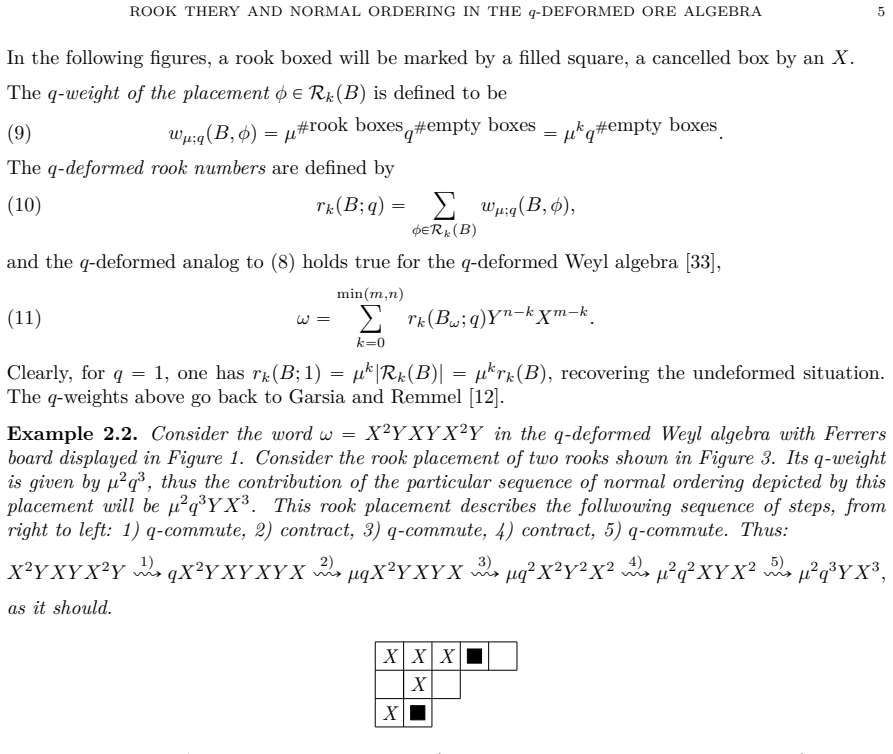
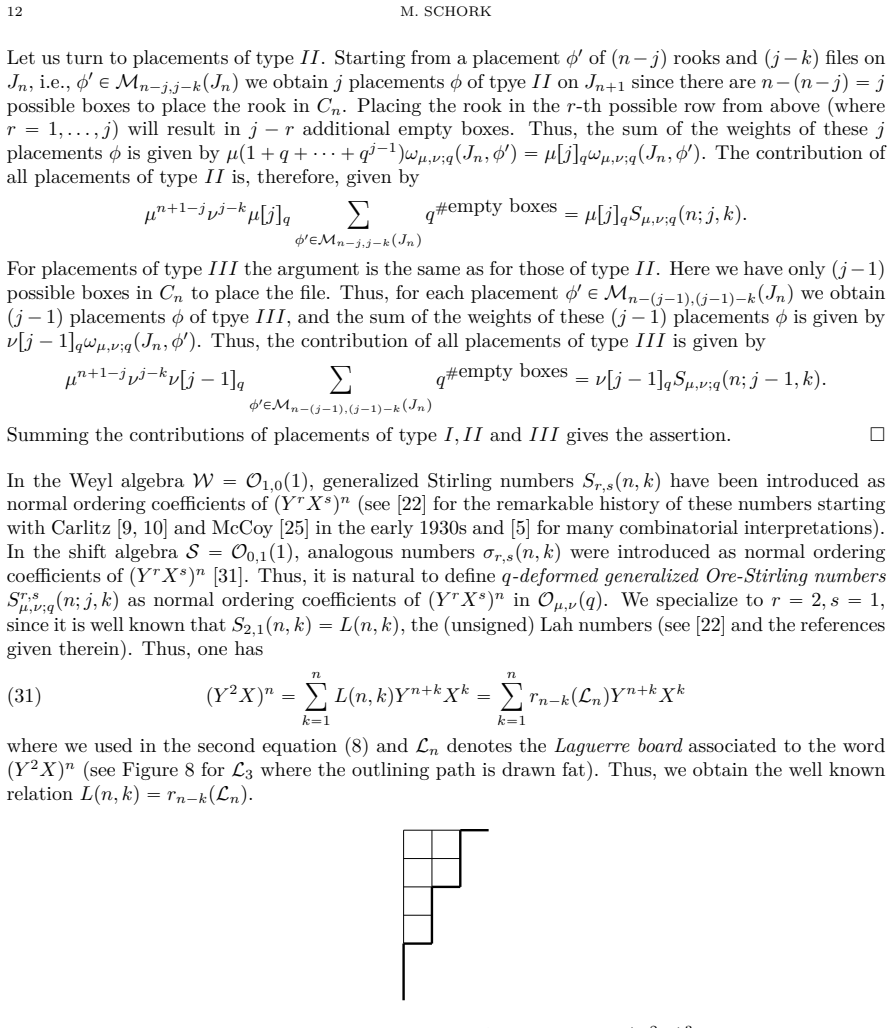
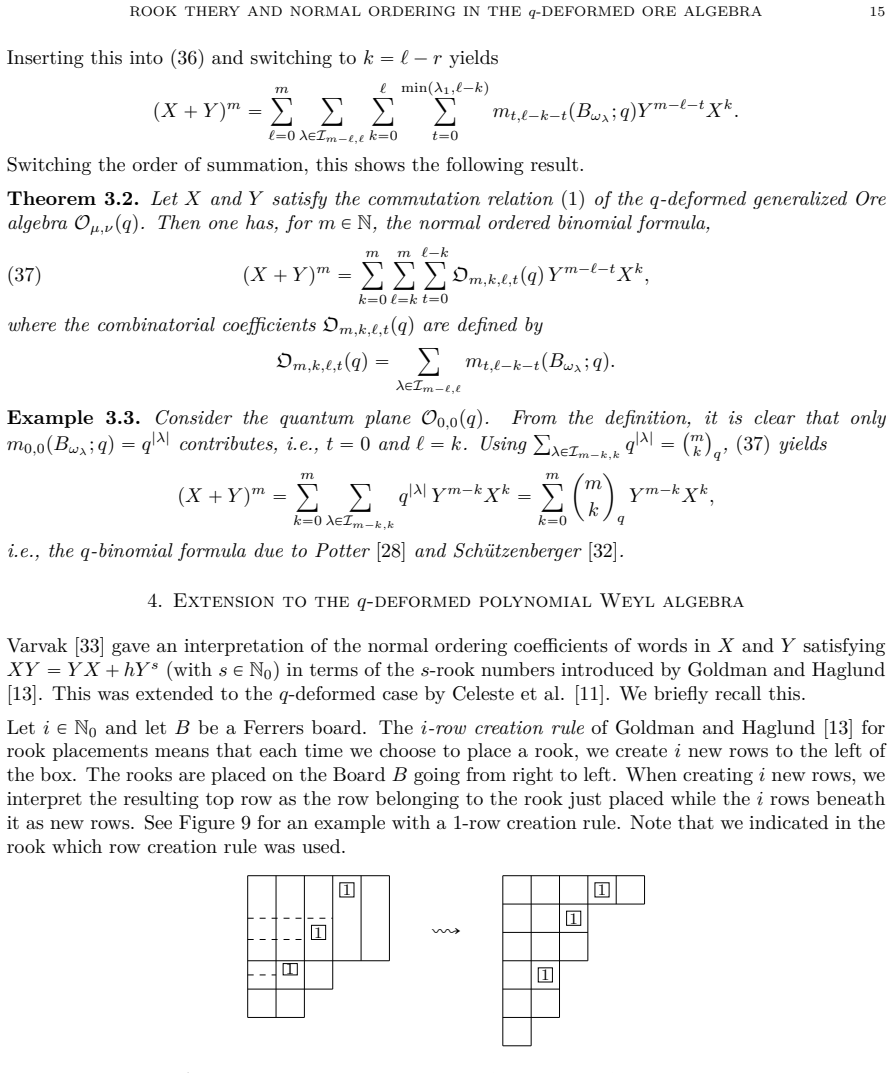
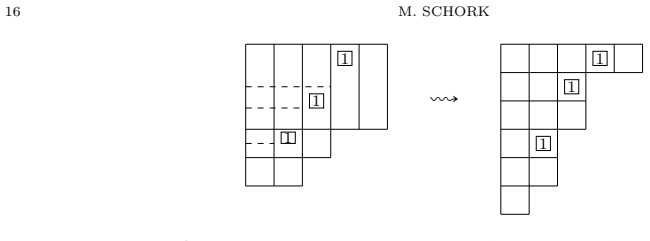
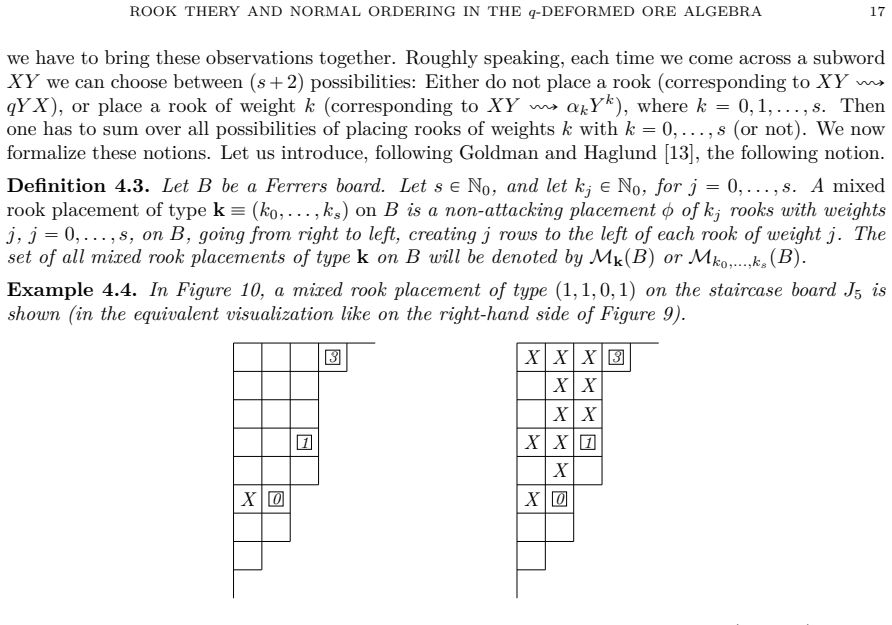
Normal ordering coefficients in the q-deformed Ore algebra count mixed placements of rooks and files on staircase and Laguerre boards.
A machine-rendered reading of the paper's core claim, the machinery that carries it, and where it could break.
Core claim
For operators X and Y obeying XY - q YX = μ I + ν Y, the coefficient of each normal-ordered monomial in the expansion of a given word equals the number of mixed rook-and-file placements on an appropriate board. In particular, the q-deformed Ore-Stirling numbers arise as these placement numbers on the staircase board, while the q-deformed Ore-Lah numbers arise on the Laguerre board. The same counting yields the normal-ordered form of (X + Y)^m. When the commutator is replaced by an arbitrary polynomial f(Y), the identical placement interpretation defines q-deformed polynomial Stirling and Lah numbers and supplies their binomial expansion.
What carries the argument
Mixed placement numbers of rooks and files on the staircase board (for q-deformed Ore-Stirling numbers) and on the Laguerre board (for q-deformed Ore-Lah numbers).
If this is right
- Recurrence relations for the q-deformed Ore-Stirling and Ore-Lah numbers follow directly from the possible ways to add one rook or file to a smaller board.
- The normal-ordered expansion of (X + Y)^m is obtained by summing the appropriate mixed placement numbers over all admissible board configurations.
- When the commutator is an arbitrary polynomial f(Y), the same placement model defines new q-deformed polynomial Stirling and Lah numbers whose properties, including binomial expansions, are inherited from the board geometry.
Where Pith is reading between the lines
- The rook-and-file model may supply direct bijective proofs linking these q-numbers to other known combinatorial sequences.
- Similar placement interpretations could apply to normal ordering in algebras whose commutation relations involve higher-order terms or additional generators.
- Explicit enumeration of placements for small boards could be used to generate new tables or conjectures about the q-deformed numbers.
Load-bearing premise
The single commutation relation completely determines a unique normal-ordering process for every word, so its coefficients admit a direct combinatorial counting interpretation.
What would settle it
For small explicit values of m, q, μ, and ν, expand a short word such as (X + Y)^m by repeated use of the commutation rule to obtain the coefficient of a normal-ordered term, then count the mixed rook-and-file placements on the corresponding board and check whether the two numbers agree.
Figures


read the original abstract
For words in the variables $X$ and $Y$ satisfying the commutation relation of the $q$-deformed generalized Ore algebra, $XY-qYX= \mu I + \nu Y$, we show that the corresponding normal ordering coefficients can be given an interpretation in terms of mixed placements of rooks and files. In particular, the associated $q$-deformed Ore-Stirling and Ore-Lah numbers are treated in detail. We show that the $q$-deformed Ore-Stirling numbers (resp., $q$-deformed Ore-Lah numbers) are given as mixed placement numbers of rooks and files on the staircase board (resp., Laguerre board). Using this combinatorial interpretation, their recurrence relations are derived. In addition, the normal ordered form of the binomial $(X+Y)^m$ in the $q$-deformed generalized Ore algebra is determined. These considerations are then extended to the $q$-deformed polynomial Weyl algebra generated by $X$ and $Y$ satisfying $XY-qYX=f(Y)$ for some polynomial $f\in \mathbb{C}[Y]$. In particular, associated $q$-deformed polynomial Stirling and Lah numbers are introduced and their properties studied. The normal ordered form of the binomial is also extended to the $q$-deformed polynomial Weyl algebra.
Editorial analysis
A structured set of objections, weighed in public.
Referee Report
Summary. The paper claims that the coefficients arising in the normal ordering of words in the q-deformed generalized Ore algebra satisfying XY - q YX = μ I + ν Y admit a direct combinatorial interpretation as mixed placements of rooks and files on the staircase board (for the associated q-Ore-Stirling numbers) and the Laguerre board (for the q-Ore-Lah numbers). Matching recurrences are derived from the placement model, the normal-ordered form of the binomial (X + Y)^m is determined, and the results are extended to the q-deformed polynomial Weyl algebra XY - q YX = f(Y) for polynomial f, where analogous q-deformed polynomial Stirling and Lah numbers are introduced and studied.
Significance. If the claimed equivalence holds, the work supplies a concrete rook-theoretic model for normal-ordering coefficients in a family of deformed algebras, thereby furnishing combinatorial derivations of recurrences and potentially new identities. The explicit matching of recurrences and initial conditions between the algebraic coefficients and the placement numbers is a strength, as is the extension to the polynomial case. This contributes to the literature connecting normal ordering, q-deformations, and combinatorial enumeration.
major comments (1)
- [§4] §4, recurrence (12) for the mixed placement numbers on the staircase board: while the algebraic recurrence for the q-Ore-Stirling numbers is standard from the commutation relation, the paper must confirm that the weighting of rook and file placements (including the precise powers of q and the parameters μ, ν) reproduces the algebraic coefficients without additional choices; an explicit low-degree verification (e.g., for total degree 3) would make the equivalence load-bearing rather than merely suggestive.
minor comments (3)
- [§3] The definition of 'mixed placements' of rooks and files should be stated once, with a clear diagram or small example, before the recurrence derivations begin.
- [§6] Notation for the q-deformed polynomial Stirling numbers in the final section is introduced without an explicit comparison table to the classical or q-Ore cases; adding such a table would improve readability.
- A few typographical inconsistencies appear in the indexing of the boards (staircase vs. Laguerre) in the statements of Theorems 3.1 and 5.2.
Simulated Author's Rebuttal
We thank the referee for the positive evaluation and the recommendation of minor revision. The suggestion to strengthen the equivalence with an explicit low-degree check is helpful, and we will incorporate it.
read point-by-point responses
-
Referee: [§4] §4, recurrence (12) for the mixed placement numbers on the staircase board: while the algebraic recurrence for the q-Ore-Stirling numbers is standard from the commutation relation, the paper must confirm that the weighting of rook and file placements (including the precise powers of q and the parameters μ, ν) reproduces the algebraic coefficients without additional choices; an explicit low-degree verification (e.g., for total degree 3) would make the equivalence load-bearing rather than merely suggestive.
Authors: We agree that an explicit verification for small degrees will make the correspondence more rigorous. In the revised manuscript we will insert a short computational check (new paragraph or subsection in §4) that directly compares the normal-ordering coefficients for all words of total degree 3, obtained both from repeated application of the commutation relation XY − qYX = μI + νY and from the weighted rook-file placements on the staircase board. The powers of q and the factors involving μ and ν will be shown to match exactly, confirming that the combinatorial weights require no additional adjustments. revision: yes
Circularity Check
No significant circularity
full rationale
The derivation proceeds by defining the normal-ordering coefficients algebraically via repeated application of the fixed commutation relation XY - q YX = μ I + ν Y, which yields a unique normal form and associated recurrence. Independently, mixed rook-file placement numbers are defined on the staircase board (for q-Ore-Stirling) and Laguerre board (for q-Ore-Lah) using standard rook-theoretic counting. The paper then derives the recurrence for the placement numbers directly from the board geometry and shows that it coincides with the algebraic recurrence together with identical initial conditions. This matching constitutes a proof of equality rather than a definitional identity. No step reduces a claimed result to a fitted parameter, self-citation, or ansatz smuggled from prior work; the combinatorial model is external to the algebra and the equivalence is established by independent verification of the same recurrence relation.
Axiom & Free-Parameter Ledger
axioms (1)
- domain assumption The commutation relation XY - q YX = μ I + ν Y holds and determines a unique normal-ordering process for every word.
Lean theorems connected to this paper
-
IndisputableMonolith/Cost/FunctionalEquation.leanwashburn_uniqueness_aczel unclear?
unclearRelation between the paper passage and the cited Recognition theorem.
We show that the q-deformed Ore-Stirling numbers ... are given as mixed placement numbers of rooks and files on the staircase board
-
IndisputableMonolith/Foundation/DimensionForcing.leanalexander_duality_circle_linking unclear?
unclearRelation between the paper passage and the cited Recognition theorem.
the q-deformed Ore-Lah numbers ... on the Laguerre board
What do these tags mean?
- matches
- The paper's claim is directly supported by a theorem in the formal canon.
- supports
- The theorem supports part of the paper's argument, but the paper may add assumptions or extra steps.
- extends
- The paper goes beyond the formal theorem; the theorem is a base layer rather than the whole result.
- uses
- The paper appears to rely on the theorem as machinery.
- contradicts
- The paper's claim conflicts with a theorem or certificate in the canon.
- unclear
- Pith found a possible connection, but the passage is too broad, indirect, or ambiguous to say the theorem truly supports the claim.
discussion (0)
Sign in with ORCID, Apple, or X to comment. Anyone can read and Pith papers without signing in.