Stardust Galaxies at z>9: A Dust-Origin Transition Behind the Excess of UV-Bright Galaxies
Pith reviewed 2026-05-20 23:14 UTC · model grok-4.3
The pith
A transition to low-opacity supernova dust explains the excess of UV-bright galaxies at z>9 by reducing attenuation without removing gas.
A machine-rendered reading of the paper's core claim, the machinery that carries it, and where it could break.
Core claim
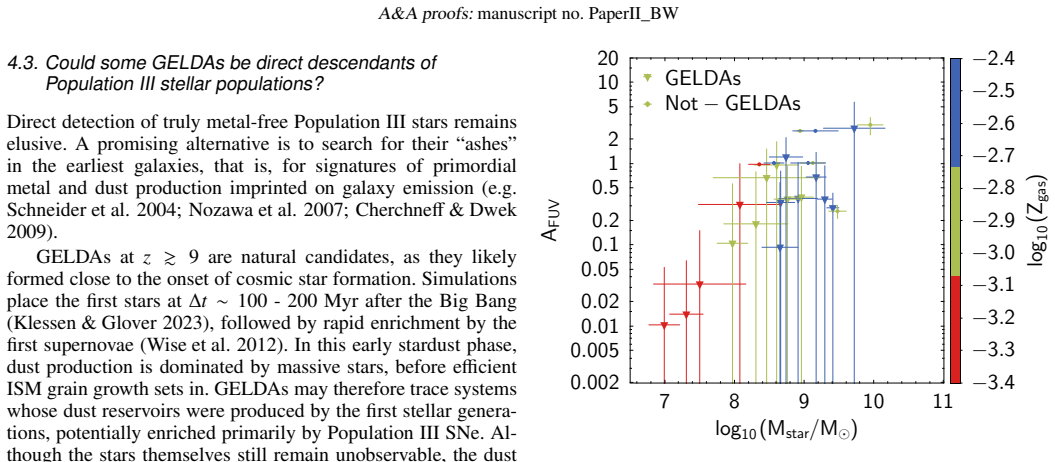
The observed A_FUV-M_star relation at z > 9 is best reproduced for an intrinsic FUV dust opacity kappa_UV(dust) of 10^3 - 10^4 cm2/g, characteristic of low-opacity SNe dust. This regime naturally produces very low attenuation even in gas-rich galaxies and reproduces galaxies with extremely low dust attenuation (GELDAs) that dominate observed samples at z > 9. Applied to intrinsic UV luminosity function models, the SNe-dominated and hybrid prescriptions mainly suppress the brightest galaxies, bringing predictions into agreement with JWST measurements without requiring extreme star-formation efficiencies or dust-free interstellar media.
What carries the argument
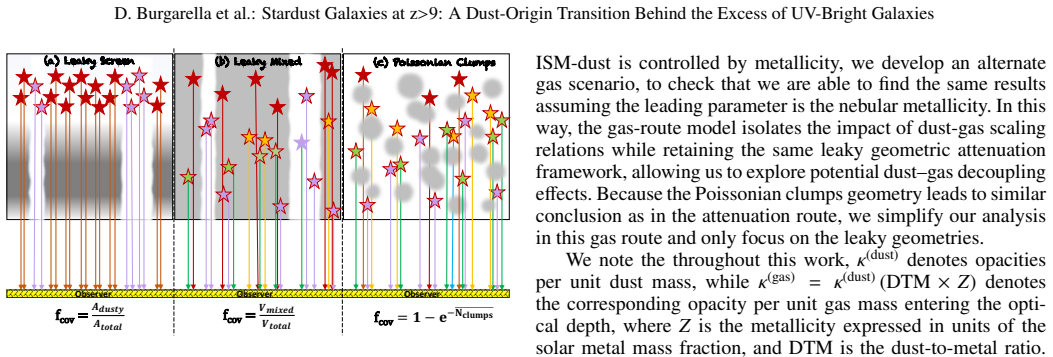
Physically motivated attenuation framework combining extinction laws for reverse-shock-processed SNe dust, metallicity- and dust-to-metal-dependent opacity scalings, and porous radiative-transfer geometries allowing partial UV-photon leakage.
If this is right
- The UV-bright excess at z>9 arises from dust composition and geometry rather than large-scale gas outflows or extreme star-formation rates.
- Galaxies can retain substantial gas reservoirs while exhibiting very low effective UV attenuation under SNe dust conditions.
- SNe-dominated and hybrid attenuation models align the predicted UV luminosity function with JWST counts by suppressing the brightest end.
- A later shift toward ISM grain-growth dust would increase attenuation as metallicity rises and galaxies evolve.
Where Pith is reading between the lines
- Dust composition signatures in high-redshift spectra could directly test whether the low-opacity SNe regime dominates before a transition occurs.
- This framework implies that UV-based estimates of star formation rates at z>9 may need adjustment for evolving dust opacity rather than assuming constant properties.
- Extending the model across redshift could predict the epoch when the UV excess fades as grain growth overtakes supernova dust production.
Load-bearing premise
Reverse-shock-processed supernova dust has intrinsically low UV opacity in the range 10^3-10^4 cm2/g and this SNe-dominated regime applies before efficient ISM grain growth at z>9.
What would settle it
Multi-wavelength observations or spectroscopy revealing UV opacities significantly above 10^4 cm2/g or extinction curves inconsistent with reverse-shock-processed SNe dust in z>9 galaxies would disprove the low-attenuation regime.
Figures



read the original abstract
Recent JWST observations suggest that galaxies at z > 9 may be dominated by low-opacity SNe-produced dust before efficient ISM grain growth is established. This transition in dust origin and opacity could explain both the prevalence of galaxies with extremely low dust attenuation and the excess of UV-bright galaxies relative to most pre-JWST predictions. We investigate whether this transition, combined with evolving star-formation efficiency, can reproduce these observed properties. We develop a physically motivated attenuation framework combining (i) extinction laws for reverse-shock-processed SNe dust, (ii) metallicity- and dust-to-metal-dependent opacity scalings, and (iii) porous radiative-transfer geometries allowing partial UV-photon leakage. Unlike outflow-driven scenarios requiring large-scale gas evacuation, our approach preserves gas reservoirs while reducing effective UV opacity through dust composition and geometry. We introduce extinction-based, gas-based, and hybrid attenuation prescriptions linking SNe-dominated and ISM grain-growth dust regimes. We find that the observed A_FUV-M_star relation at z > 9 is best reproduced for an intrinsic FUV dust opacity kappa_UV(dust)=10^3 - 10^4 cm2/g, characteristic of low-opacity SNe dust, naturally producing very low attenuation even in gas-rich galaxies. This regime reproduces galaxies with extremely low dust attenuation (GELDAs), which dominate observed samples at z > 9. Applied to intrinsic UV luminosity function models, our SNe-dominated and hybrid prescriptions mainly suppress the brightest galaxies, bringing predictions into agreement with JWST measurements without requiring extreme star-formation efficiencies or dust-free interstellar media. Our results suggest that the UV-bright galaxy excess at z > 9 reflects a transition in dust origin and opacity during the earliest phases of galaxy evolution.
Editorial analysis
A structured set of objections, weighed in public.
Referee Report
Summary. The manuscript proposes that the excess of UV-bright galaxies at z>9 is explained by a transition to low-opacity dust from supernovae before efficient ISM grain growth. The authors introduce an attenuation framework combining extinction laws for reverse-shock-processed SNe dust, metallicity- and dust-to-metal-dependent opacity scalings, and porous radiative-transfer geometries. They report that an intrinsic FUV dust opacity of kappa_UV(dust)=10^3-10^4 cm2/g best reproduces the observed A_FUV-M_star relation at z>9, produces galaxies with extremely low dust attenuation (GELDAs), and brings UV luminosity function predictions into agreement with JWST data without extreme star-formation efficiencies or dust-free media.
Significance. If the central result holds, the work supplies a physically motivated alternative to outflow-driven or extreme-efficiency scenarios for JWST high-redshift observations. It preserves gas reservoirs while reducing effective UV attenuation through dust origin, composition, and geometry, and offers a framework linking SNe-dominated and ISM grain-growth regimes with testable implications for early galaxy evolution.
major comments (2)
- [Abstract and attenuation framework] Abstract: the claim that kappa_UV(dust)=10^3-10^4 cm2/g is 'characteristic of low-opacity SNe dust' and 'naturally producing very low attenuation' is load-bearing, yet the text presents this range as the value that best reproduces the observed A_FUV-M_star relation rather than deriving it independently from the extinction laws or reverse-shock processing steps in the framework. This raises the risk that the opacity is tuned to the target JWST data.
- [Results and methods] Results and methods description: the reproduction of the UV luminosity function and A_FUV-M_star relation lacks explicit details on the observational samples employed, any data exclusion criteria, error propagation or fitting procedures, and the quantitative steps that convert the hybrid prescriptions into the reported suppression of the brightest galaxies.
minor comments (1)
- [Notation and figures] Clarify the exact definition and units of the porous geometry leakage parameter when first introduced, and ensure all figures label the three attenuation prescriptions (extinction-based, gas-based, hybrid) consistently.
Simulated Author's Rebuttal
We thank the referee for their detailed and constructive report. Their comments identify areas where additional clarity and methodological transparency will strengthen the manuscript. We address each major comment below and outline the revisions we will make.
read point-by-point responses
-
Referee: [Abstract and attenuation framework] Abstract: the claim that kappa_UV(dust)=10^3-10^4 cm2/g is 'characteristic of low-opacity SNe dust' and 'naturally producing very low attenuation' is load-bearing, yet the text presents this range as the value that best reproduces the observed A_FUV-M_star relation rather than deriving it independently from the extinction laws or reverse-shock processing steps in the framework. This raises the risk that the opacity is tuned to the target JWST data.
Authors: We agree that the presentation in the abstract could be clarified to avoid any impression of post-hoc tuning. The opacity range is motivated by independent theoretical calculations of reverse-shock-processed supernova dust (referenced in Section 2.2 of the manuscript), which predict low FUV opacities in the 10^3–10^4 cm²/g regime for the relevant grain sizes and compositions. However, we acknowledge that the manuscript does not explicitly walk through the step-by-step mapping from those extinction laws to the adopted range without reference to the observational comparison. In the revised version we will (i) move the numerical range out of the abstract’s lead claim, (ii) add a short paragraph in the methods that derives the expected opacity interval directly from the SNe dust models and reverse-shock processing, and (iii) state explicitly that this interval is then tested against the A_FUV–M⋆ relation. This change will make the logical order clearer while preserving the physical motivation. revision: yes
-
Referee: [Results and methods] Results and methods description: the reproduction of the UV luminosity function and A_FUV-M_star relation lacks explicit details on the observational samples employed, any data exclusion criteria, error propagation or fitting procedures, and the quantitative steps that convert the hybrid prescriptions into the reported suppression of the brightest galaxies.
Authors: We accept this criticism and will substantially expand the methods and results sections. The revised manuscript will include: (1) a table or paragraph listing the specific JWST photometric and spectroscopic samples used for the A_FUV–M⋆ and UVLF comparisons, together with the redshift and magnitude cuts applied; (2) a description of the error propagation (including uncertainties on dust-to-metal ratios and porosity parameters) and the fitting metric used to identify the best-matching opacity range; and (3) an explicit quantitative example showing how the hybrid attenuation prescription alters the bright-end slope of the intrinsic UVLF, including the fractional suppression at M_UV < –21. These additions will allow readers to reproduce the reported suppression without ambiguity. revision: yes
Circularity Check
Kappa_UV(dust) range selected to best reproduce observed A_FUV-M_star relation
specific steps
-
fitted input called prediction
[Abstract]
"We find that the observed A_FUV-M_star relation at z > 9 is best reproduced for an intrinsic FUV dust opacity kappa_UV(dust)=10^3 - 10^4 cm2/g, characteristic of low-opacity SNe dust, naturally producing very low attenuation even in gas-rich galaxies. This regime reproduces galaxies with extremely low dust attenuation (GELDAs), which dominate observed samples at z > 9."
The paper explicitly states the relation is 'best reproduced for' this kappa range. The value is therefore chosen because it matches the observations, rendering the subsequent claim that the SNe-dominated regime 'naturally' yields low attenuation and matches the UV luminosity function a direct consequence of the fit rather than a first-principles output of the extinction laws or dust-origin transition.
full rationale
The paper constructs an attenuation framework from extinction laws, metallicity scalings, and porous geometries, then reports that the observed A_FUV-M_star relation is best reproduced specifically for kappa_UV(dust) in the 10^3-10^4 cm2/g range. This selection step makes the claim of 'naturally producing very low attenuation' and GELDAs reduce to a fit to the target JWST data rather than an independent derivation. The framework supplies some physical content, so the circularity is partial rather than total.
Axiom & Free-Parameter Ledger
free parameters (1)
- kappa_UV(dust) =
10^3 - 10^4 cm2/g
axioms (1)
- domain assumption Reverse-shock-processed SNe dust follows specific extinction laws with low UV opacity before ISM grain growth dominates
Lean theorems connected to this paper
-
IndisputableMonolith/Cost/FunctionalEquation.leanwashburn_uniqueness_aczel unclear?
unclearRelation between the paper passage and the cited Recognition theorem.
observed A_FUV-M_star relation at z>9 is best reproduced for an intrinsic FUV dust opacity κ_UV(dust)=10^3–10^4 cm²/g, characteristic of low-opacity SNe dust
-
IndisputableMonolith/Foundation/AlphaCoordinateFixation.leanalpha_pin_under_high_calibration unclear?
unclearRelation between the paper passage and the cited Recognition theorem.
hybrid attenuation prescriptions linking SNe-dominated and ISM grain-growth dust regimes
What do these tags mean?
- matches
- The paper's claim is directly supported by a theorem in the formal canon.
- supports
- The theorem supports part of the paper's argument, but the paper may add assumptions or extra steps.
- extends
- The paper goes beyond the formal theorem; the theorem is a base layer rather than the whole result.
- uses
- The paper appears to rely on the theorem as machinery.
- contradicts
- The paper's claim conflicts with a theorem or certificate in the canon.
- unclear
- Pith found a possible connection, but the passage is too broad, indirect, or ambiguous to say the theorem truly supports the claim.
Reference graph
Works this paper leans on
-
[1]
Adams, N. J., Conselice, C. J., Ferreira, L., et al.\ 2023, , 518, 3, 4755. doi:10.1093/mnras/stac3347
-
[2]
Adams, N. J., Conselice, C. J., Austin, D., et al.\ 2024, , 965, 2, 169. doi:10.3847/1538-4357/ad2a7b
-
[3]
Arrabal Haro, P., Dickinson, M., Finkelstein, S. L., et al.\ 2023, , 951, L22. doi:10.3847/2041-8213/acdd54
-
[4]
L., et al.\ 2023, , 622, 7984, 707
Arrabal Haro, P., Dickinson, M., Finkelstein, S. L., et al.\ 2023, , 622, 7984, 707. doi:10.1038/s41586-023-06521-7
-
[5]
Asano, R. S., Takeuchi, T. T., Hirashita, H., & Inoue, A. K.\ 2013, EPS, 65, 213
work page 2013
-
[6]
Asano R. S., Takeuchi T. T., Hirashita H., Nozawa T., 2014, MNRAS, 440, 134. doi:10.1093/mnras/stu208
-
[7]
Atek, H., Shuntov, M., Furtak, L. J., et al.\ 2023, , 519, 1, 1201. doi:10.1093/mnras/stac3144
-
[8]
2019, A&A, 622, A103, doi: 10.1051/0004-6361/201834156
Boquien, M., Burgarella, D., Roehlly, Y., et al.\ 2019, , 622, A103. doi:10.1051/0004-6361/201834156
work page internal anchor Pith review doi:10.1051/0004-6361/201834156 2019
-
[9]
Bouwens, R., Illingworth, G., Oesch, P., et al.\ 2023, , 523, 1, 1009. doi:10.1093/mnras/stad1014
-
[10]
Bouwens, R. J., Illingworth, G. D., Oesch, P. A., et al.\ 2023, , 954, 128. doi:10.3847/1538-4357/ace0d8
-
[11]
doi:10.1038/s41550-023-01950-2
Boylan-Kolchin, M.\ 2023, Nature Astronomy, 7, 731. doi:10.1038/s41550-023-01950-2
- [12]
-
[13]
doi:10.1088/0034-4885/76/11/112901
Bromm, V.\ 2013, Reports on Progress in Physics, 76, 112901. doi:10.1088/0034-4885/76/11/112901
-
[14]
doi:10.1146/annurev-astro-081710-102608
Bromm, V., & Yoshida, N.\ 2011, , 49, 373. doi:10.1146/annurev-astro-081710-102608
-
[15]
2012, A&A, 545, A141, doi: 10.1051/0004-6361/201219405
Buat, V., Noll, S., Burgarella, D., et al.\ 2012, , 545, A141. doi:10.1051/0004-6361/201219405
-
[16]
doi:10.1051/0004-6361/202554231
Burgarella, D., Buat, V., Theul \'e , P., et al.\ 2025, , 699, A336. doi:10.1051/0004-6361/202554231
-
[17]
Calzetti, D., Armus, L., Bohlin, R. C., et al.\ 2000, , 533, 682. doi:10.1086/308692
work page internal anchor Pith review doi:10.1086/308692 2000
-
[18]
2023, ApJL, 948, L14, doi: 10.3847/2041-8213/accea5 16Ferrara et al
Castellano, M., Fontana, A., Treu, T., et al.\ 2023, , 948, 2, L14. doi:10.3847/2041-8213/accea5
-
[19]
2024, ApJ, 972, 143, doi: 10.3847/1538-4357/ad5f88
Castellano, M., Napolitano, L., Fontana, A., et al.\ 2024, , 972, 2, 143. doi:10.3847/1538-4357/ad5f88
-
[20]
A Simple Model for the Absorption of Starlight by Dust in Galaxies
Charlot, S. & Fall, S. M.\ 2000, , 539, 718. doi:10.1086/309250
work page internal anchor Pith review doi:10.1086/309250 2000
-
[21]
Chemerynska, I., Atek, H., Dayal, P., et al.\ 2024, , 976, L15
work page 2024
-
[22]
Cherchneff, I., & Dwek, E.\ 2009, , 703, 642
work page 2009
-
[23]
Chevallard, J., Charlot, S., Wandelt, B., & Wild, V.\ 2013, , 432, 2061. doi:10.1093/mnras/stt318
-
[24]
Choban, C. R., Kere s , D., Sandstrom, K. M., et al.\ 2024, , 529, 2356. doi:10.1093/mnras/stae716
-
[25]
R., Hutter, A., Dayal, P., et al.\ 2024, , 686, A138
Cueto, E. R., Hutter, A., Dayal, P., et al.\ 2024, , 686, A138. doi:10.1051/0004-6361/202349017
-
[26]
Cullen, F., McLure, R. J., Donnan, C. T., et al.\ 2023, , 520, 14. doi:10.1093/mnras/stad131
-
[27]
Cullen, F., Carnall, A. C., Scholte, D., et al.\ 2025, , 540, 3, 2176. doi:10.1093/mnras/staf838
-
[28]
2023, MNRAS, 518, 425, doi: 10.1093/mnras/stac2737
Curti, M., D'Eugenio, F., Carniani, S., et al.\ 2023, , 518, 1, 425. doi:10.1093/mnras/stac2737
-
[29]
2022, MNRAS, 512, 989, doi: 10.1093/mnras/stac537
Dayal, P., Ferrara, A., Sommovigo, L., et al.\ 2022, , 512, 989. doi:10.1093/mnras/stac537
-
[30]
R., Ferrara, A., et al.\ 2024, , 529, 4221
Dayal, P., Choudhury, T. R., Ferrara, A., et al.\ 2024, , 529, 4221. doi:10.1093/mnras/stae318
-
[31]
De Looze, I., Barlow, M. J., Swinyard, B. M., et al.\ 2017, , 465, 3309
work page 2017
-
[32]
De Vis, P., Jones, A., Viaene, S., et al.\ 2019, , 623, A5
work page 2019
-
[33]
Di Cesare, C., Graziani, L., Schneider, R., et al.\ 2023, , 519, 4632. doi:10.1093/mnras/stac3702
-
[34]
Donnan, C. T., McLeod, D. J., McLure, R. J., et al.\ 2023, , 518, 6011. doi:10.1093/mnras/stac3491
-
[35]
Donnan, C. T., McLure, R. J., Dunlop, J. S., et al.\ 2024, , 533, 3, 3222. doi:10.1093/mnras/stae2037
- [36]
-
[37]
doi:10.1088/0004-637X/727/2/63
Dwek, E., & Cherchneff, I.\ 2011, , 727, 63. doi:10.1088/0004-637X/727/2/63
-
[38]
Feldmann, R.\ 2015, , 449, 3274
work page 2015
-
[39]
Ferrara, A., Aiello, S., Ferrini, F., & Barsella, B.\ 1990, , 240, 259
work page 1990
-
[40]
Ferrara, A.\ 2022, , 512, 1598. doi:10.1093/mnras/stac620
-
[41]
2023, MNRAS, 522, 3986, doi: 10.1093/mnras/stad1095
Ferrara, A., Pallottini, A., & Dayal, P.\ 2023, , 522, 3, 3986. doi:10.1093/mnras/stad1095
-
[42]
Ferrara, A., & Carniani, S.\ 2025, , 694, A215
work page 2025
-
[43]
Finkelstein, S. L., Bagley, M. B., Arrabal Haro, P., et al.\ 2022, , 940, L55. doi:10.3847/2041-8213/acad00
-
[44]
Finkelstein, S. L., Bagley, M. B., Arrabal Haro, P., et al.\ 2023, , 946, L13. doi:10.3847/2041-8213/acb66d
-
[45]
Finkelstein, S. L., Bagley, M. B., Arrabal Haro, P., et al.\ 2025, , 983, 1, L4. doi:10.3847/2041-8213/adbbd3
-
[46]
Fujimoto, S., Ouchi, M., Nakajima, K., et al.\ 2024, , 964, 2, 146. doi:10.3847/1538-4357/ad235c
-
[47]
C., & Hjorth, J.\ 2011, , 19, 43
Gall, C., Andersen, A. C., & Hjorth, J.\ 2011, , 19, 43
work page 2011
-
[48]
& Hjorth, J.\ 2018, , 868, 1, 62
Gall, C. & Hjorth, J.\ 2018, , 868, 1, 62. doi:10.3847/1538-4357/aae520
-
[49]
Gallerani, S., Maiolino, R., Juarez, Y., et al.\ 2010, , 523, A85
work page 2010
-
[50]
Galliano, F., et al.\ 2022, , 30, 2
work page 2022
-
[51]
Habilitation Thesis , keywords =
Galliano, F.\ 2022, Habilitation Thesis, 1. doi:10.48550/arXiv.2202.01868
-
[52]
Gordon, K. D., Clayton, G. C., Misselt, K. A., et al.\ 2003, , 594, 279. doi:10.1086/376774
-
[53]
Graziani, L., Schneider, R., Ginolfi, M., et al.\ 2020, , 494, 1071. doi:10.1093/mnras/staa796
-
[54]
Greif, T. H., Springel, V., White, S. D. M., et al.\ 2011, , 737, 75. doi:10.1088/0004-637X/737/2/75
-
[55]
K., Mawatari, K., et al.\ 2022, , 929, 1, 1
Harikane, Y., Inoue, A. K., Mawatari, K., et al.\ 2022, , 929, 1, 1. doi:10.3847/1538-4357/ac53a9
-
[56]
2023, ApJS, 265, 5, doi: 10.3847/1538-4365/acaaa9
Harikane, Y., Ouchi, M., Oguri, M., et al.\ 2023, , 265, 5. doi:10.3847/1538-4365/acaaa9
- [57]
-
[58]
2024, ApJ, 960, 56, doi: 10.3847/1538-4357/ad0b7e
Harikane, Y., Nakajima, K., Ouchi, M., et al.\ 2024, , 960, 1, 56. doi:10.3847/1538-4357/ad0b7e
-
[59]
E., Gim \'e nez-Arteaga, C., Fujimoto, S., et al.\ 2023, , 944, 2, L30
Heintz, K. E., Gim \'e nez-Arteaga, C., Fujimoto, S., et al.\ 2023, , 944, 2, L30. doi:10.3847/2041-8213/acb2cf
-
[60]
Heintz, K. E., Fudamoto, Y., Faisst, A. L., et al.\ 2024, , 964, L15. doi:10.3847/2041-8213/ad2b25
-
[61]
Hirano, S., et al.\ 2015, , 448, 568
work page 2015
-
[62]
Hirashita, H., Nozawa, T., Takeuchi, T. T., & Kozasa, T.\ 2008, , 384, 1725. doi:10.1111/j.1365-2966.2007.12828.x
-
[63]
Inayoshi, K., Harikane, Y., Inoue, A. K., et al.\ 2022, , 938, 2, L10. doi:10.3847/2041-8213/ac9310
-
[64]
Inoue, A. K.\ 2005, , 359, 171. doi:10.1111/j.1365-2966.2005.08940.x
-
[65]
K.\ 2011, Earth, Planets and Space, 63, 1027
Inoue, A. K.\ 2011, Earth, Planets and Space, 63, 1027. doi:10.5047/eps.2011.02.013
-
[66]
K., Hashimoto, T., Chihara, H., et al.\ 2020, , 495, 1577
Inoue, A. K., Hashimoto, T., Chihara, H., et al.\ 2020, , 495, 1577. doi:10.1093/mnras/staa1203
-
[67]
Iyer, K. G., Speagle, J. S., Caplar, N., et al.\ 2024, , 961, 1, 53. doi:10.3847/1538-4357/acff64
-
[68]
L., & Bromm, V.\ 2019, , 488, 2, 2202
Jaacks, J., Finkelstein, S. L., & Bromm, V.\ 2019, , 488, 2, 2202. doi:10.1093/mnras/stz1529
-
[69]
doi:10.1051/0004-6361/201323199
Kataoka, A., Okuzumi, S., Tanaka, H., et al.\ 2014, , 568, A42. doi:10.1051/0004-6361/201323199
-
[70]
Z., Redigolo, D., & Volansky, T.\ 2025, , 2025, 10, 047
Katz, O. Z., Redigolo, D., & Volansky, T.\ 2025, , 2025, 10, 047. doi:10.1088/1475-7516/2025/10/047
-
[71]
Kawamata, R., Ishigaki, M., Shimasaku, K., et al.\ 2018, , 855, 4
work page 2018
-
[72]
Kirchschlager, F., Barlow, M. J., Priestley, F. D., & Nozawa, T.\ 2019, , 487, 195. doi:10.1093/mnras/stz1203
-
[73]
Kirchschlager, F., Schmidt, F. D., Barlow, M. J., et al.\ 2019, , 489, 4, 4465. doi:10.1093/mnras/stz2399
-
[74]
Klessen, R. S. & Glover, S. C. O.\ 2023, , 61, 65. doi:10.1146/annurev-astro-071221-053453
-
[75]
Kocevski, D. D., Papovich, C., Trump, J. R., et al.\ 2023, , 946, L14. doi:10.3847/2041-8213/acb8b5
-
[76]
Langeroodi, D., Hjorth, J., Gall, C., & Zafar, T.\ 2023, , 952, 156. doi:10.3847/1538-4357/acdffd
-
[77]
Langeroodi, D., Hjorth, J., Ferrara, A., et al.\ 2024, arXiv:2410.14671. doi:10.48550/arXiv.2410.14671
-
[78]
Leung, G. C. K., Bagley, M. B., Finkelstein, S. L., et al.\ 2023, , 954, 2, L46. doi:10.3847/2041-8213/acf365
-
[79]
Lewis, J. S. W., Ocvirk, P., Dubois, Y., et al.\ 2023, , 519, 5987. doi:10.1093/mnras/stad081
-
[80]
2019, MNRAS, 490, 1425, doi: 10.1093/mnras/stz2684
Li, Q., Narayanan, D., & Dav \'e , R.\ 2019, , 490, 1425. doi:10.1093/mnras/stz2684
discussion (0)
Sign in with ORCID, Apple, or X to comment. Anyone can read and Pith papers without signing in.