Closing the Motion Execution Gap: From Semantic Motion Task Constraints to Kinematic Control
Pith reviewed 2026-05-13 05:15 UTC · model grok-4.3
The pith
Motion Statecharts turn semantic task constraints into executable kinematic motions that transfer across robot platforms without retuning.
A machine-rendered reading of the paper's core claim, the machinery that carries it, and where it could break.
Core claim
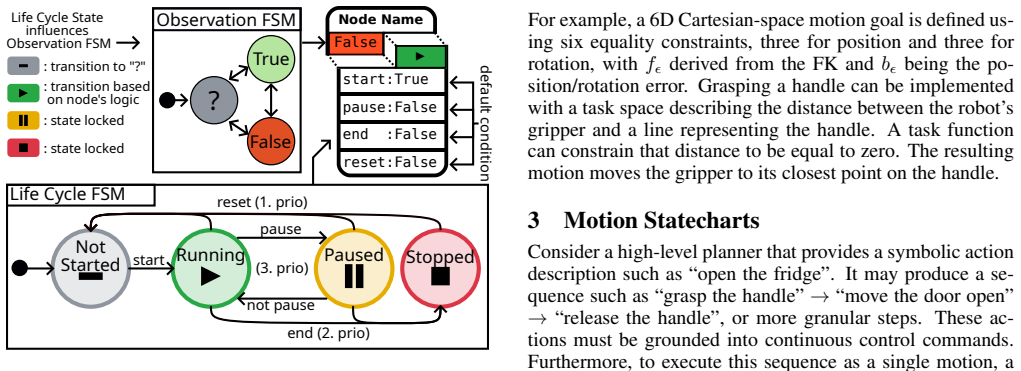
Motion Statecharts provide an executable symbolic representation for complex motions that permits arbitrary parallel and sequential composition of motion constraints, monitors, or nested statecharts. World-centric specification and cross-embodiment generalization are achieved by grounding all constraints in a unified differentiable kinematic model of robots and environments. Execution is realized by a linear model-predictive control implementation of the task-function approach that enforces jerk bounds to produce smooth transitions between tasks.
What carries the argument
Motion Statecharts, an executable symbolic structure that composes motion constraints, monitors and nested charts in parallel or sequence while being grounded in a single differentiable kinematic world model.
If this is right
- Complex tasks become composable from reusable constraint primitives without writing platform-specific code.
- The same semantic description yields executable motions on any robot whose kinematics are captured by the shared model.
- Jerk-bounded linear MPC produces continuous trajectories when the active set of constraints changes.
- Open-source deployment on eight platforms shows that the generated motions remain feasible in real hardware settings.
Where Pith is reading between the lines
- Higher-level symbolic planners could output Motion Statecharts directly, closing the loop between task planning and low-level control.
- The same constraint language might be reused for simulation-based verification before real-robot execution.
- If the kinematic model is extended with dynamics or contact forces, the framework could handle tasks that currently require separate force controllers.
Load-bearing premise
The unified differentiable kinematic model of robots and environments must be accurate enough to let the same constraint description produce correct motions on any new platform without platform-specific adjustments.
What would settle it
A motion task written once in the statechart language fails to produce collision-free, constraint-satisfying trajectories on a ninth robot embodiment or in an environment whose kinematics were not included in the shared model.
Figures




read the original abstract
This paper addresses the Motion Execution Gap, the disconnect between high-level symbolic task descriptions using semantic constraints and executable robot motions. Motion Statecharts are introduced as an executable symbolic representation for complex motions. They allow the arbitrary arrangement of motion constraints, monitors or nested statecharts in parallel and sequence. World-centric motion specification and generalization across embodiments are enabled through the use of a unified differentiable kinematic world model of both, robots and environments. Motion execution is realized through a lMPC-based implementation of the task-function approach, in which smooth transitions during task switches are ensured using jerk bounds. Cross-platform transferability was demonstrated by deploying the method on eight robot platforms, operating in diverse environments. The proposed framework is called Giskard and is available open source: https://github.com/cram2/cognitive_robot_abstract_machine.
Editorial analysis
A structured set of objections, weighed in public.
Referee Report
Summary. The paper claims to close the Motion Execution Gap between high-level semantic task descriptions and executable robot motions by introducing Motion Statecharts as an executable symbolic representation that supports arbitrary parallel and sequential arrangements of motion constraints, monitors, and nested statecharts. It enables world-centric specification and cross-embodiment generalization via a unified differentiable kinematic world model of robots and environments, realized through an lMPC implementation of the task-function approach with jerk bounds for smooth task transitions. Cross-platform transferability is asserted via deployment on eight robot platforms in diverse environments, with the Giskard framework released as open source.
Significance. If the central claims hold, the work offers a practical advance in robotics by providing an executable symbolic layer that bridges semantic constraints to kinematic control while supporting embodiment-agnostic specification. The open-source release and multi-platform demonstration are explicit strengths that support reproducibility and potential adoption, though the absence of quantitative validation limits the assessed impact.
major comments (2)
- Abstract: The claim of demonstrated cross-platform transferability on eight robots is load-bearing for the central contribution but is unsupported by any quantitative results, error metrics, or validation details for the lMPC implementation, preventing assessment of whether the motion execution gap is actually closed.
- The section describing the unified differentiable kinematic world model: The assertion that this model enables generalization across embodiments without platform-specific tuning is central to the cross-embodiment claim, yet no details are provided on model construction, kinematic parameter acquisition, or whether per-robot or per-environment adjustments occurred during the eight-platform deployments.
Simulated Author's Rebuttal
We thank the referee for the constructive feedback. We address each major comment point by point below, indicating where revisions will be made to strengthen the manuscript.
read point-by-point responses
-
Referee: Abstract: The claim of demonstrated cross-platform transferability on eight robots is load-bearing for the central contribution but is unsupported by any quantitative results, error metrics, or validation details for the lMPC implementation, preventing assessment of whether the motion execution gap is actually closed.
Authors: We agree that the abstract's claim would be better supported by quantitative indicators. The manuscript presents the deployments as qualitative demonstrations of successful task execution across platforms, but to enable assessment of the motion execution gap, we will revise the abstract to qualify the claim and add a summary table in the experiments section listing the eight platforms, associated tasks, success rates, and any collected metrics such as execution duration or smoothness indicators. revision: yes
-
Referee: The section describing the unified differentiable kinematic world model: The assertion that this model enables generalization across embodiments without platform-specific tuning is central to the cross-embodiment claim, yet no details are provided on model construction, kinematic parameter acquisition, or whether per-robot or per-environment adjustments occurred during the eight-platform deployments.
Authors: We acknowledge that additional explicit details would clarify the generalization mechanism. The model is constructed from standard kinematic descriptions, but in revision we will expand the relevant section to describe the construction process, confirm that parameters are acquired directly from URDF and environment models with no per-robot or per-environment tuning applied during the deployments, and note that the same unified model was used across all platforms. revision: yes
Circularity Check
No circularity in derivation chain
full rationale
The paper presents an architectural framework (Motion Statecharts plus unified differentiable kinematic world model) for bridging symbolic task constraints to robot control, with claims supported by open-source code and empirical deployment across eight platforms. No equations, parameter-fitting steps, or self-citations are shown that reduce any central result to its own inputs by construction. The derivation is self-contained as a system description and implementation rather than a tautological prediction or renamed prior result.
Axiom & Free-Parameter Ledger
invented entities (2)
-
Motion Statecharts
no independent evidence
-
Giskard framework
no independent evidence
discussion (0)
Sign in with ORCID, Apple, or X to comment. Anyone can read and Pith papers without signing in.