Corner Charge Fluctuations in Higher Dimensions
Pith reviewed 2026-05-15 05:12 UTC · model grok-4.3
Add this Pith Number to your LaTeX paper
What is a Pith Number?\usepackage{pith}
\pithnumber{25R7LMXN}
Prints a linked pith:25R7LMXN badge after your title and writes the identifier into PDF metadata. Compiles on arXiv with no extra files. Learn more
The pith
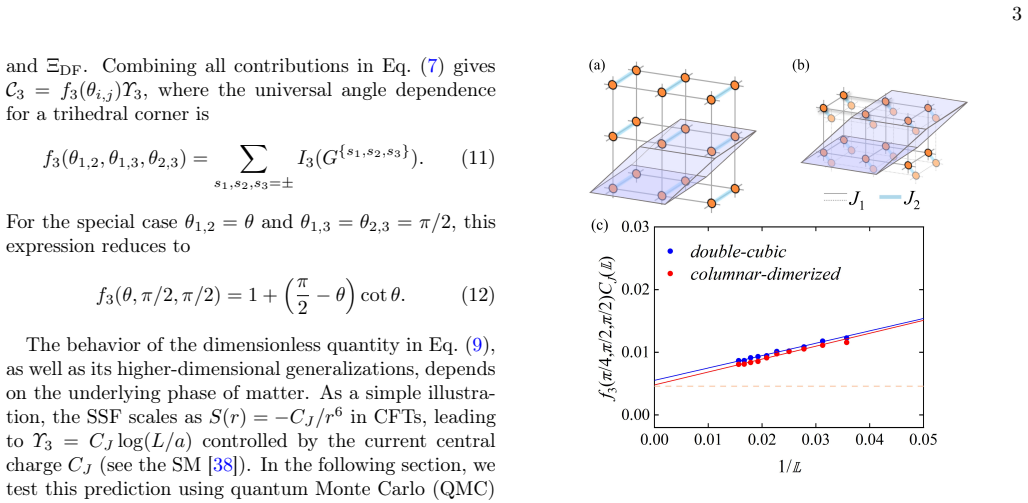
In three dimensions, trihedral corners of parallelepipeds produce a universal angle-dependent contribution to charge fluctuations that includes a term probing the quantum metric.
A machine-rendered reading of the paper's core claim, the machinery that carries it, and where it could break.
Core claim
In three dimensions, the universal angle dependence associated with trihedral corners of a generic parallelepiped is derived and a wedge-corner contribution that directly probes the quantum metric is identified. These predictions are benchmarked against Monte Carlo simulations of lattice models at the O(3) quantum critical point and for a lattice Weyl semimetal model. Angle functions for polyhedral corners of arbitrary parallelotopes in general dimensions are obtained, and the scaling of the corner contribution is clarified across phases of matter, with similar behavior in insulators and conformal critical points but a characteristic even-odd dimensional effect in metals.
What carries the argument
The corner contribution to the variance of charge inside a subregion, decomposed into universal angle functions of the dihedral angles at each polyhedral corner.
If this is right
- At any conformal critical point the corner contribution depends only on the three angles through a universal function independent of microscopic details.
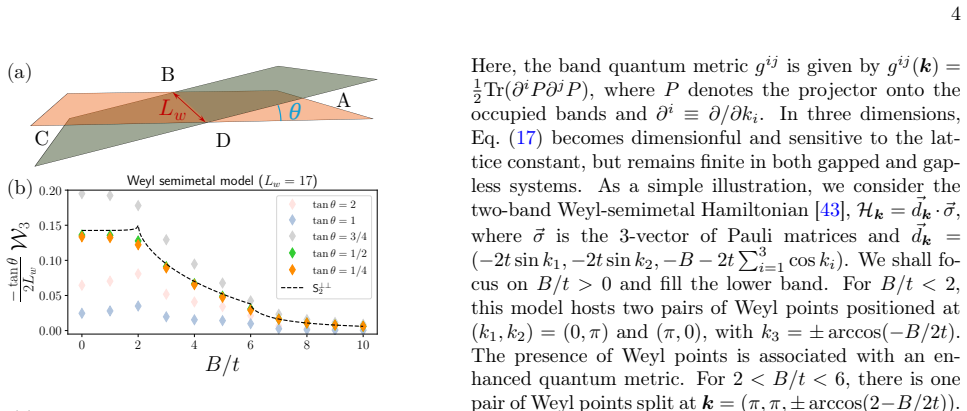
- The isolated wedge-corner term supplies a direct, real-space probe of the quantum metric in semimetallic phases.
- In arbitrary dimensions the same construction yields angle functions for all polyhedral corners of parallelotopes.
- Insulators and conformal critical points exhibit identical scaling of the corner term in every dimension, while metals acquire an even-odd dimensional distinction.
Where Pith is reading between the lines
- Charge-fluctuation measurements in three-dimensional materials could extract quantum-metric information without requiring momentum-resolved spectroscopy.
- The same corner analysis may be applied to other fluctuation or entanglement quantities to obtain analogous universal data in higher dimensions.
- The even-odd dimensional effect in metals suggests that fluctuation-based probes of geometry will behave differently in two versus three dimensions for gapless fermionic systems.
Load-bearing premise
Lattice models and Monte Carlo simulations accurately capture the universal continuum behaviors predicted by the analytical derivations for the O(3) quantum critical point and the Weyl semimetal.
What would settle it
A Monte Carlo measurement of charge variance at a trihedral corner in the O(3) critical lattice model that deviates from the derived universal function of the three corner angles.
Figures



read the original abstract
Measuring charge fluctuations within a subregion provides a powerful probe of quantum many-body systems. In two spatial dimensions, the shape dependence of the dimensionless corner contribution encodes universal data of quantum critical points and reveals observables of quantum geometry in various quantum phases. Here, we systematically extend this framework to higher dimensions. In three dimensions, we derive the universal angle dependence associated with trihedral corners of a generic parallelepiped and benchmark the predictions against Monte Carlo simulations of lattice models at the O(3) quantum critical point. We further identify a wedge-corner contribution that directly probes the quantum metric, supported by numerical results for a lattice Weyl semimetal model. More generally, we obtain angle functions for polyhedral corners of arbitrary parallelotopes in general dimensions and clarify the scaling of the corner contribution across phases of matter. While insulators and conformal critical points exhibit similar behavior across dimensions, metals display a characteristic even-odd dimensional effect.
Editorial analysis
A structured set of objections, weighed in public.
Referee Report
Summary. The manuscript extends the study of subregion charge fluctuations to higher dimensions. In three dimensions it derives the universal angle dependence of trihedral corners for generic parallelepipeds and isolates a wedge-corner term proportional to the quantum metric; both predictions are benchmarked against Monte Carlo data on lattice realizations of the O(3) quantum critical point and a Weyl semimetal. General angle functions for polyhedral corners of parallelotopes are obtained in arbitrary dimensions, together with the scaling of the corner contribution across insulators, conformal critical points, and metals (including an even-odd dimensional effect in the metallic case).
Significance. If the analytical derivations are correct and the numerical isolation of corner terms is free of significant lattice artifacts, the work supplies new universal observables for quantum geometry and criticality in three-dimensional systems, directly generalizing the two-dimensional corner-fluctuation framework and offering a concrete route to extract the quantum metric from charge-fluctuation measurements.
major comments (2)
- [Monte Carlo simulations at the O(3) point] Monte Carlo benchmarks at the O(3) point: the subtraction of area and edge contributions to isolate the trihedral corner functions assumes that lattice artifacts and irrelevant-operator corrections decay faster than the universal angle dependence; no explicit finite-size scaling analysis or estimate of residual corrections at the lattice sizes employed is provided, leaving open the possibility that the reported agreement with the analytic angle functions is contaminated by subleading terms.
- [Wedge-corner contribution] Wedge-corner contribution in the Weyl semimetal: the numerical identification of a term linear in the quantum metric relies on the clean separation of the wedge-corner piece after subtraction of other geometric contributions; without reported error bars on the extracted coefficient or a comparison against a model with vanishing quantum metric, the claim that this term directly probes the quantum metric remains only partially supported.
minor comments (1)
- [General dimensions] The notation for the higher-dimensional angle functions is introduced without an explicit table or example for d=4, which would improve readability.
Simulated Author's Rebuttal
We thank the referee for the careful reading of our manuscript and the constructive comments. We address each of the major comments below and will incorporate revisions to strengthen the numerical analysis.
read point-by-point responses
-
Referee: [Monte Carlo simulations at the O(3) point] Monte Carlo benchmarks at the O(3) point: the subtraction of area and edge contributions to isolate the trihedral corner functions assumes that lattice artifacts and irrelevant-operator corrections decay faster than the universal angle dependence; no explicit finite-size scaling analysis or estimate of residual corrections at the lattice sizes employed is provided, leaving open the possibility that the reported agreement with the analytic angle functions is contaminated by subleading terms.
Authors: We agree that an explicit demonstration of the suppression of subleading corrections would bolster the numerical evidence. In the revised manuscript, we will add a finite-size scaling analysis for the O(3) critical point data, including plots of the corner contribution versus system size to show convergence to the universal angle dependence. revision: yes
-
Referee: [Wedge-corner contribution] Wedge-corner contribution in the Weyl semimetal: the numerical identification of a term linear in the quantum metric relies on the clean separation of the wedge-corner piece after subtraction of other geometric contributions; without reported error bars on the extracted coefficient or a comparison against a model with vanishing quantum metric, the claim that this term directly probes the quantum metric remains only partially supported.
Authors: We acknowledge that error bars and a control comparison would provide stronger support. We will include statistical error bars on the extracted wedge-corner coefficient in the revised version. Furthermore, we will add a comparison to a lattice model with zero quantum metric (e.g., a gapped trivial band insulator), where the wedge-corner term is expected to vanish, confirming the connection to the quantum metric. revision: yes
Circularity Check
Analytical derivations of corner charge fluctuations are independent of numerical benchmarks
full rationale
The paper derives universal angle functions analytically for trihedral corners of parallelepipeds in 3D (and polyhedral corners in general dimensions) and identifies a wedge-corner term proportional to the quantum metric. These predictions are then benchmarked against Monte Carlo simulations on lattice models. No load-bearing step reduces by construction to a fitted parameter, self-definition, or self-citation chain; the central claims retain independent analytical content, with simulations serving as external validation rather than input.
Axiom & Free-Parameter Ledger
Lean theorems connected to this paper
-
Foundation/AlexanderDuality.leanalexander_duality_circle_linking echoes?
echoesECHOES: this paper passage has the same mathematical shape or conceptual pattern as the Recognition theorem, but is not a direct formal dependency.
In three dimensions, we derive the universal angle dependence associated with trihedral corners of a generic parallelepiped... f3(θ, π/2, π/2) = 1 + (π/2 − θ) cot θ
What do these tags mean?
- matches
- The paper's claim is directly supported by a theorem in the formal canon.
- supports
- The theorem supports part of the paper's argument, but the paper may add assumptions or extra steps.
- extends
- The paper goes beyond the formal theorem; the theorem is a base layer rather than the whole result.
- uses
- The paper appears to rely on the theorem as machinery.
- contradicts
- The paper's claim conflicts with a theorem or certificate in the canon.
- unclear
- Pith found a possible connection, but the passage is too broad, indirect, or ambiguous to say the theorem truly supports the claim.
Reference graph
Works this paper leans on
-
[1]
McGreevy, Generalized symmetries in condensed mat- ter, Annu
J. McGreevy, Generalized symmetries in condensed mat- ter, Annu. Rev. Condens. Matter Phys.14, 57 (2023)
work page 2023
-
[2]
C. Cordova, T. T. Dumitrescu, K. Intriligator, and S.- H. Shao, Snowmass white paper: Generalized symme- tries in quantum field theory and beyond, arXiv preprint arXiv:2205.09545 (2022)
- [3]
-
[4]
Laflorencie, Quantum entanglement in condensed matter systems, Physics Reports646, 1 (2016)
N. Laflorencie, Quantum entanglement in condensed matter systems, Physics Reports646, 1 (2016)
work page 2016
-
[5]
X.-G. Wen, Colloquium: Zoo of quantum-topological phases of matter, Reviews of Modern Physics89, 041004 (2017)
work page 2017
-
[6]
F. J. Wegner, Duality in generalized Ising models and phase transitions without local order parameters, J. Math. Phys.12, 2259 (1971)
work page 1971
-
[7]
L. P. Kadanoff and H. Ceva, Determination of an Opera- tor Algebra for the Two-Dimensional Ising Model, Phys. Rev. B3, 3918 (1971)
work page 1971
-
[8]
Fradkin, Disorder operators and their descendants, J
E. Fradkin, Disorder operators and their descendants, J. Stat. Phys.167, 427 (2017)
work page 2017
-
[9]
B. Estienne, J.-M. Stéphan, and W. Witczak-Krempa, Cornering the universal shape of fluctuations, Nat. Com- mun.13, 287 (2022)
work page 2022
-
[10]
L. Herviou, K. Le Hur, and C. Mora, Bipartite fluctu- ations and topology of Dirac and Weyl systems, Phys. Rev. B99, 075133 (2019)
work page 2019
- [11]
-
[12]
Y.-C. Wang, M. Cheng, and Z. Y. Meng, Scaling of the disorder operator at(2 + 1)dU(1) quantum criticality, Phys. Rev. B104, L081109 (2021)
work page 2021
-
[13]
Wu, Bipartite fluctuations of critical Fermi sur- faces, Phys
X.-C. Wu, Bipartite fluctuations of critical Fermi sur- faces, Phys. Rev. X15, 031035 (2025)
work page 2025
- [14]
-
[15]
P. M. Tam, J. Herzog-Arbeitman, and J. Yu, Corner Charge Fluctuation as an Observable for Quantum Ge- ometry and Entanglement in Two-Dimensional Insula- tors, Phys. Rev. Lett.133, 246603 (2024)
work page 2024
-
[16]
Z. H. Liu, Y. Da Liao, G. Pan, M. Song, J. Zhao, W. Jiang, C.-M. Jian, Y.-Z. You, F. F. Assaad, Z. Y. Meng, and C. Xu, Disorder operator and rényi entangle- ment entropy of symmetric mass generation, Phys. Rev. Lett.132, 156503 (2024)
work page 2024
-
[18]
W. Jiang, B.-B. Chen, Z. H. Liu, J. Rong, F. F. As- saad, M. Cheng, K. Sun, and Z. Y. Meng, Many versus one: The disorder operator and entanglement entropy in fermionic quantum matter, SciPost Phys.15, 082 (2023)
work page 2023
- [19]
-
[20]
Z. H. Liu, W. Jiang, B.-B. Chen, J. Rong, M. Cheng, K. Sun, Z. Y. Meng, and F. F. Assaad, Fermion Disor- der Operator at Gross-Neveu and Deconfined Quantum Criticalities, Phys. Rev. Lett.130, 266501 (2023)
work page 2023
- [21]
-
[22]
R. Resta, Why are insulators insulating and metals con- ducting?, Journal of Physics: Condensed Matter14, R625 (2002)
work page 2002
-
[23]
R. Resta, The insulating state of matter: a geometrical theory, The European Physical Journal B79, 121 (2011)
work page 2011
-
[24]
Y. Onishi and L. Fu, Topological bound on the structure factor, Physical Review Letters133, 206602 (2024)
work page 2024
-
[25]
Y. Onishi and L. Fu, Quantum weight: A fundamental property of quantum many-body systems, Physical Re- view Research7, 023158 (2025)
work page 2025
-
[26]
X. Liang, X.-C. Wu, Z. Liu, Z. Wang, Z. Yan, and D.-X. Yao, Scaling of the disorder operator at(3 + 1)dO(3) quantum criticality, arXiv preprint arXiv:2510.25840 (2025)
-
[27]
S. N. Solodukhin, Entanglement entropy, conformal in- variance and extrinsic geometry, Phys. Lett. B665, 305 (2008)
work page 2008
- [28]
-
[29]
R. C. Myers and A. Singh, Entanglement entropy for sin- gular surfaces, J. High Energy Phys.2012(9), 13
work page 2012
-
[30]
I. R. Klebanov, T. Nishioka, S. S. Pufu, and B. R. Safdi, On shape dependence and RG flow of entanglement en- tropy, J. High Energy Phys.2012(7), 1
work page 2012
-
[31]
T. Faulkner, R. G. Leigh, and O. Parrikar, Shape depen- denceofentanglemententropyinconformalfieldtheories, J. High Energy Phys.2016(4), 88
work page 2016
-
[32]
I. A. Kovács and F. Iglói, Universal logarithmic terms in the entanglement entropy of 2d, 3d and 4d random transverse-field Ising models, Europhys. Lett.97, 67009 (2012)
work page 2012
-
[33]
T. Devakul and R. R. P. Singh, Entanglement across a cubic interface in3 + 1dimensions, Phys. Rev. B90, 054415 (2014)
work page 2014
-
[34]
L. E. Hayward Sierens, P. Bueno, R. R. P. Singh, R. C. Myers, and R. G. Melko, Cubic trihedral corner entangle- ment for a free scalar, Phys. Rev. B96, 035117 (2017)
work page 2017
- [35]
-
[36]
Witczak-Krempa, Entanglement susceptibilities and universal geometric entanglement entropy, Phys
W. Witczak-Krempa, Entanglement susceptibilities and universal geometric entanglement entropy, Phys. Rev. B 99, 075138 (2019)
work page 2019
- [37]
-
[38]
Supplementary Materials
-
[39]
Y. Q. Qin, B. Normand, A. W. Sandvik, and Z. Y. Meng, Multiplicative logarithmic corrections to quantum criti- cality in three-dimensional dimerized antiferromagnets, Phys. Rev. B92, 214401 (2015)
work page 2015
-
[40]
A. Petkou, Conserved currents, consistency relations, and operator product expansions in the conformally in- varianto O(n)vector model, annals of physics249, 180 (1996)
work page 1996
-
[41]
H. Osborn and A. Petkou, Implications of Conformal In- variance in Field Theories for General Dimensions, Ann. Phys.231, 311 (1994)
work page 1994
-
[42]
K. Diab, L. Fei, S. Giombi, I. R. Klebanov, and G. Tarnopolsky, OnC J andC T in the gross–neveu andO(N)models, J. Phys. A:Math. Theor.49, 405402 (2016)
work page 2016
-
[43]
T. M. McCormick, I. Kimchi, and N. Trivedi, Minimal models for topological weyl semimetals, Physical Review B95, 075133 (2017)
work page 2017
- [44]
-
[45]
M. M. Wolf, Violation of the entropic area law for fermions, Physical Review Letters96, 010404 (2006)
work page 2006
-
[46]
D. Gioev and I. Klich, Entanglement entropy of fermions in any dimension and the Widom conjecture, Physical Review Letters96, 100503 (2006)
work page 2006
-
[47]
Swingle, Entanglement entropy and the Fermi surface, Physical Review Letters105, 050502 (2010)
B. Swingle, Entanglement entropy and the Fermi surface, Physical Review Letters105, 050502 (2010)
work page 2010
-
[48]
B. Swingle and T. Senthil, Universal crossovers between entanglement entropy and thermal entropy, Physical Re- view B87, 045123 (2013)
work page 2013
-
[49]
M. T. Tan and S. Ryu, Particle number fluctuations, Rényi entropy, and symmetry-resolved entanglement en- tropy in a two-dimensional Fermi gas from multidi- mensional bosonization, Physical Review B101, 235169 (2020)
work page 2020
- [50]
- [51]
- [52]
-
[53]
I. Klich and L. Levitov, Quantum noise as an entangle- ment meter, Physical Review Letters102, 100502 (2009)
work page 2009
-
[54]
B. Hsu, E. Grosfeld, and E. Fradkin, Quantum noise and entanglement generated by a local quantum quench, Physical Review B80, 235412 (2009)
work page 2009
-
[55]
H. F. Song, S. Rachel, and K. Le Hur, General relation between entanglement and fluctuations in one dimension, Physical Review B82, 012405 (2010)
work page 2010
-
[56]
H. F. Song, N. Laflorencie, S. Rachel, and K. Le Hur, Entanglement entropy of the two-dimensional heisenberg antiferromagnet, Physical Review B83, 224410 (2011)
work page 2011
-
[57]
H. F. Song, S. Rachel, C. Flindt, I. Klich, N. Lafloren- cie, and K. Le Hur, Bipartite fluctuations as a probe of many-body entanglement, Physical Review B85, 035409 (2012)
work page 2012
-
[58]
P. Calabrese, M. Mintchev, and E. Vicari, Exact relations between particle fluctuations and entanglement in fermi gases, Europhysics Letters98, 20003 (2012)
work page 2012
-
[59]
A. Petrescu, H. F. Song, S. Rachel, Z. Ristivojevic, C. Flindt, N. Laflorencie, I. Klich, N. Regnault, and K. Le Hur, Fluctuations and entanglement spectrum in quantum Hall states, Journal of Statistical Mechanics: Theory and Experiment2014, P10005 (2014)
work page 2014
-
[60]
H. F. Song, C. Flindt, S. Rachel, I. Klich, and K. Le Hur, Entanglement entropy from charge statistics: Exact re- lations for noninteracting many-body systems, Physical Review B83, 161408 (2011)
work page 2011
-
[61]
I. Frérot and T. Roscilde, Area law and its violation: A microscopic inspection into the structure of entanglement and fluctuations, Physical Review B92, 115129 (2015)
work page 2015
-
[62]
Y.Liu, R.Sohal, J.Kudler-Flam,andS.Ryu,Multiparti- tioning topological phases by vertex states and quantum entanglement, Physical Review B105, 115107 (2022)
work page 2022
-
[63]
Y. Liu, Y. Kusuki, J. Kudler-Flam, R. Sohal, and S. Ryu, Multipartite entanglement in two-dimensional chiral topological liquids, Physical Review B109, 085108 (2024)
work page 2024
-
[64]
J. Zhao, B.-B. Chen, Y.-C. Wang, Z. Yan, M. Cheng, and Z. Y. Meng, Measuring Rényi entanglement entropy with high efficiency and precision in quantum Monte Carlo simulations, npj Quantum Mater.7, 69 (2022)
work page 2022
-
[65]
J. Zhao, Y.-C. Wang, Z. Yan, M. Cheng, and Z. Y. Meng, Scaling of Entanglement Entropy at Deconfined Quan- tum Criticality, Phys. Rev. Lett.128, 010601 (2022)
work page 2022
-
[66]
M. Song, J. Zhao, Y. Qi, J. Rong, and Z. Y. Meng, Quantum criticality and entanglement for the two- dimensional long-range Heisenberg bilayer, Phys. Rev. B 109, L081114 (2024)
work page 2024
-
[67]
M. Song, J. Zhao, Z. Y. Meng, C. Xu, and M. Cheng, Extracting subleading corrections in entanglement en- tropy at quantum phase transitions, SciPost Phys.17, 010 (2024)
work page 2024
-
[68]
Z. Deng, L. Liu, W. Guo, and H. Lin, Improved scaling of the entanglement entropy of quantum antiferromagnetic heisenberg systems, Phys. Rev. B108, 125144 (2023)
work page 2023
-
[69]
Z. Deng, L. Liu, W. Guo, and H.-Q. Lin, Diagnosing quantumphasetransitionorderanddeconfinedcriticality via entanglement entropy, Phys. Rev. Lett.133, 100402 (2024)
work page 2024
- [70]
- [71]
-
[72]
Y.-M. Ding, Y. Tang, Z. Wang, Z. Wang, B.-B. Mao, andZ.Yan,TrackingthevariationofentanglementRényi negativity: A quantum Monte Carlo study, Phys. Rev. B111, L241108 (2025)
work page 2025
- [73]
-
[74]
D. Podolsky, A. Paramekanti, Y. B. Kim, and T. Senthil, 8 Mott transition between a spin-liquid insulator and a metal in three dimensions, Physical Review Letters102, 186401 (2009)
work page 2009
-
[75]
C. Berthiere, B. Estienne, J.-M. Stéphan, and W. Witczak-Krempa, Full-counting statistics of corner charge fluctuations, Physical Review B108, L201109 (2023)
work page 2023
-
[76]
K. D. Nelson, X. Li, and D. S. Weiss, Imaging single atoms in a three-dimensional array, Nature Physics3, 556 (2007)
work page 2007
-
[77]
O.Elíasson, J.S.Laustsen, R.Heck, R.Müller, J.J.Arlt, C. A. Weidner, and J. F. Sherson, Spatial tomography of individual atoms in a quantum gas microscope, Phys. Rev. A102, 053311 (2020)
work page 2020
-
[78]
C. Gross and W. S. Bakr, Quantum gas microscopy for single atom and spin detection, Nature Physics17, 1316 (2021)
work page 2021
-
[79]
P. M. Tam, Y. Sheffer, X.-C. Wu, F. D. M. Haldane, and S. Ryu, Fermi surface geometry from charge fluctuations in three-dimensional metals, to appear (2026)
work page 2026
-
[80]
Q. Niu, D. J. Thouless, and Y.-S. Wu, Quantized hall conductance as a topological invariant, Physical Review B31, 3372 (1985)
work page 1985
-
[81]
K. Kudo, H. Watanabe, T. Kariyado, and Y. Hatsugai, Many-body chern number without integration, Physical review letters122, 146601 (2019)
work page 2019
discussion (0)
Sign in with ORCID, Apple, or X to comment. Anyone can read and Pith papers without signing in.