Boris and Exponential Integrators in the Theory of Particles Interacting with Magnetic Turbulence
Pith reviewed 2026-07-01 07:33 UTC · model grok-4.3
The pith
The Rodrigues scheme matches the Boris integrator in accuracy and speed when the magnetic field is recreated independently at each time step.
A machine-rendered reading of the paper's core claim, the machinery that carries it, and where it could break.
Core claim
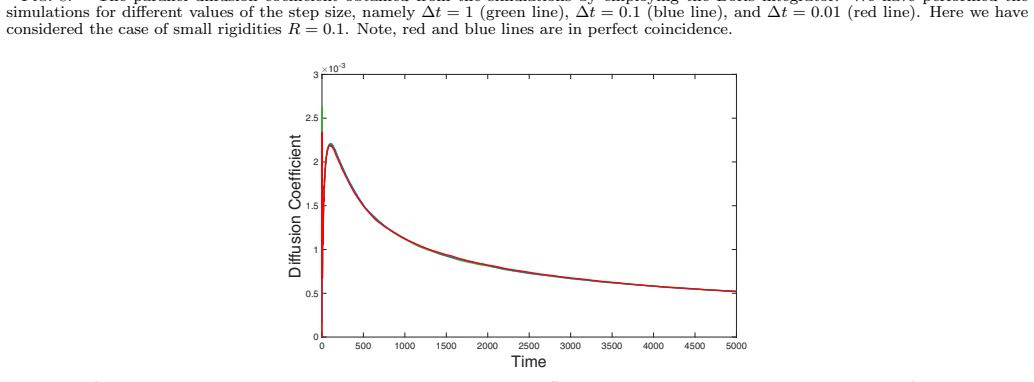
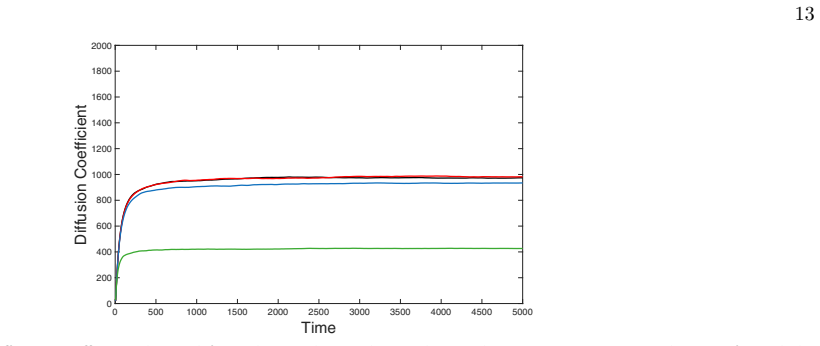
For an approach where one creates the magnetic field anew at each time step, both integrators are overall comparable. In theory the Rodrigues approach should be more accurate due to the fact that the occurring matrix exponential is evaluated without further approximations. Practically, both methods provide very similar results. A Rodrigues based integrator is a very strong alternative because for the specific problem discussed here, it does not require longer computing times.
What carries the argument
Systematic derivation of the Rodrigues scheme and Boris integrator as exponential integrators for numerically solving the Newton-Lorentz equation in test-particle simulations.
If this is right
- The Rodrigues integrator can be used interchangeably with the Boris method in similar test-particle studies of particle transport in magnetized plasmas.
- Exponential-integrator derivations provide a systematic route to obtain other integration schemes for the Newton-Lorentz equation.
- Both methods remain reliable when the turbulent field is updated independently at each step.
Where Pith is reading between the lines
- The claimed equivalence may change if the magnetic field is evolved continuously instead of regenerated at every step.
- Testing the same integrators at substantially higher particle rigidities or in different turbulence spectra would check how general the similarity remains.
- Adoption of the Rodrigues scheme could simplify code maintenance if matrix-exponential routines become standard in plasma simulation libraries.
Load-bearing premise
The magnetic field is generated independently at each time step and the accuracy and timing comparison between the two integrators holds for the turbulence model and particle energies used in the test-particle setup.
What would settle it
A side-by-side run on the same turbulence realization that shows the Rodrigues integrator taking noticeably longer or producing particle trajectories that differ by more than numerical noise from the Boris results.
Figures





read the original abstract
The interaction of electrically charged particles with magnetic fields is a fundamental problem in several areas of physics. An example is the motion of energetic particles through a magnetized plasma. The most accurate and reliable way to explore theoretically the interactions between particles and fields is via test-particle simulations. In such simulations one creates the turbulent magnetic field and solves the Newton-Lorentz equation numerically by employing an integration scheme. In the current article we discuss exponential integrators and derive systematically from this the Rodrigues scheme as well as the famous Boris integrator. For an approach where one creates the magnetic field anew at each time step, both integrators are overall comparable. In theory the Rodrigues approach should be more accurate due to the fact that the occurring matrix exponential is evaluated without further approximations. Practically, both methods provide very similar results. It is argued in the current article that a Rodrigues based integrator is a very strong alternative because for the specific problem discussed here, it does not require longer computing times.
Editorial analysis
A structured set of objections, weighed in public.
Referee Report
Summary. The manuscript derives the Boris and Rodrigues integrators systematically from the exponential-integrator framework applied to the Newton-Lorentz equation for charged-particle motion in magnetic turbulence. It focuses on the numerical regime in which the turbulent magnetic field is regenerated independently at each time step and claims that, in this regime, the two schemes produce statistically similar results at comparable wall-clock cost, with the Rodrigues method being theoretically more accurate because it evaluates the matrix exponential without auxiliary approximations.
Significance. If the numerical claims hold, the work supplies a unified derivation of two widely used integrators and identifies the Rodrigues scheme as a practical alternative that incurs no extra cost for the tested class of test-particle problems. The explicit grounding in exponential integrators and the parameter-free character of the derivation constitute a clear methodological contribution to plasma-physics simulation techniques.
major comments (1)
- [Abstract / numerical results] Abstract and numerical-comparison section: the central claim that 'both methods provide very similar results' and that the Rodrigues integrator 'does not require longer computing times' is asserted without quantitative error metrics, convergence tests, or tabulated timing data for the specific turbulence realizations and particle energies examined. This absence directly undermines the ability to assess whether the reported similarity is robust to changes in time step or field-generation method.
Simulated Author's Rebuttal
We thank the referee for the detailed review and the constructive comment on the presentation of our numerical results. We address the concern point by point below and will revise the manuscript to strengthen the quantitative support for the claims.
read point-by-point responses
-
Referee: [Abstract / numerical results] Abstract and numerical-comparison section: the central claim that 'both methods provide very similar results' and that the Rodrigues integrator 'does not require longer computing times' is asserted without quantitative error metrics, convergence tests, or tabulated timing data for the specific turbulence realizations and particle energies examined. This absence directly undermines the ability to assess whether the reported similarity is robust to changes in time step or field-generation method.
Authors: We agree that the current manuscript lacks explicit quantitative metrics to support the statements on result similarity and computational cost. While the figures in the numerical section illustrate comparable particle trajectories and statistical properties for the tested cases, we acknowledge that error metrics (e.g., relative L2 differences in position and velocity), convergence studies with respect to time step, and tabulated wall-clock timings for the specific turbulence realizations and particle energies would strengthen the claims. In the revised manuscript we will add these elements, including tables of timing data and quantitative error measures, to allow direct assessment of robustness. revision: yes
Circularity Check
No significant circularity identified
full rationale
The paper derives the Rodrigues and Boris schemes systematically from the standard exponential-integrator framework (an external mathematical construction) and then reports direct numerical comparisons for a specific turbulence-regeneration regime. No step reduces a claimed prediction or uniqueness result to a fitted parameter, self-citation chain, or definitional tautology; the central claims rest on the derivation plus external benchmarking rather than on any of the enumerated circular patterns.
Axiom & Free-Parameter Ledger
Reference graph
Works this paper leans on
-
[1]
J.420, 294 (1994)
Kallenrode, M.-B., Wibberenz, G.: Astrophys. J.420, 294 (1994)
1994
-
[2]
Bieber, J.W., Wanner, W., Matthaeus, W.H.: J. Geophys. Res. 101, 2511 (1996) 16
1996
-
[3]
Burden, R.L., Faires, J.D.: Numerical Analysis, 9th ed., Brooks/Cole, Cengage Learning, Boston (2011)
2011
-
[4]
Space Res.461208 (2010)
Dosch, A., Shalchi A.: Adv. Space Res.461208 (2010)
2010
-
[5]
Effenberger, F., Walter, D., Fichtner, H., et al.: Space Sci. Rev. 221, 75 (2025)
2025
-
[6]
J.969, 1 (2024)
Els, P., Engelbrecht, N.E.: Astrophys. J.969, 1 (2024)
2024
-
[7]
Space Res.66, 2722 (2020)
Engelbrecht, E.N., Wolmarans, C.P.: Adv. Space Res.66, 2722 (2020)
2020
-
[8]
J.908, 167 (2021)
Engelbrecht, E.N., Moloto, K.D.: Astrophys. J.908, 167 (2021)
2021
-
[9]
J.792, 133 (2014)
Ferrand, G., Danos, R., Shalchi, A., Safi-Harb, S., Mendygral, P.: Astrophys. J.792, 133 (2014)
2014
-
[10]
Hairer, E., Lubich, C., Wanner, G.: Geometric numerical integration: Structure-preserving algorithms for ordinary differential equations (2nd ed.), Springer (2006)
2006
-
[11]
Space Sci.361, 308 (2016)
Heusen, M., Shalchi, A.: Astrophys. Space Sci.361, 308 (2016)
2016
-
[12]
Thesis, University of Manitoba (2017)
2017
-
[13]
Hu, J., Li, G., Ao, X., Zank, G.P., Verkhoglyadova, O.: J. Geophys. Res.122, 938 (2017)
2017
-
[14]
Hussein, M., Tautz, R.C., Shalchi, A.: J. Geophys. Res.120, 4095 (2015)
2015
-
[15]
J.817, 136 (2016)
Hussein, M., Shalchi, A.: Astrophys. J.817, 136 (2016)
2016
-
[16]
Ivascenko, A., Lange, S., Spanier, F., Vainio, R.: Astrophys. J. 833, 223 (2016)
2016
-
[17]
Kolmogorov, A.N.: Dokl. Akad. Nauk. SSSR30, 301 (1941)
1941
-
[18]
Li, G., Zank, G.P., Rice, W.K.M.: J. Geophys. Res.108, 1082 (2003)
2003
-
[19]
Li, G., Zank, G.P., Rice, W.K.M.: J. Geophys. Res.110, A06104 (2005)
2005
-
[20]
Space Res.49, 1067 (2012)
Li, G., Shalchi, A., Ao, X., Zank, G.P., Verkhoglyadova, O.P.: Adv. Space Res.49, 1067 (2012)
2012
-
[21]
Springer-Verlag, New York, (1999)
1999
-
[22]
Matthaeus, W.H., Goldstein, M.L., Aaron, R.D.: J. Geophys. Res. 95, 20673 (1990)
1990
-
[23]
J.590, L53 (2003)
Matthaeus, W.H., Qin, G., Bieber, J.W., Zank, G.P.: Astrophys. J.590, L53 (2003)
2003
-
[24]
J.894, 121 (2020)
Moloto, K.D., Engelbrecht, N.E.: Astrophys. J.894, 121 (2020)
2020
-
[25]
Moore, E.H.: Bulletin of the American Mathematical Society26, 394 (1920)
1920
-
[26]
Space Res.69, 2330 (2022) Pad´ e, H.: Sur la r´ epresentation approch´ ee d’une fonction par des fractions rationelles (Thesis), Ann
Ramokgaba, I.I., Ndiitwani, D.C.: Adv. Space Res.69, 2330 (2022) Pad´ e, H.: Sur la r´ epresentation approch´ ee d’une fonction par des fractions rationelles (Thesis), Ann. ´Ecole Nor. 3, 3-93 (1892)
2022
-
[27]
Penrose, R.: A generalized inverse for matrices, Proceedings of the Cambridge Philosophical Society, 51, 406 (1955)
1955
-
[28]
J.671, L177 (2007)
Perri, S., Zimbardo, G.: Astrophys. J.671, L177 (2007)
2007
-
[29]
Plasma14, 012311 (2007)
Pommois, P., Zimbardo, G., Veltri, P.: Phys. Plasma14, 012311 (2007)
2007
-
[30]
J.640, L103 (2006)
Qin, G., Matthaeus, W.H., Bieber, J.W.: Astrophys. J.640, L103 (2006)
2006
-
[31]
J.860, 3 (2018)
Qin, G., Kong, F.-J., Zhang, L.-H.: Astrophys. J.860, 3 (2018)
2018
-
[32]
Plasmas20, 084503 (2013)
Qin, H., Zhang, S., Xiao, J., Liu, J., Sun, Y., Tang, W.M.: Phys. Plasmas20, 084503 (2013)
2013
-
[33]
G., et al.: Mon
Reichherzer, P., Becker Tjus, J., Zweibel, E. G., et al.: Mon. Not. R. Astron. Soc.514, 2658 (2022)
2022
-
[34]
J.235, 21 (2018)
Sironi, L., Lapenta, G., Keppens, R.: Astrophys. J.235, 21 (2018)
2018
-
[35]
J.854, 137 (2018)
Shen, Z.-N., Qin, G.: Astrophys. J.854, 137 (2018)
2018
-
[36]
J.256, 18 (2021)
Shen, Z., Qin, G., Zuo, P., Wei, F., Xu, X.: Astrophys. J.256, 18 (2021)
2021
-
[37]
362, Springer, Berlin (2009)
Shalchi, A.: Nonlinear Cosmic Ray Diffusion Theories, Astrophysics and Space Science Library, vol. 362, Springer, Berlin (2009)
2009
-
[38]
J.720, L127 (2010)
Shalchi, A.: Astrophys. J.720, L127 (2010)
2010
-
[39]
J.881, L27 (2019)
Shalchi, A.: Astrophys. J.881, L27 (2019)
2019
-
[40]
Rev.216, 23 (2020)
Shalchi, A.: Space Sci. Rev.216, 23 (2020)
2020
-
[41]
J.923, 209 (2021)
Shalchi, A.: Astrophys. J.923, 209 (2021)
2021
-
[42]
J.932, 127 (2022)
Snodin, A.P., Jitsuk, T., Ruffolo, D., Matthaeus, W.H.: Astrophys. J.932, 127 (2022)
2022
-
[43]
Tautz, R.C.: Comput. Phys. Commun.181, 71 (2010)
2010
-
[44]
Astrophys.555, A101 (2013)
Tautz, R.C., Lerche, I., Kruse, F.: Astron. Astrophys.555, A101 (2013)
2013
-
[45]
Plasmas15, 056701 (2008)
Vay, J.-L.: Phys. Plasmas15, 056701 (2008)
2008
-
[46]
J.651, 211 (2006)
Webb, G.M., Zank, G.P., Kaghashvili, E.Kh., le Roux, J.A.: Astrophys. J.651, 211 (2006)
2006
-
[47]
Yoshida, H.: Phys. Lett. A150, 262 (1990)
1990
-
[48]
Zank, G.P., Rice, W.K.M., Wu, C.C.: J. Geophys. Res.105, 25079 (2000)
2000
-
[49]
Zank, G.P., Li, G., Florinski, V., Hu, Q., Lario, D., Smith, C.W.: J. Geophys. Res.111, A06108 (2006) Zank G.P., Nakanotani M., Webb, G.M.: Astrophys. J.88, L116 (2019)
2006
-
[50]
J.639, L91 (2006)
Zimbardo, G., Pommois, P., Veltri, P.: Astrophys. J.639, L91 (2006)
2006
-
[51]
Space Res
Zimbardo, G., Perri, S., Pommois, P., Veltri, P.: Adv. Space Res. 49, 1633 (2012) This paper was built using the Open Journal of Astrophysics LATEX template. The OJA is a journal which provides fast and easy peer review for new papers in theastro-phsection of the arXiv, making the reviewing process simpler for authors and referees alike. Learn more at htt...
2012
discussion (0)
Sign in with ORCID, Apple, or X to comment. Anyone can read and Pith papers without signing in.