Njord: A Probabilistic Graph Neural Network for Ensemble Ocean Forecasting
Pith reviewed 2026-05-19 14:39 UTC · model grok-4.3
The pith
A probabilistic graph neural network for ocean forecasting achieves the lowest errors on a global benchmark while providing uncertainty estimates.
A machine-rendered reading of the paper's core claim, the machinery that carries it, and where it could break.
Core claim
Njord integrates a deep latent variable framework with a graph neural network architecture on K-means cluster meshes, enabling single-pass sampling of ensemble forecasts that outperform deterministic baselines on upper-ocean variables while supplying uncertainty estimates from the ensembles.
What carries the argument
K-means cluster meshes adapted to irregular sea surface geometry, combined with a deep latent variable model that supports efficient probabilistic sampling within the graph neural network.
Load-bearing premise
K-means cluster meshes adapt sufficiently well to irregular sea-surface geometry to allow accurate and efficient scaling of the graph neural network to global 0.25-degree and regional 2 km grids.
What would settle it
Demonstrating that a competing model produces lower average errors than Njord across upper-ocean variables on the OceanBench benchmark when validated against real-world observations would undermine the performance advantage.
Figures












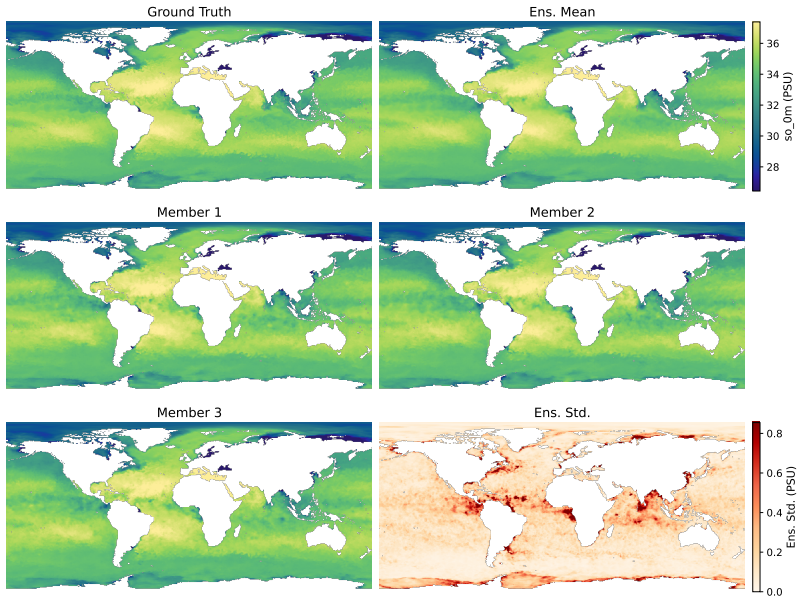

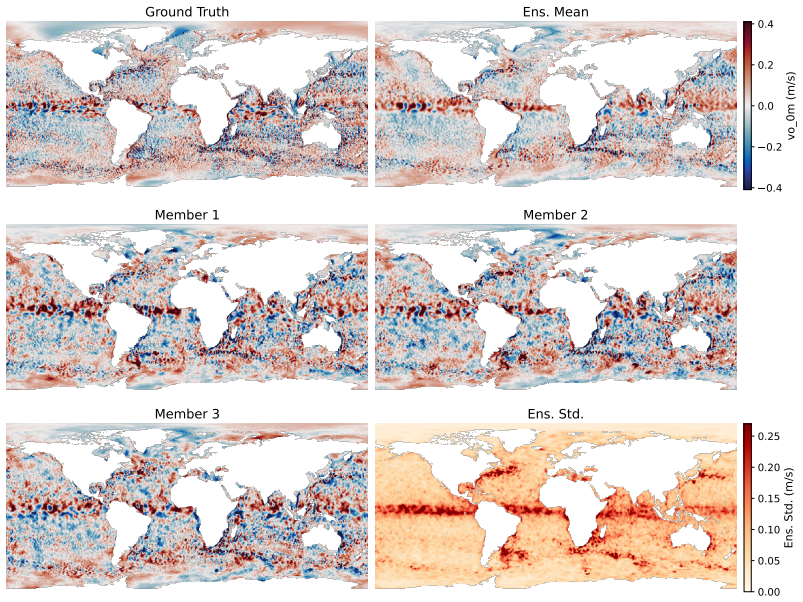


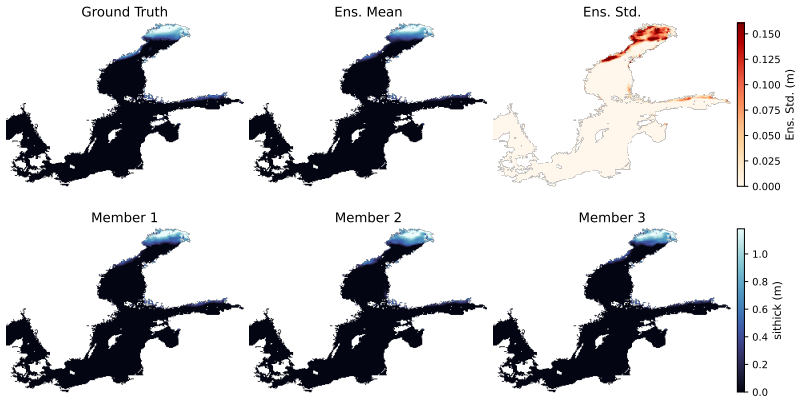
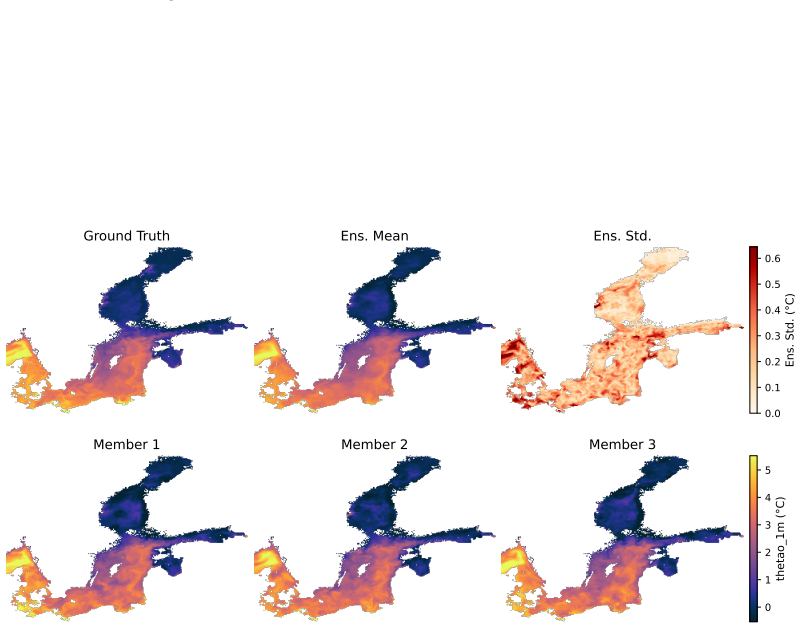


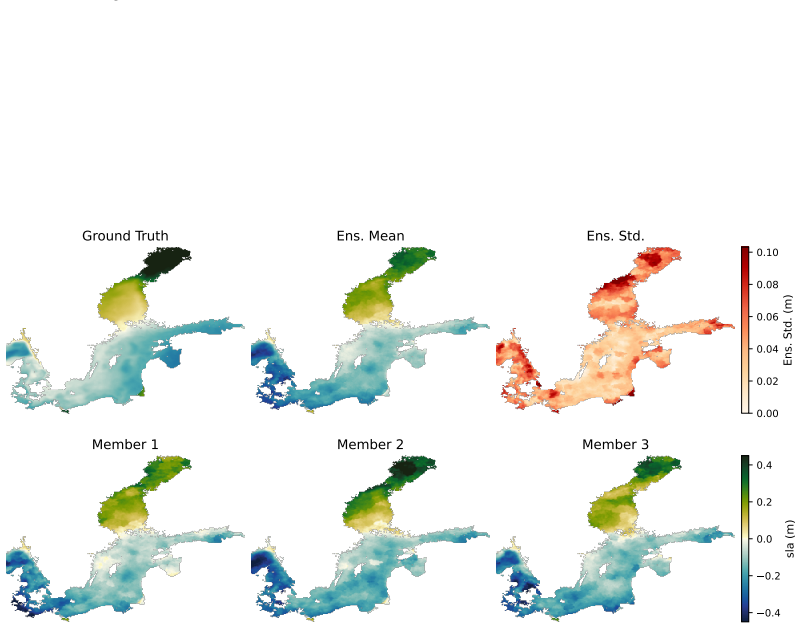
read the original abstract
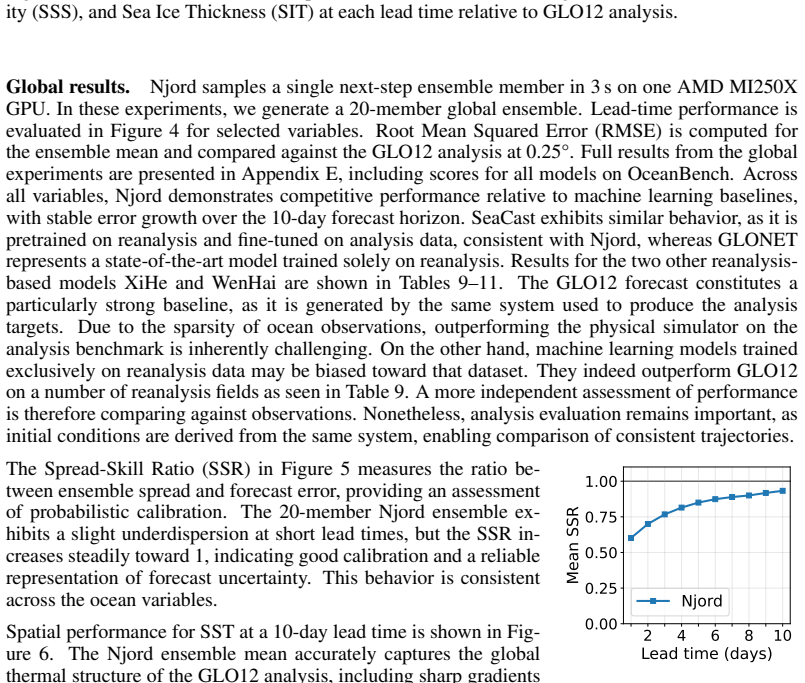
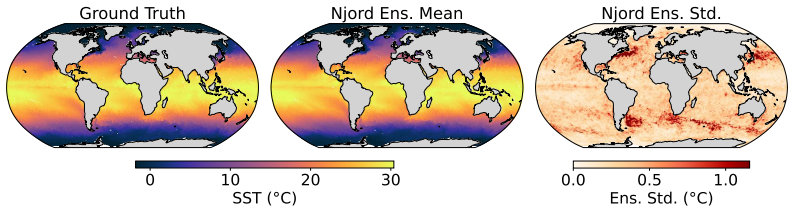
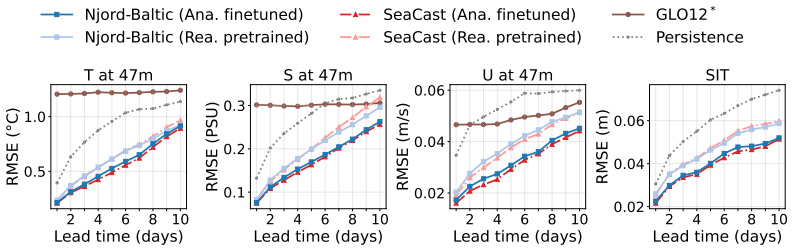
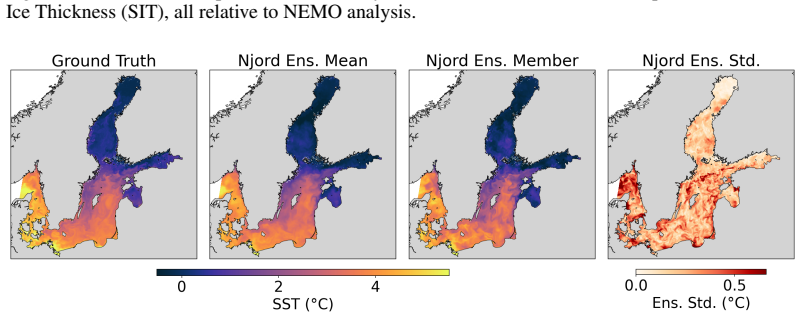
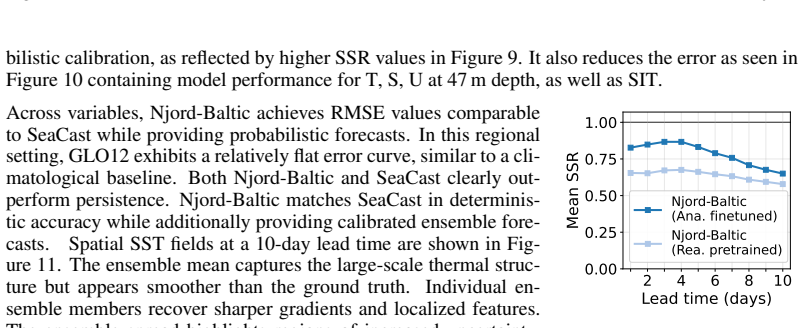
Ocean dynamics are inherently chaotic, yet existing machine learning ocean models produce only deterministic forecasts. We introduce Njord, a probabilistic data-driven model for ocean forecasting, applicable to both global and regional domains. Njord combines a deep latent variable framework with a graph neural network architecture, enabling sampling each forecast step in a single forward pass. We apply Njord globally at 0.25{\deg} resolution and regionally to the Baltic Sea at 2 km resolution. To scale to these large ocean grids we introduce K-means cluster meshes that adapt to irregular sea surface geometry. Experiments demonstrate strong performance on both domains compared to deterministic machine learning baselines, while also providing uncertainty estimates from the sampled ensemble forecasts. On the global OceanBench benchmark, Njord achieves the lowest errors on average across upper-ocean variables when evaluated against real-world observations, with the largest improvements in surface temperature prediction.
Editorial analysis
A structured set of objections, weighed in public.
Referee Report
Summary. The manuscript introduces Njord, a probabilistic graph neural network for ensemble ocean forecasting that combines a deep latent variable model with GNN message passing to generate sampled forecasts in a single forward pass. It scales the approach to a global 0.25° grid and a regional 2 km Baltic Sea grid by introducing K-means cluster meshes that adapt to irregular sea-surface geometry. The central empirical claim is that Njord attains the lowest average errors across upper-ocean variables on the OceanBench benchmark when evaluated against real-world observations, with the largest gains in surface temperature, while also supplying uncertainty estimates from the ensemble.
Significance. If the performance and scaling claims are substantiated, the work would be significant for demonstrating that probabilistic GNNs can deliver calibrated ensemble forecasts for chaotic ocean dynamics at both global and high-resolution regional scales. The provision of uncertainty estimates alongside competitive point forecasts against real observations addresses a practical gap in existing deterministic ML ocean models. The adaptive mesh construction, if shown to respect physical boundaries, could serve as a reusable technique for applying graph-based methods to masked geophysical domains.
major comments (1)
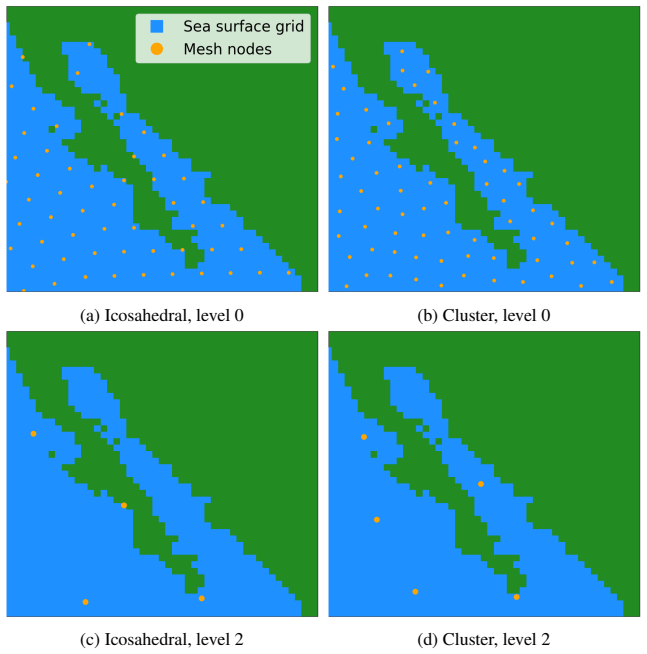
- [Abstract] Abstract and mesh-construction section: the claim that K-means cluster meshes 'adapt to irregular sea surface geometry' is load-bearing for the scaling argument to 0.25° global and 2 km regional grids, yet no description is given of how land-sea masks are enforced, whether invalid cross-land edges are removed, or what mesh-quality metrics (e.g., connectivity, boundary fidelity) are satisfied. Standard K-means on latitude-longitude coordinates does not inherently respect masks; without explicit post-processing or boundary-aware clustering, message passing can produce unphysical connections, undermining the applicability claim.
minor comments (1)
- [Abstract] Abstract: quantitative error values, baseline definitions, and training details are omitted even though the headline performance claim is stated; adding at least the key RMSE or MAE numbers and the names of the deterministic ML baselines would improve readability.
Simulated Author's Rebuttal
We thank the referee for their constructive and detailed review. The concern about insufficient description of the K-means mesh construction and mask handling is well-taken. We address this point below and will revise the manuscript to provide the requested technical details.
read point-by-point responses
-
Referee: [Abstract] Abstract and mesh-construction section: the claim that K-means cluster meshes 'adapt to irregular sea surface geometry' is load-bearing for the scaling argument to 0.25° global and 2 km regional grids, yet no description is given of how land-sea masks are enforced, whether invalid cross-land edges are removed, or what mesh-quality metrics (e.g., connectivity, boundary fidelity) are satisfied. Standard K-means on latitude-longitude coordinates does not inherently respect masks; without explicit post-processing or boundary-aware clustering, message passing can produce unphysical connections, undermining the applicability claim.
Authors: We agree that the manuscript currently provides insufficient detail on how the K-means meshes enforce land-sea boundaries. In the revised version we will expand the mesh-construction section with the following additions: (i) clustering is performed exclusively on sea-grid points identified by the land-sea mask; (ii) after clustering, any graph edges connecting nodes separated by land are explicitly removed by a post-processing step that checks line-of-sight connectivity within the masked domain; (iii) we will report quantitative mesh-quality metrics including average node degree, fraction of boundary nodes, and verification that no cross-land edges remain. These clarifications will substantiate the adaptation claim and rule out unphysical message passing. We believe the revised description will fully address the referee’s concern. revision: yes
Circularity Check
No circularity; derivation and claims are self-contained with external validation
full rationale
The paper presents Njord as a novel probabilistic latent-variable GNN for ensemble ocean forecasting, with K-means cluster meshes introduced to handle irregular sea-surface geometry at global 0.25° and regional 2 km scales. The central performance claim rests on evaluation against real-world observations on the public OceanBench benchmark, which is independent of the model's fitted parameters or internal definitions. No equations, predictions, or uniqueness arguments in the abstract or described content reduce by construction to inputs, self-citations, or ansatzes; the architecture and mesh adaptation are positioned as original contributions whose validity is tested externally rather than assumed via prior self-referential results.
Axiom & Free-Parameter Ledger
free parameters (1)
- Neural network hyperparameters (depth, width, learning rate, latent dimension)
axioms (1)
- domain assumption Ocean dynamics on irregular domains can be faithfully represented by graph neural networks on K-means-derived meshes
Lean theorems connected to this paper
-
IndisputableMonolith/Foundation/AlexanderDuality.leanalexander_duality_circle_linking unclear?
unclearRelation between the paper passage and the cited Recognition theorem.
To construct a graph better adapted to the geometry of the global ocean we instead place the graph nodes based on the density of ocean grid points. We apply spherical K-means clustering of the ocean grid point 3D Cartesian coordinates...
-
IndisputableMonolith/Cost/FunctionalEquation.leanwashburn_uniqueness_aczel unclear?
unclearRelation between the paper passage and the cited Recognition theorem.
Njord combines a deep latent variable framework with a graph neural network architecture, enabling sampling each forecast step in a single forward pass.
What do these tags mean?
- matches
- The paper's claim is directly supported by a theorem in the formal canon.
- supports
- The theorem supports part of the paper's argument, but the paper may add assumptions or extra steps.
- extends
- The paper goes beyond the formal theorem; the theorem is a base layer rather than the whole result.
- uses
- The paper appears to rely on the theorem as machinery.
- contradicts
- The paper's claim conflicts with a theorem or certificate in the canon.
- unclear
- Pith found a possible connection, but the passage is too broad, indirect, or ambiguous to say the theorem truly supports the claim.
discussion (0)
Sign in with ORCID, Apple, or X to comment. Anyone can read and Pith papers without signing in.