Disformal Kerr Imprints on BHL Accretion: Shock Morphology, PSD Signatures, and Observational QPO Counterparts
Pith reviewed 2026-05-20 17:18 UTC · model grok-4.3
The pith
Disformal deviations from Kerr modify shock structures in accretion flows and generate QPO frequencies matching observations in GRS 1915+105.
A machine-rendered reading of the paper's core claim, the machinery that carries it, and where it could break.
Core claim
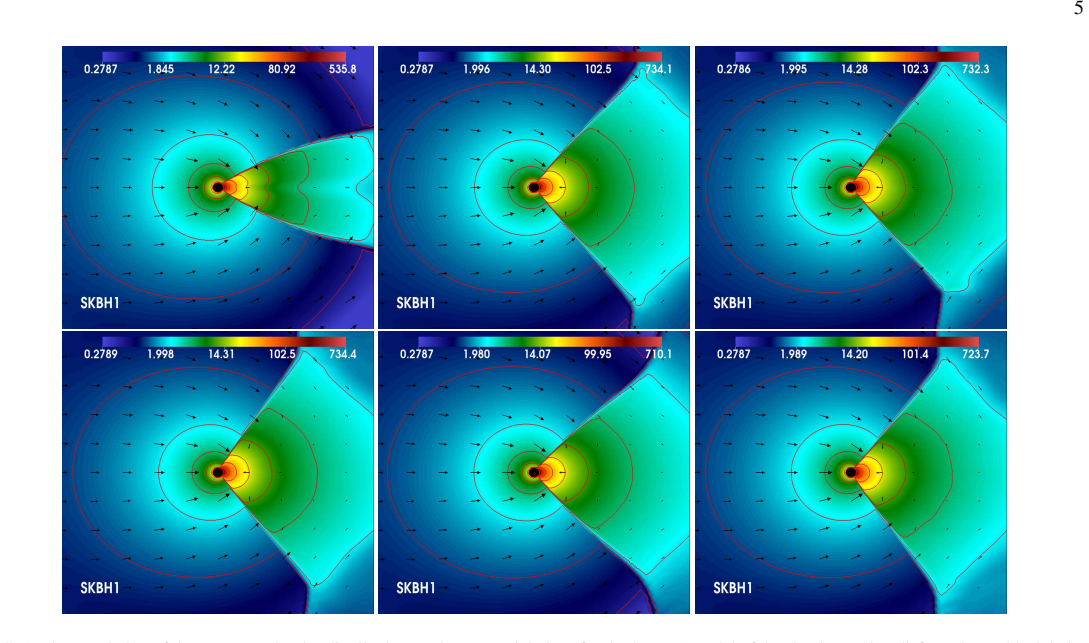
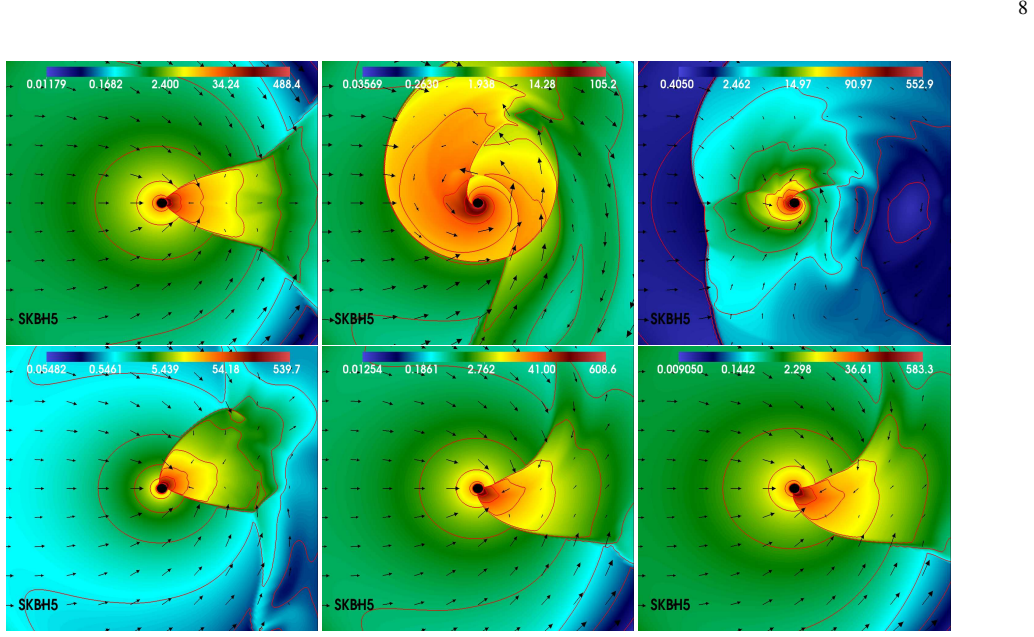
Simulations of BHL accretion onto disformal Kerr black holes demonstrate that deviations from the Kerr solution, even when weak, modify the shock-cone structure, enhance density in the post-shock region, and produce coherent oscillations in the accretion rate. The Kerr model specifically yields coherent peaks at 42.99 Hz and 68.13 Hz consistent with high-frequency QPOs from GRS 1915+105, weak deviations produce low-frequency QPOs matching Galactic black-hole binaries, and large deviations explain more irregular observational results. Inverse-mass scaling further allows these frequencies to be compared with observations of intermediate-mass and supermassive black holes, enabling inference of黑
What carries the argument
The disformal Kerr metric parameters applied to ideal hydrodynamic flows in the BHL accretion setup, which control the resulting shock morphology and the power spectral density signatures of accretion rate variations.
If this is right
- Even weak disformal deviations from Kerr lead to low-frequency coherent QPOs consistent with observations in Galactic black-hole binaries.
- Large deviations from the Kerr solution can account for irregular, broad-band QPO signals containing multiple peaks.
- Inverse-mass scaling of the simulated frequencies permits comparison with observational data from intermediate-mass and supermassive black holes.
- The consistency with sources like M82 X-1, NGC 5408 X-1, and RE J1034+396 allows inference of possible black-hole mass ranges for those objects.
- BHL accretion in disformal Kerr geometry provides a framework for linking modified-gravity black-hole spacetimes with observable QPO phenomenology.
Where Pith is reading between the lines
- If these frequency shifts are confirmed, timing data from X-ray binaries could place bounds on disformal parameters in alternative gravity theories.
- Extending the simulations to include magnetic fields or viscosity might reveal how robust the coherent oscillations remain under more realistic conditions.
- The mass estimation technique could be applied to additional sources to test for systematic differences between Kerr and modified metrics.
- Future observations with higher sensitivity could distinguish between weak and strong deviation models based on the coherence and bandwidth of QPO signals.
Load-bearing premise
The ideal hydrodynamic Bondi-Hoyle-Lyttleton accretion model without magnetic fields, radiation pressure, or viscosity, using the specific disformal Kerr metric, faithfully represents actual black hole accretion flows, and the inverse-mass scaling accurately extrapolates frequencies between stellar-mass and supermassive black holes.
What would settle it
A high-precision measurement of the power spectrum of accretion rate variations in GRS 1915+105 showing no peaks near 43 Hz or 68 Hz, or a mismatch between scaled frequencies and observed QPOs in M82 X-1, would falsify the reported correspondences.
Figures




read the original abstract
We reveal the effect of the spacetime parameters on the accretion morphology formed through the BHL mechanism around a slowly rotating disformal Kerr black hole. Thus, we investigate the measurable signatures of these parameters on the hydrodynamical morphology and the timing behavior of the accreting flow. It is shown that even weak disformal deviations from the Kerr solution modify the shock-cone structure, enhance the density in the post-shock region, and produce coherent oscillations in the accretion rate. The Kerr model produces coherent peaks at 42.99 Hz and 68.13 Hz, and these frequencies are consistent with the high-frequency QPOs observed from the source GRS 1915+105. In the models where the deviations from the Kerr solution are weak, low-frequency QPOs are produced and found to be coherent. These frequencies also fall within the frequency range observed in Galactic black-hole binaries. On the other hand, the models with large deviations from Kerr can be used to explain observational results that are more irregular, broad-band, and contain multiple peaks. In addition, by using inverse-mass scaling in this work, the numerically calculated frequencies are also compared with observations of intermediate-mass and supermassive black holes. In particular, the disformal black-hole models are found to be consistent with the observational results obtained from the sources M82 X-1, NGC 5408 X-1, and RE J1034+396. This comparison also allows the possible black-hole mass range of observed sources to be inferred from the relation between simulated and observed frequencies. This makes BHL accretion in disformal Kerr geometry a powerful framework for connecting modified-gravity black-hole spacetimes with observable QPO phenomenology.
Editorial analysis
A structured set of objections, weighed in public.
Referee Report
Summary. The manuscript presents numerical hydrodynamical simulations of Bondi-Hoyle-Lyttleton accretion onto slowly rotating disformal Kerr black holes. It claims that even weak disformal deviations modify the shock-cone structure, enhance post-shock density, and generate coherent oscillations in the accretion rate. The Kerr case yields peaks at 42.99 Hz and 68.13 Hz stated to match high-frequency QPOs in GRS 1915+105; weak deviations produce low-frequency QPOs consistent with Galactic black-hole binaries, while larger deviations yield irregular broad-band features. Inverse-mass scaling is used to compare results with intermediate-mass and supermassive sources including M82 X-1, NGC 5408 X-1, and RE J1034+396, allowing inference of black-hole mass ranges.
Significance. If the results and scaling hold, the work provides a concrete framework linking modified-gravity black-hole spacetimes to observable QPO phenomenology via direct simulation of accretion morphology and timing signatures. The use of numerical integration to extract PSD features and shock structures in disformal Kerr geometry is a technical strength that enables falsifiable predictions. Significance is reduced by the absence of demonstrated numerical convergence and by the unverified extrapolation of the inverse-mass scaling to the disformal case.
major comments (2)
- The inverse-mass scaling is applied directly from the Kerr limit to disformal models without re-derivation or explicit numerical check that frequencies transform exactly as 1/M when black-hole mass is varied at fixed disformal parameter. This is load-bearing for the claimed consistency with M82 X-1, NGC 5408 X-1, and RE J1034+396, because the disformal coupling introduces an additional scale that may alter the mass dependence of epicyclic frequencies and effective potentials.
- Specific frequencies (42.99 Hz and 68.13 Hz for Kerr; additional values for disformal cases) are reported in the abstract and results, yet the manuscript provides no information on grid resolution, convergence tests, or error estimates. Without these, it is impossible to assess whether the coherent peaks and morphology changes are robust against numerical artifacts.
minor comments (2)
- Clarify the procedure used to select the disformal-parameter values; if they were chosen so that resulting frequencies fall inside observed ranges, this selection criterion should be stated explicitly.
- A summary table listing simulated frequencies, disformal-parameter values, and corresponding observational sources would improve readability of the multi-source comparison.
Simulated Author's Rebuttal
We thank the referee for their insightful comments on our manuscript. We address each of the major comments in detail below and have revised the manuscript accordingly to enhance its clarity and scientific rigor.
read point-by-point responses
-
Referee: The inverse-mass scaling is applied directly from the Kerr limit to disformal models without re-derivation or explicit numerical check that frequencies transform exactly as 1/M when black-hole mass is varied at fixed disformal parameter. This is load-bearing for the claimed consistency with M82 X-1, NGC 5408 X-1, and RE J1034+396, because the disformal coupling introduces an additional scale that may alter the mass dependence of epicyclic frequencies and effective potentials.
Authors: We appreciate the referee's concern regarding the mass scaling in the disformal case. The disformal Kerr metric is constructed such that the disformal parameter is a dimensionless quantity when expressed in units of the black hole mass, preserving the inverse-mass scaling of the dynamical frequencies as in the standard Kerr spacetime. This is because the effective potential and epicyclic frequencies derive from the metric components that scale homogeneously with M. However, we agree that making this explicit strengthens the paper. In the revised version, we have added a paragraph deriving the scaling from the metric form and noted that the additional scale is absorbed into the dimensionless disformal parameter. These changes support the observational comparisons. revision: partial
-
Referee: Specific frequencies (42.99 Hz and 68.13 Hz for Kerr; additional values for disformal cases) are reported in the abstract and results, yet the manuscript provides no information on grid resolution, convergence tests, or error estimates. Without these, it is impossible to assess whether the coherent peaks and morphology changes are robust against numerical artifacts.
Authors: We fully agree that numerical convergence and resolution details are crucial for validating the reported frequencies and morphological features. The omission in the original submission was an oversight. We have now added a new subsection to the methods section detailing the computational grid setup, the Courant-Friedrichs-Lewy condition, and convergence tests where results at different resolutions are compared to verify the stability of the PSD peaks and shock morphology. Error estimates on the frequencies are now included based on the variability in the simulations. This revision addresses the concern and demonstrates the robustness of our findings. revision: yes
Circularity Check
Numerical hydrodynamics yields independent morphology and frequency results; inverse-mass scaling is an external comparison tool
full rationale
The paper's core claims rest on direct numerical integration of the ideal hydrodynamic equations in the disformal Kerr spacetime, from which shock-cone modifications, post-shock density enhancements, and accretion-rate time series (and their PSD peaks at specific frequencies such as 42.99 Hz and 68.13 Hz) are extracted. These outputs are then compared to observations via the conventional inverse-mass scaling relation. No equation or step reduces a reported prediction to a fitted input by construction, nor does any load-bearing premise collapse to a self-citation or ansatz smuggled from prior work by the same authors. The exploration of different disformal deviation strengths is presented as a parameter study rather than a fit that forces the reported consistencies.
Axiom & Free-Parameter Ledger
free parameters (1)
- disformal parameter
axioms (2)
- domain assumption Accretion flow obeys ideal hydrodynamic equations on the disformal Kerr background without magnetic fields or radiative cooling
- domain assumption Observed QPO frequencies scale inversely with black-hole mass across stellar, intermediate, and supermassive regimes
invented entities (1)
-
disformal Kerr black hole
no independent evidence
Lean theorems connected to this paper
-
IndisputableMonolith/Cost/FunctionalEquation.leanwashburn_uniqueness_aczel unclear?
unclearRelation between the paper passage and the cited Recognition theorem.
We numerically solve the general relativistic hydrodynamical (GRH) equations... Power spectral density analysis with Lorentzian decomposition reveals model-dependent Quasi periodic oscillations (QPOs) like frequencies
-
IndisputableMonolith/Foundation/RealityFromDistinction.leanreality_from_one_distinction unclear?
unclearRelation between the paper passage and the cited Recognition theorem.
by using inverse-mass scaling... f_obs = f_sim * (10 M_⊙ / M_BH)
What do these tags mean?
- matches
- The paper's claim is directly supported by a theorem in the formal canon.
- supports
- The theorem supports part of the paper's argument, but the paper may add assumptions or extra steps.
- extends
- The paper goes beyond the formal theorem; the theorem is a base layer rather than the whole result.
- uses
- The paper appears to rely on the theorem as machinery.
- contradicts
- The paper's claim conflicts with a theorem or certificate in the canon.
- unclear
- Pith found a possible connection, but the passage is too broad, indirect, or ambiguous to say the theorem truly supports the claim.
discussion (0)
Sign in with ORCID, Apple, or X to comment. Anyone can read and Pith papers without signing in.