Cross-Domain Molecular Relational Learning: Leveraging Chemical Structure-Activity Analysis
Pith reviewed 2026-05-25 06:05 UTC · model grok-4.3
The pith
DisTrans enables cross-domain molecular relational learning by adapting structural representations with gradient reversal and aligning functional-group semantics.
A machine-rendered reading of the paper's core claim, the machinery that carries it, and where it could break.
Core claim
DisTrans optimizes cross-domain adaptive representation for molecular structures and visual images through a gradient reversal strategy based on substructure topological discrepancies between domains, which learns domain dependence and generates domain-separable structural representations, combined with a cross-domain representation guidance mechanism that aligns functional-group semantic information to capture consistency signals.
What carries the argument
Domain Adversarial Training Network with Structural-Semantic Transfer Discrepancy (DisTrans), which combines gradient reversal on topological discrepancies for structural adaptation and semantic guidance for cross-domain consistency.
Load-bearing premise
Substructure topological discrepancies between domains can be leveraged via gradient reversal to produce domain-separable yet adaptable structural representations, and functional-group semantic information provides reliable cross-domain consistency signals.
What would settle it
A direct comparison showing DisTrans does not outperform the 16 baselines in settings with pronounced inter-domain discrepancy or when the two proposed strategies are applied.
Figures




read the original abstract
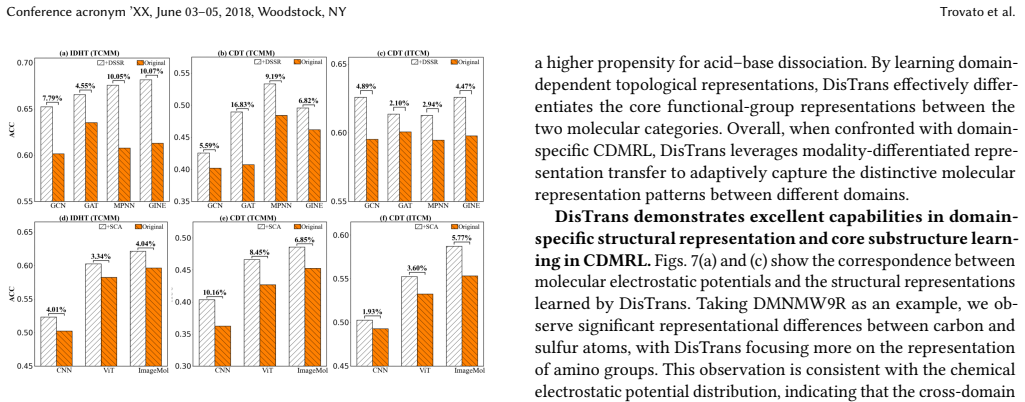
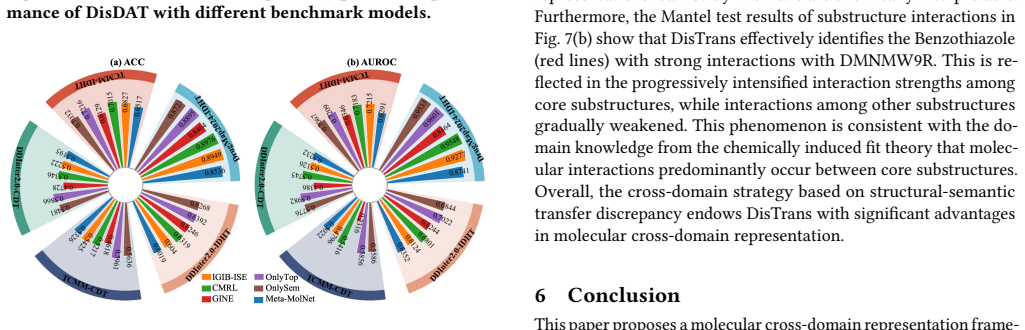
Recent advances in molecular representation integrates molecular topological and visual modalities, opening new avenues for precise Molecular Relational Learning (MRL). Existing MRL methods focus on intra-domain modeling, and their inherent domain-closed effect limits applicability to molecular science, particularly in elucidating cross-domain interaction mechanisms. Consequently, the imperative for Cross-Domain Molecular Relational Learning has become increasingly pressing. Benefiting from structure-activity analysis, we propose the Domain Adversarial Training Network with Structural-Semantic Transfer Discrepancy (DisTrans) to optimize cross-domain adaptive representation for molecular structures and visual images. 1) We employ the gradient reversal strategy based on substructure topological discrepancies between domains to learn the domain dependence of molecular structures. This strategy guides the model to adapt to the structural adjacency patterns in the target domain, generating domain-separable structural representations. 2) We apply the cross-domain representation guidance mechanism to align the functional-group semantic information between the source and target domains, learning cross-domain consistency information. The experimental results in two typical cross-domain strategies demonstrate that DisTrans outperforms 16 baseline methods, maintaining satisfactory performance even under pronounced inter-domain discrepancy.
Editorial analysis
A structured set of objections, weighed in public.
Referee Report
Summary. The manuscript proposes DisTrans, a Domain Adversarial Training Network with Structural-Semantic Transfer Discrepancy for Cross-Domain Molecular Relational Learning. It employs gradient reversal on substructure topological discrepancies between domains to learn domain dependence and adapt structural representations to target-domain adjacency patterns, while using cross-domain representation guidance to align functional-group semantic information for consistency signals. The central claim is that experiments in two typical cross-domain strategies show DisTrans outperforming 16 baseline methods even under pronounced inter-domain discrepancy.
Significance. If the mechanisms are shown to operate as described without negative transfer, the work could extend molecular relational learning beyond intra-domain settings by addressing domain-closed effects, with potential value for cross-domain applications in chemical structure-activity analysis. The explicit use of structure-activity principles for adaptive representations is a noted strength, though its significance hinges on empirical support for the gradient reversal and semantic alignment components.
major comments (3)
- [Abstract] Abstract (experimental results paragraph): The claim that DisTrans outperforms 16 baseline methods in two cross-domain strategies is presented without any quantitative metrics, baseline specifications, statistical tests, or error analysis. This directly undermines evaluation of the central outperformance claim under inter-domain discrepancy.
- [Abstract] Abstract (strategy 1 description): The gradient reversal strategy based on substructure topological discrepancies is described at a high level without equations, formal discrepancy definitions, or ablation results showing it yields domain-separable yet task-adaptive representations rather than inducing negative transfer when topological differences do not align with activity-relevant features.
- [Abstract] Abstract (strategy 2 description): The cross-domain representation guidance mechanism assumes functional-group semantic information provides reliable consistency signals across domains, but no supporting analysis, visualization, or check is provided to confirm this holds rather than functional groups carrying domain-specific roles that could undermine alignment.
minor comments (1)
- [Abstract] The expansion of MRL as Molecular Relational Learning appears only after first use; explicit definition on initial occurrence would aid readability.
Simulated Author's Rebuttal
We thank the referee for the constructive feedback on our manuscript. We respond point-by-point to the major comments below, focusing on the abstract presentation while noting that detailed methods and results appear in the full text. Revisions will be made where they strengthen clarity without altering the core claims.
read point-by-point responses
-
Referee: [Abstract] Abstract (experimental results paragraph): The claim that DisTrans outperforms 16 baseline methods in two cross-domain strategies is presented without any quantitative metrics, baseline specifications, statistical tests, or error analysis. This directly undermines evaluation of the central outperformance claim under inter-domain discrepancy.
Authors: We agree the abstract is a high-level summary and lacks specific numbers. The full manuscript (Section 4, Tables 2-3) reports the quantitative metrics, lists all 16 baselines with their categories, includes paired t-tests for statistical significance, and provides standard error analysis across the two cross-domain settings. We will revise the abstract to include one or two key performance deltas and a note on statistical validation. revision: yes
-
Referee: [Abstract] Abstract (strategy 1 description): The gradient reversal strategy based on substructure topological discrepancies is described at a high level without equations, formal discrepancy definitions, or ablation results showing it yields domain-separable yet task-adaptive representations rather than inducing negative transfer when topological differences do not align with activity-relevant features.
Authors: Abstract length constraints preclude equations and detailed ablations. The formal discrepancy definition, gradient reversal equations, and ablation studies (including controls for negative transfer when topology-activity alignment is weak) are given in Sections 3.2 and 4.3. We will add a brief clause to the abstract referencing the ablation evidence that the mechanism remains task-adaptive. revision: partial
-
Referee: [Abstract] Abstract (strategy 2 description): The cross-domain representation guidance mechanism assumes functional-group semantic information provides reliable consistency signals across domains, but no supporting analysis, visualization, or check is provided to confirm this holds rather than functional groups carrying domain-specific roles that could undermine alignment.
Authors: The supporting evidence (t-SNE visualizations of functional-group embeddings, quantitative alignment scores, and checks against domain-specific role shifts) appears in Section 4.4 and the appendix. Because the abstract is a concise overview, we maintain that these details belong in the body; no change to the abstract wording is required on this point. revision: no
Circularity Check
No circularity detected; architecture claims rest on empirical validation
full rationale
The provided abstract and description introduce DisTrans via gradient reversal on topological discrepancies and cross-domain semantic alignment, with performance asserted via experiments against 16 baselines. No equations, self-citations, fitted parameters renamed as predictions, or self-definitional reductions appear in the text. The central claims do not reduce to inputs by construction, satisfying the default expectation of a non-circular paper.
Axiom & Free-Parameter Ledger
Lean theorems connected to this paper
-
IndisputableMonolith/Cost/FunctionalEquation.leanwashburn_uniqueness_aczel unclear?
unclearRelation between the paper passage and the cited Recognition theorem.
We employ the gradient reversal strategy based on substructure topological discrepancies between domains... cross-domain representation guidance mechanism to align the functional-group semantic information
What do these tags mean?
- matches
- The paper's claim is directly supported by a theorem in the formal canon.
- supports
- The theorem supports part of the paper's argument, but the paper may add assumptions or extra steps.
- extends
- The paper goes beyond the formal theorem; the theorem is a base layer rather than the whole result.
- uses
- The paper appears to rely on the theorem as machinery.
- contradicts
- The paper's claim conflicts with a theorem or certificate in the canon.
- unclear
- Pith found a possible connection, but the passage is too broad, indirect, or ambiguous to say the theorem truly supports the claim.
Reference graph
Works this paper leans on
-
[1]
Lu Bai, Lixin Cui, Yue Wang, Ming Li, Jing Li, Philip S. Yu, and Edwin R. Hancock
-
[2]
Graph Classification.IEEE Transactions on Knowledge and Data Engineering (2024), 1–14
HAQJSK: Hierarchical-Aligned Quantum Jensen-Shannon Kernels for KDD ’26, August 09–13, 2026, Jeju Island, Republic of Korea Zhang et al. Graph Classification.IEEE Transactions on Knowledge and Data Engineering (2024), 1–14
work page 2026
-
[3]
Mohamed Ishmael Belghazi, Aristide Baratin, Sai Rajeshwar, Sherjil Ozair, Yoshua Bengio, Aaron Courville, and Devon Hjelm. 2018. Mutual Information Neural Es- timation. InProceedings of the 35th International Conference on Machine Learning. 531–540
work page 2018
-
[4]
2015.In Silico Medicinal Chemistry: Computational Methods to Support Drug Design
Nathan Brown. 2015.In Silico Medicinal Chemistry: Computational Methods to Support Drug Design. Royal Society of Chemistry
work page 2015
-
[5]
Alexey Dosovitskiy, Lucas Beyer, Alexander Kolesnikov, Dirk Weissenborn, Xi- aohua Zhai, Thomas Unterthiner, Mostafa Dehghani, Matthias Minderer, Georg Heigold, Sylvain Gelly, et al. 2020. An Image is Worth 16x16 Words: Transformers for Image Recognition at Scale. InProceedings of the 8th International Conference on Learning Representations
work page 2020
-
[6]
Wenjie Du, Shuai Zhang, Jun Xia Di Wu, Ziyuan Zhao, Junfeng Fang, and Yang Wang. 2024. MMGNN: A Molecular Merged Graph Neural Network for Explain- able Solvation Free Energy Prediction. InProceedings of the 33rd International Joint Conference on Artificial Intelligence. 5808–5816
work page 2024
-
[7]
Aniruddha Ganguly, Debolina Chatterjee, Wentao Huang, Jie Zhang, Alisa Yurovsky, Travis Steele Johnson, and Chao Chen. 2025. MERGE: Multi-faceted Hierarchical Graph-based GNN for Gene Expression Prediction from Whole Slide Histopathology Images. InProceedings of the Computer Vision and Pattern Recognition Conference. 15611–15620
work page 2025
-
[8]
Jing Gao, Ce Zheng, Laszlo A Jeni, and Zackory Erickson. 2025. DiSRT-In-Bed: Diffusion-Based Sim-to-Real Transfer Framework for In-Bed Human Mesh Re- covery. InProceedings of the Computer Vision and Pattern Recognition Conference. 1829–1838
work page 2025
-
[9]
Justin Gilmer, Samuel S. Schoenholz, Patrick F. Riley, Oriol Vinyals, and George E. Dahl. 2017. Neural Message Passing for Quantum Chemistry. InProceedings of the 34th International Conference on Machine Learning. 1263–1272
work page 2017
-
[10]
Yuqin He, Tengfei Ma, Chaoyi Li, Pengsen Ma, Hongxin Xiang, Jianmin Wang, Yip- ing Liu, Bosheng Song, and Xiangxiang Zeng. 2025. ImageDDI: Image-enhanced molecular motif sequence representation for drug-drug interaction prediction. Information Fusion(2025), 103574
work page 2025
-
[11]
Weihua Hu, Bowen Liu, Joseph Gomes, Marinka Zitnik, Percy Liang, Vijay Pande, and Jure Leskovec. 2020. Strategies for Pre-Training Graph Neural Networks. In Proceedings of the 8th International Conference on Learning Representations
work page 2020
-
[12]
ITCM. 2021. Integrated Traditional Chinese Medicine. http://itcm.biotcm.net/ index.html. Accessed: 2021
work page 2021
-
[13]
Pengcheng Jiang, Cao Xiao, Tianfan Fu, Parminder Bhatia, Taha Kass-Hout, Jimeng Sun, and Jiawei Han. 2025. Bi-Level Contrastive Learning for Knowledge- Enhanced Molecule Representations. InProceedings of the 39th AAAI Conference on Artificial Intelligence. 352–360
work page 2025
-
[14]
Joonyoung F Joung, Minhi Han, Minseok Jeong, and Sungnam Park. 2020. Exper- imental Database of Optical Properties of Organic Compounds.Scientific Data7, 1 (2020), 295
work page 2020
-
[15]
Thomas N Kipf and Max Welling. 2017. Semi-Supervised Classification with Graph Convolutional Networks. InProceedings of the 5th International Conference on Learning Representations
work page 2017
-
[16]
Na, Sungwon Kim, Junseok Lee, and Chanyoung Park
Namkyeong Lee, Dongmin Hyun, Gyoung S. Na, Sungwon Kim, Junseok Lee, and Chanyoung Park. 2023. Conditional Graph Information Bottleneck for Molecular Relational Learning. InProceedings of the 40th International Conference on Machine Learning. 18852–18871
work page 2023
-
[17]
Namkyeong Lee, Kanghoon Yoon, Gyoung S Na, Sein Kim, and Chanyoung Park
-
[18]
In Proceedings of the 29th ACM SIGKDD Conference on Knowledge Discovery and Data Mining
Shift-Robust Molecular Relational Learning with Causal Substructure. In Proceedings of the 29th ACM SIGKDD Conference on Knowledge Discovery and Data Mining. 1200–1212
-
[19]
Fengcheng Li, Minjie Mou, Xiaoyi Li, Weize Xu, Jiayi Yin, Yang Zhang, and Feng Zhu. 2024. DrugMAP 2.0: Molecular Atlas and Pharma-Information of All Drugs. Nucleic Acids Research53, D1 (09 2024), D1372–D1382
work page 2024
-
[20]
Zhaoyang Li, Yuan Wang, Wangkai Li, Tianzhu Zhang, and Xiang Liu. 2025. Dual- Agent Optimization Framework for Cross-Domain Few-Shot Segmentation. In Proceedings of the IEEE/CVF Conference on Computer Vision and Pattern Recognition. 9849–9859
work page 2025
-
[21]
Zimeng Li, Shichao Zhu, Bin Shao, Xiangxiang Zeng, Tong Wang, and Tie- Yan Liu. 2023. DSN-DDI: An Accurate and Generalized Framework for Drug- Drug Interaction Prediction by Dual-View Representation Learning.Briefings in Bioinformatics24, 1 (2023), bbac597
work page 2023
-
[22]
Xuan Liu, HaoYang Shang, and Haojian Jin. 2026. CoBRA: Programming Cog- nitive Bias in Social Agents Using Classic Social Science Experiments. InPro- ceedings of the 2026 CHI Conference on Human Factors in Computing Systems. Association for Computing Machinery, New York, NY, USA, Article 64, 30 pages. doi:10.1145/3772318.3790804
-
[23]
Qiujie Lv, Guanxing Chen, Ziduo Yang, Weihe Zhong, and Calvin Yu-Chian Chen. 2025. Meta-MolNet: A Cross-Domain Benchmark for Few Examples Drug Discovery.IEEE Transactions on Neural Networks and Learning Systems36, 3 (2025), 4849–4863
work page 2025
-
[24]
Aleksandr V Marenich, Casey P Kelly, Jason D Thompson, Gregory D Hawkins, Candee C Chambers, David J Giesen, Paul Winget, Christopher J Cramer, and Donald G Truhlar. 2020. Minnesota Solvation Database (MNSOL) Version 2012. (2020)
work page 2020
-
[25]
Arnold K Nyamabo, Hui Yu, and Jian-Yu Shi. 2021. SSI-DDI: Substructure- Substructure Interactions for Drug-Drug Interaction Prediction.Briefings in Bioinformatics22, 6 (2021), bbab133
work page 2021
-
[26]
Yashaswi Pathak, Siddhartha Laghuvarapu, Sarvesh Mehta, and U Deva Priyaku- mar. 2020. Chemically Interpretable Graph Interaction Network for Prediction of Pharmacokinetic Properties of Drug-Like Molecules. InProceedings of the 34th AAAI Conference on Artificial Intelligence. 873–880
work page 2020
-
[27]
Qucheng Peng, Ce Zheng, and Chen Chen. 2024. A Dual-Augmentor Framework for Domain Generalization in 3D Human Pose Estimation. InProceedings of the IEEE/CVF Conference on Computer Vision and Pattern Recognition. 2240–2249
work page 2024
-
[28]
Zhixiang Ren and Huan Xu. 2024. TCM Modernization. https://www.tcmm.net. cn/zh-hans/. Accessed: 2024
work page 2024
-
[29]
Zhonghao Ren, Xiangxiang Zeng, Yizhen Lao, Zhuhong You, Yifan Shang, Quan Zou, and Chen Lin. 2025. Predicting Rare Drug-Drug Interaction Events with Dual-Granular Structure-Adaptive and Pair Variational Representation.Nature Communications16, 1 (2025), 3997
work page 2025
-
[30]
Nazanin Mohammadi Sepahvand, Eleni Triantafillou, Hugo Larochelle, Doina Precup, James J Clark, Daniel M Roy, and Gintare Karolina Dziugaite. 2025. Selective Unlearning via Representation Erasure Using Domain Adversarial Training. InProceedings of the the 13rd International Conference on Learning Representations
work page 2025
-
[31]
Yao Tian, Jiacai Yi, Ningning Wang, Chengkun Wu, Jinfu Peng, Shao Liu, Guoping Yang, and Dongsheng Cao. 2024. DDInter 2.0: An Enhanced Drug Interaction Resource with Expanded Data Coverage, New Interaction Types, and Improved User Interface.Nucleic Acids Research53, D1 (08 2024), D1356–D1362
work page 2024
-
[32]
Petar Veličković, Guillem Cucurull, Arantxa Casanova, Adriana Romero, Pietro Lio, and Yoshua Bengio. 2018. Graph Attention Networks. InProceedings of the 6th International Conference on Learning Representations
work page 2018
-
[33]
Florence H Vermeire and William H Green. 2021. Transfer Learning for Solvation Free Energies: From Quantum Chemistry to Experiments.Chemical Engineering Journal418 (2021), 129307
work page 2021
-
[34]
Ruijia Wang, Haoran Dai, Cheng Yang, Le Song, and Chuan Shi. 2024. Advancing Molecule Invariant Representation via Privileged Substructure Identification. In Proceedings of the 30th ACM SIGKDD Conference on Knowledge Discovery and Data Mining. 3188–3199
work page 2024
-
[35]
Yingheng Wang, Yaosen Min, Xin Chen, and Ji Wu. 2021. Multi-View Graph Contrastive Representation Learning for Drug-Drug Interaction Prediction. In Proceedings of the 30th ACM on Web Conference. 2921–2933
work page 2021
-
[36]
Zixu Wang, Yangyang Chen, Pengsen Ma, Zhou Yu, Jianmin Wang, Yuansheng Liu, Xiucai Ye, Tetsuya Sakurai, and Xiangxiang Zeng. 2025. Image-Based Gener- ation for Molecule Design with SketchMol.Nature Machine Intelligence(2025), 1–12
work page 2025
-
[37]
Hongxin Xiang, Shuting Jin, Jun Xia, Man Zhou, Jianmin Wang, Li Zeng, and Xiangxiang Zeng. 2024. An Image-Enhanced Molecular Graph Representation Learning Framework. InProceedings of the 33rd International Joint Conference on Artificial Intelligence. 6107–6115
work page 2024
-
[38]
Hongxin Xiang, Li Zeng, Linlin Hou, Kenli Li, Zhimin Fu, Yunguang Qiu, Ruth Nussinov, Jianying Hu, Michal Rosen-Zvi, Xiangxiang Zeng, et al . 2024. A Molecular Video-Derived Foundation Model for Scientific Drug Discovery.Nature Communications15, 1 (2024), 9696
work page 2024
-
[39]
Gezheng Xu, Li Yi, Pengcheng Xu, Jiaqi Li, Ruizhi Pu, Changjian Shui, Charles Ling, A Ian McLeod, and Boyu Wang. 2025. Unraveling the Mysteries of Label Noise in Source-Free Domain Adaptation: Theory and Practice.IEEE Transactions on Pattern Analysis and Machine Intelligence(2025)
work page 2025
-
[40]
Huali Xu, Shuaifeng Zhi, Shuzhou Sun, Vishal Patel, and Li Liu. 2025. Deep Learning for Cross-Domain Few-Shot Visual Recognition: A Survey.Comput. Surveys57, 8 (2025), 1–37
work page 2025
-
[41]
Ziduo Yang, Weihe Zhong, Qiujie Lv, and Calvin Yu-Chian Chen. 2022. Learning Size-Adaptive Molecular Substructures for Explainable Drug-Drug Interaction Prediction by Substructure-Aware Graph Neural Network.Chemical Science13, 29 (2022), 8693–8703
work page 2022
-
[42]
Xiangxiang Zeng, Hongxin Xiang, Linhui Yu, Jianmin Wang, Kenli Li, Ruth Nussi- nov, and Feixiong Cheng. 2022. Accurate prediction of molecular properties and drug targets using a self-supervised image representation learning framework. Nature Machine Intelligence4, 11 (2022), 1004–1016
work page 2022
-
[43]
Peiliang Zhang, Jingling Yuan, Chao Che, Yongjun Zhu, and Lin Li. 2025. Subgraph Information Bottleneck with Causal Dependency for Stable Molecular Relational Learning. InProceedings of the 34th International Joint Conference on Artificial Intelligence. 16–22
work page 2025
-
[44]
Peiliang Zhang, Jingling Yuan, Lin Li, Wen Luo, Jiwei Hu, and Xin Li. 2024. Key substructure learning with chemical intuition for material property prediction. In International Conference on Database Systems for Advanced Applications. Springer, 87–103
work page 2024
-
[45]
Peiliang Zhang, Jingling Yuan, Jianmin Wang, Yongjun Zhu, and Lin Li. 2026. Pro- totype Learning with Structural-Semantic Alignment for Interpretable Molecular Relational Learning.Knowledge-Based Systems(2026), 115460. Cross-Domain Molecular Relational Learning: Leveraging Chemical Structure-Activity Analysi KDD ’26, August 09–13, 2026, Jeju Island, Repub...
work page 2026
-
[46]
Peiliang Zhang, Jingling Yuan, Qing Xie, Yongjun Zhu, Chao Che, and Lin Li. 2026. Representational Alignment with Chemical Induced Fit for Molecular Relational Learning. InProceedings of the 32nd SIGKDD Conference on Knowledge Discovery and Data Mining
work page 2026
-
[47]
Ran Zhang, Xuezhi Wang, Guannan Liu, Pengyang Wang, Yuanchun Zhou, and Pengfei Wang. 2025. Motif-Oriented Representation Learning with Topology Refinement for Drug-Drug Interaction Prediction. InProceedings of the 39th AAAI Conference on Artificial Intelligence. 1102–1110
work page 2025
-
[48]
Shuai Zhang, Junfeng Fang, Xuqiang Li, ALAN XIA, Ye Wei, Wenjie Du, Yang Wang, et al. 2025. Iterative Substructure Extraction for Molecular Relational Learning with Interactive Graph Information Bottleneck. InProceedings of the 13rd International Conference on Learning Representations
work page 2025
-
[49]
Wen Zhang, Yanlin Chen, Feng Liu, Fei Luo, Gang Tian, and Xiaohong Li. 2017. Predicting Potential Drug-Drug Interactions by Integrating Chemical, Biological, Phenotypic and Network Data.BMC Bioinformatics18 (2017), 1–12
work page 2017
-
[50]
Yiheng Zhu, Mingyang Li, Junlong Liu, Kun Fu, Jiansheng Wu, Qiuyi Li, Mingze Yin, Jieping Ye, Jian Wu, and Zheng Wang. 2025. A Generalist Cross-Domain Molecular Learning Framework for Structure-Based Drug Discovery.arXiv preprint arXiv:2503.04362(2025). A The Proof of Theorem 1 For any model representation 𝑍=𝑓 𝜃 (𝑀) , the prediction errors in the source a...
discussion (0)
Sign in with ORCID, Apple, or X to comment. Anyone can read and Pith papers without signing in.