QuadLink: Autoregressive Quad-Dominant Mesh Generation via Point-Relation Learning
Pith reviewed 2026-06-30 19:43 UTC · model grok-4.3
The pith
QuadLink generates quad-dominant meshes from point clouds by predicting anchors then learning vertex-to-centroid links.
A machine-rendered reading of the paper's core claim, the machinery that carries it, and where it could break.
Core claim
QuadLink formulates polygonal mesh generation as a hybrid centroid-conditioned vertex linking model: it predicts a unified set of anchors consisting of vertices and face centroids, learns links that associate vertices with those centroids, and assembles polygonal faces using a quad-first strategy guided by geometric verification, thereby producing production-ready quad-dominant meshes that support hybrid topologies.
What carries the argument
The centroid-conditioned vertex linking model, which predicts anchors and then learns relations to form faces.
If this is right
- Enables generation of sparse anisotropic quad-dominant meshes with coherent edge flow from point clouds.
- Achieves higher geometric fidelity and topological quality than prior baselines on the same inputs.
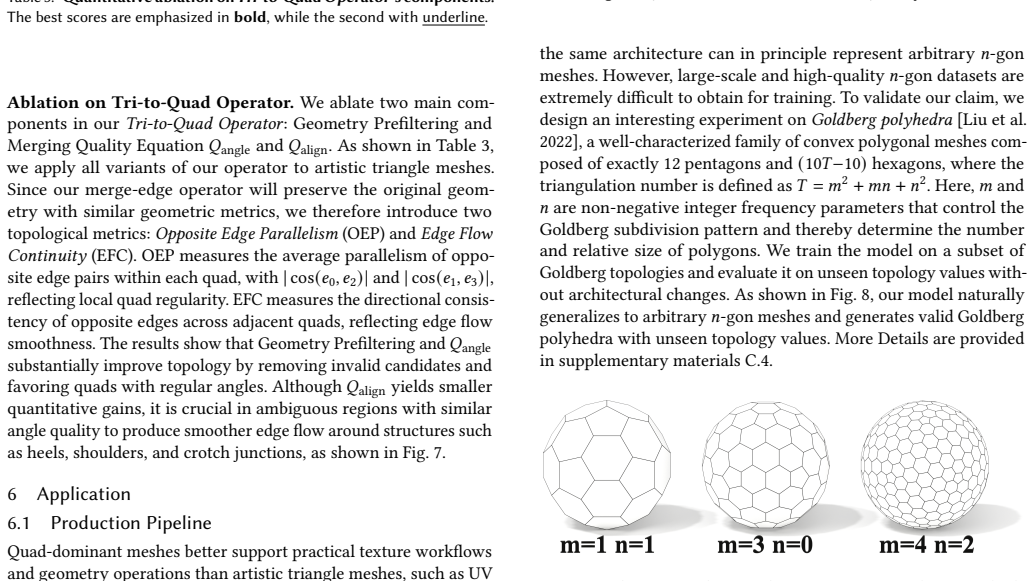
- Supports arbitrary n-gon meshes through the same architecture without modification.
- Allows direct use of artistic triangle meshes as training sources via the conversion operator.
Where Pith is reading between the lines
- The link-based view may transfer to other tasks that require structured face assembly from unstructured points.
- Because the model separates anchor prediction from relation learning, incremental updates to point sets could be handled by re-running only the linking stage.
- The quad-first assembly rule with verification could be adapted to enforce other local geometric constraints such as planarity or symmetry.
Load-bearing premise
The Tri-to-Quad Operator converts triangle meshes into quad-dominant training data that matches the distribution of desired outputs without systematic artifacts.
What would settle it
Generate meshes from point clouds sampled from known high-quality quad-dominant models, then compare the output edge-flow coherence, face anisotropy, and geometric error against the source meshes using standard quad-quality metrics.
Figures






read the original abstract
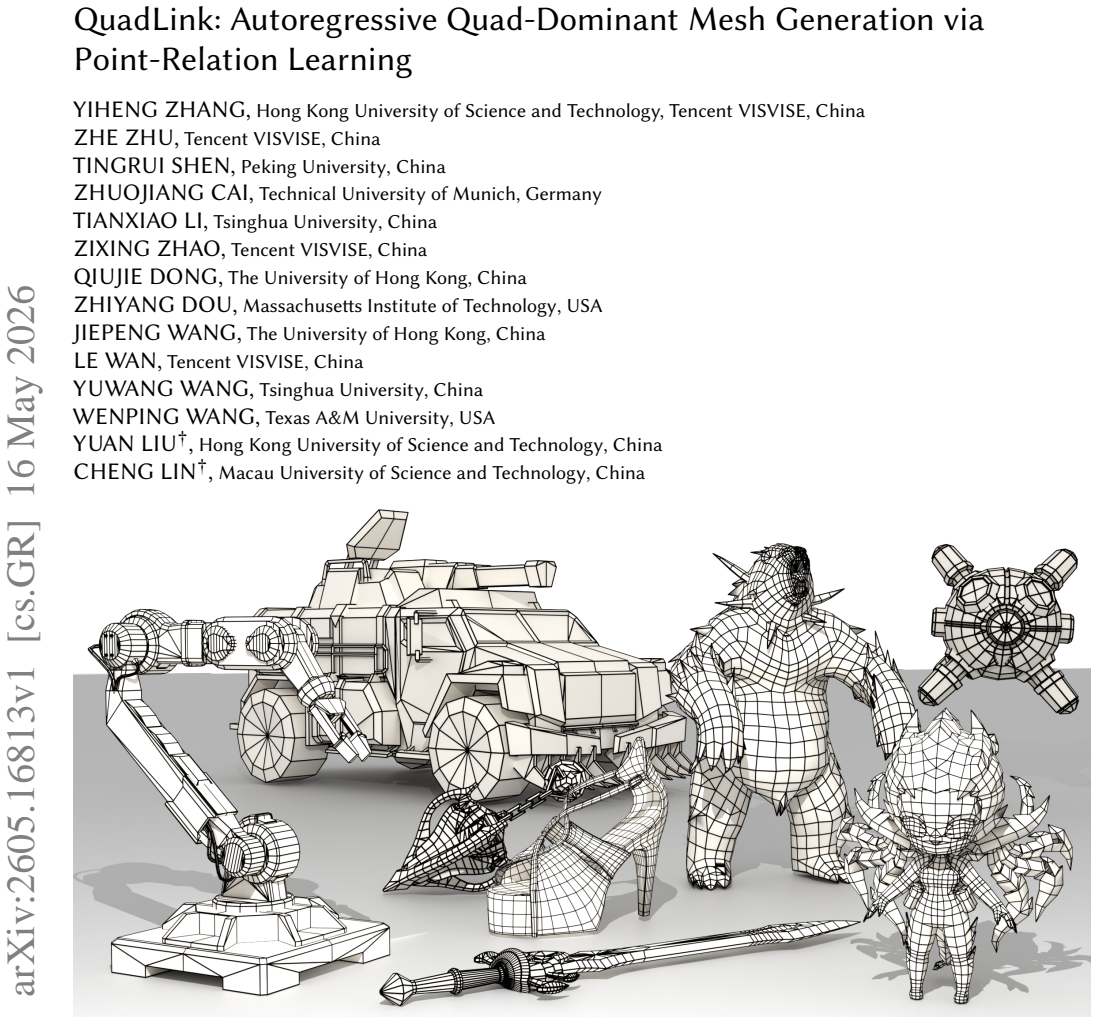
The generation of production-ready quad-dominant meshes is a cornerstone of modern 3D content creation. Generating anisotropic quad-dominant meshes from point clouds is challenging, as existing methods are typically limited to producing either pure triangular meshes or pure quadrilateral meshes with isotropic densities. In this paper, we present QuadLink, a unified framework consisting of three stages for quad-dominant mesh generation by linking points into structured faces. QuadLink formulates polygonal mesh generation as a hybrid centroid-conditioned vertex linking model: it first predicts a unified set of anchors (vertices and face centroids), then learns centroid-conditioned links that associate vertices with face centroids, and finally assembles polygonal faces with a quad-first strategy guided by robust geometric verification strategies. This link-based formulation enables efficient generation of sparse and anisotropic quad-dominant meshes with coherent edge flow and meanwhile supporting hybrid polygonal topology. To construct training data for this model, we further introduce a Tri-to-Quad Operator that converts artistic triangle meshes into quad-dominant training data via global merge selection. Extensive experiments show that QuadLink produces production-ready quad-dominant meshes from point clouds and achieves improved geometric fidelity and topological quality compared to prior baselines. Our method natively supports hybrid polygonal topology, generalizing to arbitrary n-gon meshes without architectural changes.
Editorial analysis
A structured set of objections, weighed in public.
Referee Report
Summary. The paper presents QuadLink, a three-stage autoregressive framework for quad-dominant mesh generation from point clouds. It predicts a unified set of anchors (vertices and centroids), learns centroid-conditioned vertex-to-centroid links, and assembles faces via a quad-first strategy with geometric verification. A Tri-to-Quad Operator is introduced to convert artistic triangle meshes into quad-dominant training targets via global merge selection. The central claims are that this produces production-ready anisotropic quad-dominant meshes with coherent edge flow, improved geometric fidelity and topological quality over baselines, and native support for hybrid n-gon topologies without architectural modification.
Significance. If the results hold with proper validation, the work would be significant for 3D content creation pipelines by providing a unified point-relation approach to anisotropic quad-dominant and hybrid polygonal meshes, which existing methods struggle to produce from point clouds. The link-based formulation and generalization to arbitrary n-gons are notable strengths.
major comments (2)
- [Tri-to-Quad Operator description] Tri-to-Quad Operator (methods section describing global merge selection): The central claim that QuadLink outputs production-ready meshes rests on the assumption that this operator's outputs form an unbiased training distribution matching desired anisotropic, coherent quad-dominant meshes. No quantitative validation (e.g., edge-flow coherence metrics, curvature alignment statistics, or direct comparison to artist-authored quad meshes) is supplied to rule out systematic artifacts such as over-merging in high-curvature regions or inconsistent topology. This is load-bearing because the autoregressive centroid-conditioned model will reproduce the operator's distribution.
- [Abstract and Experiments] Abstract and experimental claims: The assertion of 'improved geometric fidelity and topological quality compared to prior baselines' and 'production-ready' output is stated without reference to specific quantitative metrics, error tables, baseline implementations, or evaluation protocol. This prevents assessment of whether the improvements are statistically meaningful or merely visual.
minor comments (1)
- [Framework overview] Notation for the three stages could be clarified with explicit equations for the anchor prediction and link probability models to improve reproducibility.
Simulated Author's Rebuttal
We thank the referee for the constructive feedback. We address each major comment below, indicating planned revisions where appropriate.
read point-by-point responses
-
Referee: [Tri-to-Quad Operator description] Tri-to-Quad Operator (methods section describing global merge selection): The central claim that QuadLink outputs production-ready meshes rests on the assumption that this operator's outputs form an unbiased training distribution matching desired anisotropic, coherent quad-dominant meshes. No quantitative validation (e.g., edge-flow coherence metrics, curvature alignment statistics, or direct comparison to artist-authored quad meshes) is supplied to rule out systematic artifacts such as over-merging in high-curvature regions or inconsistent topology. This is load-bearing because the autoregressive centroid-conditioned model will reproduce the operator's distribution.
Authors: We agree that the current manuscript lacks quantitative validation of the Tri-to-Quad Operator outputs. The operator is intended to generate anisotropic quad-dominant targets via global merge selection that prioritizes coherent edge flow, but without explicit metrics it is difficult to fully rule out artifacts. In the revised version we will add edge-flow coherence metrics, curvature alignment statistics, and direct comparisons against artist-authored quad meshes to substantiate the training distribution. revision: yes
-
Referee: [Abstract and Experiments] Abstract and experimental claims: The assertion of 'improved geometric fidelity and topological quality compared to prior baselines' and 'production-ready' output is stated without reference to specific quantitative metrics, error tables, baseline implementations, or evaluation protocol. This prevents assessment of whether the improvements are statistically meaningful or merely visual.
Authors: The manuscript already reports quantitative results in Section 4, including Chamfer distance and normal consistency for geometric fidelity, quad ratio and edge-flow coherence scores for topological quality, and direct comparisons against the listed baselines with the evaluation protocol described in Section 4.1. We will revise the abstract and introduction to explicitly cite the relevant tables and metrics so that the strength of the improvements is immediately verifiable. revision: yes
Circularity Check
No circularity; derivation is self-contained pipeline
full rationale
The paper introduces a three-stage autoregressive linking model plus a separate Tri-to-Quad Operator for data preparation. No quoted equations, predictions, or uniqueness claims reduce by construction to fitted inputs, self-definitions, or prior self-citations. The central claims rest on empirical comparison to baselines and the operator's explicit role in generating training targets, which is presented as an auxiliary contribution rather than a tautology. The framework is externally falsifiable via mesh quality metrics and does not invoke load-bearing self-citations or ansatzes.
Axiom & Free-Parameter Ledger
invented entities (1)
-
Tri-to-Quad Operator
no independent evidence
Reference graph
Works this paper leans on
-
[1]
Meshanything v2: Artist-created mesh generation with adjacent mesh tokenization
Meshtron: High- fidelity, artist-like 3d mesh generation at scale.arXiv preprint arXiv:2412.09548 (2024). George Hart
-
[2]
Jeonghwan Kim, Yushi Lan, Armando Fortes, Yongwei Chen, and Xingang Pan
Instant field-aligned meshes.ACM transactions on graphics (TOG)34, 6 (2015), 1–15. Jeonghwan Kim, Yushi Lan, Armando Fortes, Yongwei Chen, and Xingang Pan
2015
- [3]
-
[4]
Royal Society Open Science9, 8 (2022)
Extending Goldberg’s method to parametrize and control the geometry of Goldberg polyhedra. Royal Society Open Science9, 8 (2022). Alessandro Muntoni and Paolo Cignoni. 2021.PyMeshLab. doi:10.5281/zenodo.4438750 Kaiyu Song, Hanjiang Lai, Yaqing Zhang, Chuangjian Cai, Yan Pan Kun Yue, and Jian Yin
-
[5]
Jianlin Su, Murtadha Ahmed, Yu Lu, Shengfeng Pan, Wen Bo, and Yunfeng Liu
Topology Sculptor, Shape Refiner: Discrete Diffusion Model for High-Fidelity 3D Meshes Generation.arXiv preprint arXiv:2510.21264(2025). Jianlin Su, Murtadha Ahmed, Yu Lu, Shengfeng Pan, Wen Bo, and Yunfeng Liu
-
[6]
Haohan Weng, Zibo Zhao, Biwen Lei, Xianghui Yang, Jian Liu, Zeqiang Lai, Zhuo Chen, Yuhong Liu, Jie Jiang, Chunchao Guo, et al
Roformer: Enhanced transformer with rotary position embedding.Neurocomputing 568 (2024), 127063. Haohan Weng, Zibo Zhao, Biwen Lei, Xianghui Yang, Jian Liu, Zeqiang Lai, Zhuo Chen, Yuhong Liu, Jie Jiang, Chunchao Guo, et al
2024
-
[7]
Ruowen Zhao, Junliang Ye, Zhengyi Wang, Guangce Liu, Yiwen Chen, Yikai Wang, and Jun Zhu
MeshMosaic: Scaling Artist Mesh Generation via Local-to-Global Assembly.arXiv preprint arXiv:2509.19995(2025). Ruowen Zhao, Junliang Ye, Zhengyi Wang, Guangce Liu, Yiwen Chen, Yikai Wang, and Jun Zhu
-
[8]
Chenliang Zhou, Fangcheng Zhong, Weihao Xia, Albert Miao, Canberk Baykal, and Cengiz Oztireli
Michelangelo: Conditional 3d shape generation based on shape-image-text aligned latent representation.Advances in neural information processing systems36 (2023), 73969–73982. Chenliang Zhou, Fangcheng Zhong, Weihao Xia, Albert Miao, Canberk Baykal, and Cengiz Oztireli
2023
- [9]
discussion (0)
Sign in with ORCID, Apple, or X to comment. Anyone can read and Pith papers without signing in.