A Collaborative Rehabilitation-Exercise Serious Game for People with Stroke and their Caregivers: A Pilot Study
Pith reviewed 2026-05-20 09:43 UTC · model grok-4.3
The pith
Collaborative rehab game with pedal input trends toward higher motivation for stroke patients and caregivers
A machine-rendered reading of the paper's core claim, the machinery that carries it, and where it could break.
Core claim
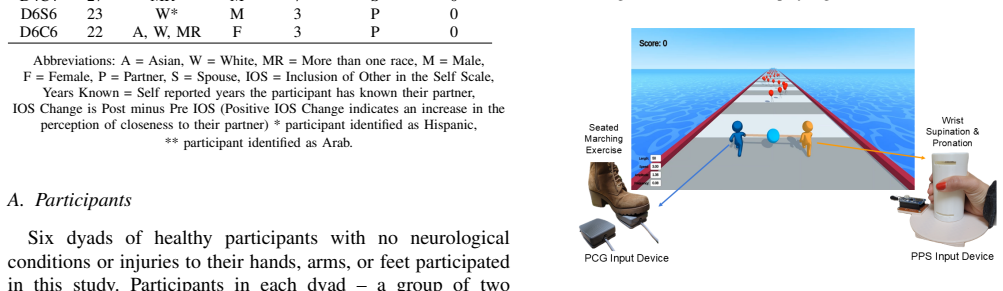
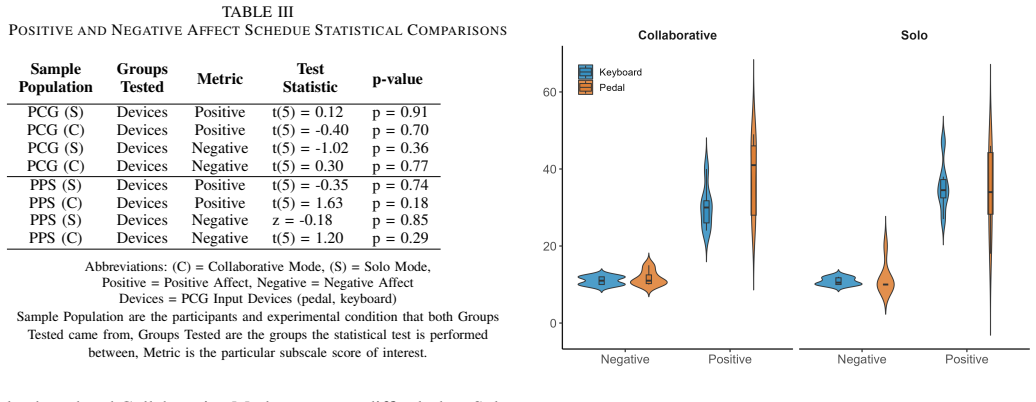
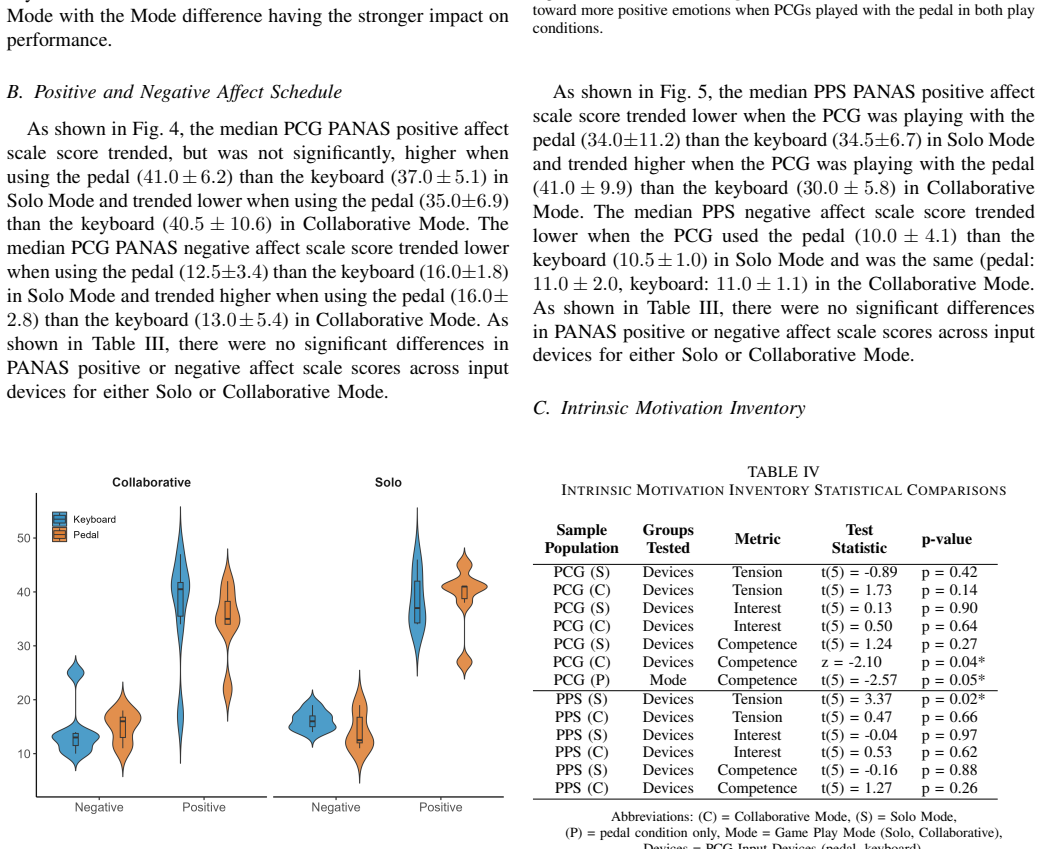
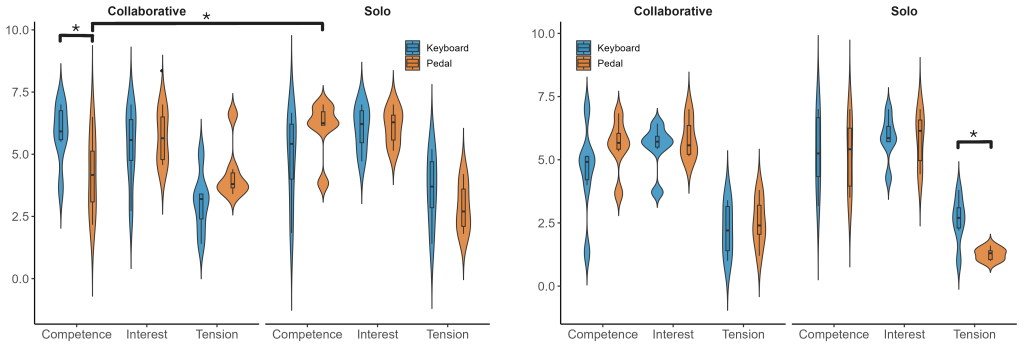
We present a collaborative, mutually beneficial, serious game designed to support therapy for persons with stroke and also exercise for their informal caregivers. One player performs rehabilitative wrist movements and the other performs a seated march exercise via pedals or a keyboard to control their avatar. While not statistically significant, we find that PCGs Interest subscale scores trended higher when using a pedal compared to a keyboard, regardless of game play mode. PPSs' positive affect scale scores and Competence subscale scores trended higher when their partner played collaboratively with a pedal compared to a keyboard. These trends encourage future work toward incorporating an e
What carries the argument
Collaborative serious game in which one avatar is controlled by wrist rehabilitation movements and the other by seated march exercise performed on pedals or keyboard
If this is right
- Exercise-based input such as a pedal can raise interest scores for the caregiver-role player regardless of game mode.
- Collaborative play with pedal input can raise positive affect and competence scores for the stroke-role player.
- Future rehabilitative serious games should explore exercise-based devices to support players with different movement abilities.
- The approach can simultaneously address movement therapy needs for stroke survivors and exercise needs for informal caregivers.
Where Pith is reading between the lines
- Directly linking caregiver physical activity to patient rehab sessions could reduce long-term caregiver burnout by making support activities mutually beneficial.
- Running the same game with actual stroke patients and their family caregivers could produce larger or differently patterned effects once real impairments and relationships are involved.
- The same paired control mechanic could be adapted for other family or partner activities such as shared fitness tracking or dual therapy tasks.
- Adding performance feedback or adaptive challenges based on each player's movements might strengthen the motivational trends already observed.
Load-bearing premise
Trends observed in six healthy dyads using assigned pseudo roles will generalize to real stroke patients and their informal caregivers, and the chosen questionnaire subscales will adequately capture motivation and emotional experience in this setting.
What would settle it
A larger study with actual stroke patients and real caregivers that measures no increase or a reversal in Interest, positive affect, or Competence scores when the caregiver player uses pedal input instead of keyboard.
Figures
read the original abstract
Motivation to perform movement therapy and caregiver burnout are major challenges to post-stroke life. Serious games have been shown to support therapeutic tasks in people with stroke, but there are few activities that simultaneously support informal caregiver health, which is also impacted post-stroke. Here, we present a collaborative, mutually beneficial, serious game designed to support therapy for persons with stroke and also exercise for their informal caregivers. One player performs rehabilitative wrist movements - useful to people with stroke - and the other performs a seated march exercise - useful to informal caregivers - via pedals or a keyboard to control their avatar. We present a pilot study with 6 healthy dyads to evaluate how exercise-based input of one player, the Pseudo Caregiver (PCG), impacts motivation and emotional experience in both the PCG and Pseudo Person with Stroke (PPS). While not statistically significant, we find that PCGs Interest subscale scores trended higher when using a pedal (the exercised-based input) compared to a keyboard, regardless of game play mode. PPSs' positive affect scale scores and Competence subscale scores trended higher when their partner played collaboratively with a pedal compared to a keyboard. These trends encourage future work toward incorporating an exercise-based device, such as a pedal, to enhance the emotional and motivational experience of rehabilitative serious games for people with different movement ability levels.
Editorial analysis
A structured set of objections, weighed in public.
Referee Report
Summary. The manuscript presents a collaborative serious game for post-stroke rehabilitation and informal caregiver exercise, with one player performing wrist movements and the other a seated march via pedal or keyboard input. A pilot study with 6 healthy dyads (acting as Pseudo Person with Stroke and Pseudo Caregiver) reports non-significant trends: higher PCG Interest subscale scores with pedal input regardless of mode, and higher PPS positive affect and Competence scores when the partner uses a pedal in collaborative mode. The authors conclude these trends support future incorporation of exercise-based devices in rehabilitative serious games for varying movement abilities.
Significance. If validated in the target population, the mutually beneficial collaborative design could meaningfully address therapy adherence and caregiver burnout, a novel contribution to serious games in HCI and health. The work provides preliminary empirical data on input device effects on motivation and affect, with credit due for the pilot implementation and focus on dual-player benefits. However, the small sample and proxy participants limit the immediate significance to hypothesis generation rather than established findings.
major comments (2)
- The central claim that the observed trends 'encourage future work' for people with stroke rests on data from 6 healthy dyads simulating roles, yet the manuscript provides no validation step, literature support, or discussion of how subscale responses (Interest, positive affect, Competence) might differ under actual motor deficits, fatigue, or caregiving load. This proxy mismatch is load-bearing for generalizability to the stated motivation of post-stroke therapy and caregiver health.
- Abstract and Pilot Study description: Results are reported only as non-significant 'trends' with n=6 and no mention of power analysis, exact statistical tests performed, effect sizes, or baseline comparisons, which weakens the evidential basis for interpreting directional differences between pedal and keyboard conditions.
minor comments (2)
- Clarify the definitions and distinctions between the game play modes referenced in the abstract, and how they were counterbalanced with input device conditions.
- Provide more detail on the specific questionnaire instruments and subscales, including any prior validation in rehabilitation or collaborative gaming contexts.
Simulated Author's Rebuttal
We thank the referee for their constructive feedback on our pilot study manuscript. We have carefully considered the major comments and provide point-by-point responses below, along with planned revisions to address the concerns.
read point-by-point responses
-
Referee: The central claim that the observed trends 'encourage future work' for people with stroke rests on data from 6 healthy dyads simulating roles, yet the manuscript provides no validation step, literature support, or discussion of how subscale responses (Interest, positive affect, Competence) might differ under actual motor deficits, fatigue, or caregiving load. This proxy mismatch is load-bearing for generalizability to the stated motivation of post-stroke therapy and caregiver health.
Authors: We recognize that the proxy participant design is a key limitation for generalizability, as noted in the manuscript's framing as a pilot study. To strengthen the paper, we will expand the Discussion section to include literature support on the use of proxy measures in stroke rehabilitation research and explicitly discuss potential differences in motivation and affect under real motor impairments and caregiving burdens. This will better contextualize the trends as hypothesis-generating for future studies with the target population. revision: yes
-
Referee: Abstract and Pilot Study description: Results are reported only as non-significant 'trends' with n=6 and no mention of power analysis, exact statistical tests performed, effect sizes, or baseline comparisons, which weakens the evidential basis for interpreting directional differences between pedal and keyboard conditions.
Authors: We agree that more detailed statistical reporting is warranted even in a pilot study. In the revision, we will specify the statistical tests employed, report effect sizes, and include a statement on the lack of power analysis given the exploratory design with small n. Baseline comparisons will be added if not already present. We maintain that the non-significant trends are appropriately described as such due to the sample size. revision: yes
Circularity Check
No circularity: purely empirical pilot study with direct questionnaire observations
full rationale
The paper reports a small-scale user study with 6 healthy dyads, collecting questionnaire responses on subscales like Interest, positive affect, and Competence. No mathematical derivations, model fits, predictions, or self-citation chains appear in the provided text or abstract. All reported trends are direct empirical observations rather than outputs derived from prior inputs or self-referential definitions. The work is self-contained as an exploratory pilot without load-bearing theoretical steps that reduce to their own assumptions.
Axiom & Free-Parameter Ledger
axioms (1)
- domain assumption Standard validated questionnaires accurately capture motivation and emotional experience for this population and activity.
Lean theorems connected to this paper
-
IndisputableMonolith/Foundation/RealityFromDistinction.leanreality_from_one_distinction unclear?
unclearRelation between the paper passage and the cited Recognition theorem.
pilot study with 6 healthy dyads... PCGs Interest subscale scores trended higher when using a pedal... PPSs' positive affect scale scores and Competence subscale scores trended higher
-
IndisputableMonolith/Cost/FunctionalEquation.leanwashburn_uniqueness_aczel unclear?
unclearRelation between the paper passage and the cited Recognition theorem.
collaborative, mutually beneficial, serious game... exercise-based input device consists of two foot pedals
What do these tags mean?
- matches
- The paper's claim is directly supported by a theorem in the formal canon.
- supports
- The theorem supports part of the paper's argument, but the paper may add assumptions or extra steps.
- extends
- The paper goes beyond the formal theorem; the theorem is a base layer rather than the whole result.
- uses
- The paper appears to rely on the theorem as machinery.
- contradicts
- The paper's claim conflicts with a theorem or certificate in the canon.
- unclear
- Pith found a possible connection, but the passage is too broad, indirect, or ambiguous to say the theorem truly supports the claim.
Reference graph
Works this paper leans on
-
[1]
A critical review of the concept of patient motivation in the literature on physical rehabilitation,
N. Maclean and P. Pound, “A critical review of the concept of patient motivation in the literature on physical rehabilitation,”Social Science & Medicine (1982), vol. 50, no. 4, pp. 495–506, 2000
work page 1982
-
[2]
Home-based technologies for stroke rehabilitation: A system- atic review,
Y . Chen, K. T. Abel, J. T. Janecek, Y . Chen, K. Zheng, and S. C. Cramer, “Home-based technologies for stroke rehabilitation: A system- atic review,”International Journal of Medical Informatics, vol. 123, pp. 11–22, 2019
work page 2019
-
[3]
Increasing the Motivation to Train Through Haptic Social Interaction – Pilot study,
A. Nehrujee, E. Ivanova, S. Srinivasan, S. Balasubramanian, and E. Burdet, “Increasing the Motivation to Train Through Haptic Social Interaction – Pilot study,” inInternational Conference on Rehabilitation Robotics (ICORR), 2023
work page 2023
-
[4]
F. Pereira, S. Berm ´udez i Badia, C. Jorge, and M. S. Cameir ˜ao, “The use of game modes to promote engagement and social involvement in multi-user serious games: A within-person randomized trial with stroke survivors,”Journal of NeuroEngineering and Rehabilitation, vol. 18, no. 1, 2021
work page 2021
-
[5]
Balancing the playing field: Collaborative gaming for physical train- ing,
M. Mace, N. Kinany, P. Rinne, A. Rayner, P. Bentley, and E. Burdet, “Balancing the playing field: Collaborative gaming for physical train- ing,”Journal of NeuroEngineering and Rehabilitation, vol. 14, no. 1, 2017
work page 2017
-
[6]
Towards customizable games for stroke rehabilitation,
G. Alankus, A. Lazar, M. May, and C. Kelleher, “Towards customizable games for stroke rehabilitation,” inProceedings of the SIGCHI Con- ference on Human Factors in Computing Systems. Association for Computing Machinery, 2010, pp. 2113–2122
work page 2010
-
[7]
The Global Prevalence of Anxiety and Depressive Symptoms Among Caregivers of Stroke Survivors,
A. Z. Loh, J. S. Tan, M. W. Zhang, and R. C. Ho, “The Global Prevalence of Anxiety and Depressive Symptoms Among Caregivers of Stroke Survivors,”Journal of the American Medical Directors Association, vol. 18, no. 2, pp. 111–116, 2017
work page 2017
-
[8]
A population-based assessment of the impact and burden of caregiving for long-term stroke survivors,
C. S. Anderson, J. Linto, and E. G. Stewart-Wynne, “A population-based assessment of the impact and burden of caregiving for long-term stroke survivors,”Stroke, vol. 26, no. 5, pp. 843–849, 1995
work page 1995
-
[9]
Caregiving in the context of ethnicity: Hispanic caregiver wives of stroke patients,
E. M. O. Garcia, “Caregiving in the context of ethnicity: Hispanic caregiver wives of stroke patients,” Ph.D. dissertation, University of California, Irvine, 1999
work page 1999
-
[10]
Rehabilitation of grasping and forearm pronation/supination with the haptic knob,
O. Lambercy, L. Dovat, H. Yun, S. K. Wee, C. Kuah, K. Chua, R. Gassert, T. Milner, C. L. Teo, and E. Burdet, “Rehabilitation of grasping and forearm pronation/supination with the haptic knob,” in IEEE International Conference on Rehabilitation Robotics, 2009, pp. 22–27
work page 2009
-
[11]
Y . Kato, M. M. Islam, D. Koizumi, M. E. Rogers, and N. Takeshima, “Effects of a 12-week marching in place and chair rise daily exercise intervention on ADL and functional mobility in frail older adults,” Journal of Physical Therapy Science, vol. 30, no. 4, pp. 549–554, 2018
work page 2018
-
[12]
D. Markland and L. Hardy, “On the factorial and construct validity of the Intrinsic Motivation Inventory: conceptual and operational concerns,” Research Quarterly for Exercise and Sport, vol. 68, no. 1, pp. 20–32, 1997
work page 1997
-
[13]
Development and validation of brief measures of positive and negative affect: The PANAS scales,
D. Watson, L. A. Clark, and A. Tellegen, “Development and validation of brief measures of positive and negative affect: The PANAS scales,” Journal of Personality and Social Psychology, vol. 54, no. 6, pp. 1063– 1070, 1988
work page 1988
-
[14]
Inclusion of Other in the Self Scale and the structure of interpersonal closeness,
A. Aron, E. N. Aron, and D. Smollan, “Inclusion of Other in the Self Scale and the structure of interpersonal closeness,”Journal of Personality and Social Psychology, vol. 63, no. 4, pp. 596–612, 1992
work page 1992
-
[15]
Social-Cultural Factors in the Design of Technology for Hispanic People with Stroke,
E. D. Vasquez, A. M. Okamura, and S. Follmer, “Social-Cultural Factors in the Design of Technology for Hispanic People with Stroke,” 2022, arXiv:2203.08889. [Online]. Available: https://arxiv.org/abs/2203.08889
discussion (0)
Sign in with ORCID, Apple, or X to comment. Anyone can read and Pith papers without signing in.