Matching and Power Coupling
Pith reviewed 2026-05-20 01:36 UTC · model grok-4.3
The pith
Impedance matching overcomes reflections to enable efficient power coupling into high-Q accelerating cavities.
A machine-rendered reading of the paper's core claim, the machinery that carries it, and where it could break.
Core claim
The author establishes that standard impedance matching methods from transmission line theory can be adapted to high-Q cavities to achieve efficient coupling without steady-state reflections, applicable to both standing-wave and travelling-wave cavities.
What carries the argument
Impedance matching between the transmission line and the cavity's shunt impedance to eliminate reflections.
If this is right
- Efficient coupling maximizes the power delivered to the beam in accelerators.
- Stable operation is achieved without power loss to reflected waves.
- Designs for both standing-wave and travelling-wave cavities benefit from these matching approaches.
- Overall RF system efficiency improves, reducing the required amplifier power.
Where Pith is reading between the lines
- These matching techniques may require modifications when beam loading or frequency detuning is present in operational accelerators.
- Similar principles could apply to other high-Q resonant structures outside of particle physics.
- Testing these methods in actual accelerator environments would validate their robustness against nonlinear effects.
Load-bearing premise
Standard impedance matching techniques from transmission line theory can be applied directly to high-Q cavities without significant additional effects from beam loading, frequency detuning, or nonlinearities.
What would settle it
Observation of steady-state reflections persisting in a high-Q cavity after applying the described matching techniques during operation.
Figures


read the original abstract
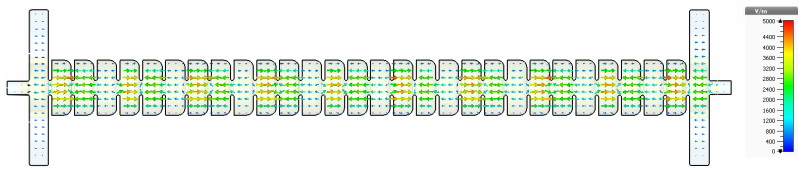
A key factor in any RF system is the mechanism for coupling the RF power from an amplifier into an accelerating cavity. Any tranmission line will experience reflections if there is a mismatch in the impedance between the line and its load. In accelerating cavities due to their high quality factors there is often a large mismatch between the cavity shunt impedance and the tranmission line. This lecture will look at how to overcome this mismatch and ensure efficient coupling without steady-state reflections in both standing-wave and travelling-wave cavties.
Editorial analysis
A structured set of objections, weighed in public.
Referee Report
Summary. The manuscript is a lecture note explaining impedance matching and power coupling from transmission lines to high-Q accelerating cavities. It identifies the mismatch arising from high cavity Q factors and describes standard techniques, such as variable coupling loops or irises, to achieve critical coupling (external Q equal to unloaded Q) that eliminates steady-state reflections for both standing-wave and travelling-wave cavities under linear circuit theory and resonance assumptions.
Significance. If the derivations and explanations hold, the work offers a clear pedagogical review of established RF engineering methods essential for efficient power transfer in particle accelerators. It correctly frames the problem using transmission line theory without claiming new physics or extending to beam-loaded or nonlinear regimes, which aligns with its lecture-note format. This provides value as a reference or training resource in accelerator physics, though the concepts are textbook-level rather than advancing the state of the art.
minor comments (2)
- [Abstract] Abstract: spelling errors ('tranmission' should be 'transmission'; 'cavties' should be 'cavities'). These should be corrected for professionalism.
- The manuscript would benefit from explicit section headings or numbered equations to allow readers to follow the derivations of critical coupling conditions more easily.
Simulated Author's Rebuttal
We thank the referee for their positive and accurate summary of our lecture note on impedance matching and power coupling techniques for high-Q accelerating cavities. We agree that the manuscript reviews established methods under linear circuit theory and resonance assumptions, without claiming new physics, and serves as a pedagogical resource. We accept the recommendation for minor revision.
Circularity Check
No significant circularity in standard lecture notes on RF coupling
full rationale
The paper is an explanatory lecture on established transmission-line impedance matching techniques applied to high-Q accelerating cavities. It presents textbook concepts such as setting external Q equal to unloaded Q for critical coupling in standing-wave and travelling-wave structures, without introducing new derivations, fitted parameters, or predictions that reduce to the paper's own inputs. No self-citations are load-bearing, no ansatzes are smuggled, and no results are renamed as novel findings. The derivation chain is self-contained against external benchmarks of linear circuit theory and resonance assumptions.
Axiom & Free-Parameter Ledger
Reference graph
Works this paper leans on
- [1]
-
[2]
Electromagnetic Vibrations, Waves, and Radiation , author=. 1977 , publisher=
work page 1977
-
[3]
Electromagnetic Fields and Waves (3rd edition) , author=. 1988 , publisher=
work page 1988
-
[4]
Classical Electrodynamics (3rd edition) , author=. 1998 , publisher=
work page 1998
-
[5]
Demonstration of electron acceleration in a laser-driven dielectric microstructure , author=. Nature , volume=. 2013 , publisher=
work page 2013
-
[6]
Cavity types , author=. arXiv preprint arXiv:1111.4897 , year=
work page internal anchor Pith review Pith/arXiv arXiv
-
[7]
Gardner, ISK , volume=
-
[8]
Nature Communications , volume=
Observation of acceleration and deceleration in gigaelectron-volt-per-metre gradient dielectric wakefield accelerators , author=. Nature Communications , volume=. 2016 , publisher=
work page 2016
-
[9]
Reviews of Modern Physics , volume=
Dielectric laser accelerators , author=. Reviews of Modern Physics , volume=. 2014 , publisher=
work page 2014
-
[10]
New local field quantity describing the high gradient limit of accelerating structures , author =. Phys. Rev. ST Accel. Beams , volume =. 2009 , month =. doi:10.1103/PhysRevSTAB.12.102001 , url =
-
[11]
Fakhari, M. and Fallahi, A. and Kartner, F.X , journal=. 2017 , publisher=
work page 2017
-
[12]
Terahertz-driven acceleration of a relativistic 35
Hibberd, MT and Healy, AL and Lake, DS and Georgiadis, V and Smith, EJH and Finlay, OJ and Pacey, TH and Jones, JK and Saveliev, Y and Walsh, DA and others , booktitle=. Terahertz-driven acceleration of a relativistic 35. 2019 , organization=
work page 2019
-
[13]
Physical Review Letters , volume=
Meter-scale terahertz-driven acceleration of a relativistic beam , author=. Physical Review Letters , volume=. 2018 , publisher=
work page 2018
-
[14]
Acceleration of electrons in the plasma wakefield of a proton bunch , author=. Nature , volume=. 2018 , publisher=
work page 2018
-
[15]
Developments in laser-driven plasma accelerators , author=. Nature Photonics , volume=. 2013 , publisher=
work page 2013
-
[16]
Apollinari, G and Gonin, I and Khabiboulline, T and Lanfranco, G and McConologue, F and Romanov, G and Wagner, R , journal=. Design of 325. 2007 , publisher=
work page 2007
-
[17]
Physical Review Special Topics: Accelerators and Beams , volume=
Superconducting spoke cavities for high-velocity applications , author=. Physical Review Special Topics: Accelerators and Beams , volume=. 2013 , publisher=
work page 2013
- [18]
-
[19]
Proceedings of the 18th International Workshop on RF Superconductivity , year=
Design and Fabrication of Balloon Single Spoke Resonator , author=. Proceedings of the 18th International Workshop on RF Superconductivity , year=
-
[20]
Aune, Bernard and Bandelmann, R and Bloess, D and Bonin, B and Bosotti, A and Champion, M and Crawford, C and Deppe, G and Dwersteg, B and Edwards, DA and others , journal=. Superconducting. 2000 , publisher=
work page 2000
-
[21]
Olry, G and Biarrotte, JL and Blivet, S and Bousson, S and Chatelet, F and Junquera, T and Le Goff, A and Lesrel, J and Mi. Development of. Proceedings of the 9th International Workshop on RF Superconductivity , volume=
-
[22]
Sekutowicz, J. and Ko, K and Ge, L and Lee, L and Li, Zenghai and Ng, C and Schussman, G and Xiao, Liling and Gonin, I and Khabibouline, T and others , booktitle=. Design of a Low Loss. 2005 , organization=
work page 2005
-
[23]
Amaldi, U. and Berra, P and Crandall, K and Toet, D and Weiss, M and Zennaro, R and Rosso, E and Szeless, B and Vretenar, M and Cicardi, C and others , journal=. 2004 , publisher=
work page 2004
-
[24]
Broemmelsiek, D. and Chase, B. and Edstrom, D. and Harms, E. and Leibfritz, J. and Nagaitsev, S. and Pischalnikov, Y. and Romanov, A. and Ruan, J. and Schappert, W. and others , journal=. Record high-gradient. 2018 , publisher=
work page 2018
- [25]
-
[26]
Vogt, J-M and Kugeler, O and Knobloch, J , journal=. High-. 2015 , publisher=
work page 2015
-
[27]
Investigation of the surface resistance of superconducting materials , author=
-
[28]
IEEE Transactions on Nuclear Science , volume=
RF phase focusing in portable x-band, linear accelerators , author=. IEEE Transactions on Nuclear Science , volume=. 1985 , publisher=
work page 1985
-
[29]
High Efficiency Klystron Development for Particle Accelerators , author=. 58th ICFA Advanced Beam Dynamics Workshop on High Luminosity Circular e ^+ e ^- Colliders (eeFACT'16), Daresbury, UK, October 24-27, 2016 , pages=
work page 2016
-
[30]
Microwave and RF Vacuum Electronic Power Sources , author=. 2018 , publisher=
work page 2018
-
[31]
IEEE Transactions on Nuclear Science , number=
Design of Travelling Wave Electron Linear Accelerators , author=. IEEE Transactions on Nuclear Science , number=
-
[32]
Physical Review Accelerators and Beams , volume=
High gradient linac for proton therapy , author=. Physical Review Accelerators and Beams , volume=. 2017 , publisher=
work page 2017
-
[33]
The electron accelerator for the
Pepitone, K and Doebert, S and Burt, G and Chevallay, E and Chritin, N and Delory, C and Fedosseev, V and Hessler, Ch and McMonagle, G and Mete, Oznur and others , journal=. The electron accelerator for the. 2016 , publisher=
work page 2016
-
[34]
and Burt, G and Kumar, AV Praveen and Saveliev, Y
Jenkins, M. and Burt, G and Kumar, AV Praveen and Saveliev, Y. and Corlett, P. and Hartnett, T. and Smith, R and Wheelhouse, A and McIntosh, P and Middleman, K , journal=. Prototype 1. 2019 , publisher=
work page 2019
-
[35]
Optimisation studies for a high gradient proton Linac for application in proton imaging: ProBE: Proton Boosting Linac for imaging and therapy , author=. 2019 , school=
work page 2019
- [36]
-
[37]
Pritzkau, D.P and Siemann, R.H , journal=. Experimental study of. 2002 , publisher=
work page 2002
-
[38]
Physical Review Special Topics: Accelerators and Beams , volume =
Prediction of multipactor in the iris region of RF deflecting mode cavities , author =. Physical Review Special Topics: Accelerators and Beams , volume =. 2011 , month =. doi:10.1103/PhysRevSTAB.14.122002 , url =
-
[39]
Macpherson, A. and Hernández-Chahín, K. and Jarrige, C. and Maesen, P. and Pillon, F. and Schirm, K. and Torres-Sanchez, R. and Valverde Alonso, N. CERN’s bulk niobium high gradient SRF programme: developments and recent cold test results. 2015. doi:10.18429/JACoW-SRF2015-MOPB074
-
[40]
Physical Review Special Topics: Accelerators and Beams , volume=
Development of room temperature crossbar-H-mode cavities for proton and ion acceleration in the low to medium beta range , author=. Physical Review Special Topics: Accelerators and Beams , volume=. 2011 , publisher=
work page 2011
-
[41]
Physical Review Special Topics: Accelerators and Beams , volume=
Defect model for the dependence of breakdown rate on external electric fields , author=. Physical Review Special Topics: Accelerators and Beams , volume=. 2012 , publisher=
work page 2012
-
[42]
Atomistic modeling of metal surfaces under electric fields: Direct coupling of electric fields to a molecular dynamics algorithm , author=. Physical Review E , volume=. 2011 , publisher=
work page 2011
-
[43]
Wake fields and instabilities in linear accelerators
Ferrario, M and Migliorati, M and Palumbo, L. Wake fields and instabilities in linear accelerators. 2006. doi:10.5170/CERN-2006-002.343
-
[44]
RF breakdown studies in room temperature electron linac structures , author=. 1988 , Journal=
work page 1988
- [45]
-
[46]
DQW Crab Cavity HOMs and Dampers for the HL-LHC , author=. 2019 , publisher=
work page 2019
-
[47]
Proceedings of Linac2014, Geneva, Switzerland , year=
DESIGN OF THE HIGH REPETITION RATE PHOTOCATHODE GUN FOR THE CLARA PROJECT , author=. Proceedings of Linac2014, Geneva, Switzerland , year=
-
[48]
Physical Review Special Topics: Accelerators and Beams , volume =
First demonstration and performance of an injection locked continuous wave magnetron to phase control a superconducting cavity , author =. Physical Review Special Topics: Accelerators and Beams , volume =. 2011 , month =. doi:10.1103/PhysRevSTAB.14.032001 , url =
-
[49]
Physical Review Special Topics: Accelerators and Beams , volume=
Suppressing multipacting in a 56 MHz quarter wave resonator , author=. Physical Review Special Topics: Accelerators and Beams , volume=. 2010 , publisher=
work page 2010
-
[50]
Drift tube linac design and prototyping for the CERN LINAC4 , author=. proc. Linac08 , year=
-
[51]
PSI status 2008: Developments at the 590 MeV proton accelerator facility , author=. Nuclear Instruments and Methods in Physics Research Section A: Accelerators, Spectrometers, Detectors and Associated Equipment , volume=. 2009 , publisher=
work page 2008
-
[52]
Low and Intermediate Beta Cavity Design-A Tutorial , author=. 2003 , booktitle=
work page 2003
-
[53]
Physical Review Special Topics: Accelerators and Beams , volume=
Low-field accelerator structure couplers and design techniques , author=. Physical Review Special Topics: Accelerators and Beams , volume=. 2004 , publisher=
work page 2004
-
[54]
Journal of Applied Physics , volume=
Disk-Loaded Wave Guides , author=. Journal of Applied Physics , volume=. 1949 , publisher=
work page 1949
-
[55]
doi:10.1088/0953-2048/26/10/102001 , url =
A Grassellino and A Romanenko and D Sergatskov and O Melnychuk and Y Trenikhina and A Crawford and A Rowe and M Wong and T Khabiboulline and F Barkov , title =. doi:10.1088/0953-2048/26/10/102001 , url =
-
[56]
A Travelling-Wave Linear Accelerator for 4-
Fry, DW and Harvie, RBR-S- and Mullett, LB and Walkinshaw, W , journal=. A Travelling-Wave Linear Accelerator for 4-. 1948 , publisher=
work page 1948
-
[57]
Physical Review Special Topics: Accelerators and Beams , volume =
Probabilistic model for the simulation of secondary electron emission , author =. Physical Review Special Topics: Accelerators and Beams , volume =. 2002 , month =. doi:10.1103/PhysRevSTAB.5.124404 , url =
- [58]
-
[59]
Proceedings of Linac2012, Tel-Aviv, Israel , year=
Solid-state Marx Modulators for Emerging Applications , author=. Proceedings of Linac2012, Tel-Aviv, Israel , year=
-
[60]
Physical Review Special Topics: Accelerators and Beams , volume=
Electron emission contributions to dark current and its relation to microscopic field enhancement and heating in accelerator structures , author=. Physical Review Special Topics: Accelerators and Beams , volume=. 2008 , publisher=
work page 2008
-
[61]
Proceedings of the Royal Society A: Mathematical, Physical and Engineering Sciences , volume=
Reformulation of the standard theory of Fowler--Nordheim tunnelling and cold field electron emission , author=. Proceedings of the Royal Society A: Mathematical, Physical and Engineering Sciences , volume=. 2007 , publisher=
work page 2007
-
[62]
Siggins, T and Sinclair, C and Bohn, C and Bullard, D and Douglas, David and Grippo, A and Gubeli, J and Krafft, GA and Yunn, B , journal=. Performance of a. 2001 , publisher=
work page 2001
-
[63]
Electron emission from metals as a function of temperature , author=. Physical Review , volume=. 1924 , publisher=
work page 1924
-
[64]
Wangler, T. P. , title =. 2008 , isbn =
work page 2008
- [65]
-
[66]
Zhang, Chuan and Busch, Michael and Dziuba, Florian and Klein, Horst and Podlech, Holger and Ratzinger, Ulrich , year =. Recent studies on a 3-17MeV DTL for EUROTRANS with respect to rf structures and beam dynamics , journal =
-
[67]
Electron emission: From the Fowler--Nordheim relation to the Child--Langmuir law , author=. Physics of Plasmas , volume=. 1994 , publisher=
work page 1994
-
[68]
and Bricault, Pierre and Fong, Ken and Laxdal, R.E
Mitra, A.K. and Bricault, Pierre and Fong, Ken and Laxdal, R.E. and Poirier, Raymond and Vasyuchenko, A. , year =. RF measurement summary of ISAC DLT tanks and DTL bunchers , isbn =
-
[69]
Los Alamos Group AT-1 Report , volume=
Kilpatrick’s criterion , author=. Los Alamos Group AT-1 Report , volume=
-
[70]
Physical Review Special Topics: Accelerators and Beams , volume =
High-energy ion linacs based on superconducting spoke cavities , author =. Physical Review Special Topics: Accelerators and Beams , volume =. 2003 , month =. doi:10.1103/PhysRevSTAB.6.080101 , url =
-
[71]
Podlech, H. and Ratzinger, U. and Klein, H. and Commenda, C. and Liebermann, H. and Sauer, A. , journal =. Superconducting. 2007 , month =. doi:10.1103/PhysRevSTAB.10.080101 , url =
-
[72]
Comparison of the conditioning of high gradient accelerating structures , author =. Phys. Rev. Accel. Beams , volume =. 2016 , month =. doi:10.1103/PhysRevAccelBeams.19.032001 , url =
-
[73]
Nature Photonics14(12), 755–759 (2020) https://doi.org/10.1038/s41566-020-0674-1
Acceleration of relativistic beams using laser-generated terahertz pulses , author =. Nature Photonics , year =. doi:10.1038/s41566-020-0674-1 , url =
-
[74]
Reviews of Accelerator Science and Technology , volume=
Superconducting radio-frequency cavities for low-beta particle accelerators , author=. Reviews of Accelerator Science and Technology , volume=. 2012 , publisher=
work page 2012
-
[75]
Proceedings, 12th International Conference on High-Energy Accelerators, HEACC 1983: Fermilab, Batavia , author=
work page 1983
-
[76]
Skaria, E and Varghese, BM , journal=
-
[77]
Review of Scientific Instruments , volume=
Berkeley proton linear accelerator , author=. Review of Scientific Instruments , volume=. 1955 , publisher=
work page 1955
-
[78]
Rolf Wider e: Progenitor of Particle Accelerators , author=. SSCL-SR-ll86 , Year=
-
[79]
Ion sources for high-power hadron accelerators
Ion sources for high-power hadron accelerators , author=. arXiv preprint arXiv:1302.3745 , year=
work page internal anchor Pith review Pith/arXiv arXiv
-
[80]
Proceedings of the Royal Society of London
Experiments with high velocity positive ions.―(I) Further developments in the method of obtaining high velocity positive ions , author=. Proceedings of the Royal Society of London. Series A, Containing Papers of a Mathematical and Physical Character , volume=. 1932 , publisher=
work page 1932
discussion (0)
Sign in with ORCID, Apple, or X to comment. Anyone can read and Pith papers without signing in.