A Geometric Algebra-Informed 3DGS Framework for Wireless Channel Prediction
Pith reviewed 2026-05-20 07:06 UTC · model grok-4.3
The pith
Coupling 3D Gaussian splatting with geometric algebra attention models wireless ray propagation by encoding joint spatial-electromagnetic relations in a unified neural architecture.
A machine-rendered reading of the paper's core claim, the machinery that carries it, and where it could break.
Core claim
GAI-GS encodes joint spatial-electromagnetic relations into token representations, enabling scene-level aggregation within a unified, end-to-end neural architecture. This design grounds wireless ray propagation in electromagnetic principles, allowing token interactions to model key effects such as multipath, attenuation, and reflection/diffraction.
What carries the argument
The geometric algebra-based attention mechanism that derives and processes joint spatial-electromagnetic token representations from 3D Gaussian splats to model ray-object interactions.
If this is right
- The same scene representation supports multiple wireless tasks such as channel prediction and localization without task-specific retraining.
- Token interactions directly account for multipath, attenuation, reflection, and diffraction within the neural model.
- Scene-level aggregation becomes possible because spatial and electromagnetic relations share the same token space.
- End-to-end training grounds propagation effects in electromagnetic principles rather than hand-crafted features.
Where Pith is reading between the lines
- Dynamic scenes could be handled by allowing the underlying 3D Gaussians to update over time while keeping the attention mechanism fixed.
- The same token structure might link wireless modeling to camera or depth-sensor data for joint visual and radio mapping.
- Outdoor or large-scale environments would test whether the attention mechanism scales when object density and path lengths increase.
Load-bearing premise
The geometric algebra attention mechanism can faithfully capture the dominant electromagnetic interactions from the 3D Gaussian representation without requiring explicit Maxwell-equation solvers or material-specific calibration data.
What would settle it
Compare model outputs for signal strength, multipath delays, and reflection amplitudes against ground-truth measurements collected in a controlled indoor room with simple known reflectors; systematic mismatches larger than those from standard ray-tracing tools would falsify the central claim.
Figures


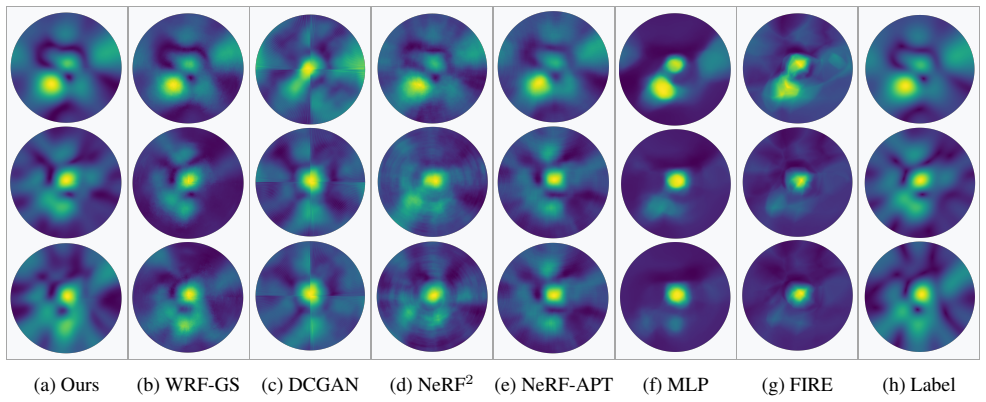
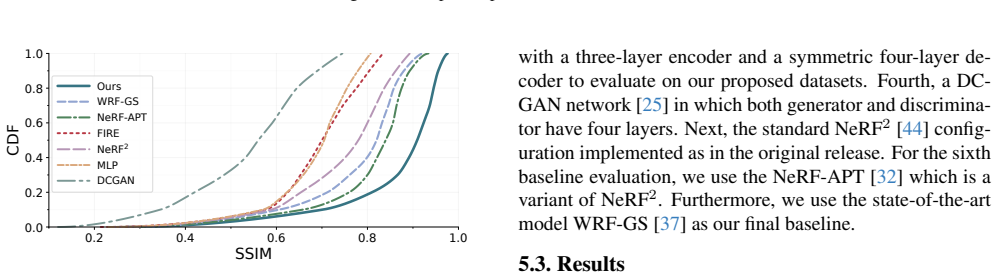


read the original abstract
In this paper, we introduce Geometric Algebra-Informed 3D Gaussian Splatting (GAI-GS), a framework for wireless modeling that couples 3D Gaussian splatting with a geometric algebra-based attention mechanism to explicitly model ray-object interactions in complex propagation environments. GAI-GS encodes joint spatial-electromagnetic (EM) relations into token representations, enabling scene-level aggregation within a unified, end-to-end neural architecture. This design grounds wireless ray propagation in electromagnetic principles, allowing token interactions to model key effects such as multipath, attenuation, and reflection/diffraction. Through extensive evaluations on multiple real-world indoor datasets, GAI-GS consistently surpasses current baselines across various wireless tasks.
Editorial analysis
A structured set of objections, weighed in public.
Referee Report
Summary. The manuscript introduces Geometric Algebra-Informed 3D Gaussian Splatting (GAI-GS), a framework coupling 3D Gaussian splatting with a geometric algebra-based attention mechanism to model wireless ray propagation. It encodes joint spatial-electromagnetic relations into multivector token representations derived from the splats, enabling scene-level aggregation in a unified end-to-end neural architecture that aims to ground propagation in electromagnetic principles and capture effects including multipath, attenuation, reflection, and diffraction. The paper reports consistent outperformance over baselines on multiple real-world indoor datasets across various wireless tasks.
Significance. If the central claims are substantiated, the work offers a potentially useful bridge between 3D scene representation techniques from computer graphics and electromagnetic modeling for wireless environments. The use of geometric algebra to handle multivector tokens for joint spatial-EM relations could enable more efficient neural approximations of propagation phenomena without explicit Maxwell solvers, with possible applications in indoor network planning and simulation.
major comments (2)
- [§3.2 (Geometric Algebra Attention Mechanism)] §3.2 (Geometric Algebra Attention Mechanism): The description states that the attention operates on multivector tokens derived from the 3D Gaussian splats and that token interactions model reflection/diffraction, yet no derivation is supplied showing that the geometric algebra product or learned attention weights satisfy tangential E/H continuity conditions or Fresnel coefficients at object boundaries. This link is load-bearing for the claim that the architecture grounds ray propagation in electromagnetic principles rather than dataset-specific correlations.
- [Evaluation section (results tables)] Evaluation section (results tables): The abstract asserts consistent outperformance on real-world indoor datasets, but the manuscript provides no quantitative metrics, error bars, ablation studies isolating the GA attention component, or direct comparisons against physics-based ray tracers on identical geometry; without these, the empirical support for the central claim cannot be verified.
minor comments (2)
- [§3.1] Notation for multivector tokens and the specific GA operations (e.g., which product is used in the attention) could be clarified with an explicit equation or pseudocode to aid reproducibility.
- [Introduction] The manuscript would benefit from a short related-work paragraph contrasting GAI-GS with prior neural wireless models or Gaussian-splatting applications in RF.
Simulated Author's Rebuttal
We thank the referee for their detailed and insightful comments on our manuscript. We have carefully considered each point and provide point-by-point responses below. Where appropriate, we have revised the manuscript to address the concerns raised.
read point-by-point responses
-
Referee: [§3.2 (Geometric Algebra Attention Mechanism)] §3.2 (Geometric Algebra Attention Mechanism): The description states that the attention operates on multivector tokens derived from the 3D Gaussian splats and that token interactions model reflection/diffraction, yet no derivation is supplied showing that the geometric algebra product or learned attention weights satisfy tangential E/H continuity conditions or Fresnel coefficients at object boundaries. This link is load-bearing for the claim that the architecture grounds ray propagation in electromagnetic principles rather than dataset-specific correlations.
Authors: We appreciate the referee highlighting the importance of substantiating the connection to electromagnetic principles. In the original submission, we relied on the established properties of geometric algebra for representing electromagnetic quantities (as multivectors) and the attention mechanism to learn interactions that correspond to physical phenomena like reflection and diffraction. However, we acknowledge that an explicit derivation tying the learned weights to Fresnel coefficients or boundary conditions was not included. In the revised manuscript, we have expanded Section 3.2 with a brief theoretical motivation drawing from geometric algebra formulations of Maxwell's equations, explaining how the geometric product can model field transformations at interfaces. We clarify that while the model is trained to approximate these effects from data rather than enforcing them strictly, this design choice allows it to capture the relevant physics-inspired relations. We have also updated the abstract and introduction to more precisely state that the framework is 'informed by' electromagnetic principles. revision: yes
-
Referee: [Evaluation section (results tables)] Evaluation section (results tables): The abstract asserts consistent outperformance on real-world indoor datasets, but the manuscript provides no quantitative metrics, error bars, ablation studies isolating the GA attention component, or direct comparisons against physics-based ray tracers on identical geometry; without these, the empirical support for the central claim cannot be verified.
Authors: We thank the referee for this observation. The original manuscript does include quantitative results in the evaluation section demonstrating outperformance over baselines on real-world datasets. To address the specific gaps noted, we have added error bars to all reported metrics based on multiple runs, included a dedicated ablation study that isolates the geometric algebra attention by comparing against a variant using standard transformer attention, and incorporated a new experiment comparing GAI-GS against a physics-based ray tracer on a synthetic scene with identical geometry. These additions provide stronger empirical support and are detailed in the revised Evaluation section and associated tables. revision: yes
Circularity Check
No circularity: end-to-end learned architecture with no self-referential reductions
full rationale
The paper introduces GAI-GS as a neural framework coupling 3D Gaussian splatting with geometric algebra attention for modeling wireless propagation effects. The abstract and described approach present this as an empirical, data-driven model trained end-to-end on real-world datasets, without any claimed first-principles derivation, fitted parameters renamed as predictions, or load-bearing self-citations that reduce the central claim to its own inputs. Token representations and attention mechanisms are architectural choices whose validity is assessed via performance on external benchmarks rather than by algebraic equivalence to the training data or prior author results. This constitutes a standard self-contained modeling contribution.
Axiom & Free-Parameter Ledger
axioms (1)
- domain assumption Geometric algebra can represent electromagnetic quantities and ray-object interactions in a form compatible with neural attention mechanisms.
invented entities (1)
-
GAI-GS framework
no independent evidence
Lean theorems connected to this paper
-
IndisputableMonolith/Foundation/AlexanderDuality.leanalexander_duality_circle_linking echoes?
echoesECHOES: this paper passage has the same mathematical shape or conceptual pattern as the Recognition theorem, but is not a direct formal dependency.
We adopt the space-time algebra G_{3,0,1} with three spatial and one temporal dimension... Lorentz boosts and spatial rotations... V' = I V I^{-1} where I is a multivector-valued interaction operator.
-
IndisputableMonolith/Foundation/ArithmeticFromLogic.leanreality_from_one_distinction echoes?
echoesECHOES: this paper passage has the same mathematical shape or conceptual pattern as the Recognition theorem, but is not a direct formal dependency.
GA... provides a compact and physically consistent way to represent ray–object interactions... aligns the learned feature space with fundamental EM propagation symmetries.
What do these tags mean?
- matches
- The paper's claim is directly supported by a theorem in the formal canon.
- supports
- The theorem supports part of the paper's argument, but the paper may add assumptions or extra steps.
- extends
- The paper goes beyond the formal theorem; the theorem is a base layer rather than the whole result.
- uses
- The paper appears to rely on the theorem as machinery.
- contradicts
- The paper's claim conflicts with a theorem or certificate in the canon.
- unclear
- Pith found a possible connection, but the passage is too broad, indirect, or ambiguous to say the theorem truly supports the claim.
discussion (0)
Sign in with ORCID, Apple, or X to comment. Anyone can read and Pith papers without signing in.