Tunable cylindrical vector beam generation via low-cost printed binary holograms
Pith reviewed 2026-05-20 07:26 UTC · model grok-4.3
The pith
Binary holograms printed on acetate sheets generate tunable cylindrical vector beams in a modified Michelson interferometer.
A machine-rendered reading of the paper's core claim, the machinery that carries it, and where it could break.
Core claim
By exchanging binary holograms printed on acetate sheets inside a Michelson interferometer equipped with a cylindrical-lens mode converter, the apparatus produces a family of cylindrical vector beams whose spatial-polarisation nonseparability can be tuned. Stokes polarimetry reconstructs transverse polarization distributions that remain consistent with numerical simulations, and the vector quality factor (concurrence) yields values that track theoretical expectations. Insertion of wave-plate retarders further permits continuous variation from scalar to fully vector regimes.
What carries the argument
Binary hologram printed on acetate sheet that encodes the target phase and amplitude pattern, placed in one arm of the modified Michelson interferometer containing the cylindrical-lens mode converter to transform the input into the desired cylindrical vector state.
If this is right
- A range of cylindrical vector beams becomes accessible simply by printing and exchanging new holograms.
- The degree of spatial-polarisation nonseparability can be varied continuously by rotating wave plates in the beam path.
- Transverse polarization maps obtained via Stokes polarimetry remain consistent with numerical simulations for each generated state.
- Vector quality factor measurements agree with theoretical concurrence values across the produced beams.
- The overall arrangement offers a compact, robust alternative to spatial light modulators for use in teaching or portable optical setups.
Where Pith is reading between the lines
- The same printed-hologram approach could be adapted to generate other families of structured light by redesigning the binary pattern.
- Resource-limited laboratories might adopt the method to demonstrate vector-beam phenomena without purchasing expensive modulators.
- Further tests could check whether the acetate holograms maintain performance under higher laser powers or repeated use.
Load-bearing premise
The printed binary patterns on acetate faithfully reproduce the phase and amplitude needed for the intended cylindrical vector modes, and the Stokes measurements accurately recover the actual polarization structure without major distortions from printing errors or misalignment.
What would settle it
If swapping holograms yields polarization maps that deviate markedly from the simulated distributions or if measured concurrence values fall consistently outside the theoretically predicted range for the chosen states, the accuracy of the low-cost encoding and reconstruction would be falsified.
Figures


read the original abstract
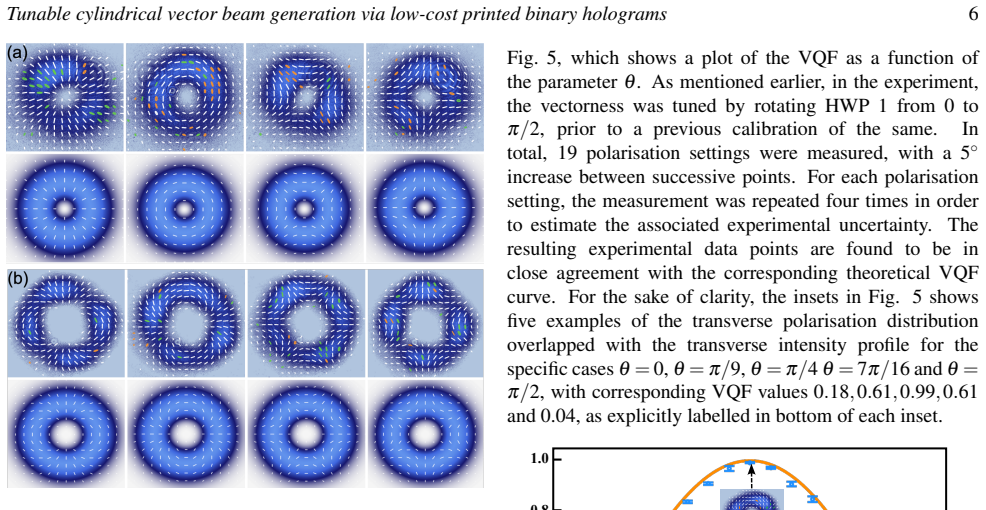
We report a low-cost method for generating cylindrical vector beams using binary holograms printed on acetate sheets and a modified Michelson interferometer incorporating a cylindrical-lens mode converter. By simply exchanging the hologram the device produces a variety of CVBs with tunable spatial-polarisation nonseparability. The transverse polarisation distributions reconstructed via Stokes polarimetry show spatial-polarisation features consistent with numerical simulations. The degree of nonseparability is further quantified using the vector quality factor (concurrence), demonstrating values in good agreement with theoretical expectations across the generated states. The use of wave-plate retarders enables continuous tuning from scalar to fully vector beams. The simplicity, robustness, and low cost of the proposed system make it an attractive alternative to programmable modulators for compact optical platforms and teaching laboratories.
Editorial analysis
A structured set of objections, weighed in public.
Referee Report
Summary. The manuscript presents a low-cost experimental method for generating cylindrical vector beams (CVBs) by printing binary holograms on acetate sheets and incorporating them into a modified Michelson interferometer with a cylindrical-lens mode converter. Exchanging holograms produces a variety of CVBs whose spatial-polarization nonseparability is tuned continuously from scalar to vector states using wave-plate retarders. Stokes polarimetry reconstructs the transverse polarization distributions, which are reported as consistent with numerical simulations, and the degree of nonseparability is quantified via the vector quality factor (concurrence), with values stated to agree with theoretical expectations.
Significance. If the central experimental claims are supported by quantitative error analysis, the work would demonstrate a practical, inexpensive alternative to spatial light modulators for CVB generation. This could enable wider use in teaching laboratories and compact optical platforms. The tunability feature and direct comparison to simulations are positive aspects, though the absence of fidelity metrics and error budgets currently limits the strength of the demonstration.
major comments (2)
- [Results section] Results section on concurrence quantification: the manuscript states that concurrence values demonstrate 'good agreement with theoretical expectations' across generated states, but provides no error bars, standard deviations, or quantitative agreement metrics (e.g., RMS deviation from theory or simulated values). This is load-bearing for the central claim of tunable nonseparability, as binary encoding and acetate printing can introduce quantization and resolution errors that degrade purity.
- [Experimental methods] Experimental methods describing hologram fabrication and interferometer alignment: no quantitative assessment is given of binary hologram fidelity (e.g., measured diffraction efficiency, mode overlap integrals, or robustness tests against printing variations). Without this, it is unclear whether the reported consistency with simulations and theory holds beyond visual inspection, directly affecting the validity of the low-cost CVB generation claim.
minor comments (2)
- [Figure captions] Figure captions for polarization maps could include explicit scale bars and clearer indication of the Stokes parameter components to facilitate direct comparison with the numerical simulations.
- [Introduction] The introduction would benefit from additional citations to recent work on CVB generation with low-cost diffractive elements for better context.
Simulated Author's Rebuttal
We thank the referee for their constructive feedback on our manuscript. The comments highlight important aspects for strengthening the quantitative support of our claims regarding the low-cost generation of tunable cylindrical vector beams. We address each point below.
read point-by-point responses
-
Referee: [Results section] Results section on concurrence quantification: the manuscript states that concurrence values demonstrate 'good agreement with theoretical expectations' across generated states, but provides no error bars, standard deviations, or quantitative agreement metrics (e.g., RMS deviation from theory or simulated values). This is load-bearing for the central claim of tunable nonseparability, as binary encoding and acetate printing can introduce quantization and resolution errors that degrade purity.
Authors: We agree with the referee that the absence of error bars and quantitative metrics limits the strength of the agreement claim. In the revised manuscript, we will add error bars to the concurrence values based on the propagation of uncertainties from the Stokes polarimetry measurements and multiple experimental runs. We will also compute and report the root-mean-square deviation from the theoretical expectations to provide a more rigorous quantitative comparison. revision: yes
-
Referee: [Experimental methods] Experimental methods describing hologram fabrication and interferometer alignment: no quantitative assessment is given of binary hologram fidelity (e.g., measured diffraction efficiency, mode overlap integrals, or robustness tests against printing variations). Without this, it is unclear whether the reported consistency with simulations and theory holds beyond visual inspection, directly affecting the validity of the low-cost CVB generation claim.
Authors: We acknowledge that a quantitative assessment of hologram fidelity would better support the low-cost claim. We will include in the revised methods section the measured diffraction efficiency of the printed binary holograms on acetate. For mode overlap integrals and robustness tests, these were not part of the original experimental protocol; however, the close visual and qualitative match to simulations across multiple states provides supporting evidence. We will add a discussion of potential error sources from printing variations. revision: partial
Circularity Check
No circularity: experimental demonstration validated against independent theory and simulations
full rationale
The paper describes an experimental method for generating cylindrical vector beams (CVBs) via printed binary holograms in a modified Michelson interferometer with a cylindrical-lens converter. Key results include transverse polarization maps from Stokes polarimetry and the vector quality factor (concurrence) for nonseparability, reported as matching numerical simulations and theoretical expectations. No equations or claims reduce these measurements to parameters fitted from the same data, self-definitions, or load-bearing self-citations. The central claims rest on direct comparison to external benchmarks (simulations and standard vector beam theory), making the derivation chain self-contained without circular reduction.
Axiom & Free-Parameter Ledger
axioms (1)
- standard math Standard wave optics and polarization theory govern beam propagation, interference, and Stokes parameter reconstruction in the described interferometer setup.
Lean theorems connected to this paper
-
IndisputableMonolith/Foundation/AbsoluteFloorClosure.leanreality_from_one_distinction unclear?
unclearRelation between the paper passage and the cited Recognition theorem.
We construct complex optical fields from the solutions of the paraxial wave equation... encoded in a binary amplitude hologram using the transfer function T(ρ,ϕ)=1/2 + 1/2 sgn{cos[p(ρ,ϕ)] + cos[q(ρ,ϕ)]}
-
IndisputableMonolith/Cost/FunctionalEquation.leanwashburn_uniqueness_aczel unclear?
unclearRelation between the paper passage and the cited Recognition theorem.
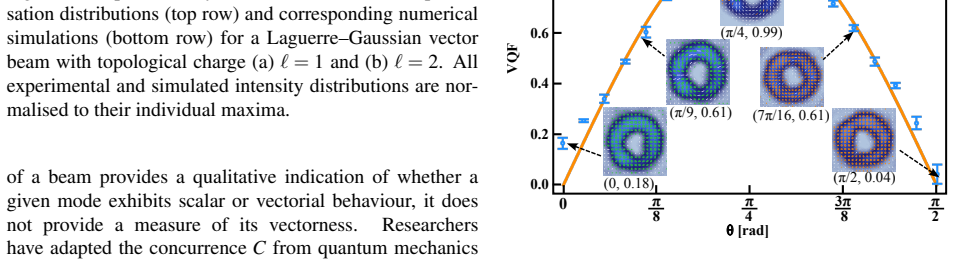
The degree of nonseparability is further quantified using the vector quality factor (concurrence)... VQF(θ)=|sin(2θ)|
What do these tags mean?
- matches
- The paper's claim is directly supported by a theorem in the formal canon.
- supports
- The theorem supports part of the paper's argument, but the paper may add assumptions or extra steps.
- extends
- The paper goes beyond the formal theorem; the theorem is a base layer rather than the whole result.
- uses
- The paper appears to rely on the theorem as machinery.
- contradicts
- The paper's claim conflicts with a theorem or certificate in the canon.
- unclear
- Pith found a possible connection, but the passage is too broad, indirect, or ambiguous to say the theorem truly supports the claim.
Reference graph
Works this paper leans on
-
[1]
Rubinsztein-Dunlop H, Forbes A, Berry M V , Dennis M R, Andrews D L, Mansuripur M, Denz C, Alpmann C, Banzer P and Bauer T 2017J. Opt.19013001
-
[2]
Shen Y and Rosales-Guzmán C 2022Laser & Photonics Reviews16 2100533
-
[3]
Rosales-Guzmán C and Rodríguez-Fajardo V 2024Applied Physics Letters125
-
[4]
Forbes A, de Oliveira M and Dennis M R 2021Nature Photonics15 253–262 ISSN 1749-4893
-
[5]
Forbes A, Aiello A and Ndagano B 2019 Classically entangled light Progress in Optics(Elsevier Ltd.) pp 99–153
work page 2019
-
[6]
Chen J, Forbes A and Qiu C W 2025Light: Science & Applications 1428
-
[7]
Shen Y , Zhang Q, Shi P, Du L, Yuan X and Zayats A V 2024Nature Photonics1815–25
-
[8]
Shen Y , Wang H and Fan S 2025Advances in Optics and Photonics 17295–374
-
[9]
Shvedov V , Davoyan A R, Hnatovsky C, Engheta N and Krolikowski W 2014Nature photonics8846–850
-
[10]
Berg-Johansen S, Töppel F, Stiller B, Banzer P, Ornigotti M, Giacobino E, Leuchs G, Aiello A and Marquardt C 2015Optica 2864–868
-
[11]
Milione G, Lavery M P, Huang H, Ren Y , Xie G, Nguyen T A, Karimi E, Marrucci L, Nolan D A, Alfano R Ret al.2015Opt. Lett.40 1980–1983
work page 1980
-
[12]
Marrucci L, Manzo C and Paparo D 2006Phys. Rev. Lett.96163905
-
[13]
Devlin R C, Ambrosio A, Rubin N A, Mueller J P B and Capasso F 2017ScienceISSN 0036-8075
-
[14]
Rodríguez-Fajardo V , Arvizu F, Daza-Salgado D, Perez-Garcia B and Rosales-Guzmán C 2024Journal of Optics26065606
- [15]
-
[16]
Savage N 2009Nature Photonics3170–172
-
[17]
Moreno I, Davis J A, Hernandez T M, Cottrell D M and Sand D 2012 Opt. Express20364–376
work page 2012
-
[18]
Mitchell K J, Radwell N, Franke-Arnold S, Padgett M J and Phillips D B 2017Opt. Express2525079–25089
- [19]
-
[20]
Rosales-Guzmán C and Forbes A 2017How to shape light with spatial light modulatorsSPIE.SPOTLIGHT (SPIE Press)
-
[21]
Scholes S, Kara R, Pinnell J, Rodríguez-Fajardo V and Forbes A 2019Optical Engineering591 – 12
-
[22]
Gong L, Ren Y , Liu W, Wang M, Zhong M, Wang Z and Li Y 2014 J. Appl. Phys.116183105 Tunable cylindrical vector beam generation via low-cost printed binary holograms8
work page 2014
-
[23]
Hu X B and Rosales-Guzmán C 2022Journal of Optics24034001
-
[24]
Ren Y X, Lu R D and Gong L 2015Annalen der Physik527447–470
-
[25]
Lett.374826–4828 URL http://ol.osa.org/abstract.cfm?URI=ol-37-23-4826
Lerner V , Shwa D, Drori Y and Katz N 2012Opt. Lett.374826–4828 URL http://ol.osa.org/abstract.cfm?URI=ol-37-23-4826
-
[26]
Torres-Leal F, Moreno-Rodriguez H A, Rubio-Perez J P, Hernandez- Aranda R I, Rosales-Guzmán C and Perez-Garcia B 2023Appl. Opt.627104–7110
-
[27]
Li C Y , Liu S J, Wu H J, Jiang J Q, Zhao B, Rosales-Guzmán C, Zhu Z H, Chen P and Lu Y Q 2024Phys. Rev. Appl.21(3) 034021
-
[28]
Ndagano B, Sroor H, McLaren M, Rosales-Guzmán C and Forbes A 2016Opt. Lett.413407
-
[29]
Selyem A, Rosales-Guzmán C, Croke S, Forbes A and Franke- Arnold S 2019Phys. Rev. A100(6) 063842
-
[30]
McLaren M, Konrad T and Forbes A 2015Phys. Rev. A92023833
-
[31]
Lee W H 1974Applied optics131677–1682
- [32]
- [33]
-
[34]
Galvez E J, Khadka S, Schubert W H and Nomoto S 2012Appl. Opt. 512925–2934
-
[35]
Goldstein D H 2011Polarized light(CRC Press)
-
[36]
Goodman J W 2017Introduction to F ourier Optics4th ed (New York: WH Freeman) ISBN 978-1319119164
-
[37]
Singh K, Nape I, Buono W T, Dudley A and Forbes A 2023Laser & Photonics Reviews172200844
-
[38]
Zhen W, Ren Z C, Wang X L, Ding J and Wang H T 2025Science China Physics, Mechanics & Astronomy68244211
discussion (0)
Sign in with ORCID, Apple, or X to comment. Anyone can read and Pith papers without signing in.