DAFT-s-AFDM Enabled ISAC Systems: Ambiguity Function Analysis and Waveform Design
Pith reviewed 2026-05-20 02:09 UTC · model grok-4.3
pith:S5IA2R2K Add to your LaTeX paper
What is a Pith Number?\usepackage{pith}
\pithnumber{S5IA2R2K}
Prints a linked pith:S5IA2R2K badge after your title and writes the identifier into PDF metadata. Compiles on arXiv with no extra files. Learn more
The pith
A probabilistic constellation shaping framework applied to DAFT-s-AFDM waveforms jointly optimizes communication throughput and sensing ambiguity function characteristics in ISAC systems.
A machine-rendered reading of the paper's core claim, the machinery that carries it, and where it could break.
Core claim
By analyzing the ambiguity function of DAFT-s-AFDM and obtaining its closed-form magnitude expectation, the authors identify parameter choices that improve integrated sensing and communication. They then introduce probabilistic constellation shaping to adjust symbol probabilities, formulating and solving a multi-objective problem whose solutions, obtained via a closed-form bit error rate expression, produce Pareto-optimal waveforms that deliver superior and controllable dual-functional performance.
What carries the argument
The probabilistic constellation shaping framework on DAFT-s-AFDM, which reweights symbol probabilities to jointly control communication bit error rate and sensing ambiguity function sidelobe behavior.
If this is right
- Parameter selection guided by the ambiguity function expression directly improves the sensing resolution and communication reliability of DAFT-s-AFDM.
- The multi-objective formulation yields a family of waveforms whose communication-sensing tradeoff can be tuned by the designer.
- The closed-form bit error rate enables low-complexity computation of operating points without exhaustive search.
- Reduced multiuser interference and Doppler robustness are preserved while the peak-to-average power ratio remains low.
Where Pith is reading between the lines
- The same shaping technique could be applied to other affine or chirp-based waveforms to extend the performance gains beyond the specific DAFT-s-AFDM case.
- Real-time adaptation of the constellation probabilities might allow the system to respond to changing channel or target conditions.
- The approach suggests a general method for embedding sensing constraints into constellation design for any multicarrier ISAC waveform.
Load-bearing premise
The closed-form bit error rate expression used to obtain Pareto-optimal solutions accurately captures the system behavior under the DAFT-s-AFDM model.
What would settle it
An experiment or simulation in which the measured bit error rate under the optimized DAFT-s-AFDM constellations deviates substantially from the closed-form expression, producing a different set of Pareto points than predicted.
Figures



read the original abstract
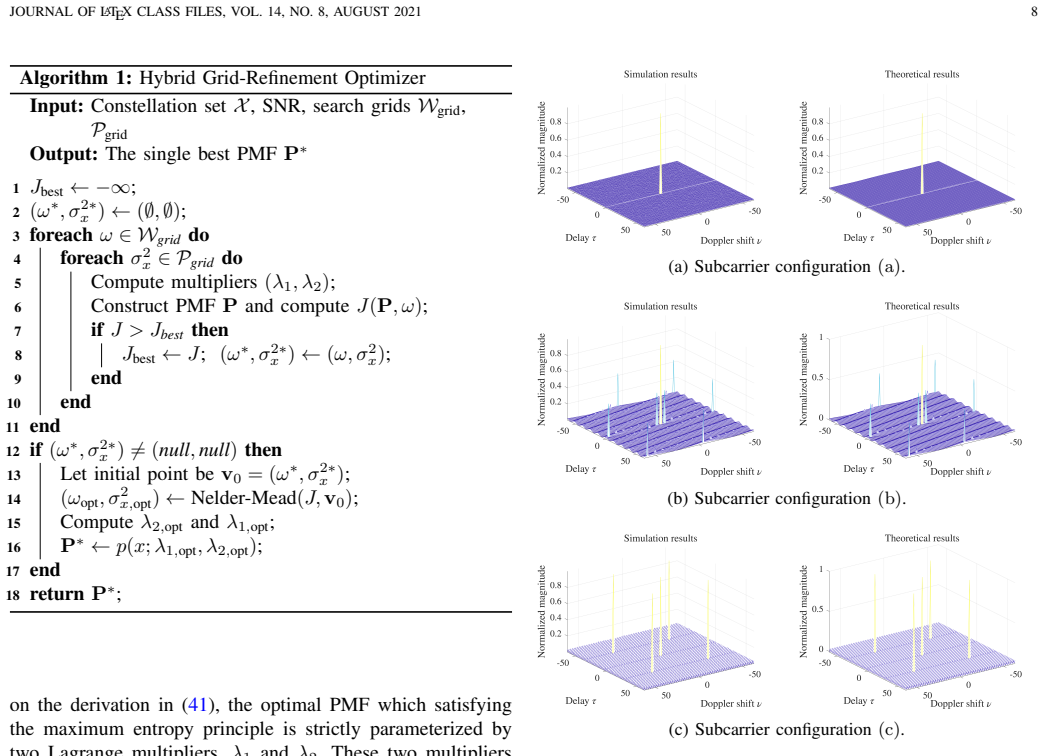
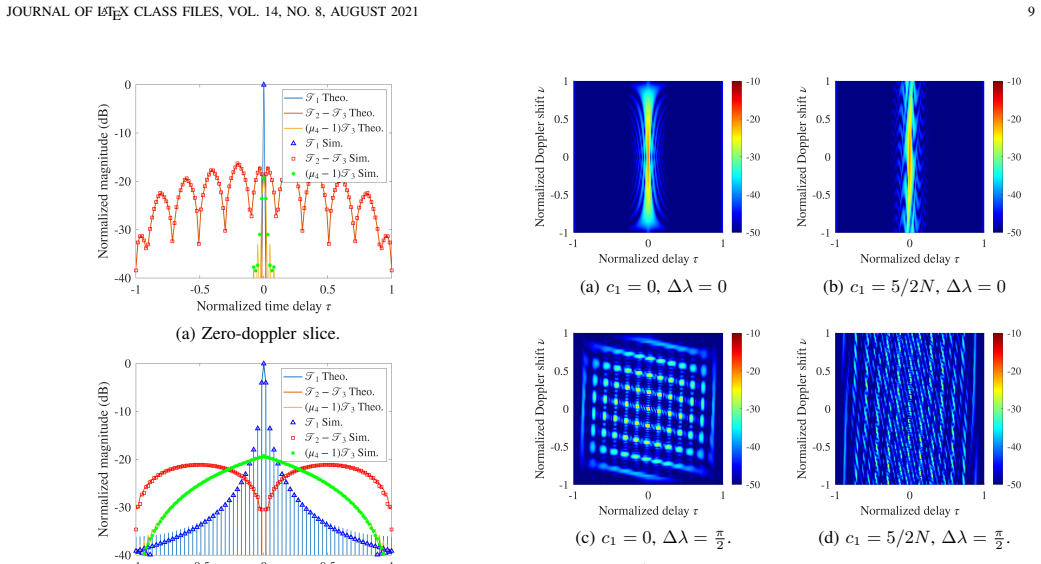
Discrete affine Fourier transform spread affine frequency division multiplexing (DAFT-s-AFDM) is a promising waveform for integrated sensing and communication (ISAC) due to its low peak-to-average power ratio, robustness to Doppler shifts, and reduced multiuser interference in the uplink transmission. This paper presents a comprehensive ambiguity function (AF) analysis of DAFT-s-AFDM and derives the closed-form expression for the AF magnitude expectation. Several key insights into the impact of DAFT-s-AFDM parameters on ISAC performance are revealed, thus providing concrete guidance for the subsequent waveform design. Building on these insights, a novel probabilistic constellation shaping (PCS) framework is proposed for ISAC waveform enhancement, where the communication throughput and the sensing AF characteristics are jointly optimized by addressing a multi-objective problem. An efficient algorithm based on a closed-form bit error rate expression is developed to obtain the Pareto-optimal solutions. Extensive simulations validate the theoretical results and that the proposed PCS-enhanced DAFT-s-AFDM can significantly outperform the classical counterparts, achieving a superior and highly controllable tradeoff between the dual-functional performances.
Editorial analysis
A structured set of objections, weighed in public.
Referee Report
Summary. The manuscript analyzes the ambiguity function (AF) of discrete affine Fourier transform spread affine frequency division multiplexing (DAFT-s-AFDM) for integrated sensing and communication (ISAC), derives a closed-form expression for the AF magnitude expectation, extracts parameter insights for ISAC performance, and proposes a probabilistic constellation shaping (PCS) framework. This framework solves a multi-objective optimization problem using a closed-form bit error rate (BER) expression to locate Pareto-optimal points that balance communication throughput against sensing AF characteristics, with simulations claiming superior and controllable dual-functional tradeoffs over classical waveforms.
Significance. If the closed-form AF expectation and BER expressions are accurate and the PCS optimization translates to realized performance, the work supplies concrete design guidelines for Doppler-robust, low-PAPR ISAC waveforms with reduced multiuser interference. The explicit closed-form derivations and simulation validation of the Pareto frontier constitute a strength that could inform practical waveform selection in high-mobility scenarios.
major comments (2)
- [Waveform design / multi-objective optimization section (around the closed-form BER and Pareto solver)] The central optimization in the PCS framework relies on a closed-form BER expression to identify Pareto-optimal solutions. This expression must be shown to incorporate DAFT-s-AFDM-specific effects (affine Fourier spreading, residual affine-frequency interference, and reduced MUI) when symbol probabilities become non-uniform under PCS; otherwise the claimed controllable tradeoff cannot be guaranteed. The manuscript should explicitly state the assumptions (e.g., perfect channel estimation, uniform vs. shaped constellations) used in the BER derivation and verify them against the full DAFT-s-AFDM signal model.
- [Ambiguity function analysis section (closed-form AF magnitude expectation)] The AF magnitude expectation derivation is presented as closed-form and used to guide parameter selection. It is unclear whether the expectation accounts for the statistical properties introduced by PCS (non-uniform symbol amplitudes) or whether it remains valid only under uniform constellations. A direct comparison or extension of the AF expression under PCS is needed to support the subsequent claim that PCS-enhanced DAFT-s-AFDM achieves a superior ISAC tradeoff.
minor comments (2)
- [Simulation results section] Simulation parameters (e.g., number of Monte Carlo trials, exact Doppler ranges, MUI levels, and error-bar reporting) should be stated more explicitly so that the reported performance gains can be reproduced.
- [System model / PCS framework] Notation for the DAFT spreading matrix and the PCS probability distribution should be introduced consistently before their first use in the optimization formulation.
Simulated Author's Rebuttal
We thank the referee for the constructive and detailed comments. We have carefully reviewed the concerns regarding the closed-form expressions in the PCS framework and AF analysis. Below we address each major comment point by point, indicating the revisions we will make to strengthen the manuscript.
read point-by-point responses
-
Referee: The central optimization in the PCS framework relies on a closed-form BER expression to identify Pareto-optimal solutions. This expression must be shown to incorporate DAFT-s-AFDM-specific effects (affine Fourier spreading, residual affine-frequency interference, and reduced MUI) when symbol probabilities become non-uniform under PCS; otherwise the claimed controllable tradeoff cannot be guaranteed. The manuscript should explicitly state the assumptions (e.g., perfect channel estimation, uniform vs. shaped constellations) used in the BER derivation and verify them against the full DAFT-s-AFDM signal model.
Authors: We agree that the current closed-form BER expression was derived under the assumption of uniform symbol probabilities and requires extension to fully capture non-uniform probabilities under PCS along with DAFT-s-AFDM-specific effects such as affine Fourier spreading and residual interference. In the revised manuscript we will provide an updated BER derivation that incorporates these effects, explicitly list all assumptions including perfect channel estimation and shaped constellations, and add a verification step comparing the expression to the complete DAFT-s-AFDM signal model. This will ensure the Pareto-optimal solutions remain valid for the proposed PCS-enhanced waveform. revision: yes
-
Referee: The AF magnitude expectation derivation is presented as closed-form and used to guide parameter selection. It is unclear whether the expectation accounts for the statistical properties introduced by PCS (non-uniform symbol amplitudes) or whether it remains valid only under uniform constellations. A direct comparison or extension of the AF expression under PCS is needed to support the subsequent claim that PCS-enhanced DAFT-s-AFDM achieves a superior ISAC tradeoff.
Authors: The original closed-form AF magnitude expectation was obtained assuming equiprobable symbols. To address the concern, the revised manuscript will include an explicit extension of the AF analysis for non-uniform symbol probabilities under PCS. We will derive the adjusted expectation, provide a direct comparison of AF characteristics between uniform and shaped cases, and demonstrate that the key parameter insights and the claimed superior ISAC tradeoff continue to hold (or are appropriately adjusted) when PCS is applied. revision: yes
Circularity Check
No significant circularity; derivations are self-contained
full rationale
The paper derives a closed-form expression for the AF magnitude expectation directly from the DAFT-s-AFDM waveform model and uses it to extract parameter insights. It then introduces a PCS framework whose multi-objective optimization is solved via a separate closed-form BER expression developed for the same model. These steps constitute independent analytical content rather than re-labeling of fitted inputs or self-referential definitions. Simulations are invoked to validate the theoretical expressions, confirming that the central tradeoff claims rest on model-derived formulas rather than tautological reductions. No load-bearing self-citation chains or ansatz smuggling are present in the provided derivation outline.
Axiom & Free-Parameter Ledger
Reference graph
Works this paper leans on
-
[1]
Integrated sensing and communications: Toward dual- functional wireless networks for 5G and beyond,
F. Liu et al. , “Integrated sensing and communications: Toward dual- functional wireless networks for 5G and beyond,” IEEE J. Sel. Areas Commun., vol. 40, no. 6, pp. 1728–1767, Jun. 2022. velocity(m/s) 0 20 40 60 80 100 Magnitude (dB) -20 -15 -10 -5 0 Sens.-centric Balanced Commun.-centric 3.1dB (a) (b) Fig. 10. Illustration of (a) MUSIC Spectrum at SNR =...
work page 2022
-
[2]
Z. Sui, Q. Luo, Z. Liu, M. Temiz, L. Musavian, C. Masouros, Y . L. Guan, P . Xiao, and L. Hanzo, “Multi-functional chirp signalling for next-generation multi-carrier wireless networks: Communications, sensing and ISAC perspectives,” Aug. 2025. [Online]. Available: https://arxiv.org/abs/2508.06022
-
[3]
Cross-domain dual-functional OFDM waveform design for accurate sensing/positioning,
F. Zhang et al., “Cross-domain dual-functional OFDM waveform design for accurate sensing/positioning,” IEEE J. Sel. Areas Commun. , vol. 42, no. 9, pp. 2259–2274, Sept. 2024
work page 2024
-
[4]
CP-OFDM achieves the lowest average ranging sidelobe under QAM/PSK constellations,
F. Liu et al. , “CP-OFDM achieves the lowest average ranging sidelobe under QAM/PSK constellations,” IEEE Trans. Inf. Theory, vol. 71, no. 9, pp. 6950–6967, 2025
work page 2025
-
[5]
Reshaping the ISAC tradeoff under OFDM signaling: A probabilistic constellation shaping approach,
Z. Du et al. , “Reshaping the ISAC tradeoff under OFDM signaling: A probabilistic constellation shaping approach,” IEEE Trans. Signal Process., vol. 72, pp. 4782–4797, Sept. 2024
work page 2024
-
[6]
A tutorial on terahertz-band localization for 5G communication systems,
H. Chen, H. Sarieddeen, T. Ballal, H. Wymeersch, M.-S. Alouini, and T. Y . Al-Naffouri, “A tutorial on terahertz-band localization for 5G communication systems,” IEEE Commun. Surv. Tutorials , vol. 24, no. 3, pp. 1780–1815, Thirdquarter 2022
work page 2022
-
[7]
Affine frequency division multiplexing for next generation wireless communications,
A. Bemani, N. Ksairi, and M. Kountouris, “Affine frequency division multiplexing for next generation wireless communications,” IEEE Trans. Wireless Commun., vol. 22, no. 11, pp. 8214–8229, Nov. 2023
work page 2023
-
[8]
MIMO-AFDM outperforms MIMO-OFDM in the face of hardware impairments,
Z. Sui et al. , “MIMO-AFDM outperforms MIMO-OFDM in the face of hardware impairments,” 2026. [Online]. Available: https: //arxiv.org/abs/2601.00502
-
[9]
Generalized spatial modulation aided affine frequency division multiplexing,
——, “Generalized spatial modulation aided affine frequency division multiplexing,” IEEE Trans. Wireless Commun. , vol. 25, pp. 4658–4673, 2026
work page 2026
-
[10]
Q. Yi, Z. Liu, L. Musavian, and Z. Sui, “Non-orthogonal affine JOURNAL OF LATEX CLASS FILES, VOL. 14, NO. 8, AUGUST 2021 13 frequency division multiplexing for spectrally efficient high-mobility communications,” 2026. [Online]. Available: https://arxiv.org/abs/2508. 09782
work page 2021
-
[11]
An integrated sensing and communications system based on affine frequency division multiplexing,
Y . Niet al., “An integrated sensing and communications system based on affine frequency division multiplexing,” IEEE Trans. Wireless Commun., vol. 24, no. 5, pp. 3763–3779, 2025
work page 2025
-
[12]
Ambiguity function analysis of AFDM signals for integrated sensing and communications,
H. Yin et al. , “Ambiguity function analysis of AFDM signals for integrated sensing and communications,” IEEE J. Sel. Areas Commun. , Early Access, 2025
work page 2025
-
[13]
Ambiguity function analysis of AFDM under pulse-shaped random ISAC signaling,
Y . Ni, F. Liu, H. Yin, Y . Tang, and Z. Wang, “Ambiguity function analysis of AFDM under pulse-shaped random ISAC signaling,” Nov
-
[14]
Available: https://arxiv.org/abs/2511.04200
[Online]. Available: https://arxiv.org/abs/2511.04200
-
[15]
Integrated sensing and communications with affine frequency division multiplexing,
A. Bemani, N. Ksairi, and M. Kountouris, “Integrated sensing and communications with affine frequency division multiplexing,” IEEE Wireless Commun. Lett. , vol. 13, no. 5, pp. 1255–1259, 2024
work page 2024
-
[16]
AFDM-enabled integrated sensing and communication: Theoretical framework and pilot design,
F. Zhang, Z. Wang, T. Mao, T. Jiao, Y . Zhuo, M. Wen, W. Xiang, S. Chen, and G. K. Karagiannidis, “AFDM-enabled integrated sensing and communication: Theoretical framework and pilot design,” IEEE J. Sel. Areas Commun. , Early Access, 2025
work page 2025
-
[17]
Y . Tao, M. Wen, Y . Ge, T. Mao, Y . Tang, and A. Doosti-Aref, “Affine frequency division multiple access based on DAFT spreading for next- generation wireless networks,” IEEE Trans. Wireless Commun. , Early Access, 2025
work page 2025
-
[18]
Supporting probabilistic constellation shaping in 5G-NR evolution,
S. Hu, H. Wang, and S. Semenov, “Supporting probabilistic constellation shaping in 5G-NR evolution,” IEEE Trans. Wireless Commun. , vol. 23, no. 4, pp. 3586–3599, Apr. 2024
work page 2024
-
[19]
Probabilistic constellation shaping for optical fiber communications,
J. Cho and P . J. Winzer, “Probabilistic constellation shaping for optical fiber communications,” J. Lightwave Technol. , vol. 37, no. 6, pp. 1590– 1607, Mar. 2019
work page 2019
-
[20]
Constel- lation design for integrated sensing and communication with random waveforms,
X. Y ang, R. Zhang, D. Zhai, F. Liu, R. Du, and T. X. Han, “Constel- lation design for integrated sensing and communication with random waveforms,”IEEE Trans. Wireless Commun., vol. 23, no. 11, pp. 17 415– 17 428, Nov. 2024
work page 2024
-
[21]
Learning- based constellation design for uplink bi-static integrated sensing and communication,
J. Hu, K. Han, L. Jiang, K. Meng, F. Liu, and C. Masouros, “Learning- based constellation design for uplink bi-static integrated sensing and communication,” IEEE Trans. V eh. Technol., vol. 74, no. 8, pp. 13 219– 13 224, 2025
work page 2025
-
[22]
Probabilistic constellation shaping for ofdm isac signals under temporal-frequency filtering,
Z. Du, J. Xu, Y . Xiong, J. Wang, M. Furkan Keskin, H. Wymeersch, F. Liu, and S. Jin, “Probabilistic constellation shaping for ofdm isac signals under temporal-frequency filtering,” IEEE Trans. Wireless Com- mun., vol. 25, pp. 12 914–12 929, 2026
work page 2026
-
[23]
On the fundamental tradeoff of integrated sensing and communications under Gaussian channels,
Y . Xiong, F. Liu, Y . Cui, W. Y uan, T. X. Han, and G. Caire, “On the fundamental tradeoff of integrated sensing and communications under Gaussian channels,” IEEE Trans. Inf. Theory , vol. 69, no. 9, pp. 5723– 5751, 2023
work page 2023
-
[24]
Sensing with communication signals: From information theory to signal processing,
F. Liu, Y .-F. Liu, Y . Cui, C. Masouros, J. Xu, T. X. Han, S. Buzzi, Y . C. Eldar, and S. Jin, “Sensing with communication signals: From information theory to signal processing,” IEEE J. Sel. Areas Commun. , Early Access, 2025
work page 2025
-
[25]
Constant composition distribution match- ing,
P . Schulte and G. Bocherer, “Constant composition distribution match- ing,” IEEE Trans. Inf. Theory , vol. 62, no. 1, pp. 430–434, Jan. 2016
work page 2016
-
[26]
Time-domain zero-padding (TZP) AFDM with two-stage iterative MMSE detection,
C. Shen, J. Y uan, and J. Tong, “Time-domain zero-padding (TZP) AFDM with two-stage iterative MMSE detection,” IEEE Trans. Wireless Commun., vol. 25, pp. 6255–6269, 2026
work page 2026
-
[27]
Error Rate Analysis and Low-Complexity Receiver Design for Zero-Padded AFDM
Q. Yi, Z. Sui, and Z. Liu, “Error rate analysis and low-complexity receiver design for zero-padded AFDM,” 2025. [Online]. Available: https://arxiv.org/abs/2510.14507
work page internal anchor Pith review Pith/arXiv arXiv 2025
-
[28]
S. Cui et al. , “Detailed proofs for the manuscript DAFT-s-AFDM enabled ISAC systems: Ambiguity function analysis and waveform design,” Apr. 2026. [Online]. Available: https://doi.org/10.13140/RG.2. 2.30548.97929
-
[29]
F. Liu, Y . Xiong, S. Lu, S. Li, W. Y uan, C. Masouros, S. Jin, and G. Caire, “Uncovering the iceberg in the sea: Fundamentals of pulse shaping and modulation design for random ISAC signals,” IEEE Trans. Signal Process. , vol. 73, pp. 2511–2526, Jun. 2025
work page 2025
-
[30]
Convergence properties of the nelder–mead simplex method in low dimensions,
J. C. Lagarias, J. A. Reeds, M. H. Wright, and P . E. Wright, “Convergence properties of the nelder–mead simplex method in low dimensions,” SIAM J. Optim. , vol. 9, no. 1, pp. 112–147, 1998. [Online]. Available: https://doi.org/10.1137/S1052623496303470
-
[31]
On discrete ambiguity functions of random communication waveforms,
Y . Zhang, F. Liu, Y . Xiong, W. Y uan, S. Li, L. Zheng, T. X. Han, C. Masouros, and S. Jin, “On discrete ambiguity functions of random communication waveforms,” Dec. 2025. [Online]. Available: https://arxiv.org/abs/2512.08352
-
[32]
Through-the-Wall Sensing of Personnel Using Passive Bistatic WiFi Radar at Standoff Distances,
K. Chetty, G. E. Smith, and K. Woodbridge, “Through-the-Wall Sensing of Personnel Using Passive Bistatic WiFi Radar at Standoff Distances,” IEEE Trans. Geosci. Remote Sens. , vol. 50, no. 4, pp. 1218–1226, Apr. 2012
work page 2012
-
[33]
Triangular FM- OFDM waveform design for integrated sensing and communication,
Y . Wang, Z. Wei, W. Zhou, K. Han, and Z. Feng, “Triangular FM- OFDM waveform design for integrated sensing and communication,” in 2022 IEEE International Conference on Communications Workshops (ICC Workshops), May 2022, pp. 515–519
work page 2022
-
[34]
Analysis of CFAR processors in nonhomoge- neous background,
P . Gandhi and S. Kassam, “Analysis of CFAR processors in nonhomoge- neous background,” IEEE Trans. Aerosp. Electron. Syst. , vol. 24, no. 4, pp. 427–445, 1988
work page 1988
-
[35]
An overview of signal processing techniques for joint communication and radar sensing,
J. A. Zhang, F. Liu, C. Masouros, R. W. Heath, Z. Feng, L. Zheng, and A. Petropulu, “An overview of signal processing techniques for joint communication and radar sensing,” IEEE J. Sel. Top. Signal Process. , vol. 15, no. 6, pp. 1295–1315, 2021
work page 2021
-
[36]
Integrating low- complexity and flexible sensing into communication systems,
K. Wu, J. A. Zhang, X. Huang, and Y . J. Guo, “Integrating low- complexity and flexible sensing into communication systems,” IEEE J. Sel. Areas Commun. , vol. 40, no. 6, pp. 1873–1889, 2022
work page 2022
discussion (0)
Sign in with ORCID, Apple, or X to comment. Anyone can read and Pith papers without signing in.