Error Rate Analysis and Low-Complexity Receiver Design for Zero-Padded AFDM
Pith reviewed 2026-05-18 06:29 UTC · model grok-4.3
The pith
Zero-padded AFDM enables low-complexity detectors with no loss in bit error rate performance compared to full-matrix MMSE.
A machine-rendered reading of the paper's core claim, the machinery that carries it, and where it could break.
Core claim
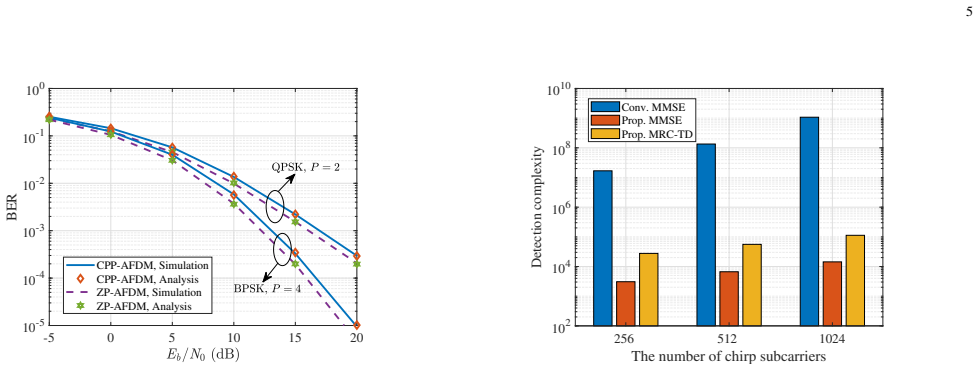
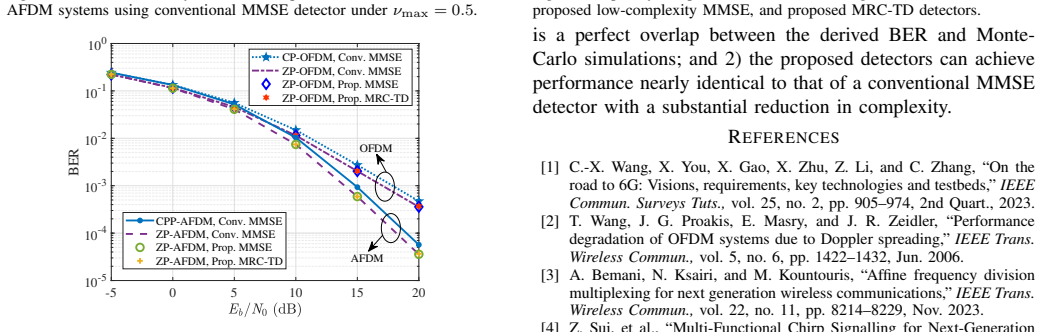
By exploiting the unique ZP-aided lower triangular structure of the time domain channel matrix, a novel low-complexity MMSE detector and a maximum ratio combining-based TD detector are proposed for ZP-AFDM systems. The theoretical bit error rate performance of both the MMSE and maximum likelihood detectors is analyzed. The proposed detectors achieve identical BER performance to the conventional MMSE detector based on matrix inversion while enjoying significantly reduced complexity.
What carries the argument
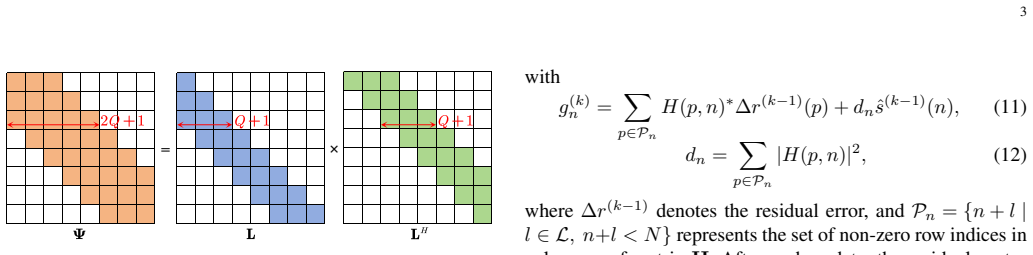
The ZP-aided lower triangular structure of the time domain channel matrix, which permits efficient sequential computation for detection instead of full matrix inversion.
If this is right
- Proposed MMSE detector reduces complexity by avoiding direct matrix inversion using the triangular form.
- MRC-TD detector provides an alternative with even lower complexity based on combining in time domain.
- Theoretical BER analysis allows performance evaluation without relying solely on simulations.
- Identical performance means no trade-off between complexity and reliability in ZP-AFDM reception.
Where Pith is reading between the lines
- This triangular exploitation could be generalized to other multicarrier schemes that use zero-padding for channel estimation or interference avoidance.
- Lower complexity receivers may support higher data rates or lower power consumption in mobile high-mobility applications.
- Further work could investigate how these detectors perform when combined with channel estimation errors or in MIMO configurations.
Load-bearing premise
The zero-padding creates a strictly lower-triangular time-domain channel matrix that allows low-complexity detection without any loss in accuracy compared to full inversion.
What would settle it
A simulation result where the bit error rate of the proposed low-complexity detectors exceeds that of the conventional MMSE detector under identical conditions would disprove the no-performance-penalty claim.
Figures


read the original abstract
This paper studies the error rate performance and low-complexity receiver design for zero-padded affine frequency division multiplexing (ZP-AFDM) systems. By exploiting the unique ZP-aided lower triangular structure of the time domain (TD) channel matrix, we propose a novel low-complexity minimum mean square error (MMSE) detector and a maximum ratio combining-based TD (MRC-TD) detector. Furthermore, the theoretical bit error rate (BER) performance of both the MMSE and maximum likelihood detectors is analyzed. Simulation results demonstrate that the proposed detectors can achieve identical BER performance to that of the conventional MMSE detector based on matrix inversion while enjoying significantly reduced complexity.
Editorial analysis
A structured set of objections, weighed in public.
Referee Report
Summary. The manuscript studies error rate performance and low-complexity receiver design for zero-padded affine frequency division multiplexing (ZP-AFDM). It exploits the ZP-aided lower-triangular structure of the time-domain channel matrix to propose a novel low-complexity MMSE detector and an MRC-TD detector, derives theoretical BER expressions for the MMSE and ML detectors, and presents simulations claiming identical BER to conventional matrix-inversion MMSE with substantially reduced complexity.
Significance. If the proposed detectors achieve exact algebraic equivalence to full-matrix MMSE (i.e., identical output to solving (H^H H + N0 I) ŝ = H^H y) without performance loss, the work would provide practical value for complexity reduction in AFDM systems suited to high-mobility channels. The theoretical BER analysis is a positive addition, but the load-bearing claim of zero performance penalty rests on the triangular structure being exploitable for exact MMSE rather than an approximation or successive-cancellation variant.
major comments (2)
- [§III] §III (detector derivation): even if the ZP-aided TD channel matrix H is strictly lower triangular, the Gram matrix H^H H remains dense Hermitian in general. The manuscript must explicitly demonstrate (via equations or proof) that the proposed recursive/substitution method yields the exact MMSE solution without dropping cross terms or using diagonal approximations for the noise covariance; otherwise the asserted BER identity in simulations cannot hold.
- [Simulation results] Simulation section (results and parameters): the claim of 'identical BER' requires reporting of exact simulation parameters (SNR range, channel model, number of Monte Carlo runs, error-bar details) and confirmation that the low-complexity MMSE matches the full-inversion reference to machine precision rather than within visual tolerance; without this, post-hoc parameter choices cannot be ruled out.
minor comments (2)
- [§IV] Clarify the notation for the MRC-TD detector combining weights and how they differ from standard MRC in the presence of the triangular structure.
- Add a complexity table (e.g., Table X) comparing floating-point operations of the proposed detectors versus conventional MMSE for varying N and L to make the 'significantly reduced complexity' claim quantitative.
Simulated Author's Rebuttal
We thank the referee for the constructive and detailed comments on our manuscript. We address each major comment below and indicate the specific revisions we will incorporate in the next version to strengthen the presentation of the detector derivation and simulation results.
read point-by-point responses
-
Referee: [§III] §III (detector derivation): even if the ZP-aided TD channel matrix H is strictly lower triangular, the Gram matrix H^H H remains dense Hermitian in general. The manuscript must explicitly demonstrate (via equations or proof) that the proposed recursive/substitution method yields the exact MMSE solution without dropping cross terms or using diagonal approximations for the noise covariance; otherwise the asserted BER identity in simulations cannot hold.
Authors: We appreciate the referee highlighting the need for explicit algebraic verification. In Section III, the low-complexity MMSE detector is derived by exploiting the strictly lower-triangular structure of the ZP-aided time-domain channel matrix H to enable a recursive forward-substitution procedure that solves the normal equations (H^H H + N0 I) ŝ = H^H y exactly. No cross terms are dropped and the noise covariance remains the original scalar N0 I; the recursion simply reorders the arithmetic operations to avoid explicit matrix inversion while preserving equivalence. In the revised manuscript we will insert a short lemma (with supporting equations) immediately after the detector derivation that proves this algebraic equivalence by induction on the triangular structure, confirming that the output ŝ is identical to the conventional solution. revision: yes
-
Referee: [Simulation results] Simulation section (results and parameters): the claim of 'identical BER' requires reporting of exact simulation parameters (SNR range, channel model, number of Monte Carlo runs, error-bar details) and confirmation that the low-complexity MMSE matches the full-inversion reference to machine precision rather than within visual tolerance; without this, post-hoc parameter choices cannot be ruled out.
Authors: We agree that reproducibility and numerical verification details are essential. In the revised simulation section we will explicitly list: SNR range (0–30 dB in 1 dB steps), channel model (L-path time-varying channel with maximum Doppler shift corresponding to the high-mobility scenario), number of Monte Carlo realizations (10^6 per SNR point), and error-bar computation method. We will also add a new paragraph stating that, for every simulated frame, the Euclidean distance between the symbol vectors produced by the low-complexity recursive MMSE and the full matrix-inversion MMSE was verified to be on the order of 10^{-15} or smaller (machine precision), thereby confirming exact numerical agreement rather than visual overlap of BER curves. revision: yes
Circularity Check
No circularity detected; derivation relies on explicit triangular structure and standard MMSE algebra without self-referential reduction.
full rationale
The paper's core claim rests on exploiting the ZP-induced lower-triangular TD channel matrix to derive low-complexity MMSE and MRC-TD detectors whose BER matches full-matrix inversion. This is presented as a direct consequence of the matrix structure and conventional detection theory rather than any fitted parameter, self-citation chain, or ansatz that is redefined as output. No equations reduce a reported performance result to a quantity defined by the same result; the identity of BER performance is asserted via algebraic equivalence under the stated structure, which is externally verifiable from the channel model. The analysis therefore remains self-contained against external benchmarks.
Axiom & Free-Parameter Ledger
axioms (1)
- domain assumption Zero-padding produces a lower-triangular time-domain channel matrix that can be exploited for low-complexity detection.
Lean theorems connected to this paper
-
IndisputableMonolith/Cost/FunctionalEquation.leanwashburn_uniqueness_aczel unclear?
unclearRelation between the paper passage and the cited Recognition theorem.
By exploiting the unique ZP-aided lower triangular structure of the time domain (TD) channel matrix, we propose a novel low-complexity minimum mean square error (MMSE) detector ... Ψ = H^H H + 1/γ_s I_N ... Cholesky decomposition ... forward and backward substitution
-
IndisputableMonolith/Foundation/AbsoluteFloorClosure.leanabsolute_floor_iff_bare_distinguishability unclear?
unclearRelation between the paper passage and the cited Recognition theorem.
the TD channel matrix can be given as H = sum hi Δ_νi Π_li ... exhibits a lower-triangular structure with a bandwidth of Q+1
What do these tags mean?
- matches
- The paper's claim is directly supported by a theorem in the formal canon.
- supports
- The theorem supports part of the paper's argument, but the paper may add assumptions or extra steps.
- extends
- The paper goes beyond the formal theorem; the theorem is a base layer rather than the whole result.
- uses
- The paper appears to rely on the theorem as machinery.
- contradicts
- The paper's claim conflicts with a theorem or certificate in the canon.
- unclear
- Pith found a possible connection, but the passage is too broad, indirect, or ambiguous to say the theorem truly supports the claim.
Forward citations
Cited by 1 Pith paper
-
DAFT-s-AFDM Enabled ISAC Systems: Ambiguity Function Analysis and Waveform Design
DAFT-s-AFDM with probabilistic constellation shaping achieves a superior controllable tradeoff between communication and sensing ambiguity function performance in ISAC systems.
Reference graph
Works this paper leans on
-
[1]
On the road to 6G: Visions, requirements, key technologies and testbeds,
C.-X. Wang, X. You, X. Gao, X. Zhu, Z. Li, and C. Zhang, “On the road to 6G: Visions, requirements, key technologies and testbeds,”IEEE Commun. Surveys Tuts.,vol. 25, no. 2, pp. 905–974, 2nd Quart., 2023
work page 2023
-
[2]
Performance degradation of OFDM systems due to Doppler spreading,
T. Wang, J. G. Proakis, E. Masry, and J. R. Zeidler, “Performance degradation of OFDM systems due to Doppler spreading,”IEEE Trans. Wireless Commun.,vol. 5, no. 6, pp. 1422–1432, Jun. 2006
work page 2006
-
[3]
Affine frequency division multiplexing for next generation wireless communications,
A. Bemani, N. Ksairi, and M. Kountouris, “Affine frequency division multiplexing for next generation wireless communications,”IEEE Trans. Wireless Commun.,vol. 22, no. 11, pp. 8214–8229, Nov. 2023
work page 2023
-
[4]
Z. Sui, et al., “Multi-Functional Chirp Signalling for Next-Generation Multi-Carrier Wireless Networks: Communications, Sensing and ISAC Perspectives,” 2025, [online]: https://arxiv.org/abs/2508.06022
-
[5]
Chirp parameter selection for affine frequency division multiplexing with MMSE equalization,
Z. Li, C. Zhang, G. Song, X. Fang, X. Sha, and D. Slock, “Chirp parameter selection for affine frequency division multiplexing with MMSE equalization,”IEEE Trans. Commun.,vol. 73, no. 7, pp. 5079– 5093, Jul. 2025
work page 2025
-
[6]
Non-orthogonal AFDM: A promising spectrum-efficient waveform for 6G high-mobility communications,
Y . Zhang, Q. Yi, L. Musavian, T. Xu, and Z. Liu, “Non-orthogonal AFDM: A promising spectrum-efficient waveform for 6G high-mobility communications,” 2025, [online]: https://arxiv.org/abs/2507.17292
-
[7]
Q. Yi, Z. Liu, L. Musavian, and Z. Sui, “Non-orthogonal affine frequency division multiplexing for spectrally efficient high-mobility communica- tions,” 2025, [online]: https://arxiv.org/abs/2508.09782
-
[8]
An integrated sensing and communications system based on affine frequency division multiplexing,
Y . Ni, P. Yuan, Q. Huang, F. Liu, and Z. Wang, “An integrated sensing and communications system based on affine frequency division multiplexing,”IEEE Trans. Wireless Commun.,vol. 24, no. 5, pp. 3763– 3779, May 2025
work page 2025
-
[9]
AFDM-SCMA: A promising waveform for massive connectivity over high mobility channels,
Q. Luo, P. Xiao, Z. Liu, Z. Wan, N. Thomos, Z. Gao, and Z. He, “AFDM-SCMA: A promising waveform for massive connectivity over high mobility channels,”IEEE Trans. Wireless Commun.,vol. 23, no. 10, pp. 14421–14436, Oct. 2024
work page 2024
-
[10]
Design and performance analysis of index modulation empowered AFDM system,
J. Zhu, Q. Luo, G. Chen, P. Xiao, and L. Xiao, “Design and performance analysis of index modulation empowered AFDM system,”IEEE Wireless Commun. Lett.,vol. 13, no. 3, pp. 686–690, Mar. 2024
work page 2024
-
[11]
Generalized spatial modulation aided affine frequency division multiplexing,
Z. Sui, Z. Liu, L. Musavian, L.L. Yang, and L. Hanzo, “Generalized spatial modulation aided affine frequency division multiplexing,”IEEE Trans. Wireless Commun.,Early Access, 2025
work page 2025
-
[12]
Cyclic prefixing or zero padding for wireless multicarrier transmis- sions,
B. Muquet, Z. Wang, G. Giannakis, M. de Courville, and P. Duhamel, “Cyclic prefixing or zero padding for wireless multicarrier transmis- sions,”IEEE Trans. Commun.,vol. 50, no. 12, pp. 2136–2148, Dec. 2002
work page 2002
-
[13]
A novel equalization scheme for ZP- OFDM system over deep fading channels,
J. Wang, J. Song, and L. Yang, “A novel equalization scheme for ZP- OFDM system over deep fading channels,”IEEE Trans. Broadcast.,vol. 56, no. 2, pp. 249–252, Jun. 2010
work page 2010
-
[14]
On the performance analysis of zero-padding OFDM for monostatic ISAC systems,
R. Bomfin and M. Chafii, “On the performance analysis of zero-padding OFDM for monostatic ISAC systems,”IEEE Trans. Commun.,vol. 73, no. 3, pp. 2103–2117, Mar. 2025
work page 2025
-
[15]
G. H. Golub and C. F. Van Loan,Matrix Computations,3rd ed. Johns Hopkins Univ. Press, 1996
work page 1996
-
[16]
Goldsmith, Wireless communications.Cambridge university press, 2005
A. Goldsmith, Wireless communications.Cambridge university press, 2005
work page 2005
discussion (0)
Sign in with ORCID, Apple, or X to comment. Anyone can read and Pith papers without signing in.