A Novel Stochastic Particle-Field Algorithm for a Reaction-Diffusion-Advection Cancer Invasion Model
Pith reviewed 2026-06-30 17:57 UTC · model grok-4.3
The pith
A stochastic particle-field algorithm solves a three-dimensional cancer invasion model while preserving positivity and bounded mass.
A machine-rendered reading of the paper's core claim, the machinery that carries it, and where it could break.
Core claim
The authors present a stochastic particle-field algorithm for a biological reaction-diffusion-advection system of cancer growth in three dimensions. Empirical particle measures represent cell density, and concentration fields of chemical species are constructed dynamically on a grid. The Particle-in-Cell algorithm handles particle-grid interactions, while a spectral method solves diffusion. The rate of particle mass change is bounded over finite time, positivity is preserved unconditionally, and error analysis with numerical confirmation of convergence rates is given. This enables the first 3D computations showing rapid haptotactic cell spread.
What carries the argument
Empirical particle measures of variable mass that represent cell density and interact with grid-based concentration fields via the Particle-in-Cell algorithm.
If this is right
- The method extends previous two-dimensional simulations to three dimensions.
- Positivity of cell density and grid concentrations is guaranteed by construction.
- Particle mass remains bounded, supporting long-time stability.
- Convergence rates are proven and verified numerically.
- Rapid cell spread driven by haptotaxis is observed in 3D as in 2D.
Where Pith is reading between the lines
- Similar particle methods could apply to other advection-dominated biological models.
- The 3D results suggest that dimensionality does not alter the dominance of haptotactic invasion.
- Variable mass allows efficient representation of density variations without excessive particle numbers.
Load-bearing premise
The empirical particle measures with variable mass represent the cell density evolution accurately without introducing discretization artifacts that invalidate positivity or bounded-mass properties.
What would settle it
A numerical experiment demonstrating either negative cell densities or unbounded particle mass growth within a finite time interval would falsify the preservation claims.
Figures


read the original abstract
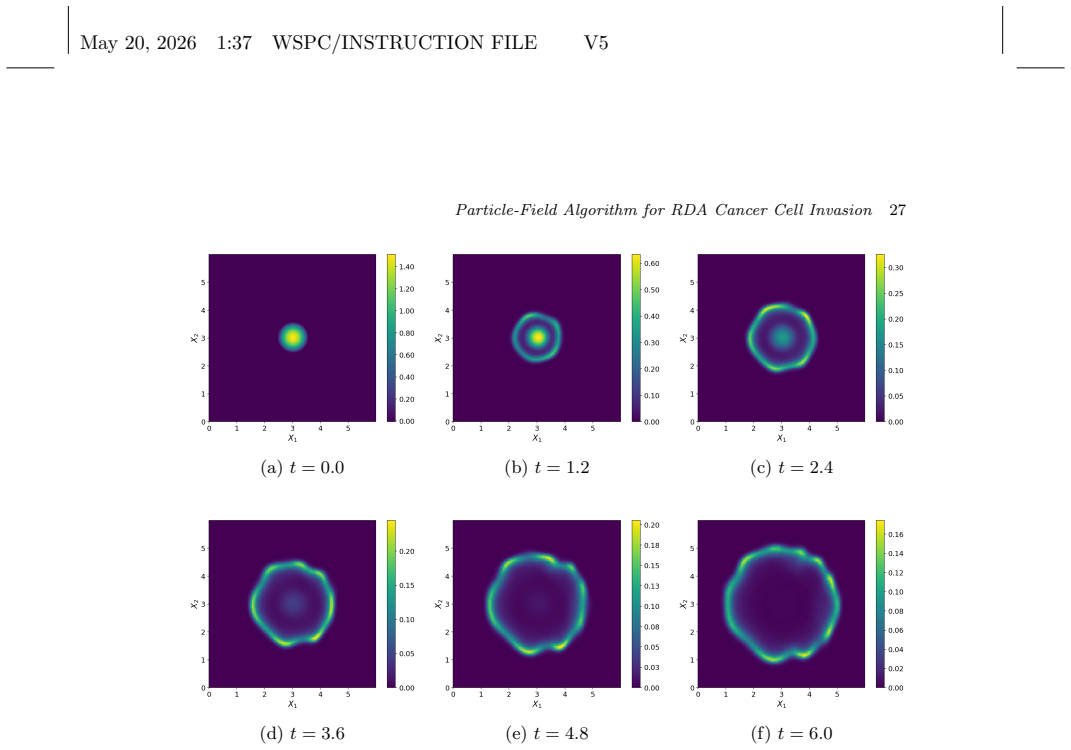
In this paper, we present a novel numerical framework for solving a specific biological reaction-diffusion-advection system of cancer growth in three dimensions (3D) using particles of variable mass. We adopt empirical particle measures to represent cell density and dynamically construct the concentration fields of multiple related chemical species throughout the 3D domain. Efficient interaction between the particles and the spatial grid is achieved through a Particle-in-Cell (PIC) algorithm, while diffusion in space is solved rapidly using a spectral method. We demonstrate that for this particular system, the rate of change of particle mass remains bounded over finite time intervals. Furthermore, in addition to the inherent positivity preservation of cell density guaranteed by the empirical particle measures, the concentrations constructed by the algorithm are also unconditionally positivity-preserving on the spatial grid. Moreover, we present a rigorous error analysis for the proposed method, and numerical experiments confirm the theoretical convergence rates. To the best of our knowledge, this is the first numerical work to solve this system in three dimensions, wherein a rapid spread of cells driven by haptotactic flux is observed, similar to the behavior documented in the two-dimensional case.
Editorial analysis
A structured set of objections, weighed in public.
Referee Report
Summary. The paper proposes a novel stochastic particle-field algorithm using empirical measures with variable mass particles to solve a reaction-diffusion-advection system modeling cancer invasion in 3D. The method couples particles to grid fields via Particle-in-Cell (PIC) and uses spectral methods for diffusion. It claims that particle mass change is bounded, positivity is preserved unconditionally on the grid, provides a rigorous error analysis with numerically confirmed convergence rates, and presents the first 3D simulations showing rapid cell spread driven by haptotactic flux, similar to 2D cases.
Significance. If the error analysis holds and controls the discretization effects in 3D, this work would be significant as the first numerical solution of this model in three dimensions, offering a positivity-preserving method that could be useful for studying biological invasion processes. The combination of particle methods with spectral techniques and the bounded mass property are notable strengths for maintaining physical fidelity in simulations.
major comments (1)
- [Error analysis] Error analysis section: the rigorous error analysis asserts convergence rates that are numerically confirmed, but it must explicitly establish uniformity of the bounds under variable particle mass and haptotactic advection coupling in 3D (where particle count for accurate front propagation may grow faster than in 2D); without this, the central claim that the observed rapid spread is not a discretization artifact remains unverified.
minor comments (2)
- [Abstract] The abstract is lengthy; condensing the claims on bounded mass change, positivity, and error analysis would improve readability.
- [Introduction] Ensure all citations to prior 2D work and PIC/spectral methods are complete and up-to-date in the introduction and method sections.
Simulated Author's Rebuttal
We thank the referee for their careful reading of the manuscript and for the constructive comment on the error analysis. We address the point below and indicate the planned revision.
read point-by-point responses
-
Referee: [Error analysis] Error analysis section: the rigorous error analysis asserts convergence rates that are numerically confirmed, but it must explicitly establish uniformity of the bounds under variable particle mass and haptotactic advection coupling in 3D (where particle count for accurate front propagation may grow faster than in 2D); without this, the central claim that the observed rapid spread is not a discretization artifact remains unverified.
Authors: We appreciate the referee's emphasis on making the uniformity explicit. The error analysis already incorporates the bounded mass change property (established in the manuscript for finite time intervals) to control the variable particle masses uniformly, independent of spatial dimension. The haptotactic advection term is treated via the PIC coupling, and the estimates on the empirical measure approximation and spectral diffusion are derived without dimension-dependent blow-up in the constants. Numerical confirmation in 3D further supports that the observed front propagation is not an artifact. Nevertheless, to address the request for explicitness, we will add a short clarifying paragraph in the error analysis section stating the uniformity with respect to mass variation and 3D advection coupling. revision: partial
Circularity Check
No significant circularity; method is direct construction from PIC/spectral techniques with independent analysis
full rationale
The paper constructs a numerical method from existing Particle-in-Cell and spectral techniques, proves bounded mass change and positivity preservation for this system, and supplies a rigorous error analysis whose rates are verified numerically. The 3D rapid-spread observation is reported as an empirical outcome, not derived by fitting or self-referential definition. The sole potential self-citation (the 2D case) is not load-bearing for the 3D claims or error bounds. No equation or claim reduces the central results to inputs by construction.
Axiom & Free-Parameter Ledger
axioms (1)
- standard math Standard convergence and stability properties of particle-in-cell and Fourier spectral methods for advection-diffusion equations hold under the smoothness assumptions of the cancer model.
Reference graph
Works this paper leans on
-
[1]
Chertock and A
A. Chertock and A. Kurganov, A second-order positivity preserving central-upwind scheme for chemotaxis and haptotaxis models,Numerische Mathematik.111(2008) 169–205
2008
-
[2]
S. Wise, J. Lowengrub, H. Frieboes and V. Cristini, Three-dimensional multispecies nonlinear tumor growth I,Journal of Theoretical Biology.(2008)
2008
-
[3]
Anderson and M
A. Anderson and M. Chaplain, Continuous and Discrete Mathematical Models of Tumor-induced Angiogenesis,Bulletin of Mathematical Biology.60(1998) 857-899
1998
-
[4]
M. H. Zangooei and J. Habibi, Hybrid multiscale modeling and prediction of cancer cell behavior,PLOS ONE.12(2017)
2017
-
[5]
Anderson, A hybrid mathematical model of solid tumour invasion: the importance of cell adhesion,Mathematical medicine and biology: a journal of the IMA.22(2005) 163–186
A. Anderson, A hybrid mathematical model of solid tumour invasion: the importance of cell adhesion,Mathematical medicine and biology: a journal of the IMA.22(2005) 163–186
2005
-
[6]
Ayati, G
B. Ayati, G. Webb and A. Anderson, Computational methods and results for struc- tured multiscale models of tumor invasion,Multiscale Modeling and Simulation.5 (2006) 1–20
2006
-
[7]
Z. Wang, J. Xin and Z. Zhang, A Novel Stochastic Interacting Particle-Field Algo- rithm for 3D Parabolic-Parabolic Keller-Segel Chemotaxis System,Journal of Scien- tific Computing.102(2025)
2025
- [8]
- [9]
-
[10]
Keller and L
E. Keller and L. Segel, Initiation of slime mold aggregation viewed as an instability, Journal of Theoretical Biology.26(1970)
1970
-
[11]
Chertock, Y
A. Chertock, Y. Epshteyn, H. Hu and A. Kurganov, High-order positivity-preserving hybrid finite-volume-finite-difference methods for chemotaxis systems,Advances in Computational Mathematics.44(2018) 327–350. May 20, 2026 1:37 WSPC/INSTRUCTION FILE V5 32Jingyuan Hu, Zhongjian Wang, Jack Xin and Zhiwen Zhang
2018
-
[12]
Shen and J
J. Shen and J. Xu, Unconditionally bound preserving and energy dissipative schemes for a class of Keller-Segel equations,SIAM Journal on Numerical Analysis.58(2020) 1674–1695
2020
- [13]
-
[14]
J. Liu, L. Wang and Z. Zhou, Positivity-preserving and asymptotic preserving method for 2D Keller-Segel equations,Mathematics of computation.87(2018) 1165-1189
2018
-
[15]
Hillen and K
T. Hillen and K. Painter, Global existence for a parabolic chemotaxis model with prevention of overcrowding,Advances in Applied Mathematics.26(2001) 280–301
2001
-
[16]
Gnanasekaran, A
S. Gnanasekaran, A. Columbu, R. Fuentes and N. Nithyadevi, Global existence and lower bounds in a class of tumor-immune cell interactions chemotaxis systems,Discrete and Continuous Dynamical Systems.18(2025)
2025
-
[17]
Vel´ azquez, Point dynamics in a singular limit of the Keller–Segel model 1: Motion of the concentration regions,SIAM Journal on Applied Mathematics.(2004) 1198–1223
J. Vel´ azquez, Point dynamics in a singular limit of the Keller–Segel model 1: Motion of the concentration regions,SIAM Journal on Applied Mathematics.(2004) 1198–1223
2004
-
[18]
Haˇ skovec and C
J. Haˇ skovec and C. Schmeiser, Stochastic particle approximation for measure valued solutions of the 2D Keller-Segel system,Journal of Statistical Physics.135(2009) 133–151
2009
-
[19]
Liu and R
J. Liu and R. Yang, A random particle blob method for the Keller-Segel equation and convergence analysis,Mathematics of Computation.86(2017) 725–745
2017
-
[20]
Haˇ skovec and C
J. Haˇ skovec and C. Schmeiser, Convergence of a stochastic particle approximation for measure solutions of the 2D Keller-Segel system,Communications in Partial Differ- ential Equations.36(2011) 940–960
2011
-
[21]
Mischler and C
S. Mischler and C. Mouhot, Kac’s program in kinetic theory,Inventiones mathemati- cae.193(2013) 1–147
2013
-
[22]
Liu and R
J. Liu and R. Yang, Propagation of chaos for the Keller-Segel equation with a loga- rithmic cut-off,Methods and Applications of Analysis.26(2019) 319–348
2019
-
[23]
S. Khan, J. Johnson, E. Cartee and Y. Yao, Global regularity of chemotaxis equations with advection,Involve, a Journal of Mathematics.9(2015) 119–131
2015
-
[24]
Jin and L
S. Jin and L. Li, Random batch methods for classical and quantum interacting particle systems and statistical samplings,Active Particles, Volume 3: Advances in Theory, Models, and Applications.(Springer, 2021) 153–200
2021
- [25]
-
[26]
Fournier and M
N. Fournier and M. Tomaˇ sevi´ c, Particle approximation of the doubly parabolic Keller- Segel equation in the plane,Journal of Functional Analysis.285(2023)
2023
-
[27]
Stevens, The derivation of chemotaxis equations as limit dynamics of moderately interacting stochastic many-particle systems,SIAM Journal on Applied Mathematics
A. Stevens, The derivation of chemotaxis equations as limit dynamics of moderately interacting stochastic many-particle systems,SIAM Journal on Applied Mathematics. 61(2000) 183–212
2000
- [28]
-
[29]
Walker and G
C. Walker and G. F. Webb, Global existence of classical solutions for a haptotaxis model,SIAM Journal on Mathematical Analysis.38(2007) 1694–1713
2007
-
[30]
Grigorev, V
I. Grigorev, V. Vshivkov and M. Fedoruk, Numerical ”particle-in-cell” methods: the- ory and applications, Reprint 2012. (VSP, 2002)
2012
-
[31]
G. N. Milstein and M. V. Tretyakov, Stochastic numerics for mathematical physics. ( Springer, 2004)
2004
discussion (0)
Sign in with ORCID, Apple, or X to comment. Anyone can read and Pith papers without signing in.