Observational Constraints and Cosmological Dynamics of Interacting Fractional Holographic Dark Energy in Light of DESI DR2
Pith reviewed 2026-05-21 08:31 UTC · model grok-4.3
The pith
Only the interacting fractional holographic dark energy model with combined matter and dark energy terms describes the full cosmic history and drives late-time acceleration.
A machine-rendered reading of the paper's core claim, the machinery that carries it, and where it could break.
Core claim
The central claim is that only the interacting fractional holographic dark energy model with interaction rate Q equal to beta times the Hubble parameter times matter density plus gamma times the Hubble parameter times dark energy density can describe the complete evolutionary history of the universe, as its phase space trajectories converge to the de Sitter fixed point, while also being consistent with current observational constraints and driving the late-time acceleration.
What carries the argument
The interaction term Q = β H ρ_m + γ H ρ_de added to the continuity equations for matter and fractional holographic dark energy.
If this is right
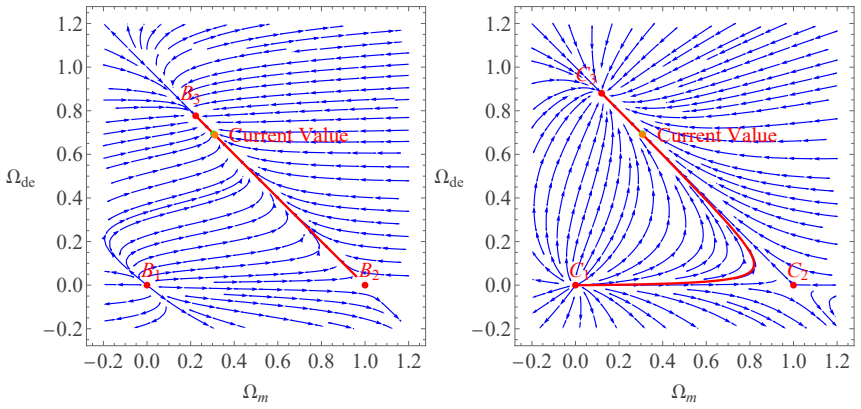
- The model with the combined interaction term converges to the de Sitter fixed point in the future.
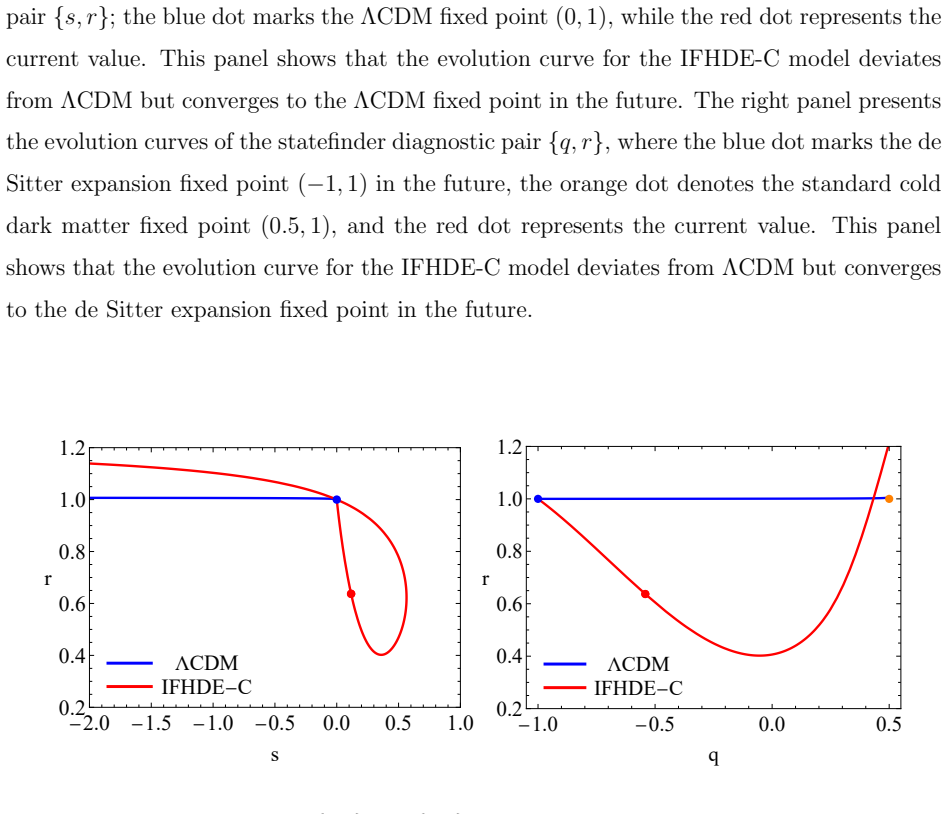
- Statefinder diagnostics show deviation from Lambda CDM but convergence toward its fixed point.
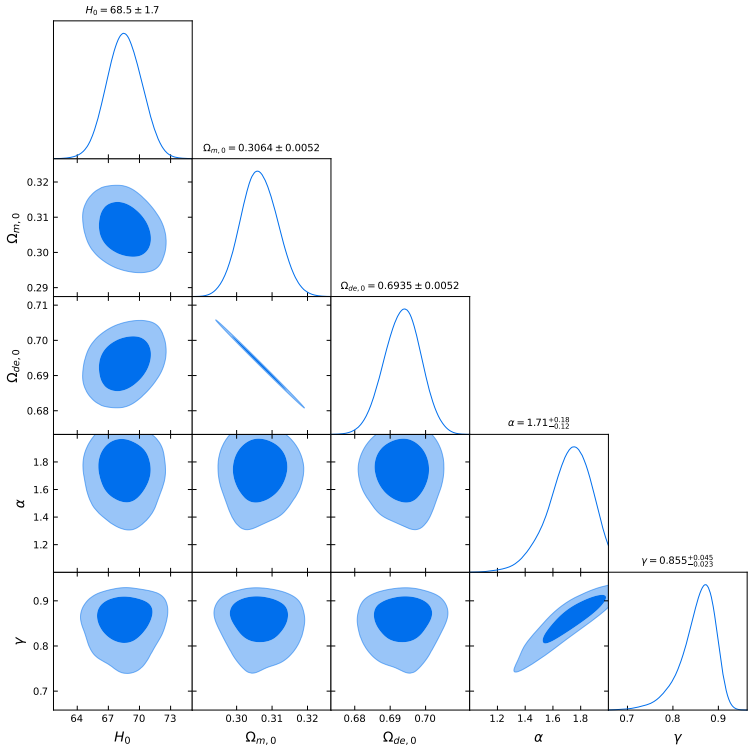
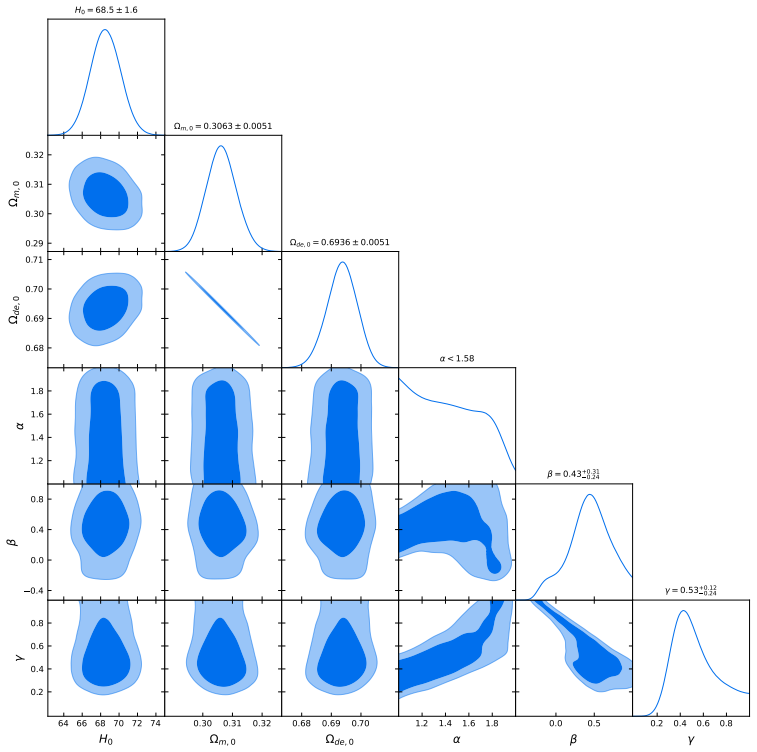
- Observational data from SNIa, OHD, BAO, and CMB prefer the interaction forms that include the dark energy density.
- The model accounts for the transition to observed late-time acceleration.
Where Pith is reading between the lines
- If the fractional entropy origin remains consistent with interactions, similar structures could be tested in other entropy-based dark energy proposals.
- Higher-precision measurements of the transition redshift to acceleration could tighten bounds on the interaction coefficients.
- The phase space approach may extend to non-flat cosmologies or models with varying fractional order.
Load-bearing premise
The fractional holographic dark energy density based on fractional entropy keeps its defining form when interaction terms are added to the continuity equations.
What would settle it
A precise measurement of the late-time expansion history or statefinder parameters showing that the universe does not converge to a constant Hubble parameter de Sitter phase would rule out the central claim for this interaction form.
Figures


read the original abstract
Based on the fractional entropy originating from fractional quantum mechanics, the fractional holographic dark energy (FHDE) model has been proposed. In this paper, we consider an interaction between the pressureless matter and FHDE and analyze three different interacting FHDE models. Combining the latest observational data including SNIa, OHD, BAO, and CMB, we estimate the model parameters and find that the interaction forms $Q=\gamma H \rho_{de}$ and $Q=\beta H \rho_{m}+\gamma H \rho_{de}$ show some preference from the observational data. Using phase space analysis, we further find that only interacting FHDE model with $Q=\beta H \rho_{m}+\gamma H \rho_{de}$ can describe the full evolutionary history of the universe. The statefinder diagnostic pair reveals that this model deviates from the $\Lambda$CDM model but converges to the $\Lambda$CDM fixed point and the de Sitter expansion fixed point in the future. Finally, we analyze the evolution of cosmological parameters and demonstrate that this model can drive the late time acceleration of the universe.
Editorial analysis
A structured set of objections, weighed in public.
Referee Report
Summary. The manuscript examines three interacting fractional holographic dark energy (FHDE) models with different forms of the interaction term Q between pressureless matter and FHDE. Parameter constraints are obtained from combined SNIa, OHD, BAO, and CMB datasets including DESI DR2; two interaction forms show statistical preference. Phase-space analysis of the autonomous system is then used to argue that only the model with Q = β H ρ_m + γ H ρ_de reproduces the full cosmic evolutionary history, converges to a de Sitter attractor, and drives late-time acceleration, as further supported by statefinder diagnostics.
Significance. If the central modeling assumptions hold, the work supplies timely observational bounds on interacting FHDE using DESI DR2 and integrates dynamical-systems methods to discriminate among interaction forms. Explicit credit is due for the multi-probe likelihood analysis and the attempt to link observational fits to global phase-space behavior.
major comments (2)
- [Section 2 and Section 3] Section 2 (model definition): the FHDE energy density is obtained from the fractional entropy expression (Eq. (8) or equivalent) in the non-interacting case. In Section 3 the continuity equations are modified by the addition of Q while the identical functional form of ρ_de is retained without re-derivation or explicit justification under the altered energy transfer. Because the autonomous system, fixed-point locations, and stability conclusions in Section 4 are constructed directly from this ρ_de, the assumption is load-bearing for the claim that only one interaction form works.
- [Section 4.2] Section 4.2 (phase-space analysis): the reported convergence to the de Sitter fixed point and the statement that only the Q = β H ρ_m + γ H ρ_de model describes the full history rely on the best-fit values of β and γ obtained from the same observational data used for model selection. No propagation of the posterior uncertainties on β and γ into the locations or eigenvalues of the fixed points is shown, weakening the robustness of the dynamical conclusions.
minor comments (2)
- [Table 2] Table 2: the reported ΔAIC and ΔBIC values for the three models should be accompanied by the absolute χ² values and the number of degrees of freedom to allow direct assessment of fit quality.
- [Figure 5] Figure 5 (statefinder trajectories): the plot would be clearer if the ΛCDM fixed point and the future de Sitter attractor were explicitly marked with distinct symbols rather than inferred from the curve endpoints.
Simulated Author's Rebuttal
We thank the referee for the careful reading and constructive comments on our manuscript. We address each major comment below and have revised the manuscript to strengthen the presentation and robustness of the results.
read point-by-point responses
-
Referee: [Section 2 and Section 3] Section 2 (model definition): the FHDE energy density is obtained from the fractional entropy expression (Eq. (8) or equivalent) in the non-interacting case. In Section 3 the continuity equations are modified by the addition of Q while the identical functional form of ρ_de is retained without re-derivation or explicit justification under the altered energy transfer. Because the autonomous system, fixed-point locations, and stability conclusions in Section 4 are constructed directly from this ρ_de, the assumption is load-bearing for the claim that only one interaction form works.
Authors: We acknowledge the referee's point that the functional form of ρ_de originates from the fractional entropy in the non-interacting derivation. In the interacting models, we have followed the standard phenomenological approach in the interacting dark energy literature by retaining the same ρ_de expression while adding the interaction term Q to the continuity equations. This assumes the holographic relation is intrinsic to the dark energy component and is not directly altered by the energy transfer. To address the concern, we will add an explicit justification paragraph in the revised Section 3 explaining this assumption and its consistency with the fractional entropy framework. revision: yes
-
Referee: [Section 4.2] Section 4.2 (phase-space analysis): the reported convergence to the de Sitter fixed point and the statement that only the Q = β H ρ_m + γ H ρ_de model describes the full history rely on the best-fit values of β and γ obtained from the same observational data used for model selection. No propagation of the posterior uncertainties on β and γ into the locations or eigenvalues of the fixed points is shown, weakening the robustness of the dynamical conclusions.
Authors: We agree that using only the best-fit values without propagating uncertainties reduces the robustness of the dynamical conclusions. In the revised manuscript, we will include additional analysis evaluating the fixed-point locations and eigenvalues at the boundaries of the 1σ and 2σ posterior intervals for β and γ. This will confirm that the qualitative results, including convergence to the de Sitter attractor for the Q = β H ρ_m + γ H ρ_de model, remain consistent within the observationally allowed ranges. revision: yes
Circularity Check
FHDE density formula from fractional entropy used unchanged after adding interaction Q, without re-derivation
specific steps
-
ansatz smuggled in via citation
[Abstract and model introduction]
"Based on the fractional entropy originating from fractional quantum mechanics, the fractional holographic dark energy (FHDE) model has been proposed. In this paper, we consider an interaction between the pressureless matter and FHDE and analyze three different interacting FHDE models."
The ρ_de expression is taken unchanged from the fractional-entropy definition and substituted into the modified continuity equations that now include Q. The subsequent autonomous system, fixed-point analysis, and conclusion that only the β+γ interaction form describes the full evolutionary history therefore rest on the original ansatz rather than a re-derived density consistent with energy transfer.
full rationale
The paper defines the FHDE density via fractional entropy (from prior proposal), then directly inserts interaction terms Q into the continuity equations while retaining the identical ρ_de functional form. Phase-space analysis and the claim that only Q=βHρ_m + γHρ_de reaches the full history and de Sitter attractor therefore depend on this unadjusted density; altering the dynamics via interaction would in principle require re-deriving ρ_de(H) and could shift fixed-point locations and stability. Observational fitting of β, γ to the same SNIa/OHD/BAO/CMB data then reinforces model preference, but the core load-bearing step is the preserved ansatz rather than a fresh derivation. This produces partial circularity (score 6) without reducing the entire result to a pure fit or self-citation chain.
Axiom & Free-Parameter Ledger
free parameters (2)
- fractional parameter
- interaction parameters β and γ
axioms (2)
- domain assumption The universe is described by a flat FLRW metric with standard continuity equations modified by an interaction term.
- domain assumption Fractional holographic dark energy density follows from fractional entropy in the same way as standard holographic dark energy follows from Bekenstein entropy.
Lean theorems connected to this paper
-
IndisputableMonolith/Cost/FunctionalEquation.leanwashburn_uniqueness_aczel unclear?
unclearRelation between the paper passage and the cited Recognition theorem.
ρ_de = 3c² H^{3α-2}/α (Eq.1); Q=βHρ_m + γHρ_de (IFHDE-C); autonomous system Ω'_m, Ω'_de (Eqs.13-14); critical points C1-C3 with stability from eigenvalues
-
IndisputableMonolith/Foundation/RealityFromDistinction.leanreality_from_one_distinction unclear?
unclearRelation between the paper passage and the cited Recognition theorem.
phase-space analysis shows only Q=βHρ_m+γHρ_de reaches radiation→matter→de Sitter attractor
What do these tags mean?
- matches
- The paper's claim is directly supported by a theorem in the formal canon.
- supports
- The theorem supports part of the paper's argument, but the paper may add assumptions or extra steps.
- extends
- The paper goes beyond the formal theorem; the theorem is a base layer rather than the whole result.
- uses
- The paper appears to rely on the theorem as machinery.
- contradicts
- The paper's claim conflicts with a theorem or certificate in the canon.
- unclear
- Pith found a possible connection, but the passage is too broad, indirect, or ambiguous to say the theorem truly supports the claim.
discussion (0)
Sign in with ORCID, Apple, or X to comment. Anyone can read and Pith papers without signing in.