pith. machine review for the scientific record. sign in

physics.gen-ph

General Physics

Description coming soon

0
physics.gen-ph 2026-05-11 2 theorems

Amplitude profile mediates link between Bohm potential and scalar EM mode

A Structural Link Between the Bohm Quantum Potential and the Scalar Mode of Aharonov-Bohm Electrodynamics in a Bosonic Schr\"odinger Model

Boundary conditions in the bosonic model turn the shared dependence on R into a functional relation between the quantum potential and the Ah

abstract click to expand
We discuss a formal and physical connection between the Bohm quantum potential and the scalar mode of the Aharonov-Bohm extension of electrodynamics. The analysis is motivated by the effective non-relativistic bosonic model recently proposed by Minotti and Modanese, in which the electromagnetic field is coupled to a conserved current while the field equations contain an additional source term. In the Madelung representation $\psi=R\exp(i\theta/\hbar)$, the Bohm quantum potential $ Q_B=-\frac{\hbar^2}{2m}\frac{\nabla^2 R}{R} $ is determined by the relative curvature $\nabla^2R/R$ of the amplitude profile $R$. In the same bosonic model, the scalar electromagnetic mode $S=\partial_\mu A^\mu$ is sourced by the extra-current $I=\partial_\mu j^\mu$, which contains the density-weighted electromagnetic combination $\nabla\cdot(R^2\mathbf A)$. Thus $Q_B$ does not act as a direct source of $S$; rather, the two quantities probe different differential aspects of the same amplitude profile: $Q_B$ is sensitive to the relative curvature of $R$, whereas the source of $S$ is sensitive to its density and gradient content through $R^2$ and $\nabla R$. We show that, once boundary and normalization data are fixed, this observation may be written as a mediated functional dependence of $S$ on $Q_B$ through $R$. We also clarify the physical status of $Q_B$: although it is state-dependent and should not be interpreted as an autonomous external potential, its density-weighted integral gives the amplitude-gradient energy, equivalently a Fisher-information contribution. This makes $Q_B$ a compact diagnostic of quantum pressure, rigidity, and inhomogeneity of a bosonic condensate. The resulting link with $S$ is therefore best understood as a structural relation between the order-parameter amplitude profile of the condensate and the scalar sector of the extended electromagnetic theory.
0
0
physics.gen-ph 2026-05-11 2 theorems

Neural net data flip suggests closed universe with evolving dark energy

Constraining Dark Energy Dynamics in Curved Spacetime with Current Observations

Reconstructed Hubble and supernova data push the dark energy parameter farther from a constant and change the sign of spatial curvature.

abstract click to expand
We investigate a dark energy (DE) equation of state (EoS) parametrization in a curved spacetime using current observations. We constrain the model parameters by using observational Hubble data from Cosmic Chronometer (CC), Pantheon Plus SH0ES (PPS), and DESI BAO DR2, along with their reconstructed datasets using an Artificial Neural Network (ANN). The parameter $\alpha$ is constrained as $\alpha \approx 0.35 (\approx 0.56)$ from original (reconstructed) data. This means reconstruction pushes the model toward a significant deviation from the standard $\Lambda$CDM framework. We find that the curvature parameter $\Omega_{k0} = 0.068 \pm 0.029$ at 68\% CL with original data, suggests a slightly open universe, whereas with the reconstruction method, $\Omega_{k0} = -0.131 \pm 0.032$ at 68\% CL suggests a closed universe. This shift in the mean value indicates that the reconstruction method is highly sensitive to curvature. We perform statistical model comparison criteria, namely, AIC and BIC to assess the reliability of our framework.
0
0
physics.gen-ph 2026-05-07

Quantum collapses may violate local charge conservation

Quantum collapse, local conservation of charge, and possible experimental consequences

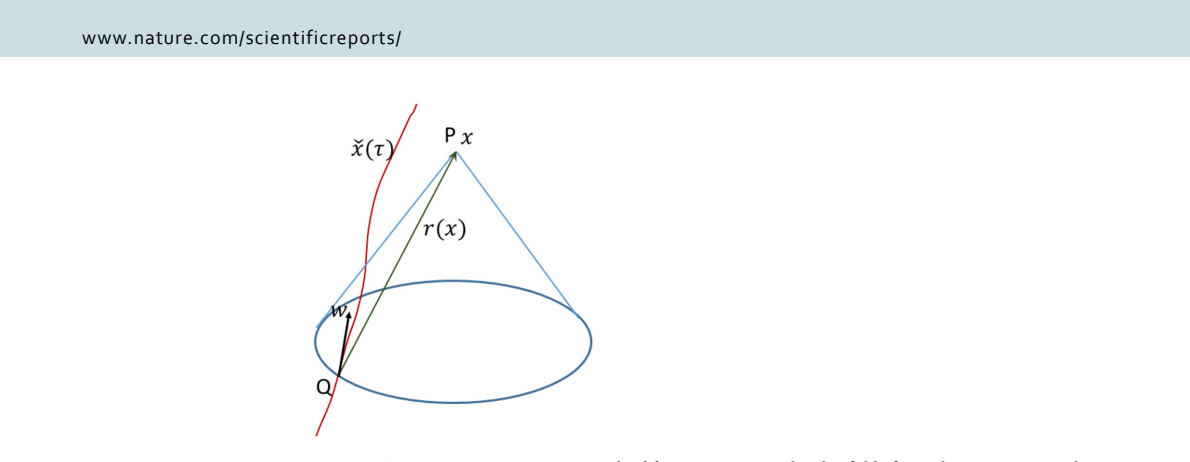
Aharonov-Bohm electrodynamics describes the fields, and diode detectors could register signals from state reductions.

Figure from the paper full image
abstract click to expand
We investigate the possibility that idealized quantum state-reduction processes may produce a local violation of charge conservation. If this occurs, the corresponding electromagnetic fields cannot be consistently described within Maxwell electrodynamics, and a natural alternative is provided by Aharonov-Bohm electrodynamics, which reduces to Maxwell theory when local charge conservation holds, but remains compatible with non-conserved sources. Within this framework we first analyze how state reduction may generate non-conserved local currents, including statistically compensated cases and biased tunnelling configurations with persistent average current. We then study the interaction of gauge waves with fermionic and bosonic quantum systems, the latter being described by a modified Schr\"odinger equation previously proposed for boson matter. As an application, we discuss the interaction of gauge waves with superconductors and show that they can effectively shield such waves. Finally, we present experimental proposals based on inverse-biased diodes and estimate the expected detector response.
0
0
physics.gen-ph 2026-05-04 3 theorems

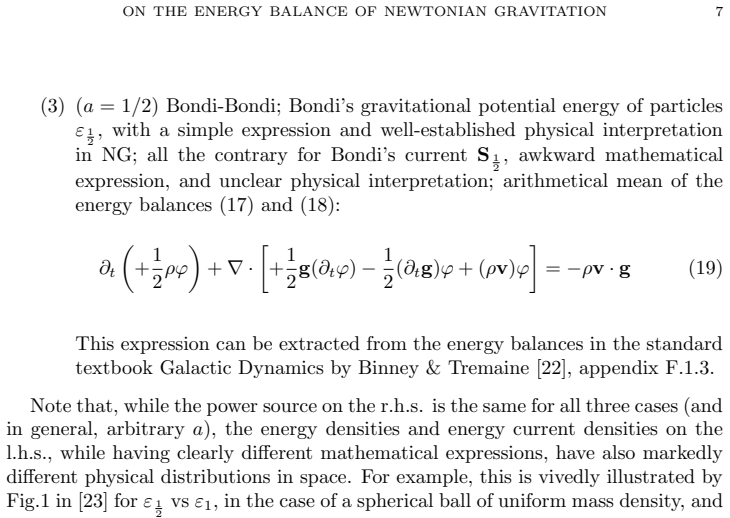
Thermodynamics distinguishes Newtonian gravity energy densities

On the energy balance of Newtonian Gravitation

Three formulas give identical energy balances and boundary conditions but differ in thermodynamic consistency.

Figure from the paper full image
abstract click to expand
It is shown that the energy density formulas of Newtonian gravity by Maxwell, Bondi and Ohanian cannot be distinguished by boundary conditions, and also the corresponding energy balances are identical. However, they are not equivalent. From a thermodynamic point of view, the Ohanian energy density is distinguished.
0
0
physics.gen-ph 2026-05-04

Narrowing KLJN resistor gap cuts attack success to 0.7

Binary Classifier Wire-Resistance Attack on KLJN: Impact of Narrowing the Resistor Gap

Simulations show noise-voltage clouds overlap more as high and low values approach each other, limiting eavesdropper recovery.

abstract click to expand
It is shown that narrowing the difference between the high and low resistor values in the Kirchhoff Law-Johnson Noise (KLJN) key exchange strongly affects security against a recently introduced binary classifier-based wire resistance attack. Using time domain simulations of a non-ideal KLJN loop with finite cable resistance, we generate large ensembles of secure (HL/LH) bits and evaluate the mean-square noise voltages at Alice's and Bob's ends. For each bit, these mean-square values form a point in a two-dimensional classifier plane, where the separation between the HL and LH point clouds characterizes the information available to an eavesdropper (Eve). We quantify Eve's success probability p by a simple decision rule based on the sign of the difference between the measured mean-square voltages. For strongly asymmetric resistors (for example RL = 4 kOhm and RH = 10 kOhm) and realistic wire resistances, the HL and LH clouds are fully separable and Eve's p approaches 1, which confirms that the classifier attack can practically recover all secure bits. As the low resistor value approaches the high one (for example RL = 9 kOhm and RH = 10 kOhm) at the same cable resistance, the HL and LH clouds increasingly overlap, and the measured p drops close to 0.7, approaching the ideal limit p = 0.5 as RL approaches RH. A surprising phenomenon is that, in this classifier-based scenario, increasing the wire resistance can decrease the information leak. This counterintuitive effect is strikingly the opposite of the behavior in the classical Bergou-Scheuer-Yariv wire resistance attack, where the mean-square voltages at the two ends of the wire are simply compared.
0
0
physics.gen-ph 2026-04-30

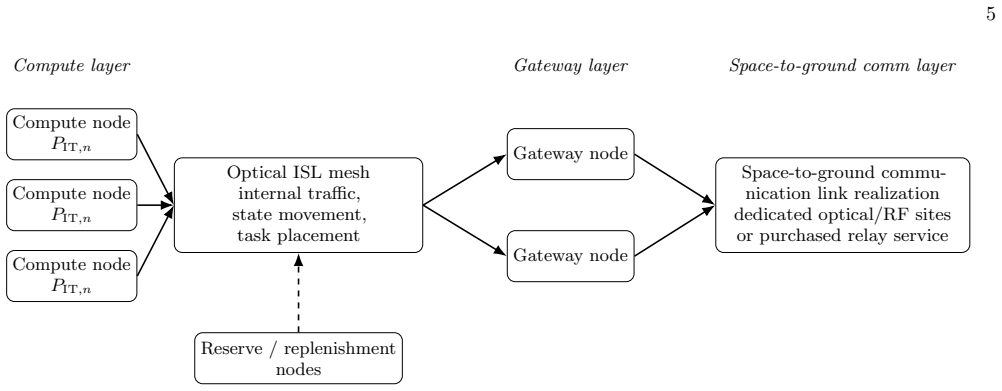
Orbital compute needs launch costs cut by factor of ten

Orbital Data Centers: Spacecraft Constraints and Economic Viability

At 40 kg per kW the allowed budget is 250-1000 dollars per kilogram before communications and lifetime penalties begin.

Figure from the paper full image
abstract click to expand
Orbital data centers are being evaluated as solar-powered compute constellations and relay-integrated processing platforms. Their feasibility is not set by orbital solar flux alone, but by simultaneous closure of photovoltaic generation, eclipse recharge, radiative heat rejection, sustained space-to-ground communications, utilization, replacement cadence, and delivered compute-years over finite mission life. This paper derives necessary cluster-level competitiveness conditions using delivered information-technology (IT) electrical power $P_{\rm IT}$, deployed mass per delivered IT power $m_{\rm kW}$ in kg/kW, communication intensity $\Gamma=D_{\rm sg}/E_{\rm IT}$, sustained communication ceiling $\Gamma_{\max}$, effective utilization $U_{\rm eff}$, and lifetime penalty $\Pi_{\rm life}$. For a representative $P_{\rm IT}$=1 MW high-sunlight anchor, the base case gives beginning-of-life photovoltaic area $A^{\rm BOL}_{\rm PV}=5.64 \times 10^3 {\rm m}^2$, radiator area $A_{\rm rad}=2.50 \times 10^3 {\rm m^2}$, and 29.4 kg/kW for photovoltaic, storage, and radiator mass; fixed spacecraft mass raises the total to 34-59 kg/kW. At m_kW ~ 40 kg/kW, a terrestrial infrastructure benchmark of 10-40 k\$/kW allows only 250-1000 \$/kg for the combined launch and spacecraft-build cost before space-to-ground communications, operations, utilization, and lifetime terms are included. That allowance is 3.4-13.5 times below the current public Falcon 9 dedicated low-Earth-orbit launch-price benchmark alone, before spacecraft build is included. Space-native preprocessing and communications-integrated edge compute are credible early regimes; terrestrial-user general compute closes only for low Earth-coupled communication intensity, high effective utilization, long delivered lifetime, and very low combined launch-plus-build cost.
0
0
physics.gen-ph 2026-04-30

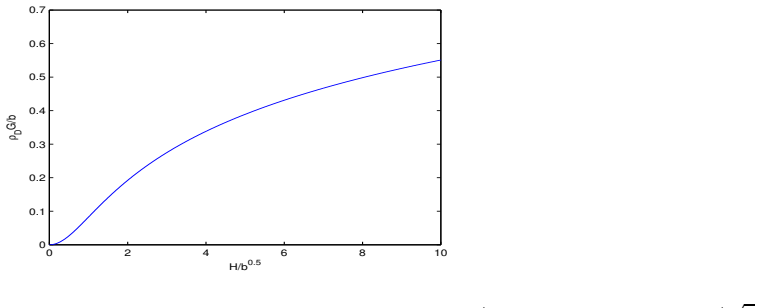
Rényi entropy yields dark energy matching Planck data

The R\'{e}nyi entropy and entropic cosmology

Modified apparent horizon entropy produces a model where matter density and deceleration match observations and Hubble rates agree within 5%

Figure from the paper full image
abstract click to expand
Entropic cosmology with the R\'{e}nyi entropy of the apparent horizon $S_R=(1/\alpha)\ln(1+\alpha S_{BH})$, where $S_{BH}$ is the Bekenstein--Hawking entropy, is studied. By virtue of the thermodynamics-gravity correspondence a model of dark energy is investigated. The generalised Friedmann equations for the Friedmann--Lema\^{i}tre--Robertson--Walker spatially flat universe with the barotropic matter fluid are obtained. We compute the dark energy density $\rho_D$, pressure $p_D$ and the deceleration parameter $q$ of the universe. At some model parameters the normalized density parameter of the matter $\Omega_{m0}\approx 0.315$ and the deceleration parameter $q_0\approx -0.535$ for the current epoch, which are in the agreement with the Planck data, are found. Making use of the thermodynamics-gravity correspondence, we describe the late time of the universe acceleration. The entropic cosmology considered is equivalent to cosmology based on the teleparallel gravity with the definite function $F(T)$. The Hubble parameters are in approximate agreement (within $5$ percents) with the observational Hubble data for redshifts $0.07\leq z \leq 1.75$ at the entropy parameter $\alpha\approx 0.305~GH_0^2$.
0
0
physics.gen-ph 2026-04-29

Projective limits turn local pairwise comparisons into global relational structures

Pairwise-comparison-valued cosurfaces: a projective framework for multi-scale relational structures

Global coherence is recovered solely from compatibility of comparison data across ordered refinements of finite discretizations.

abstract click to expand
We introduce cosurfaces with values in the group \(\PC_n(H)\) of \(H\)-valued reciprocal pairwise comparison matrices. The composition law is covariant on upper triangular coefficients and contravariant on lower triangular coefficients, which makes \(\PC_n(H)\) a natural target for oriented gluing constructions. Starting from a directed family of finite oriented discretizations, we define finite configuration spaces, coarse-graining maps induced by ordered refinements, and the associated universal projective limit. This yields a multi-scale organization of local comparative data in which global objects are reconstructed only through compatibility across scales. In the stochastic setting, projectively compatible probability laws define a cylindrical semantics on the limit space. We also introduce inconsistency observables, interpreted as discrete curvature-type defects measuring obstructions to global coherence. The resulting framework is simultaneously geometric, algebraic, and probabilistic, and suggests a foundational perspective on relational structures built from local comparisons rather than absolute observables.
0
0
physics.gen-ph 2026-04-28

Benchmark splits cross-section and EEDF effects on light-atom ionization

Electron-impact ionization rates for neutral He, Li, and Be in the Tsallis framework

For He, Li, and Be the Bell-Lotz spread is small for helium but reaches 95 percent for lithium, while distribution tails scale with Ip overT

Figure from the paper full image
abstract click to expand
The single-ionization rate coefficient of a plasma neutral depends both on the microscopic electron-impact cross section and on the macroscopic shape of the electron energy distribution function (EEDF). We present a reproducible benchmark and sensitivity study -- not a new theory -- of these two effects for the three lightest neutrals He, Li, and Be, combining the recommended Bell~\textit{et~al.}\ (1983) cross sections with a properly normalized two-temperature Tsallis $q$-generalized EEDF and varying $q$ on both sides of the Maxwellian limit and the hot-electron fraction $f_{\mathrm{hot}}$ at $T_{\mathrm{hot}}=10\,T_{\mathrm{bulk}}$. The calculation cleanly separates two independent uncertainty axes -- cross-section model (Bell vs.\ Lotz) and EEDF shape (Maxwellian vs.\ Tsallis). The Bell--Lotz spread on $\tau_M$ is small for He (within about $7\%$), moderate for Be ($\lesssim 17\%$), and largest for Li (up to $+95\%$ at $T=1$~keV); sub-extensive distributions ($q<1$) suppress ionization through a hard tail cut-off, while super-extensive distributions ($q>1$) enhance low-temperature ionization through a $\kappa$-like power-law tail with $\kappa=1/(q-1)$. The quantitatively safest non-Maxwellian cases are $q=1$ and $q=1.2$ ($\kappa=5$), which lie inside the finite-mean-energy regime; the cases $q=1.4$ and $q=1.6$ are retained as heavy-tail stress tests and should be read as qualitative trends rather than as quantitatively reliable predictions. Both EEDF effects scale with $I_p/k_BT$, so He responds most strongly and Li least. The full numerical pipeline is released as a persistent reproducibility package, intended as a drop-in non-Maxwellian ionization module for collisional-radiative and ionization-balance modelling of light-neutral plasmas.
0
0
physics.gen-ph 2026-04-28

Galaxy evolution constrained by Wasserstein geometry and energy rules

A Measure-Theoretic Transport Formulation of Galaxy Evolution on the Galaxy Manifold: Geometric Constraints

Populations as measures evolve via transport and jumps, restricted by curvature bounds and free-energy dissipation rather than arbitrarily.

abstract click to expand
We develop a measure-theoretic framework for galaxy evolution in which galaxy populations are described as probability measures on a state space. Galaxy evolution is represented as the time evolution of a measure $\nu_t$, governed by the sum of a continuous transport term and a jump operator. The transport term describes internal galaxy evolution, while the jump operator captures discrete events such as mergers and interactions, yielding a unified reaction--transport system on the space of measures. We further equip the space of probability measures with the Wasserstein distance and impose a curvature--dimension condition CD$(K,\infty)$ to reveal the geometric structure of the dynamics. In this setting, the transport term is interpreted as a gradient flow of a free-energy functional, whereas the jump operator generates nonlinear rearrangements induced by many-body interactions. In the low-density limit, these interactions reduce effectively to two-body processes, leading to a closed dynamical system. A central consequence is that galaxy evolution is not arbitrary, but constrained by a variational structure, curvature bounds, and an interaction hierarchy. Admissible trajectories are restricted by energy dissipation, geometric contractivity, and effective interaction closure. The framework also separates intrinsic galaxy dynamics from observational projection, treating observables as pushforwards of measures. It thus provides a unified foundation for structure formation and galaxy evolution as a geometrically constrained reaction--transport process.
1 0
0
physics.gen-ph 2026-04-27

S3 symmetry adds Higgs sector to algebraic three-generation model

Higgs Sector and Flavour Structure in an Algebraic Three-Generation Model with S3 Family Symmetry

Right-action operators produce six doublets with Type-II Yukawa separation and no tree-level FCNCs in the invariant limit

abstract click to expand
We extend our previous algebraic construction of three fermion generations in the complex Clifford algebra $\mathbb{C}\ell(10)$ by incorporating the Higgs sector. Using the $S_3$ family symmetry that permutes three algebraically distinguished fermion sectors, we construct Higgs components as right-action operators and extract the corresponding Yukawa coefficients by means of a trace pairing. This yields two first-generation Higgs doublets with the correct electroweak quantum numbers and a natural Type-II-like separation between down-type and up-type Yukawa channels. The $S_3$ action triplicates this Higgs sector, producing six Higgs doublets organised into $S_3$-orbits. In the exact $S_3$-invariant limit, the Yukawa sector retains its Type-II structure, while the generation-space Yukawa matrices are not diagonal in the algebraic generation basis. If electroweak symmetry breaking is implemented in the usual way, tree-level flavour-changing neutral currents are not expected in this limit.
0
0
physics.gen-ph 2026-04-27

Einstein photon field fills space instantly

The quantum mechanics of Einstein photons and generalized functions

Reinterpreting Majorana equations gives a generalized measure where the quantum field fills all space at once in evolution.

abstract click to expand
The article consider an interpretation of Majorana equations as a quantum Lorentz covariant equations for the field of Einstein photon. A photon with "deinterlaced" spins (with diagonal Hamiltonian) is considered, its generalized Green function as a functional on finite test functions and its Schr\"{o}dinger equation are constructed. The generalized process corresponding to this Green function is continued to $\sigma$-additive quantum generalized measure on the space dual to the compact subspace of a photon paths in $L_{2}(-\infty,\infty)$. In this case, the filling of whole space by such quantum field instantly occurs in the evolutionary problem. The last part of the article gives the calculation of the "Casimir forces" arising in this field.
0
0
physics.gen-ph 2026-04-27

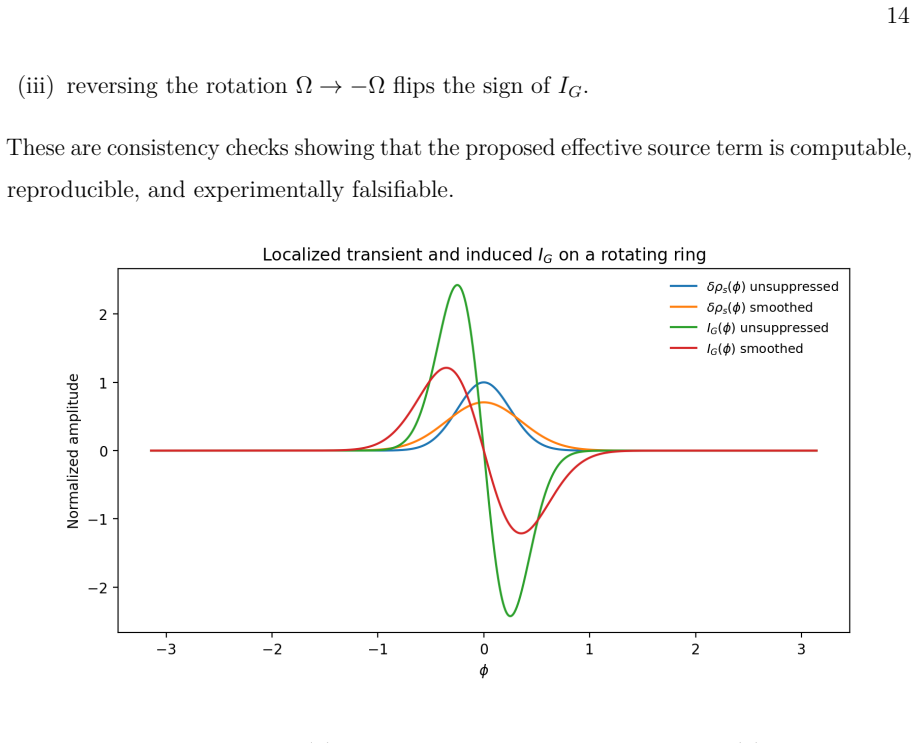
Rotating frames create effective source for Aharonov-Bohm scalar effects

Effective Observer-Split Source Terms in Rotating Frames and Gravitomagnetic Backgrounds in Extended Aharonov-Bohm Electrodynamics

A 3+1 decomposition of conserved currents yields a term that drives phenomenological models at macroscopic scales with reversal under sign(Ω

Figure from the paper full image
abstract click to expand
We examine whether rotating frames and stationary gravitomagnetic backgrounds can provide a meaningful link to extended Aharonov-Bohm electrodynamics without invoking microscopic charge non-conservation. For standard generally covariant, locally $U(1)$-invariant matter, the answer at the microscopic level is negative: the physical four-current remains covariantly conserved, so neither rotation nor stationary gravitomagnetism by themselves generate a genuine source for the scalar sector. A weaker but still useful connection nevertheless emerges after a $3+1$ decomposition with respect to a rotating observer congruence. In that description, the observer-measured transport current on the spatial slice obeys a projected continuity equation containing an exact split source term $I_{\mathrm{split}} \equiv \frac{1}{N} D_i(\rho\,\beta^i)$, which reduces in the weak-field regime to $I_G = D_i(\rho\,\beta^i)$. This term is not a frame-independent microscopic anomaly; it is the bookkeeping term that appears when covariant conservation is rewritten in transport variables adapted to a rotating slicing. We then propose a phenomenological AB-type closure in which this split source drives the scalar sector on finite-scale rotating systems. In the rigid-rotation weak-field limit, the source reduces to $I_G = (\boldsymbol{\Omega} \times \mathbf{r})\cdot \nabla \rho$, and for localized transients to $ I_G = \Omega\partial_\phi (\delta\rho_s)$. The resulting framework is therefore effective rather than fundamental, observer-tied rather than local-inertial, and experimentally meaningful only at mesoscopic or macroscopic scales. It yields concrete operational signatures, including reversal under $\Omega \to -\Omega$, suppression for nearly axisymmetric charge distributions, and sensitivity to transient non-axisymmetric charge structure.
0
0
physics.gen-ph 2026-04-22

Hadrons follow Regge-like paths with variable mass

Novel Regge-like trajectories for spinning, dilating, hadronic particles

Spinning dilating particles have dynamical mass tied to dilation and shear currents rather than fixed rest mass.

abstract click to expand
We study the of motion of a spinning, dilating particle with hadronic properties moving on a generic geometric background including curvature, torsion, and nonmetricity. In particular, we discuss generalized spin supplementary conditions and also introduce the concept of a shear supplementary condition. Using these, we investigate the evolution of the dynamical mass of the microstructured test body and the cases where the latter is a constant of motion. In general, we find novel Regge-like trajectories relating the mass to the dilation and/or the shear currents of hypermomentum. This means that for particles with hadronic properties, the rest mass is not a constant of motion in general.
0
0
physics.gen-ph 2026-04-22

Classical fluid splitter reproduces quantum Bell violations

Quantum Correlations in Classical Systems

Molecular paths show rotationally invariant and cosine-squared correlations matching Stern-Gerlach devices, allowing Tsirelson-type outcomes

abstract click to expand
A classical fluid splitter produces the same patterns of energy redistribution as a Stern-Gerlach quantum device, with rotationally invariant coefficients of correlation between molecular paths. Alternative settings express a cosine squared relationship, leading to Tsirelson-type Bell violations with outcome independence. This result confirms the Correspondence Principle of quantum mechanics, where individual detection events express system-level properties according to Born's Rule. Kochen-Specker contextuality and Bell Locality are not formally contradicted, but their interpretation is in question. Current definitions of Local Realism are limited to intrinsic particle properties. In contrast, quantum-like correlations require the acknowledgement of ensemble effects on dynamically inseparable entities, even when those entities are observed one at a time.
0
0
physics.gen-ph 2026-04-21

One conductance quantum covers electric

The fundamental units of generalized quantum conductance and quantum diffusion

A quasi-particle Drude model ties Planck's constant to a statistics-adjusted action and derives the same unit for all listed currents.

abstract click to expand
Although quantum transport at the nanoscale has received widespread attention since Landauer's pioneering work in 1957, we remark, that a general theory that sheds light on the difference between classical and quantum relativistic physical models is still lacking. By considering a classical 3D gas of non-interacting quasi.particles, the article presents a unified theory that provides a generalized conductance of dimensionless quasi-particles, neutral massive, electric, thermal, and photon currents. The investigation begins with an analogy between the original Drude model of 1900 and a modified Drude model of quasi-particles, which includes a ballistic transport regime and is independent of statistics (excluding Bose-Einstein condensation). Next, we construct connections between the quasi-particle unit in the modified Drude model and the carrier unit in dimensionless, electric, massive neutral, phonon, and photon currents. By establishing a connection between Planck's constant $h$ and a classica\`o action that takes into account the correct statistics, $h_s$, we derive the fundamental quantum unit of conductance for any of the mentioned currents. We further extend the diffusion coefficient of quasi-particles from the classical regime to the quantum and relativistic regimes.
0
0
physics.gen-ph 2026-04-21

Gravity forms structures without violating the second law

Entropy, Gravity, and an Apparent Violation of the Second Law

When all radiation from the full system is counted, total entropy rises in the Sun, black holes, and collapsing stars.

Figure from the paper full image
abstract click to expand
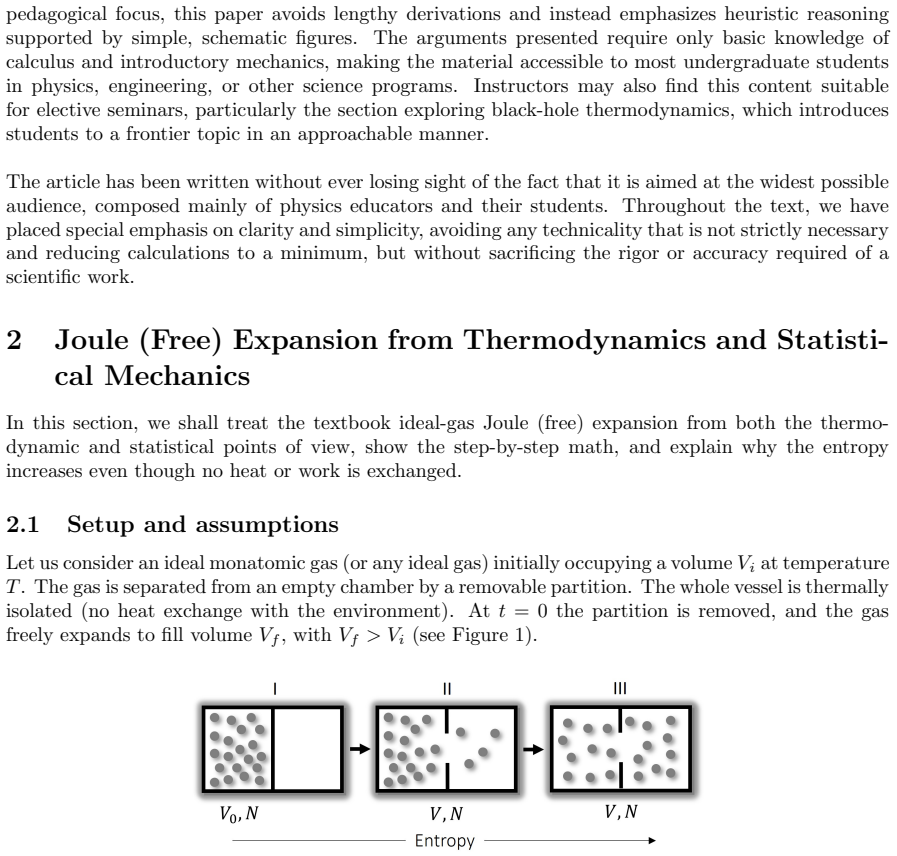
An interesting question to explore in physics classes is whether gravity violates the second law of thermodynamics. Standard physics textbooks provide little to no discussion of the relationship between entropy and gravity, and the same is often true of specialized texts. The aim of this work is to address this question by analyzing the behavior of an ideal gas in two simple scenarios: one in which gravity is negligible and another in which its effects are significant. We show that although systems influenced by gravity may exhibit counterintuitive behavior, such as local ordering through structure formation, the second law of thermodynamics remains valid when the entire system is considered, including all emitted energy and radiation. Given the educational focus of this work and the complexity of the entropy-gravity relationship, we omit detailed calculations that are not strictly necessary and instead focus on the simplest physical scenarios. In this context, we analyze four representative examples through simple calculations: the Sun, the limit of extreme contraction in black holes, the protostellar contraction sequence, and core collapse with neutrino cooling.
0
0
physics.gen-ph 2026-04-20

Linear superposition of metric deviations builds multi-source gravity

Superposition Principle in Relativistic Gravity

The construction stays Lorentz covariant in flat spacetime and recovers standard GR tests for weak or slow sources.

abstract click to expand
We develop a framework for superposition in relativistic gravity within Extended Relativity (ER), a Lorentz-covariant theory formulated in flat spacetime. In this approach, gravitational fields are described by deviations from the Minkowski metric associated with individual sources, and multi-source configurations are constructed through a superposition principle linear in the source parameters. The resulting metric preserves Lorentz covariance and reproduces the standard classical tests of General Relativity in the appropriate limits. We derive the explicit form of the superposed field for multiple moving sources and analyze its properties in both near and far zones. The formalism provides a consistent and physically transparent description of interacting gravitational sources and forms the basis for applications to relativistic dynamics and gravitational radiation.
0
0
physics.gen-ph 2026-04-20

Relativistic action unifies gravity and electromagnetism

A unifying physically meaningful relativistic action

It remains Lorentz covariant, reduces to the classical limit, and produces consistent equations for particles in combined fields.

Figure from the paper full image
abstract click to expand
We introduce a relativistic action that provides a unified and physically meaningful description of particle dynamics in external fields. The proposed action is constructed to be Lorentz covariant and reduces to the standard classical action in the appropriate limit. It incorporates gravitational and electromagnetic interactions within a single framework and leads to equations of motion consistent with known physical laws. The formulation offers a new perspective on relativistic dynamics and suggests a pathway toward unification of fundamental interactions.
0
0
physics.gen-ph 2026-04-20

Discrete Boltzmann factor suppresses black-hole luminosity near cutoff

Bounded thermal weights from a discrete Boltzmann factor

It shuts off the thermal Hawking channel and yields an exact work identity for deterministic protocols, recovering standard results as the b

Figure from the paper full image
abstract click to expand
The discrete Boltzmann factor $B_E(\beta_n)=(1-bE)^n$, introduced by Chung, Hassanabadi, and Boumali, provides a lattice regularization of the canonical weight $e^{-\beta E}$ and imposes the compact-support condition $E<1/b$. In the present analysis we systematically separate results that follow directly from this bounded thermal weight from those that require additional phenomenological input. First, we study the discrete Bose--Einstein occupation factor relevant for Hawking radiation, derive the leading suppression of black-hole luminosity, and show that the thermal Hawking channel shuts off as the cutoff scale is approached. Second, we formulate a discrete work functional built from ratios of thermal weights and establish an exact Jarzynski-type identity for deterministic measure-preserving protocols; in contrast, the corresponding Crooks relation does not collapse to a function of work alone, and first-order approximations retain an explicit initial-energy dependence that cannot be reduced to a simple $W$-dependent correction without additional assumptions. Third, and purely as an ancillary kinematic extension rather than a derivation from the statistical framework itself, we examine a bounded modified-dispersion ansatz and estimate the associated time-of-flight constraints. Throughout, we include illustrative figures, clarify the non-universal status of the entropy correction, and emphasize that direct laboratory signatures are negligible whenever $b$ is universal and Planck suppressed. Finally, the standard continuum expressions are recovered smoothly in the limit $b\to 0$.
0
0
physics.gen-ph 2026-04-20

Aharonov-Bohm theory keeps Maxwell energy spectrum despite non-conserved charges

Fluctuations in Aharonov-Bohm Electrodynamics

Doubled electric energy is offset by negative scalar field; added violet noise appears in conductor fluctuations.

abstract click to expand
We consider the application of the Fluctuation Dissipation Theorem (FDT) to the electrodynamics of Aharonov-Bohm (ABE), which differs from Maxwell's in that it allows for local non-conservation of charge. For the case of a system of non-conserved charges at thermal equilibrium we obtain the same spectral distribution of energy of the electromagnetic field as in Maxwell electrodynamics. However, the electric field contribution to that energy doubles that in Maxwell case, while the magnetic contribution is the same as in Maxwell theory, the electric excess energy is compensated by a negative contribution arising form the Aharonov-Bohm (AB) scalar field. For a conductor with local non-conservation of charge described by the $\gamma$ model, we derive the spectrum of current correlation at first order in $\gamma$, which results in a violet noise contribution added to the classical Johnson-Nyquist white noise result for the voltage fluctuations in a conductor.
0
0
physics.gen-ph 2026-04-20

Decaying vacuum models fit DESI data with H0 near 73

Observational tests of texorpdfstring{Λ(t)}{Lambda(t)} cosmology in light of DESI DR2

Joint analysis of supernovae, chronometers and BAO returns evolution parameter 0.3, showing a mild departure from constant vacuum energy.

Figure from the paper full image
abstract click to expand
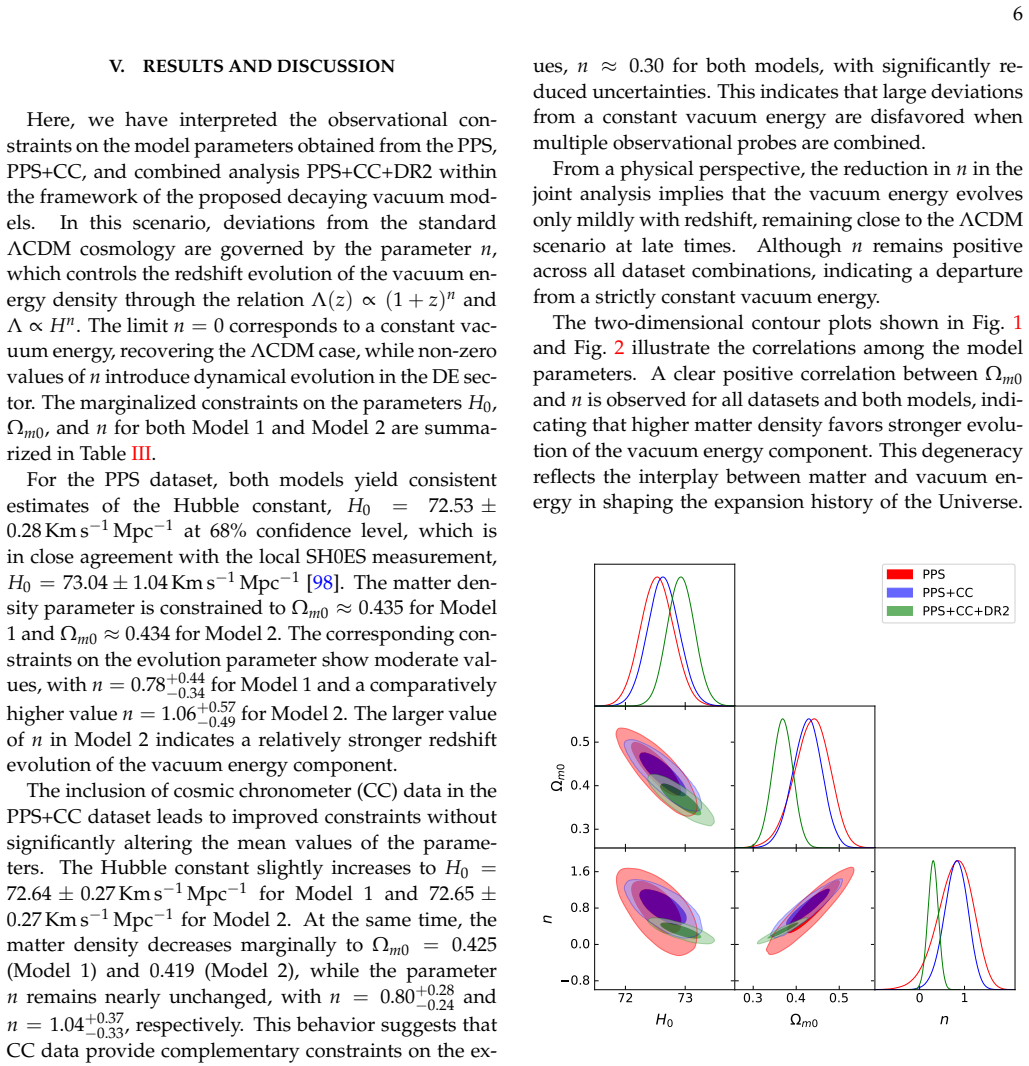
In this article, we investigate two phenomenological decaying vacuum cosmological models describing the accelerated expansion of the Universe. We constrain the model parameters using a Markov Chain Monte Carlo (MCMC) technique with recent datasets, including cosmic chronometer (CC), Pantheon+SH0ES (PPS), and DESI BAO data release (DR2). Our analysis provides constraints from PPS, PPS+CC, and the joint PPS+CC+DR2 datasets for both models. All datasets favor $H_0 \simeq 72.53$--$73.01~\mathrm{Km\,s^{-1}\,Mpc^{-1}}$, while $\Omega_{m0}$ is higher with PPS alone and decreases to standard paradigm estimates with the inclusion of additional data. The evolution parameter is $n \approx 0.30$ from joint analysis, indicating a mild deviation from the $\Lambda$CDM framework. Furthermore, the physical behavior of the models is examined through the deceleration parameter and the total equation of state, confirming a smooth transition from past deceleration expansion to the present accelerated expansion.
0
0
physics.gen-ph 2026-04-17

Mass-center motion equations derived in scalar gravity theory

Equations of motion of the mass centers in a scalar theory of gravity with a preferred frame

Post-Newtonian integration inside bodies produces the center equations for the second version with a preferred frame.

abstract click to expand
The theory considered interprets gravity as a pressure force. Thus, the scalar gravitational field defines the gravity acceleration field. However, it also determines the relation between the flat ``background metric'' and a curved ``physical metric''. Here we derive the equations of motion of the mass centers of a system of weakly gravitating bodies in the second version of that theory. We use the framework which was built and used for the first version. Namely, we use an asymptotic scheme of post-Newtonian (PN) approximation to derive the local (field) PN equations, and by integration inside the bodies we deduce from those local equations the equations of motion of the mass centers, using also an asymptotic framework for the good separation between the different bodies.
0
0
physics.gen-ph 2026-04-15

Bessel beams carry finite OAM along light cones

Finite Orbital Angular momentum Bessel beams propagating along light-cone coordinates

Airy function products create asymmetric exact solutions to Maxwell's equations with nonzero orbital angular momentum density.

abstract click to expand
New solutions for Bessel electromagnetic beams, propagating along the light cones, are investigated. Of the variety of structures possible in the light cone variables, the one involving a product of Airy functions is discussed in detail. This class of solutions, representing an asymmetry on the light-cone coordinates dependence, is a non-trivial extension to the usual plane wave solutions. We also explore the conditions under which these solutions will carry finite orbital angular momentum density.
0
0
physics.gen-ph 2026-04-15

Lattice Universe model accounts for ANITA events naturally

A possible solution to the mystery of the ANITA anomalous events

The upward radio pulses fit a symmetric cosmology that also explains accelerated expansion without dark energy.

Figure from the paper full image
abstract click to expand
In 2006 and 2014, the Antarctic Impulsive Transient Antenna (ANITA), a balloon-borne radio observatory flying over Antarctica, detected two strange upward-going radio pulse events that have not yet been explained by our current understanding of physics. These were not signals reflected by the ice and therefore it must have been an air shower originating from a cosmic ray coming from under the Antarctic ice, but this hypothesis was also ruled out by various data analyses. The CPT gravity theory and its associated cosmological model, the lattice Universe, can instead explain those events in a completely natural and spontaneous way, without any additional assumptions beyond general relativity and the expected matter-antimatter symmetry of the Universe on which they are based. Together with the antihelium candidate events from AMS-02, the anomalous ANITA events can thus lend further validity to a cosmological model that has already achieved considerable success in explaining the accelerated expansion of the Universe, without the need for dark energy. These events thus add to a series of problems unsolved by standard cosmology and physics, but whose solution is straightforward, spontaneous and natural within the framework of CPT gravity, without the need for ad hoc hypotheses and unknown ingredients.
0
0
physics.gen-ph 2026-04-15

Thermodynamics recovered when small-system group becomes irrelevant

Small-System Group: Thermodynamics as a Complete Self-Similarity Limit

Boltzmann's constant introduces Π_B in dimensional analysis; its irrelevance in the macroscopic limit yields standard thermodynamics while Π

abstract click to expand
We revisit the Rayleigh--Riabouchinsky paradox in dimensional analysis by making explicit the bridge between thermodynamics and the mechanical interpretation of temperature. Boltzmann's constant $k_B$ acts as a dimensional unifier, leading to an augmented $\Pi$-theorem with an additional dimensionless group that encodes system size. In the macroscopic thermodynamic limit this small-system group, $\Pi_B = k_B/(c\,\ell^3)$ -- the inverse heat capacity of a control volume of size $\ell^3$ in units of $k_B$ -- becomes irrelevant as the response becomes self-similar with respect to it, recovering Rayleigh's formulation. Under suitable conditions, macroscopic limits make the fluctuations of the observables of interest negligible compared to their expected values, hence the state of a system is characterized by a reduced set of parameters. We thus recast thermodynamics as the complete-similarity limit of statistical mechanics with respect to $\Pi_B$, which also controls thermodynamic fluctuations. We also discuss second-order phase transitions from the viewpoint of incomplete similarity.
1 0
0
physics.gen-ph 2026-04-14 3 theorems

Golden ratio governs quantum metric fluctuations at Mott points

Quantum Geometry, Fractionalization, and Provability Hierarchy: A Unified Framework for Strongly Correlated Systems

Framework also restricts fractional charges to Fibonacci numbers and labels strange metals as unprovable problems.

abstract click to expand
Mott physics - the interplay between itinerancy and localization of electrons - is undergoing a paradigm shift from the binary "bandwidth - filling" tuning framework to an intertwining of geometric, topological, and fractionalized degrees of freedom. Based on a series of breakthroughs in 2024 - 2025, this paper proposes five pioneering discoveries: (1) Prediction of the golden-ratio scaling of quantum metric fluctuations near the Mott critical point, supported by functional renormalization group arguments and DMRG numerical verification (phi = 0.618 +/- 0.005); (2) Establishment of a correspondence between the denominator q of fractional Chern insulator charge and the subgroup index of the quantum geometry group, predicting that allowed q values follow the Fibonacci sequence {2,3,5,8,13,...} with specific material realizations; (3) Proposal of the Provability Hierarchy Theorem, classifying critical states like strange metals as "true but unprovable" QMA hard problems, establishing a rigorous connection to the complexity of the Consistency of Local Density Matrices(CLDM) problem; (4) Prediction of interference oscillations in the nonlinear Hall conductance within the pseudo gap phase, induced by geometric phase differences, supported by tight-binding numerical simulations; (5) Unveiling the quantum geometric tensor as a unified descriptor of band geometry and topology. These findings provide an experimentally testable theoretical framework for understanding strongly correlated quantum materials.
0
0
physics.gen-ph 2026-04-13

Planck data bound doubly logarithmic correction to radiation density

Doubly Logarithmic Corrections to Radiation Domination from CET {Ω}: Theory and Planck/BBN Constraints

Analysis shows the correction parameter is consistent with zero but limited to absolute value no larger than 0.006

Figure from the paper full image
abstract click to expand
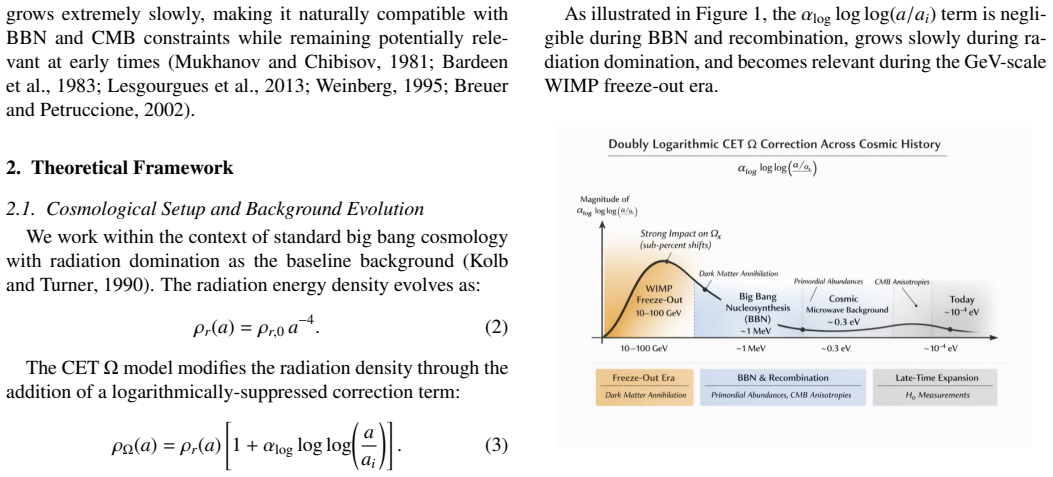
We present the CET Omega framework, a causal-informational extension of standard cosmology that predicts a universal doubly logarithmic correction to the radiation energy density in the early Universe. This correction arises naturally from scale-invariant spectral sectors with logarithmically-running infrared scales and represents a low-energy manifestation of the full CET Omega theory. We derive the doubly logarithmic form from two complementary perspectives -- spectral integration and renormalization group flow -- and perform a full Markov Chain Monte Carlo analysis jointly varying six LambdaCDM parameters and alpha_log, using Planck 2018 TT, TE, EE + lowE likelihoods and BBN constraints. The result, alpha_log = -0.008 +/- 0.006 (68\% C.L.), is consistent with zero. We identify the expected N_eff degeneracies with H0 and n_s, establish the first observational bound |alpha_log| <= 0.006, and demonstrate that future CMB-S4 measurements can probe |alpha_log| ~ 10^{-3}.
0
0
physics.gen-ph 2026-04-09 2 theorems

Causality fixes inertial-frame transformations to Lorentz group plus dilatations

Relativity: A matter of causality

Defining spatial distance geometrically and requiring finite-time communication between observers yields the orthochronous inhomogeneous Lor

abstract click to expand
We take causality and uniqueness of events observation as our driving forces. They are built in in the way we define distinct observers, which then require a finite time to communicate between each other. This unavoidably leads to the existence of maximal transfer-information velocity between arbitrary (not necessarily inertial) reference frames. Inertial reference frames are defined by fixing the geometrical properties of (spatial) distance without any reference to relativity, electromagnetism, or laws of physics in general. For these inertial reference frames, the causality condition fixes the causal group to be the orthochronous inhomogeneous Lorentz group times dilatations. The mathematics we will use are quite basic.
0
0
physics.gen-ph 2026-04-09 Recognition

28th workshop continues discussions beyond standard models

Proceedings to the 28th Workshop What Comes Beyond the Standard Models

Since 1998 the series has favored open exchanges on high-energy physics, cosmology, and dark matter over formal presentations.

abstract click to expand
This year was 28th time that our series of workshops entitled "What Comes Beyond the Standard Models?" took place. The series started in 1998 with the idea of organising a workshop where participants would spend most of the time in discussions, encompassing different approaches and ideas, from high energy to cosmology, dark matter physics, random dynamics, and discussions about the nature of spatial dimensions.
0
0
physics.gen-ph 2026-04-08 Recognition

Asymmetric gyration creates curvature drift in curving fields

What causes the magnetic curvature drift?

Field direction rotates along the particle path, activating the Lorentz force periodically and leaving a net velocity offset.

Figure from the paper full image
abstract click to expand
When asked what causes the magnetic curvature drift of a charged particle moving in a curving magnetic field, people respond that there is an `F-cross-B' motion of the `guiding center' due to the centrifugal force on the particle as it follows the magnetic field line. This and similar explanations `beg the question' by assuming that the particle follows the field line. In a curving magnetic field, however, a particle moving parallel to the field direction soon won't be. The convective rotation of the field along the particle trajectory ensures that the Lorentz force switches on, and the resulting acceleration rotates the velocity vector back into alignment periodically. The gyration is not symmetric about the field vector, and the resulting velocity offset is the curvature drift. This explanation is guided by Newton's second law of motion in vector notation. It provides a common framework for explaining the three guiding-centre motions of a charged particle in a static nonuniform magnetic field: curvature drift, mirror reflection in a magnetic bottle, and gradient-B drift. The discussion is motivated with the aim of providing insight to instructors of electricity and magnetism or plasma physics at the intermediate to advanced undergraduate level.
0
0
physics.gen-ph 2026-04-08 2 theorems

Black hole shadows depend on monopoles

On Computational CUDA Studies of Black Hole Shadows

CUDA ray tracing shows energy emission and silhouette size ignore the nonlinear parameter but yield EHT bounds on the other three quantities

Figure from the paper full image
abstract click to expand
Combining high-performance CUDA numerical codes with the Hamilton--Jacobi formalism, we investigate the shadows properties of rotating charged Euler--Heisenberg black holes in the presence of global monopoles. Then, we discuss the associated energy emission rate by varying the involved black hole parameters. As a result, we show that both the shadow structure and the energy emission rate depend on the global monopole parameter, the electric charge, and the rotation parameter. However, we observe that the Euler--Heisenberg nonlinear parameter does not significantly affect either the shadow or the energy emission rate. In order to reconcile the present theoretical predictions with the shadow observations reported by the Event Horizon Telescope collaboration, we employ a CUDA-based computational approach to establish strict bounds on the GM parameter, the electric charge, and the rotation parameter.
0
0
physics.gen-ph 2026-04-02 2 theorems

Dynamics emerge from relaxing local gauge mismatches

A Local Gauge-Covariant Formulation of Classical Dynamics

State and transport geometry adapt together to restore compatibility, recovering fluid and electromagnetic equations as effective limits.

Figure from the paper full image
abstract click to expand
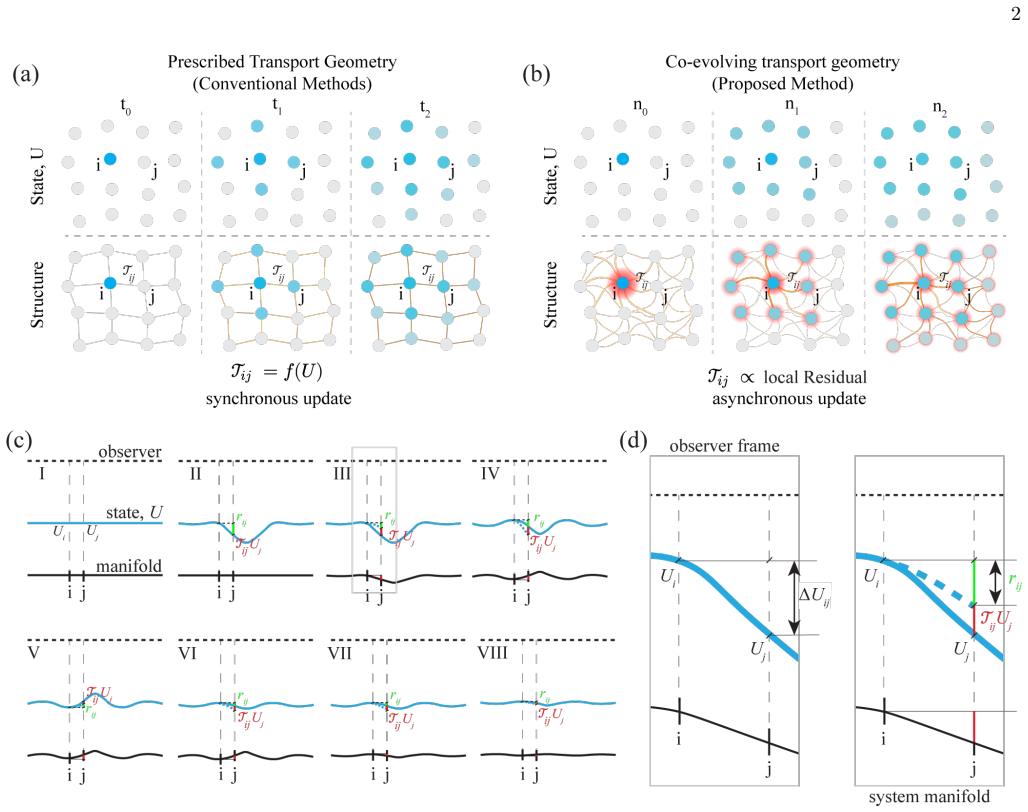
Classical dynamical laws are conventionally formulated as closed evolution equations defined on fixed geometric backgrounds and a global time parameter. We develop a formulation in which neither prescribed evolution laws nor an external clock are assumed a priori. Grounded in the principles of conservation, locality of interaction, and independent local frame freedom, the framework treats spatial geometry as a relational structure that may evolve together with the state. We introduce a notion of local incompatibility defined as the covariant difference between neighboring states under a dynamical transport connection. Because the transport relations are not fixed, restoring compatibility requires the joint adaptation of both state variables and transport geometry. We show that locality, gauge covariance, and coercivity strongly restrict the admissible form of this incompatibility and lead to a simple, globally additive, gauge-invariant quadratic measure of mismatch. Admissible dynamics are then defined as the asynchronous, finite-rate relaxation of this measure, without assuming a predefined action principle. A global time description appears only as an effective coarse-grained limit of this local relaxation process. In appropriate limits, the resulting compatibility-restoration dynamics recovers familiar continuum equations, including diffusion, incompressible Navier--Stokes, and the Amp\`ere--Maxwell relation. In this sense, dynamics arises from the coupled evolution of state and transport geometry toward local gauge consistency. The formulation provides a constructive framework in which effective physical laws emerge from local relational constraints.
0
0
physics.gen-ph 2026-04-02 Recognition

One library solves acoustic to anisotropic waves with built-in gradients

SWEEP (Seismic Wave Equation Exploration Platform): A Unified Solver Framework for Differentiable Wave Physics

SWEEP supplies interchangeable seismic engines and automatic differentiation so full-waveform inversion and related methods run from the同一个

Figure from the paper full image
abstract click to expand
SWEEP (Seismic Wave Equation Exploration Platform) is a unified and extensible wave equation solver library designed for wavefield modeling and inversion. It supports a wide range of wave propagation engines, including acoustic, elastic, attenuative, VTI, TTI, and their Born approximations, among others. With a built-in support for automatic differentiation, the framework enables seamless implementation of full-waveform inversion (FWI), least-squares reverse time migration (LSRTM), and other gradient-based optimization methods. It also features a plug-and-play architecture, allowing easy integration and flexible combination of custom loss functions, multi-GPU computation, neural networks, and more. This makes Sweep a powerful and customizable platform for tackling advanced seismic inverse problems.
0
0
physics.gen-ph 2026-03-31 2 theorems

Gravitational redshift may conflict with uncertainty principle

Gravitational Redshift of Light and the Heisenberg Uncertainty Principle

Pound-Rebka photon exchange leaves spacetime interaction unclear, prompting EPR entanglement test on Earth to check compatibility.

Figure from the paper full image
abstract click to expand
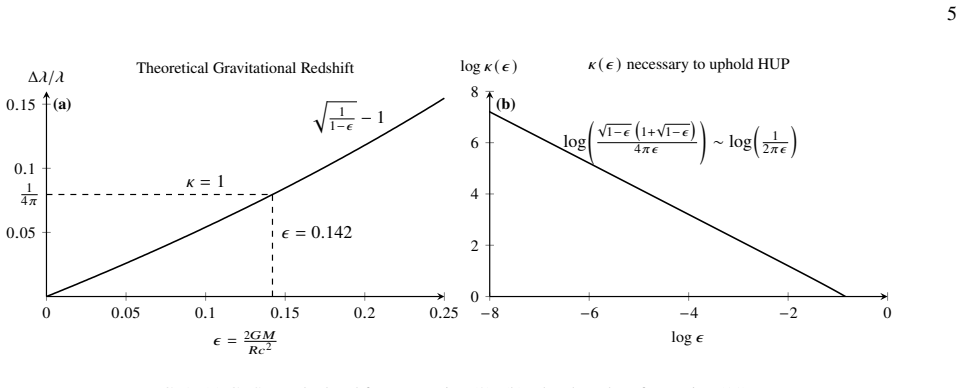
Empirical observations together with theoretical analyses are being used to argue that the classical phenomenon of gravitational redshift -- namely, the redshift of light in a static gravitational potential -- may be in tension with the Heisenberg uncertainty principle. In particular, in the Pound-Rebka experiment, the emitter-absorber pair interact with each other by exchanging a Mossbauer photon, a process that is fully describable within quantum mechanics but how the photon interacts with the spacetime metric remains unclear. Since the uncertainty principle is incompatible with local realism, as per general relativity, we propose to study continuous-variable photonic entanglement within the Einstein-Podolsky-Rosen (EPR) framework in a weak gravitational field. We outline a thought experiment, realizable on the surface of the Earth, that could shed further light on this problematic seamline between general relativity and quantum mechanics in the weak-field regime.
0
0
physics.gen-ph 2025-06-16 9 theorems

All fermion masses and α from one equation and the cube

A Complete Derivation of the Fermion Spectrum from the Recognition Composition Law

Every fermion mass and the fine-structure constant claimed as integer combinations of φ, with the electron mass as the only scale.

abstract click to expand
We present a first-principles derivation of the masses of all twelve known fermions -- three charged leptons, six quarks, and three neutrinos -- and the fine-structure constant $\alpha^{-1}$, from a single discrete functional equation, the Recognition Composition Law (RCL), with \textbf{zero continuously adjustable parameters}. The mass spectrum follows from the RCL supplemented by four regularity conditions and eight structural theorems (T1--T8): the golden ratio $\varphi=(1+\sqrt{5})/2$ emerges as the unique hierarchy base (T6); an 8-step period is fixed by the 3-cube Hamiltonian cycle (T7); three spatial dimensions are selected by a unique combinatorial identity (T8). All integers entering the mass formula are the six combinatorial invariants of the 3-cube $Q_3$; none is fitted. The sole empirical input is the electron mass, which fixes an irreducible unit-conversion constant~$\tau_0$. Predictions are confronted with PDG measurements. Charged-lepton masses are reproduced at sub-ppm accuracy for the muon and $\sim\!10^{-4}$ for the tau (Table~\ref{tab:lepton_validation}). All six quark masses are predicted at integer level; first-generation quarks agree to better than $1\%$, while second/third-generation residuals of $2$--$16\%$ are expected integer-precision effects (Table~\ref{tab:quark_validation}). Neutrino mass-squared splittings agree with NuFIT~5.3 within $1$--$2\sigma$, normal ordering is predicted, and $\Sigma m_\nu\approx 0.063$~eV satisfies cosmological bounds. All structural claims are machine-verified in Lean~4 (179 files, 0~\texttt{sorry}; \texttt{github.com/\allowbreak jonwashburn/\allowbreak recognition-science}).
0
0
physics.gen-ph 2023-06-22

Holey niobium film reported resistance-free up to 290 K

Evidence for room temperature superconductivity associated with a first-order phase transition

Author attributes the signal to a Nb–O square lattice and a first-order superconducting transition with thermal hysteresis.

Figure from the paper full image
abstract click to expand
By making periodic thru-holes in a suspended film, the phonon system can be modified. Motivated by the BCS theory, the technique -- so-called phonon engineering -- was applied to a metallic niobium sheet. It was found that its electrical resistance dropped to zero at 175 K, and the zero-resistance state persisted up to 290 K in the subsequent warming process. Despite the initial motivation, neither these high transition temperatures nor the phase transition with thermal hysteresis can be accounted for by the BCS theory. Therefore, we abandon the BCS theory. Instead, it turns out that the metallic holey sheet is partly oxidized to form a niobium-oxygen square lattice, which has points of resemblance to a copper-oxygen plane, the fundamental component of cuprate high-$T_{c}$ superconductors. Therefore, the pairing mechanism underlying this study should be related to that of cuprate high-$T_{c}$ superconductors, which we may not yet understand. In addition to the electrical results of zero resistance, the holey sheet exhibited a decrease in magnetization upon cooling, i.e., the Meissner effect. Moreover, the remnant magnetization was clearly detected at 300 K, which can only be attributed to persistent currents flowing in a superconducting sample. Thus, this study meets the established criteria for a conclusive demonstration of true superconductivity. Finally, the superconducting transition with the unambiguous thermal hysteresis is discussed. According to Halperin, Lubensky, and Ma, or HLM for short, any superconducting transition must $always$ be first order with thermal hysteresis because of the intrinsic fluctuating magnetic field. The HLM theory is very compatible with the highly oriented system harboring two-dimensional superconductivity.
0
0
physics.gen-ph 2019-08-27

Time as a cut, not a duration: an essay reframes the clock

The cut of time

The author asks what energy a body spends to merely exist in time, with no motion and no interaction.

Figure from the paper full image
abstract click to expand
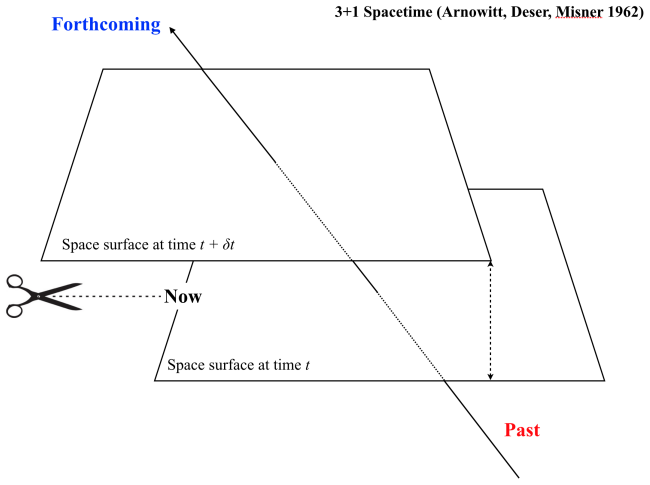
After a short review on the use of time in various branches of physics, I suggest to change the interpretation of time, from a duration to a cut. A reassessment of terminology is also required to avoid meaning traps. I also address the problem of estimating the energy needed by a physical object to shift in time without any other interaction or motion, that is, only to exist.
0

browse all of physics.gen-ph → full archive · search · sub-categories