HyperBones: Realtime Bone-driven Neural Garment Simulation with Hypernetwork Conditioning
Pith reviewed 2026-05-21 06:12 UTC · model grok-4.3
The pith
Virtual bones drive a neural network to simulate realistic garment dynamics in real time.
A machine-rendered reading of the paper's core claim, the machinery that carries it, and where it could break.
Core claim
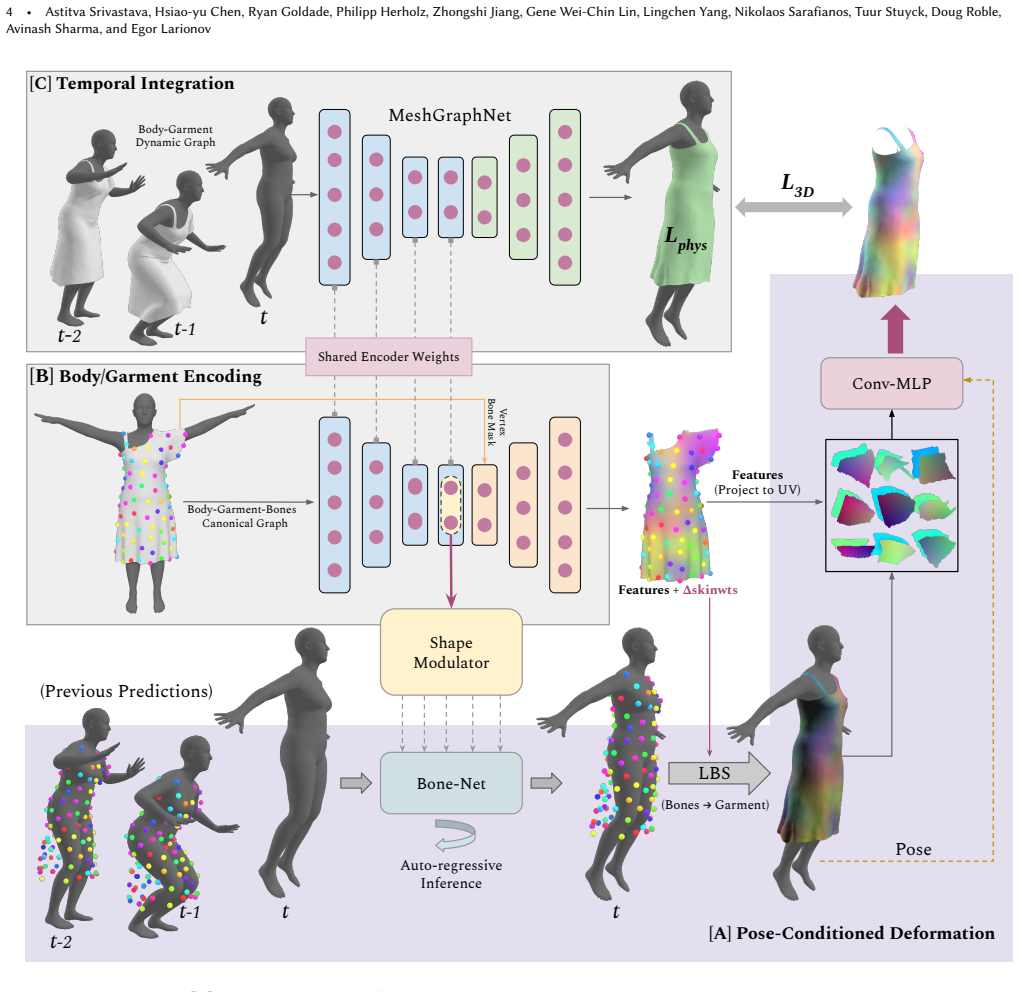
The authors propose a reduced-space neural dynamics simulator that uses a set of virtual bones integrated with a hypernetwork-conditioned neural network for coarse garment motion, followed by a trained convolutional neural map to recover fine-scale wrinkle details. By decoupling identity-specific aspects and employing a physics-supervision scheme during training, the method achieves physically plausible results without an external simulator at runtime, running at over 300 frames per second on a commodity GPU while generalizing to various motions and body shapes for a fixed set of garments.
What carries the argument
Hypernetwork-conditioned virtual bone drivers for coarse-level dynamics combined with a convolutional neural map for fine-scale details.
If this is right
- Real-time performance at 300+ FPS enables use in interactive applications.
- Generalization to different body shapes and motions supports diverse character animations.
- Support for a fixed set of garments allows pre-training for specific clothing items.
- Physics supervision removes dependency on external simulators during deployment.
Where Pith is reading between the lines
- Similar bone-driven approaches might apply to simulating other soft body elements like hair or flesh.
- Extending the hypernetwork to handle garment changes or tears could broaden applications.
- Integration with full character animation pipelines would test end-to-end performance.
Load-bearing premise
That the physics-supervision during training produces dynamics that remain accurate and stable without an external simulator for guidance at runtime.
What would settle it
A direct comparison of the neural simulation outputs against a high-accuracy physics-based simulator for a sequence of complex, unseen motions and body shapes.
Figures



read the original abstract
Recent advances in garment simulation have brought high-quality results closer to real-time performance. Physics-based simulators can produce accurate motion, but remain too computationally expensive for interactive applications. In contrast, linear blend skinning is efficient, but cannot capture the complex dynamics of loose-fitting garments, often leading to unrealistic motion and visual artifacts. Neural methods offer a promising alternative, yet they still struggle to animate loose clothing plausibly under strict runtime constraints. We present a fast and physically plausible approach for dynamic garment simulation. Our method trains a reduced-space neural dynamics simulator composed of independent coarse- and fine-level components. At the coarse level, the garment is driven by a set of virtual bones integrated with a lightweight neural network. Fine-scale wrinkle details are then recovered using a trained convolutional neural map. By decoupling identity-specific computation from real-time neural integration, our architecture maintains high performance while supporting diverse body shapes and motions. We further introduce an effective physics-supervision scheme that enables accurate results without relying on an external simulator. Experiments show that our method produces physically plausible garment dynamics, generalizes across a range of motions and body shapes, and supports a fixed set of garments. Our simulator runs at 300+ FPS on a commodity GPU, making it suitable for real-time applications.
Editorial analysis
A structured set of objections, weighed in public.
Referee Report
Summary. The manuscript presents HyperBones, a realtime neural garment simulation method using hypernetwork conditioning. It decomposes the problem into a coarse-level reduced-space dynamics model driven by a set of virtual bones integrated with a lightweight neural network, followed by a convolutional neural map to recover fine-scale wrinkle details. A physics-supervision scheme is introduced to train the model without an external simulator. The central claims are that the approach produces physically plausible garment dynamics, generalizes across motions and body shapes for a fixed set of garments, and achieves 300+ FPS on commodity GPUs.
Significance. If the physics-supervision claim holds and the quantitative results support the plausibility and generalization assertions, this work could meaningfully advance real-time garment simulation for interactive graphics applications such as games and VR. The decoupling of coarse dynamics from fine details via bones and hypernetworks, combined with the avoidance of external simulators during training, would be a practical strength for deployment and reproducibility. The method's efficiency at 300+ FPS addresses a key bottleneck in current neural garment approaches.
major comments (2)
- [§3.2] §3.2 (Physics Supervision Scheme): The central claim that the physics-supervision scheme produces accurate dynamics without any external simulator is load-bearing for the paper's contribution. However, the separation between the coarse bone-driven network and the fine-scale convolutional wrinkle map creates a potential point of circularity: if gradients for physical constraints (e.g., collision response or momentum) on the bone network flow through the wrinkle map, the supervision may implicitly depend on precomputed trajectories or ground-truth forces rather than purely analytic internal terms. The manuscript should provide the explicit loss equations, the computation graph, and confirmation that all physical terms are differentiable and self-contained within the network's own predictions.
- [Experiments] Experiments (quantitative evaluation section): The abstract asserts physically plausible results and generalization, yet no error metrics (e.g., position or velocity RMSE against ground-truth simulation), ablation studies on the supervision loss, or cross-body-shape comparisons are referenced in the provided text. If Tables 1–3 or Figures 4–6 report such numbers, they must be explicitly tied to the physics-supervision claim; otherwise the evidence for plausibility remains qualitative and insufficient to support the generalization statements.
minor comments (2)
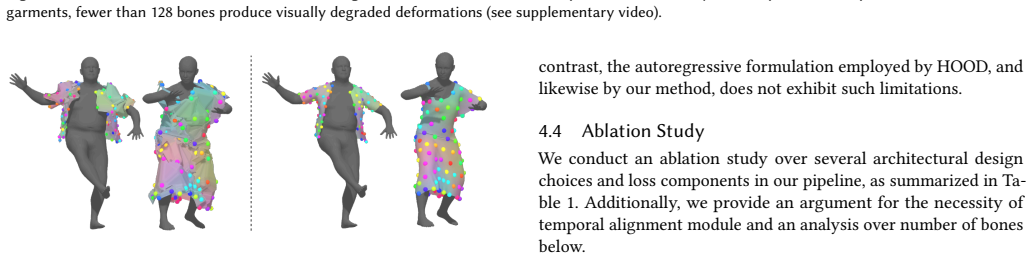
- [§2.1] The definition and initialization of the 'virtual bones' (distinct from standard linear blend skinning bones) should be clarified with a diagram or pseudocode in §2.1, as this is foundational to the reduced-space model.
- [Method] Notation for the hypernetwork conditioning parameters is introduced but not consistently used in equations; ensure all symbols are defined before first use.
Simulated Author's Rebuttal
We thank the referee for their constructive and detailed feedback. We address each major comment below and outline the revisions we will make to strengthen the manuscript's clarity and evidentiary support.
read point-by-point responses
-
Referee: [§3.2] §3.2 (Physics Supervision Scheme): The central claim that the physics-supervision scheme produces accurate dynamics without any external simulator is load-bearing for the paper's contribution. However, the separation between the coarse bone-driven network and the fine-scale convolutional wrinkle map creates a potential point of circularity: if gradients for physical constraints (e.g., collision response or momentum) on the bone network flow through the wrinkle map, the supervision may implicitly depend on precomputed trajectories or ground-truth forces rather than purely analytic internal terms. The manuscript should provide the explicit loss equations, the computation graph, and confirmation that all physical terms are differentiable and self-contained within the network's own predictions.
Authors: We appreciate the referee's careful analysis of the physics-supervision scheme. To clarify, the physical constraints (collision penalties, momentum preservation, and energy terms) are applied exclusively to the coarse-level bone-driven network outputs. The convolutional wrinkle map operates as a decoupled post-processing stage that adds high-frequency details but does not participate in the physics loss computation or receive gradients from it. All supervision terms are therefore analytic, differentiable, and computed solely from the bone network's predictions without reference to external trajectories or precomputed forces. We will revise §3.2 to include the full loss equations and a computation-graph diagram that explicitly shows the separation of the two stages. revision: yes
-
Referee: [Experiments] Experiments (quantitative evaluation section): The abstract asserts physically plausible results and generalization, yet no error metrics (e.g., position or velocity RMSE against ground-truth simulation), ablation studies on the supervision loss, or cross-body-shape comparisons are referenced in the provided text. If Tables 1–3 or Figures 4–6 report such numbers, they must be explicitly tied to the physics-supervision claim; otherwise the evidence for plausibility remains qualitative and insufficient to support the generalization statements.
Authors: We thank the referee for this observation. The current manuscript emphasizes visual and qualitative demonstrations of physical plausibility together with runtime measurements. We agree that explicit quantitative metrics would provide stronger support for the claims. In the revised version we will add position and velocity RMSE tables against ground-truth physics simulation, ablation results on the individual supervision loss terms, and cross-body-shape error comparisons. These new quantitative results will be directly referenced in the text and tied to the physics-supervision and generalization arguments. revision: yes
Circularity Check
No significant circularity in derivation chain
full rationale
The paper's central claims rest on a described architecture (coarse bone-driven neural network plus convolutional wrinkle map) and an explicitly stated physics-supervision scheme that operates without external simulators. No equations, fitted parameters, or self-citations are shown reducing predictions to inputs by construction. The supervision is presented as enforcing physical constraints via internal losses rather than precomputed trajectories or author-specific uniqueness theorems. The method is self-contained against the stated benchmarks of runtime performance and generalization, with no load-bearing reduction to prior self-citations or ansatz smuggling visible in the text.
Axiom & Free-Parameter Ledger
free parameters (1)
- hypernetwork conditioning parameters
axioms (1)
- domain assumption Physics-based supervision during training can produce accurate dynamics without an external simulator at inference time.
invented entities (1)
-
virtual bones
no independent evidence
Lean theorems connected to this paper
-
IndisputableMonolith/Cost/FunctionalEquation.leanwashburn_uniqueness_aczel unclear?
unclearRelation between the paper passage and the cited Recognition theorem.
Our method trains a reduced-space neural dynamics simulator composed of independent coarse- and fine-level components. At the coarse level, the garment is driven by a set of virtual bones integrated with a lightweight neural network. ... physics-supervision scheme ... Lphys = λs Lstretch + λb Lbend + λc Lcollision + λi Linertia
-
IndisputableMonolith/Foundation/AlphaCoordinateFixation.leanalpha_pin_under_high_calibration unclear?
unclearRelation between the paper passage and the cited Recognition theorem.
FiLM conditioning ... Shape Modulator MLP maps the precomputed shape code z ... hℓ ← γℓ(z) ⊙ hℓ + βℓ(z)
What do these tags mean?
- matches
- The paper's claim is directly supported by a theorem in the formal canon.
- supports
- The theorem supports part of the paper's argument, but the paper may add assumptions or extra steps.
- extends
- The paper goes beyond the formal theorem; the theorem is a base layer rather than the whole result.
- uses
- The paper appears to rely on the theorem as machinery.
- contradicts
- The paper's claim conflicts with a theorem or certificate in the canon.
- unclear
- Pith found a possible connection, but the passage is too broad, indirect, or ambiguous to say the theorem truly supports the claim.
discussion (0)
Sign in with ORCID, Apple, or X to comment. Anyone can read and Pith papers without signing in.