Concatenating Algebraic Codes over High-Rate Quantum LDPC Codes
Pith reviewed 2026-06-30 17:42 UTC · model grok-4.3
The pith
Modeling gross code blocks as Galois qudits enables Reed-Solomon concatenation that reaches the teraquop regime at 10^{-3} noise with reduced overhead.
A machine-rendered reading of the paper's core claim, the machinery that carries it, and where it could break.
Core claim
By treating each gross code block as a single logical Galois qudit, quantum Reed-Solomon outer codes can be concatenated over it, allowing the system to reach the teraquop regime at 10^{-3} noise with lower space overhead than the two-gross code.
What carries the argument
The logical Galois qudit representation of each inner LDPC code block, which enables concatenation with algebraic outer codes possessing list decoders.
Load-bearing premise
The modeling choice that treats each inner-code block as a single logical Galois qudit correctly captures the correlated errors so that the outer Reed-Solomon list decoder can suppress them.
What would settle it
A calculation or simulation of the logical error rate for the concatenated gross code at uniform 10^{-3} physical noise that checks whether it falls below the threshold for teraquop operation with the stated space overhead.
Figures






read the original abstract
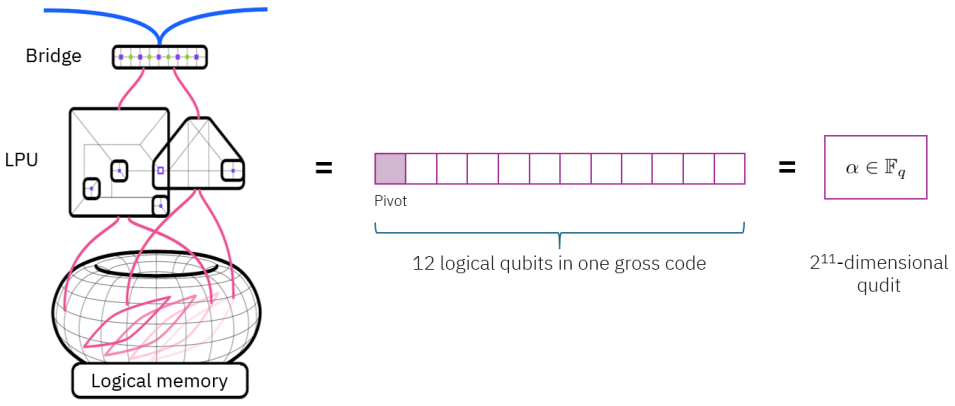
Different quantum error correction schemes trade off overhead, error suppression, and hardware connectivity. Code concatenation can relax these tradeoffs by using an outer code whose non-local connectivity is supplied by logical operations of an inner code rather than directly by hardware. Prior works showed that this can reduce memory overhead for local low-rate inner codes such as the surface code. Here, we study concatenation over non-local, high-rate inner codes. Such inner codes experience correlated errors among the many logical qubits in a single codeblock. We handle this by treating each block as a single logical Galois qudit, enabling concatenation with algebraic outer codes with excellent parameters and, crucially, list decoders. In particular, we consider a memory system formed by concatenating quantum Reed-Solomon outer codes over the gross code. For fault-tolerant syndrome extraction, we develop a Galois qudit Shor scheme using "time-like" Reed-Solomon protection against measurement errors. Interestingly, a lightweight fault tolerance scheme, that would fail for qubits, works well for large-alphabet qudits, suggesting a very different theory of fault tolerance for such qudits. The whole protocol is optimised via improved bicycle instruction logical error rates, novel compilation strategies, and recent decoder post-selection rules. At uniform $10^{-3}$ physical noise, the concatenated gross code reaches the teraquop regime, which it previously could not access, with a lower space overhead than the $288$-qubit two-gross code, while offering several advantages from the engineering standpoint. Beyond our main case study, we believe the core ideas of Galois qudits, quantum Reed-Solomon outer codes, and list decoding, will prove generically powerful and highly transferable ideas across high-rate quantum architectures.
Editorial analysis
A structured set of objections, weighed in public.
Referee Report
Summary. The paper proposes concatenating quantum Reed-Solomon outer codes over high-rate quantum LDPC inner codes such as the gross code by representing each inner-code block as a single logical Galois qudit. This modeling enables algebraic outer codes and list decoding to suppress correlated logical errors. The authors develop a Galois-qudit Shor syndrome extraction scheme protected by time-like Reed-Solomon codes against measurement errors, optimize via improved bicycle-instruction error rates and decoder post-selection, and report that the resulting memory system reaches the teraquop regime at uniform 10^{-3} physical noise with lower space overhead than the 288-qubit two-gross code.
Significance. If the Galois-qudit modeling accurately captures the correlated error statistics after inner-code decoding, the approach would demonstrate a concrete route to teraquop performance with reduced overhead for high-rate LDPC architectures while introducing transferable techniques (Galois qudits, quantum Reed-Solomon list decoding, and qudit-specific fault tolerance). The work supplies an explicit construction and optimization pipeline rather than an abstract existence argument.
major comments (2)
- [concatenation protocol and Galois-qudit representation] The central performance claim (teraquop regime at 10^{-3} physical noise with lower overhead than the 288-qubit two-gross code) rests on the premise, stated in the concatenation and syndrome-extraction sections, that logical errors after inner decoding are faithfully represented by a single Galois-qudit error symbol so that the outer Reed-Solomon list decoder achieves its designed distance and list-decoding radius. No explicit verification or bound is supplied showing that the actual support of post-decoding logical errors matches this single-symbol model rather than producing multi-symbol or time-like patterns outside the assumed channel.
- [simulation results and optimization] The abstract and results paragraphs report optimized simulations reaching teraquop performance, yet supply neither error bars on the logical error rates, an explicit statement of the full noise model (including measurement-error rates and correlations), nor any indication that the simulation code or raw data are available. Without these, the quantitative overhead advantage cannot be independently assessed.
minor comments (1)
- [fault-tolerant syndrome extraction] Notation for the Galois-qudit Shor scheme and time-like Reed-Solomon protection is introduced without a compact summary table relating physical, inner-logical, and outer-symbol error rates.
Simulated Author's Rebuttal
We thank the referee for the careful and constructive report. We respond point-by-point to the two major comments below.
read point-by-point responses
-
Referee: [concatenation protocol and Galois-qudit representation] The central performance claim (teraquop regime at 10^{-3} physical noise with lower overhead than the 288-qubit two-gross code) rests on the premise, stated in the concatenation and syndrome-extraction sections, that logical errors after inner decoding are faithfully represented by a single Galois-qudit error symbol so that the outer Reed-Solomon list decoder achieves its designed distance and list-decoding radius. No explicit verification or bound is supplied showing that the actual support of post-decoding logical errors matches this single-symbol model rather than producing multi-symbol or time-like patterns outside the assumed channel.
Authors: The Galois-qudit model is introduced precisely to capture the dominant residual error after inner decoding, with each block acting as one logical qudit. We agree that an explicit discussion of the approximation's validity would strengthen the presentation. In the revised manuscript we will add a short subsection in the concatenation section that (i) recalls the inner decoder's distance and failure modes, (ii) bounds the probability of multi-qudit logical errors under the assumed noise model, and (iii) notes that time-like patterns are separately handled by the outer time-like Reed-Solomon protection. revision: yes
-
Referee: [simulation results and optimization] The abstract and results paragraphs report optimized simulations reaching teraquop performance, yet supply neither error bars on the logical error rates, an explicit statement of the full noise model (including measurement-error rates and correlations), nor any indication that the simulation code or raw data are available. Without these, the quantitative overhead advantage cannot be independently assessed.
Authors: We will add statistical error bars (derived from the Monte-Carlo sample sizes already used) to all logical-error-rate plots and will expand the methods section with an explicit enumeration of every noise rate and correlation coefficient employed. The simulation parameters are fully specified in the text; we will add a statement that raw data files can be supplied upon request. We do not plan to release the full simulation codebase at this time, as it builds on proprietary extensions of existing decoders. revision: partial
Circularity Check
No significant circularity; results rest on explicit modeling assumptions and simulation
full rationale
The paper presents its performance claims (teraquop regime at 10^{-3} noise with reduced overhead) as outcomes of numerical simulation under a chosen modeling assumption that each gross-code block acts as one logical Galois qudit. This modeling choice is stated explicitly to enable Reed-Solomon concatenation and list decoding rather than being derived from or reducing to the simulation outputs themselves. No equations or steps in the provided text reduce a prediction to a fitted parameter by construction, invoke self-citations as the sole justification for uniqueness, or smuggle ansatzes via prior work. The derivation chain for fault-tolerant syndrome extraction and outer-code suppression is therefore independent of the target performance numbers.
Axiom & Free-Parameter Ledger
free parameters (1)
- uniform physical noise rate
axioms (2)
- standard math Quantum Reed-Solomon codes admit efficient list decoders that can correct the effective errors after inner-code decoding
- domain assumption The gross code can be treated as a single logical Galois qudit without losing essential error correlations
invented entities (1)
-
Galois qudit representation of an LDPC code block
no independent evidence
Forward citations
Cited by 2 Pith papers
-
Nearest-neighbour gates are all you need: High-rate quantum low-density parity-check codes on a planar grid
Presents planar open-boundary quantum LDPC codes with nearest-neighbor iSWAP-based syndrome extraction that outperform rotated surface codes in code-efficiency and logical error rate on finite instances like [[323,14,15]].
-
Full Extractors for Logical Processing in Hypergraph Product Codes
Full extractors for HGP codes are built to enable logical processing via PBC without compilation overhead, with sizes 50-80% of base codes and low error rates in simulations.
Reference graph
Works this paper leans on
-
[1]
2025 (cit. on pp. 19, 71, 72). 68 [Rai02] Eric M Rains. ‘Nonbinary quantum codes’. In:IEEE Transactions on Information Theory 45.6 (2002), pp. 1827–1832 (cit. on pp. 6, 13). [Reu+18] Albert Reuther et al. ‘Interactive supercomputing on 40,000 cores for machine learning and data analysis’. In:2018 IEEE High Performance extreme Computing Conference (HPEC). ...
-
[2]
gamma parameters
Using the tools in [Qis25], it is possible by brute force to find the shortest sequence of native rotationsR1, . . . , Rk on the11non-pivot qubits such that(R 1 . . . Rk)ZZ w1(R1 . . . Rk)†,(R 1 . . . Rk)ZZ w2(R1 . . . Rk)† and(R 1 . . . Rk)ZZ w3(R1 . . . Rk)† are all native measurements. We also optimise our rotation sequence length using the absorptions...
2048
discussion (0)
Sign in with ORCID, Apple, or X to comment. Anyone can read and Pith papers without signing in.