Nearest-neighbour gates are all you need: High-rate quantum low-density parity-check codes on a planar grid
Pith reviewed 2026-06-26 20:37 UTC · model grok-4.3
The pith
High-rate quantum LDPC codes achieve better efficiency than surface codes using only nearest-neighbour gates on a planar grid.
A machine-rendered reading of the paper's core claim, the machinery that carries it, and where it could break.
Core claim
Nearest-neighbour iSWAP walks both define the stabiliser supports and implement their measurement for a family of planar quantum LDPC codes, yielding optimal constant-depth extraction independent of code size, natural leakage removal, and finite-size performance advantages over surface codes that survive compilation to strictly local circuits.
What carries the argument
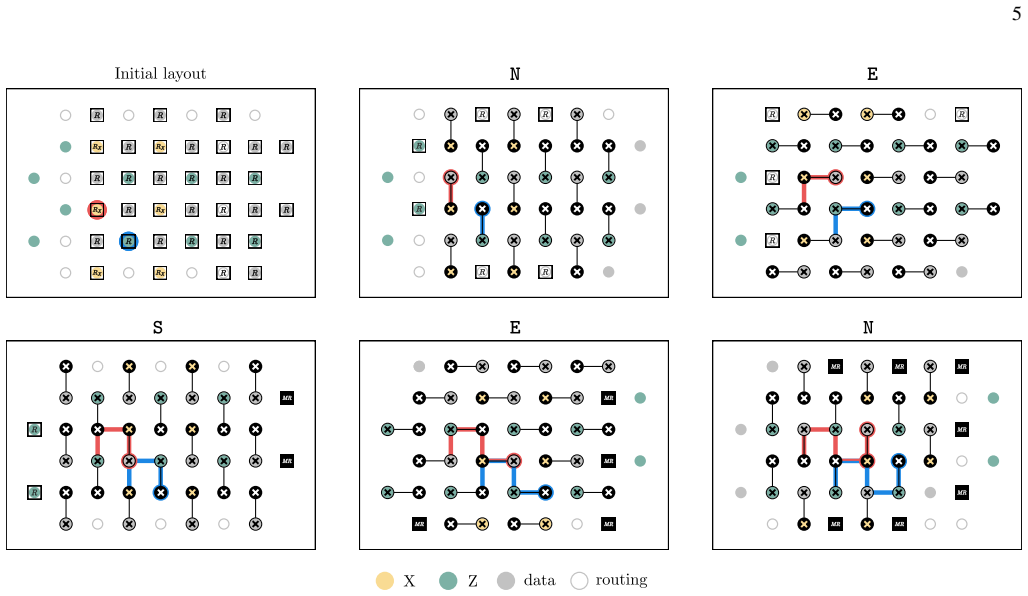
Directional tile-code layouts whose check-data connectivity is generated on the fly by nearest-neighbour iSWAP walks that both specify stabiliser supports and perform syndrome extraction.
If this is right
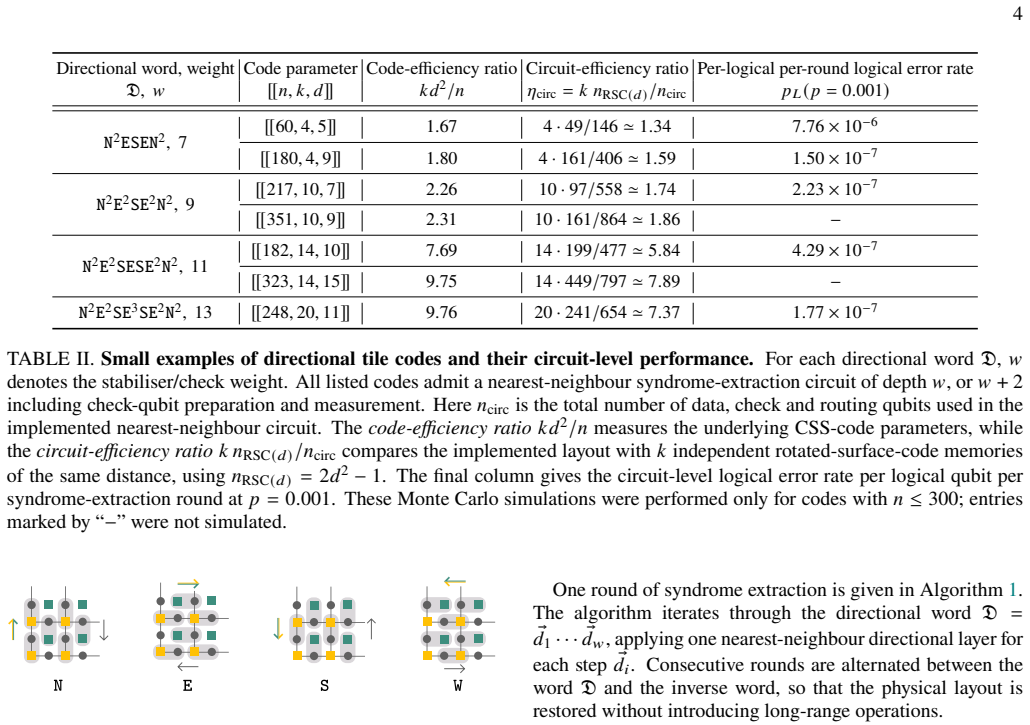
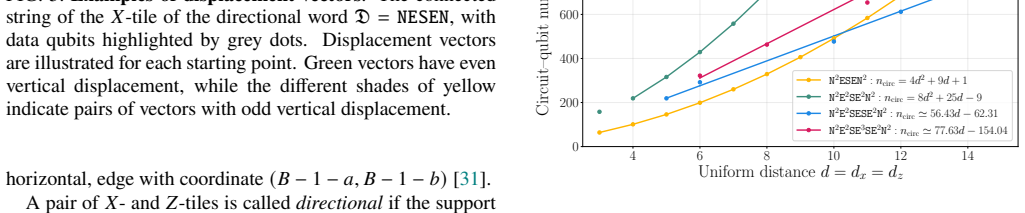
- Finite-size instances such as the [[323,14,15]] code reach a code-efficiency ratio nearly an order of magnitude larger than rotated surface-code patches.
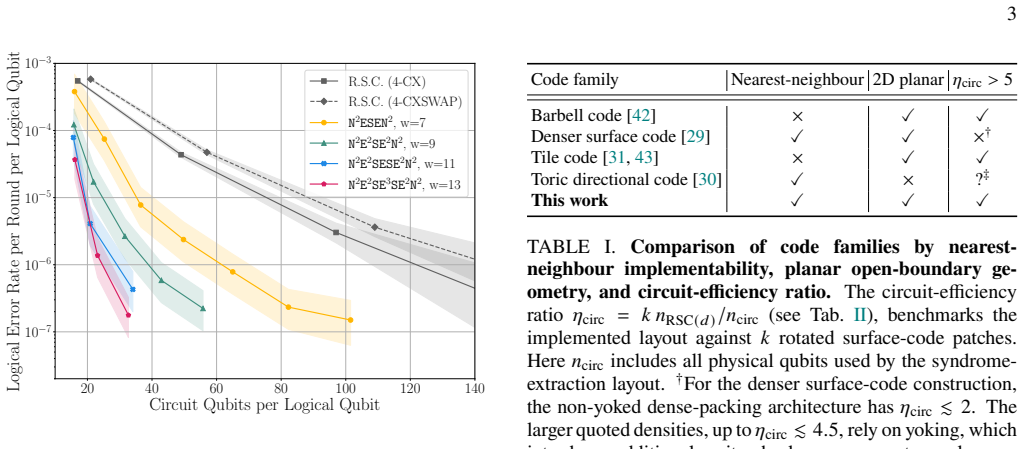
- At around 30 circuit qubits per logical qubit the best layouts reduce per-logical per-round logical error rate by up to a factor of 1000 relative to rotated surface-code memories.
- The advantages of quantum LDPC codes survive compilation into strictly planar nearest-neighbour circuits.
- Stabiliser measurement circuits achieve optimal constant depth independent of code size and exchange check and data qubit roles each round.
Where Pith is reading between the lines
- Low-overhead fault-tolerant quantum memories become plausible on near-term superconducting hardware that only supports nearest-neighbour gates.
- The same dynamic-connectivity idea could be tested on other families of codes that currently require long-range interactions.
- If the leakage-removal property holds under realistic noise, fewer dedicated leakage-mitigation primitives may be needed in larger architectures.
Load-bearing premise
Nearest-neighbour iSWAP walks can both define the stabiliser supports and implement their measurement while achieving optimal constant-depth extraction independent of code size and naturally removing leakage, without introducing unmodeled connectivity or error sources.
What would settle it
A circuit-level noise simulation or hardware run on a small directional tile-code instance that measures whether the reported logical error-rate reductions hold once the full iSWAP walk circuits and any resulting leakage or connectivity effects are included.
Figures

read the original abstract
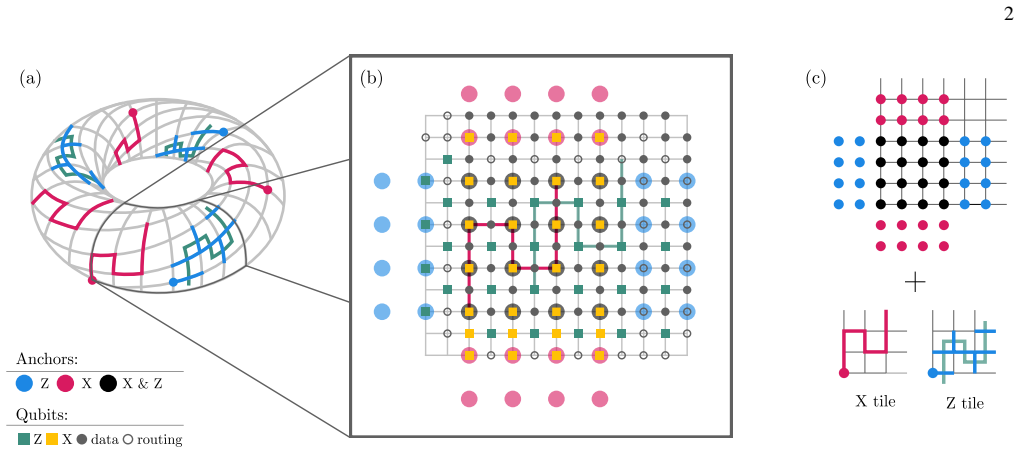
High-performance quantum low-density parity-check codes promise substantial reductions in the overhead of fault-tolerant quantum computation, but most constructions require long-range connectivity or qubit shuttling, both of which are difficult to realise in superconducting architectures. Here we introduce a family of quantum low-density parity-check codes that, for the first time, combines planar open-boundary layouts, finite-size advantages over surface codes, and syndrome extraction using only nearest-neighbour gates on a square grid of qubits. The key idea is to generate check-data connectivity dynamically: nearest-neighbour iSWAP walks both define the stabiliser supports and implement their measurement, avoiding the need for a long-range hardware graph. The resulting circuits achieve optimal constant-depth stabiliser measurement, independent of code size, and naturally remove leakage from the system by exchanging the role of check and data qubits at each syndrome extraction round. We find finite-size instances such as a [[323,14,15]] code, whose code-efficiency ratio is nearly an order of magnitude larger than that of rotated surface-code patches. At around 30 circuit qubits per logical qubit, the best directional tile-code layouts reduce the per-logical per-round logical error rate by up to a factor of 1000 relative to rotated surface-code memories. These results show that the advantages of quantum low-density parity-check codes can survive compilation into strictly planar nearest-neighbour circuits, bringing low-overhead fault-tolerant memories closer to near-term hardware.
Editorial analysis
A structured set of objections, weighed in public.
Referee Report
Summary. The manuscript introduces a family of planar quantum LDPC codes realized on a square grid of qubits using only nearest-neighbour gates. The central construction employs dynamic iSWAP walks that simultaneously define stabiliser supports and perform syndrome extraction in constant depth independent of code size, while exchanging the roles of check and data qubits to remove leakage. Finite-size examples are given, including a [[323,14,15]] code whose efficiency ratio is claimed to be nearly an order of magnitude better than rotated surface-code patches; at roughly 30 circuit qubits per logical qubit the best directional tile-code layouts are reported to reduce per-logical per-round logical error rates by up to a factor of 1000 relative to surface-code memories.
Significance. If the construction and compiled-circuit performance claims are substantiated, the work would be significant for fault-tolerant quantum computing: it demonstrates that high-rate qLDPC advantages can survive strict planar nearest-neighbour compilation without long-range connectivity or shuttling, directly addressing a major obstacle for superconducting hardware. The constant-depth extraction and built-in leakage removal are notable technical strengths, and the provision of concrete finite-size instances with explicit parameters makes the overhead claims falsifiable and practically relevant.
major comments (2)
- [§4 and §5.1] §4 (iSWAP walk construction) and §5.1 (compiled circuit depth): the claim that nearest-neighbour iSWAP walks achieve optimal constant-depth stabiliser measurement independent of code size while exactly realising the directional tile-code stabiliser supports must be accompanied by an explicit schedule and distance-preservation argument; without it the [[323,14,15]] parameters and the factor-of-1000 error-rate comparison rest on an unverified assumption.
- [§6 and Table 2] §6 (numerical results) and Table 2: the reported 1000× logical-error reduction at ~30 qubits per logical qubit is obtained only under a specific noise model after iSWAP compilation; the manuscript must specify the additional two-qubit and idle-error rates introduced by the walks and demonstrate that they do not erode the quoted gain relative to rotated surface codes, as any hidden depth scaling or coherent-error accumulation would invalidate the headline comparison.
minor comments (2)
- [Figure 3] Figure 3 caption: the timing diagram for a single syndrome round should explicitly label the number of iSWAP layers to allow immediate verification of the constant-depth claim.
- [§2.2] Notation in §2.2: the definition of the directional tile code parameters (n,k,d) should be cross-referenced to the explicit [[323,14,15]] instance to avoid ambiguity when comparing efficiency ratios.
Simulated Author's Rebuttal
We thank the referee for their thorough review and constructive suggestions. The comments highlight important points for substantiating our claims on the iSWAP-based compilation. We address each major comment below and will incorporate clarifications and additional material in the revised manuscript.
read point-by-point responses
-
Referee: [§4 and §5.1] §4 (iSWAP walk construction) and §5.1 (compiled circuit depth): the claim that nearest-neighbour iSWAP walks achieve optimal constant-depth stabiliser measurement independent of code size while exactly realising the directional tile-code stabiliser supports must be accompanied by an explicit schedule and distance-preservation argument; without it the [[323,14,15]] parameters and the factor-of-1000 error-rate comparison rest on an unverified assumption.
Authors: We agree that an explicit schedule strengthens verifiability. The manuscript already outlines the local iSWAP walk rules in §4 that generate the directional tile supports in constant depth via nearest-neighbour interactions on the grid; the distance preservation follows from the fact that the walks exactly reproduce the stabiliser supports of the underlying tile code without introducing new weight-2 errors that reduce distance. In the revision we will add an explicit step-by-step schedule for the [[323,14,15]] instance together with a short distance-preservation argument showing that the compiled circuit realises the same logical operators as the abstract code. revision: yes
-
Referee: [§6 and Table 2] §6 (numerical results) and Table 2: the reported 1000× logical-error reduction at ~30 qubits per logical qubit is obtained only under a specific noise model after iSWAP compilation; the manuscript must specify the additional two-qubit and idle-error rates introduced by the walks and demonstrate that they do not erode the quoted gain relative to rotated surface codes, as any hidden depth scaling or coherent-error accumulation would invalidate the headline comparison.
Authors: The simulations in §6 employ a uniform depolarising model in which every two-qubit gate (including iSWAPs) has the same error probability p; idle errors during the constant-depth walks are already included at the same rate. Because the extraction depth remains O(1) independent of code size, there is no hidden depth scaling. In the revision we will explicitly tabulate the per-gate error rates used for the walks, add a short paragraph confirming the absence of coherent-error accumulation under the assumed model, and include a supplementary simulation showing that the reported factor-of-1000 advantage persists when idle errors are set to the same strength as gate errors. revision: yes
Circularity Check
No significant circularity detected in derivation chain
full rationale
The paper presents an explicit construction of planar quantum LDPC codes whose stabiliser supports are generated dynamically via nearest-neighbour iSWAP walks on a square grid. Reported instances such as the [[323,14,15]] code and the associated efficiency and error-rate comparisons are obtained from concrete finite-size layouts and circuit simulations rather than from any fitted parameter renamed as a prediction or from a self-referential definition. No load-bearing step reduces a claimed performance metric to an input by construction, invokes a self-citation for uniqueness, or smuggles an ansatz. The architecture (constant-depth extraction, leakage removal by role exchange) is part of the proposed method and does not tautologically presuppose the numerical advantages asserted. The derivation is therefore self-contained.
Axiom & Free-Parameter Ledger
Forward citations
Cited by 1 Pith paper
-
Bunny Codes: Broadening Superconducting Quantum Error Correction Capability through Advanced Control Engineering
Bunny codes are qLDPC codes found via exhaustive search that achieve ~3x higher code rate than toric codes (periodic) and ~2x over rotated surface codes (open) when using CNOT+CXSWAP on nearest-neighbor connectivity, ...
Reference graph
Works this paper leans on
-
[1]
E. T. Campbell, B. M. Terhal, and C. Vuillot, Nature549, 172 (2017)
2017
-
[2]
Roffe, Contemp
J. Roffe, Contemp. Phys.60, 226 (2019)
2019
- [3]
-
[4]
A. A. Mele, A. Angrisani, S. Ghosh,et al., Nature Phys.22, 751 (2026)
2026
-
[5]
Stilck Franc ¸a and R
D. Stilck Franc ¸a and R. Garc´ıa-Patr´on, Nature Phys.17, 1221 (2020)
2020
-
[6]
Dennis, A
E. Dennis, A. Kitaev, A. Landahl,et al., J. Math. Phys.43, 4452 (2002)
2002
-
[7]
A. Y. Kitaev, Ann. Phys.303, 2 (2003)
2003
-
[8]
Google Quantum AI and collaborators, Nature638, 920 (2025)
2025
-
[9]
Krinner, N
S. Krinner, N. Lacroix, A. Remm,et al., Nature605, 669 (2022)
2022
-
[10]
Y. Zhao, Y. Ye, H.-L. Huang,et al., Phys. Rev. Lett.129, 030501 (2022)
2022
-
[11]
N. P. Breuckmann and J. N. Eberhardt, PRX Quantum2, 040101 (2021)
2021
-
[12]
Panteleev and G
P. Panteleev and G. Kalachev, Quantum5, 585 (2021)
2021
-
[13]
Leverrier and G
A. Leverrier and G. Z ´emor, in2022 IEEE 63rd Annual Sympo- sium on Foundations of Computer Science (FOCS)(2022) pp. 872–883
2022
-
[14]
Panteleev and G
P. Panteleev and G. Kalachev, IEEE Trans. Inf. Th.68, 213 (2022)
2022
-
[15]
N. P. Breuckmann and J. N. Eberhardt, IEEE Trans. Inf. Th.67, 6653 (2021)
2021
-
[16]
Bravyi, A
S. Bravyi, A. W. Cross, J. M. Gambetta,et al., Nature627, 778 (2024)
2024
- [17]
-
[18]
M. Cain, Q. Xu, R. King,et al., (2026), arXiv:2603.28627
Pith/arXiv arXiv 2026
-
[19]
C. Zhao, C. Duckering, A. Gu,et al., (2026), arXiv:2604.16209
Pith/arXiv arXiv 2026
-
[20]
S. Khan, S. Sethi, K. Sahay,et al., (2026), arXiv:2604.19735
Pith/arXiv arXiv 2026
-
[21]
A. Wills, M. E. Beverland, L. S. Bishop,et al., (2026), arXiv:2605.21898
Pith/arXiv arXiv 2026
-
[22]
S. Dasu, M. DeCross, A. Y. Guo,et al., (2026), arXiv:2602.22211
arXiv 2026
-
[23]
Q. Xu, J. P. Bonilla Ataides, C. A. Pattison,et al., Nature Phys. 20, 1084 (2024)
2024
-
[24]
Bluvstein, S
D. Bluvstein, S. J. Evered, A. A. Geim,et al., Nature626, 58 (2024)
2024
-
[25]
Mathews, L
M. Mathews, L. Pahl, D. Pahl, V. L. Addala,et al., npj Quant. Inf.10, in press (2026)
2026
-
[26]
K. Wang, Z. Lu, C. Zhang,et al., Nature Phys.22, 308–314 (2026)
2026
-
[27]
Bravyi, D
S. Bravyi, D. Poulin, and B. Terhal, Phys. Rev. Lett.104, 050503 (2010)
2010
-
[28]
Baspin and A
N. Baspin and A. Krishna, Quantum6, 711 (2022)
2022
-
[29]
G. H. Low, W. J. Huggins, D. W. Berry,et al., (2026), arXiv:2605.30455
Pith/arXiv arXiv 2026
-
[30]
G. P. Geh ´er, D. Byfield, and A. Ruban, (2025), arXiv:2507.19430
arXiv 2025
-
[31]
Steffan, S
V. Steffan, S. H. Choe, N. P. Breuckmann,et al., Phys. Rev. Lett. 135, 170601 (2025)
2025
-
[32]
Eickbusch, M
A. Eickbusch, M. McEwen, V. Sivak,et al., Nature Phys.21, 1994 (2025)
1994
-
[33]
Y. Sung, L. Ding, J. Braum¨ uller,et al., Phys. Rev. X11, 021058 (2021)
2021
-
[34]
L. R. B. Picard, A. J. Park, G. E. Patenotte,et al., Nature637, 821 (2024)
2024
-
[35]
Z. Chen, W. Liu, Y. Ma,et al., Nature Phys.21, 1489 (2025)
2025
- [36]
- [37]
-
[38]
A. G. Fowler, Phys. Rev. A88, 042308 (2013)
2013
-
[39]
K. C. Miao, M. McEwen, J. Atalaya,et al., Nature Phys.19, 1780–1786 (2023)
2023
-
[40]
McEwen, D
M. McEwen, D. Bacon, and C. Gidney, Quantum7, 1172 (2023)
2023
-
[41]
Bombin and M
H. Bombin and M. A. Martin-Delgado, Phys. Rev. A76, 012305 (2007)
2007
-
[42]
S. H. Choe, V. Steffan, F. Vigneau,et al., (2026), arXiv:2606.06062
Pith/arXiv arXiv 2026
-
[43]
Liang, J
Z. Liang, J. N. Eberhardt, and Y.-A. Chen, PRX Quantum6, 040330 (2025)
2025
- [44]
- [45]
-
[46]
K. X. Wei, I. Lauer, E. Pritchett,et al., PRX Quantum5, 020338 (2024)
2024
-
[47]
Kriˇ zan, J
C. Kriˇ zan, J. Bizn´arov´a, L. Chen,et al., New J. Phys.27, 074507 (2025)
2025
-
[48]
Y. Yang, G. Zhang, and Y. Li, (2025), arXiv:2506.18061
arXiv 2025
-
[49]
Horsman, A
C. Horsman, A. G. Fowler, S. Devitt,et al., New J. Phys.14, 123011 (2012)
2012
-
[50]
N. P. Breuckmann, S. H. Choe, J. N. Eberhardt,et al., (2025), arXiv:2511.14589
arXiv 2025
-
[51]
Sayginel, S
H. Sayginel, S. Koutsioumpas, M. Webster,et al., PRX Quantum 6, 030343 (2025)
2025
-
[52]
Liang, K
Z. Liang, K. Liu, H. Song,et al., PRX Quantum6, 020357 (2025)
2025
-
[53]
J. N. Eberhardt and V. Steffan, (2024), arXiv:2407.03973
arXiv 2024
-
[54]
Putterman, K
H. Putterman, K. Noh, C. T. Hann,et al., Nature638, 927 (2025)
2025
-
[55]
A. Hajr, B. Qing, K. Wang,et al., Phys. Rev. X14, 041049 (2024)
2024
-
[56]
Lescanne, M
R. Lescanne, M. Villiers, T. Peronnin,et al., Nature Phys.16, 509 (2020)
2020
-
[57]
J. P. Bonilla Ataides, D. K. Tuckett, S. D. Bartlett,et al., Nature Comm.12, 2172 (2021)
2021
-
[58]
D. K. Tuckett, S. D. Bartlett, and S. T. Flammia, Phys. Rev. Lett. 120, 050505 (2018)
2018
-
[59]
Tiurev, A
K. Tiurev, A. Pesah, P.-J. H. S. Derks,et al., Phys. Rev. Lett. 133, 110601 (2024)
2024
-
[60]
Roffe, L
J. Roffe, L. Z. Cohen, A. O. Quintavalle,et al., Quantum7, 1005 (2023)
2023
-
[61]
Q. Xu, N. Mannucci, A. Seif, A. Kubica,et al., Phys. Rev. Res. 5, 013035 (2023)
2023
-
[62]
J. Das, S. Dhara, P. Medina,et al., (2026), arXiv:2605.15348
Pith/arXiv arXiv 2026
-
[63]
L. P. Pryadko, V. A. Shabashov, and V. K. Kozin, J. Open Source Soft.7, 4120 (2022)
2022
-
[64]
Z. He, A. Cowtan, D. J. Williamson,et al., (2025), arXiv:2503.10390
arXiv 2025
-
[65]
S. Koutsioumpas, H. Sayginel, M. Webster,et al., (2025), arXiv:2503.01738
arXiv 2025
-
[66]
Gidney, Quantum5, 497 (2021)
C. Gidney, Quantum5, 497 (2021)
2021
- [67]
-
[68]
route window shortening
T. Hillmann, L. Berent, A. O. Quintavalle,et al., Nature Comm. 16, 8214 (2025). 10 Appendix A: Toric directional codes as bivariate-bicycle codes Toric directional codes [30, 44] are obtained by tessellating a generalised torus with directional tiles. This yields a trans- lationally invariant CSS code whose𝑋-type stabilisers are translates of the directio...
2025
discussion (0)
Sign in with ORCID, Apple, or X to comment. Anyone can read and Pith papers without signing in.