Silicate cosmic dust grain collisions in the interstellar medium: A molecular dynamics study
Pith reviewed 2026-05-22 05:15 UTC · model grok-4.3
The pith
Molecular dynamics simulations show silicate dust grains shatter at collision speeds near 6 km/s, twice the canonical threshold.
A machine-rendered reading of the paper's core claim, the machinery that carries it, and where it could break.
Core claim
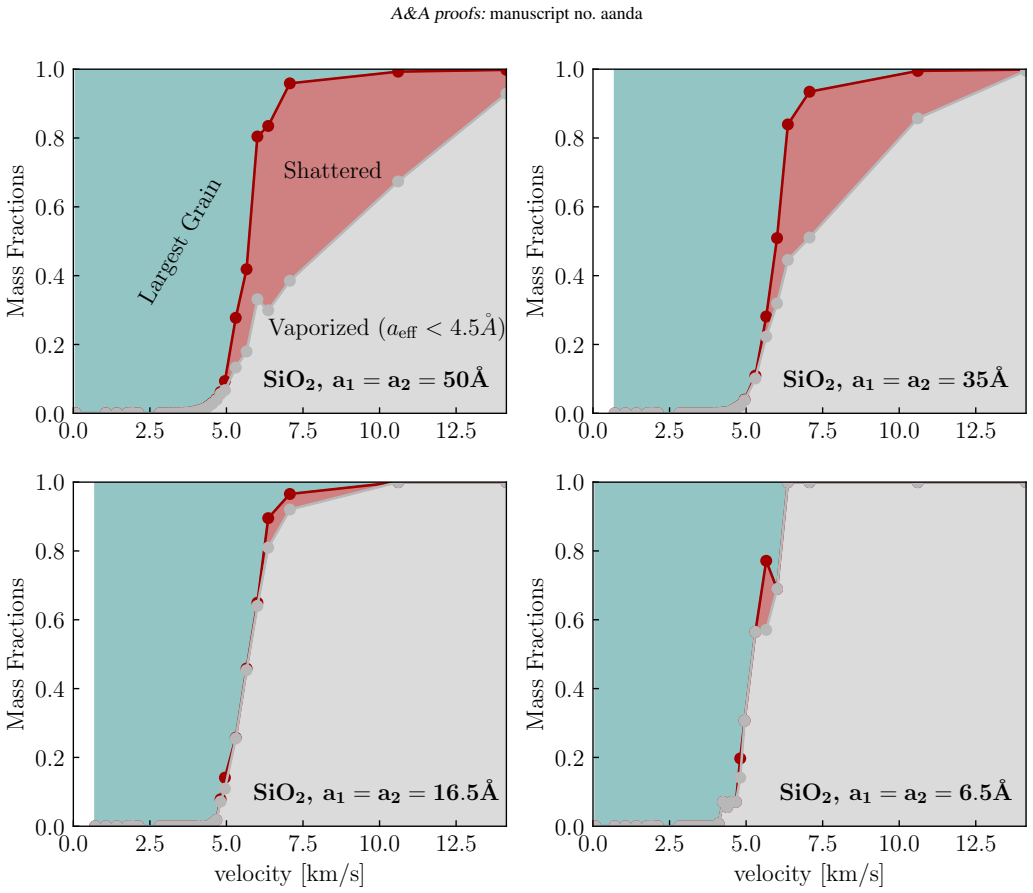
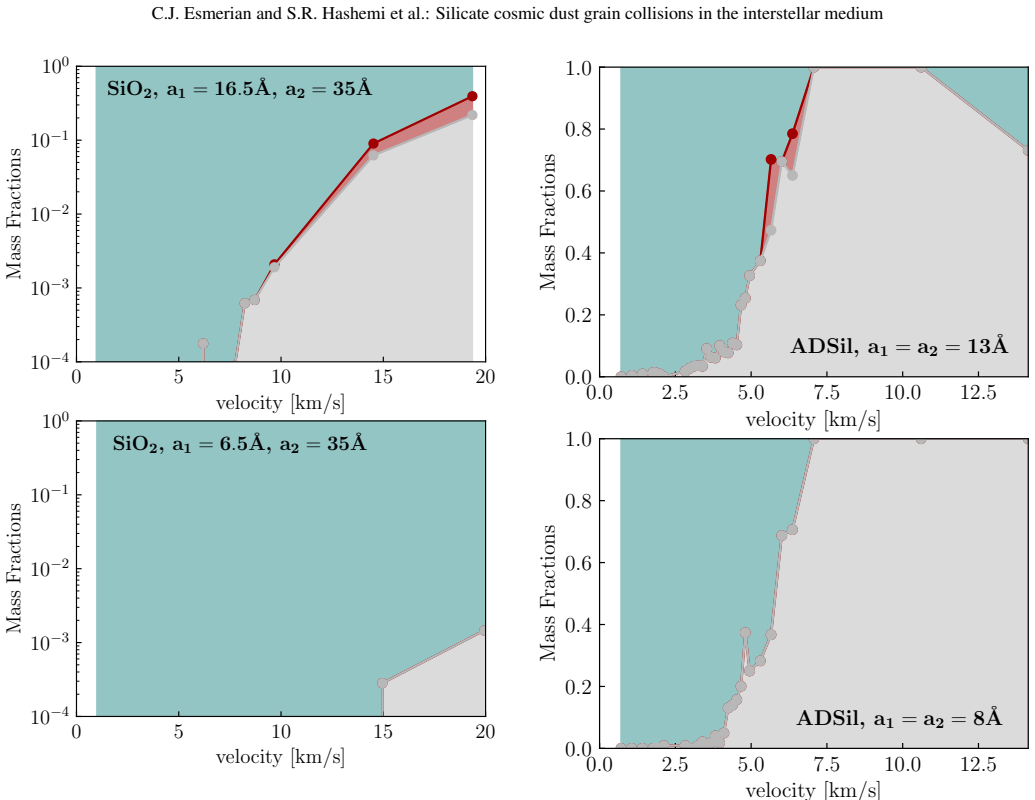
Molecular dynamics simulations of amorphous SiO2 and Draine-Hensley astrodust grains with radii 5-50 Å colliding at 0.1-20 km/s yield a shattering threshold of approximately 6 km/s for both materials. This value is a factor of two higher than the 2.7 km/s canonical figure from Jones et al. (1996). The simulations further show that the shattered and vaporized mass fractions, as well as the fragment size distributions, deviate from the predictions of the analytical expressions in Tielens et al. (1994) and Hirashita & Kobayashi (2013). The authors supply revised velocity thresholds for standard grain materials and conclude that interstellar silicate grains are more resistant to shattering than
What carries the argument
Molecular dynamics simulations that evolve the position and velocity of every atom inside colliding dust grains to quantify the onset of shattering, vaporization, and the resulting fragment size distributions.
If this is right
- Models of interstellar grain evolution should adopt the revised shattering threshold near 6 km/s instead of 2.7 km/s.
- Dust grains are more robust to destruction in high-velocity collisions such as those in supernova shocks.
- The size distribution of fragments after shattering is not well described by the power-law form assumed in earlier analytic models.
- Both the Tielens et al. (1994) and Hirashita & Kobayashi (2013) expressions for shattered and vaporized mass fractions fail to match the simulation results.
Where Pith is reading between the lines
- If the higher threshold holds for larger grains, the lifetime of dust against collisional destruction increases, which would raise the steady-state dust-to-gas ratio in galaxies.
- Grain-growth calculations that rely on the survival of small fragments after collisions may need to be recomputed with the new fragment statistics.
- Observations of dust size distributions in regions with known high-velocity shocks could provide an independent check on the revised thresholds.
Load-bearing premise
The collision physics observed in simulations of grains only 5-50 angstroms across remains valid for the much larger grains that dominate interstellar dust populations.
What would settle it
Laboratory experiments that collide silicate grains several hundred nanometers or larger in size at speeds between 3 and 7 km/s and measure the fraction of mass that shatters would directly test whether the simulated threshold applies at astrophysically relevant sizes.
Figures



read the original abstract
(abridged) We aim to predict the most important parameters for grain-grain collision outcomes for models of interstellar grain population evolution on astrophysical scales: the threshold velocity above which colliding grains shatter, the threshold for vaporization, and resulting distributions of grain sizes. We use molecular dynamics simulations which evolve the dynamics of each atom in a dust grain to explore the outcomes of collisions between silicate grains of radii $a \in [5,50]~\AA$ at velocities $0.1-20$ km/s. We run simulations of grains with two materials: amorphous SiO$_2$ and an amorphous silicate of composition suggested by Draine \& Hensley (2021). With these simulations, we quantify the collision velocity dependence of shattered and vaporized mass fractions, and the resulting size distributions of shattering products. We find grain shattering thresholds are $\sim$6 km/s for both amorphous SiO$_2$ and astrodust material, which is a factor of $\sim$2 higher than the canonical value for silicates of 2.7 km/s from Jones et al. (1996). This discrepancy is mostly alleviated by correcting an error in the expression for these velocity thresholds derived in Tielens et al. (1994). We find that the size distributions of shattered products are generally not consistent with the power law distributions predicted by this previous model. We also find that their expression fails to predict the fraction of shattered or vaporized material observed in our numerical simulations. The model of Hirashita \& Kobayashi (2013) for the same quantities similarly fails to match the simulations. We provide updated shattering velocity thresholds for candidate grain materials. Broadly, our updated threshold velocity prescription suggests that astrophysical dust grains, particularly those composed of silicate materials, may be more robust to shattering in the interstellar medium than previously assumed.
Editorial analysis
A structured set of objections, weighed in public.
Referee Report
Summary. The manuscript reports molecular dynamics simulations of head-on collisions between amorphous silicate grains (SiO2 and a Draine-Hensley astrodust composition) with radii 5-50 Å at velocities 0.1-20 km/s. It extracts velocity-dependent shattered and vaporized mass fractions, derives a shattering threshold of ~6 km/s for both materials, notes that this is roughly twice the Jones et al. (1996) canonical value, attributes part of the difference to an error in the Tielens et al. (1994) analytic expression, shows that neither that model nor Hirashita & Kobayashi (2013) reproduces the simulated mass fractions or fragment size distributions, and supplies updated threshold velocities for use in interstellar dust evolution calculations.
Significance. If the reported thresholds and fragment distributions hold for larger grains, the work would raise the velocity scale at which silicate grains shatter in the ISM, implying greater robustness and slower evolution of the grain size distribution than assumed in current models. The direct atomistic comparison to prior analytic prescriptions and the identification of quantitative mismatches constitute a useful benchmark, provided the nano-scale results can be shown to extrapolate.
major comments (2)
- [Abstract] Abstract and methods description: the shattering threshold of ~6 km/s (and the claim that grains are more robust than previously assumed) is obtained exclusively from grains with radii 5-50 Å. No grain-size convergence tests are presented, nor is it shown that the velocity at which 50 % of the mass is shattered remains invariant when radius is increased by even one order of magnitude. Because typical ISM silicate grains lie in the 100-10000 Å range, this untested extrapolation is load-bearing for the astrophysical conclusions.
- [Results] Results section on size distributions: the statement that the simulated fragment size distributions are 'generally not consistent' with the power-law form predicted by Tielens et al. (1994) is central to the claim that prior models fail. The precise algorithm used to identify post-collision clusters (e.g., distance cutoff, minimum cluster size) and the quantitative measure of inconsistency (e.g., fitted exponent and its uncertainty) must be specified so that the discrepancy can be reproduced and assessed.
minor comments (2)
- [Abstract] Abstract: the phrase 'astrodust material' should be accompanied by the explicit composition or a direct citation to Draine & Hensley (2021) on first use.
- The manuscript would benefit from a compact table that tabulates the new shattering and vaporization thresholds alongside the Jones et al. (1996) and corrected Tielens et al. (1994) values for direct comparison.
Simulated Author's Rebuttal
We thank the referee for the constructive and detailed report. The comments highlight important limitations in our current simulations and the need for greater methodological transparency. We have revised the manuscript to add explicit caveats on grain-size extrapolation, a new methods subsection detailing cluster identification, and quantitative fits to the fragment distributions. Point-by-point responses follow.
read point-by-point responses
-
Referee: [Abstract] Abstract and methods description: the shattering threshold of ~6 km/s (and the claim that grains are more robust than previously assumed) is obtained exclusively from grains with radii 5-50 Å. No grain-size convergence tests are presented, nor is it shown that the velocity at which 50 % of the mass is shattered remains invariant when radius is increased by even one order of magnitude. Because typical ISM silicate grains lie in the 100-10000 Å range, this untested extrapolation is load-bearing for the astrophysical conclusions.
Authors: We agree that the absence of explicit convergence tests for larger radii is a limitation. Molecular-dynamics simulations become prohibitively expensive beyond ~50 Å because the number of atoms scales as a³. We have added a dedicated paragraph in the revised Discussion section explaining this computational constraint and noting that the dominant energy scales (Si–O bond dissociation energies and elastic moduli) are local and therefore expected to be size-independent in the 5–100 Å regime. We have also inserted a clear caveat in the abstract and conclusions stating that the reported thresholds apply directly only to the simulated nano-grain range and that extrapolation to 100–10000 Å grains remains to be validated by future work or coarser-grained methods. revision: partial
-
Referee: [Results] Results section on size distributions: the statement that the simulated fragment size distributions are 'generally not consistent' with the power-law form predicted by Tielens et al. (1994) is central to the claim that prior models fail. The precise algorithm used to identify post-collision clusters (e.g., distance cutoff, minimum cluster size) and the quantitative measure of inconsistency (e.g., fitted exponent and its uncertainty) must be specified so that the discrepancy can be reproduced and assessed.
Authors: We thank the referee for this request for reproducibility. In the revised Methods section we now specify that post-collision clusters are identified with a neighbor cutoff of 2.8 Å (chosen from the first minimum of the Si–O radial distribution function) and a minimum cluster size of four atoms. We have added a new figure panel and accompanying text that reports power-law fits to the cumulative fragment mass distributions for velocities above the shattering threshold, yielding exponents of −2.9 ± 0.2 (SiO₂) and −3.2 ± 0.3 (astrodust). These values are statistically inconsistent with the −3.5 slope assumed by Tielens et al. (1994) at the 2σ level. The revised text also quantifies the mismatch in shattered-mass fraction between the simulations and both the Tielens et al. and Hirashita & Kobayashi analytic expressions. revision: yes
- Direct molecular-dynamics convergence tests for grains with radii 100–10000 Å remain computationally infeasible with current resources; only indirect arguments based on local bond energetics can be offered.
Circularity Check
No significant circularity: results from independent MD simulations, not reduced to prior fits or self-citations
full rationale
The paper derives shattering and vaporization thresholds directly from molecular dynamics simulations that evolve individual atoms in 5-50 Å grains of amorphous SiO2 and Draine-Hensley astrodust compositions. These atomistic calculations are first-principles and self-contained; the reported ~6 km/s threshold is an output of the simulations rather than a fit to or renaming of prior analytical expressions. The paper identifies and corrects an algebraic error in the velocity-threshold formula from Tielens et al. (1994) as a separate step, but does not use that correction to generate its own numerical results. No load-bearing self-citation, ansatz smuggling, or fitted-input-called-prediction pattern appears in the derivation chain. The extrapolation from nano-grains to interstellar sizes is an untested modeling assumption but does not render the simulation outputs circular by construction.
Axiom & Free-Parameter Ledger
axioms (1)
- domain assumption Interatomic potentials chosen for amorphous SiO2 and Draine & Hensley astrodust accurately reproduce real material response under collision conditions.
discussion (0)
Sign in with ORCID, Apple, or X to comment. Anyone can read and Pith papers without signing in.