Nonlinear Magnon Magnetic Moment Transport in Triangular-Lattice f-Wave Antialtermagnets
Pith reviewed 2026-05-22 03:23 UTC · model grok-4.3
The pith
Magnons in triangular-lattice antiferromagnets carry an out-of-plane magnetic moment due to their f-wave symmetry.
A machine-rendered reading of the paper's core claim, the machinery that carries it, and where it could break.
Core claim
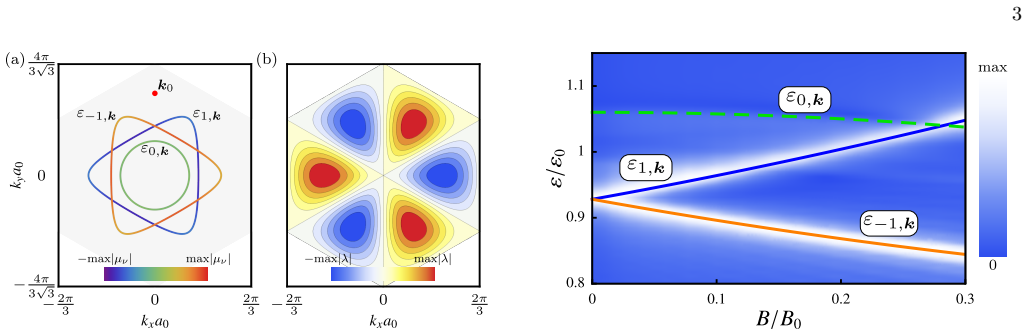
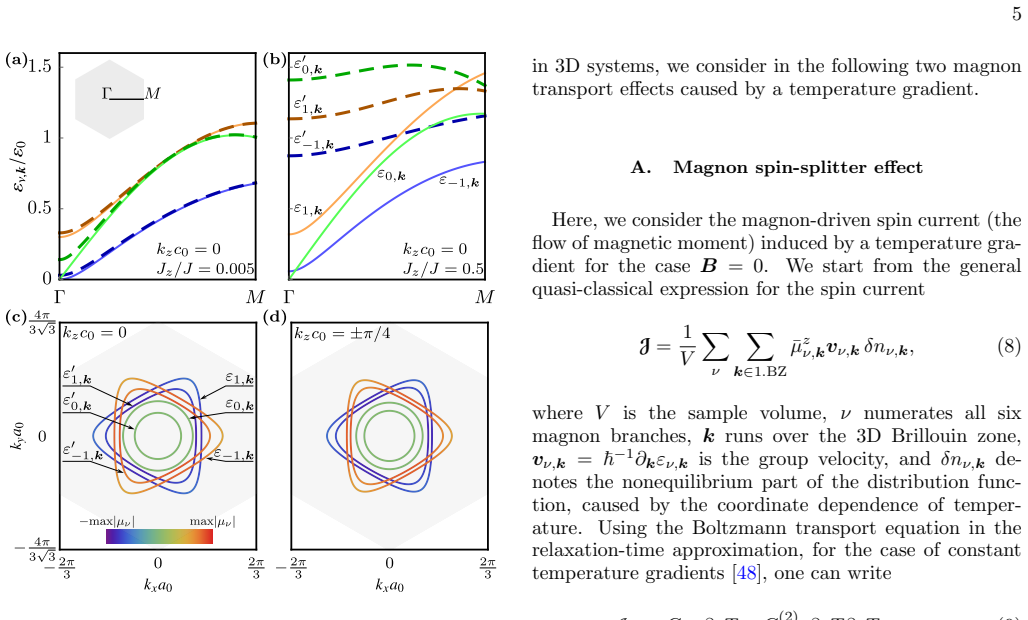
In the coplanar 120-degree ground state of the triangular-lattice Heisenberg antiferromagnet, the magnons carry a magnetic moment perpendicular to the plane in which the spins order, despite the ground-state sublattice moments having no out-of-plane component. The symmetry of the momentum dependence of the magnetic moment and energy of the magnons renders the system an odd-parity f-wave magnet. Extending this model to a stack of antiferromagnetically coupled triangular layers provides a realization of magnons in a three-dimensional f-wave antialtermagnet. Nonlinear thermal transport effects of magnons, such as Edelstein and spin-splitter effects, provide clear experimental signatures.
What carries the argument
The out-of-plane magnon magnetic moment with f-wave symmetry in momentum space, which classifies the system as an odd-parity f-wave antialtermagnet.
Load-bearing premise
The ground state is the ideal frustrated coplanar 120-degree state of the pure triangular-lattice Heisenberg antiferromagnet without deviations from additional interactions or disorder.
What would settle it
Absence of the out-of-plane magnon magnetic moment in measurements or lack of the predicted Edelstein and spin-splitter effects in transport experiments would disprove the claim.
Figures




read the original abstract
We study the spin excitations in the frustrated coplanar 120-degree ground state of the triangular-lattice Heisenberg antiferromagnet and demonstrate that they carry a magnetic moment perpendicular to the plane in which the spins order, despite the ground-state sublattice moments having no out-of-plane component. The symmetry of the momentum dependence of the magnetic moment and energy of the magnons renders the system an odd-parity f-wave magnet. Extending this model to a stack of antiferromagnetically coupled triangular layers provides a realization of magnons in a three-dimensional f-wave antialtermagnet. We show that nonlinear thermal transport effects of magnons, such as Edelstein and spin-splitter effects, provide clear experimental signatures of magnons in f-wave antialtermagnets.
Editorial analysis
A structured set of objections, weighed in public.
Referee Report
Summary. The manuscript studies magnon excitations above the coplanar 120° ground state of the triangular-lattice nearest-neighbor Heisenberg antiferromagnet. It reports that these magnons carry a finite out-of-plane magnetic moment whose momentum dependence exhibits odd-parity f-wave symmetry, thereby classifying the system as an f-wave antialtermagnet. The analysis is extended to a stack of antiferromagnetically coupled triangular layers, yielding a three-dimensional realization, and nonlinear magnon transport quantities (Edelstein and spin-splitter effects) are computed as experimental signatures.
Significance. If the central symmetry-based result holds, the work supplies a concrete, parameter-free realization of magnon antialtermagnetism in a well-studied frustrated magnet and identifies clear nonlinear transport diagnostics. The use of the pure Heisenberg model together with symmetry arguments for the moment and its parity is a strength; the extension to stacked layers and the explicit transport calculations add concrete value for future experiments on triangular-lattice materials.
major comments (2)
- [Symmetry analysis and magnon moment derivation (likely §3)] The out-of-plane magnon moment and f-wave classification are derived under the assumption of a strictly coplanar 120° state with only nearest-neighbor exchange. The manuscript should explicitly demonstrate (via an added calculation or symmetry table) that this moment remains finite and retains odd parity when weak next-nearest-neighbor exchange or single-ion anisotropy is included, as these terms are known to be present in candidate materials and can lift the protecting degeneracy.
- [Three-dimensional stacked model (likely §5)] In the stacked-layer extension, the interlayer coupling is taken to be perfectly antiferromagnetic. A brief check is needed to confirm that the three-dimensional f-wave character and the nonlinear transport coefficients survive small deviations from this ideal coupling, since even weak ferromagnetic interlayer terms can cant the ground-state moments and suppress the out-of-plane magnon moment.
minor comments (2)
- [Abstract] The abstract introduces 'f-wave antialtermagnet' without a one-sentence definition; a brief parenthetical clarification would improve accessibility.
- [Figures showing k-dependence] Momentum-space plots of the magnon moment and energy should include a direct visual comparison to the expected f-wave angular dependence (e.g., cos(3θ) or equivalent) to make the parity claim immediate.
Simulated Author's Rebuttal
We thank the referee for the positive evaluation of our work and for the constructive suggestions. We address each major comment below and outline the revisions we will make to strengthen the manuscript.
read point-by-point responses
-
Referee: [Symmetry analysis and magnon moment derivation (likely §3)] The out-of-plane magnon moment and f-wave classification are derived under the assumption of a strictly coplanar 120° state with only nearest-neighbor exchange. The manuscript should explicitly demonstrate (via an added calculation or symmetry table) that this moment remains finite and retains odd parity when weak next-nearest-neighbor exchange or single-ion anisotropy is included, as these terms are known to be present in candidate materials and can lift the protecting degeneracy.
Authors: We agree that robustness against weak perturbations relevant to real materials is important. In the revised manuscript we will add a symmetry table and a short perturbative calculation (new Appendix) showing that the out-of-plane magnon moment remains finite and keeps its odd-parity f-wave momentum dependence for small next-nearest-neighbor exchange and single-ion anisotropy, provided the 120° ground state stays coplanar. The leading-order correction to the magnon magnetic-moment operator preserves the required parity under the residual symmetries of the triangular lattice. revision: yes
-
Referee: [Three-dimensional stacked model (likely §5)] In the stacked-layer extension, the interlayer coupling is taken to be perfectly antiferromagnetic. A brief check is needed to confirm that the three-dimensional f-wave character and the nonlinear transport coefficients survive small deviations from this ideal coupling, since even weak ferromagnetic interlayer terms can cant the ground-state moments and suppress the out-of-plane magnon moment.
Authors: We thank the referee for this observation. In the revised version we will include a brief perturbative analysis of small deviations from perfect antiferromagnetic interlayer coupling. We will show that the three-dimensional f-wave symmetry of the magnon moment and the leading nonlinear transport coefficients (Edelstein and spin-splitter effects) remain intact for weak canting, as long as the out-of-plane component is not completely quenched. A short discussion and supporting calculation will be added to §5. revision: yes
Circularity Check
No significant circularity; derivation follows from symmetry and standard spin-wave analysis of the Heisenberg model.
full rationale
The central result—that magnons in the ideal 120° coplanar state acquire a perpendicular magnetic moment with f-wave momentum dependence—is obtained by direct calculation within the nearest-neighbor Heisenberg Hamiltonian on the triangular lattice. The out-of-plane moment emerges from the three-sublattice structure and the form of the magnon operators; it is not introduced by fitting, self-definition, or a load-bearing self-citation. The f-wave classification follows from parity analysis of the computed moment and dispersion. Extension to stacked layers and nonlinear transport signatures inherits the same model assumptions without circular reduction. No quoted step equates a prediction to its input by construction.
Axiom & Free-Parameter Ledger
axioms (1)
- domain assumption The magnetic interactions are described by the nearest-neighbor Heisenberg antiferromagnet on the triangular lattice.
invented entities (1)
-
f-wave antialtermagnet
no independent evidence
Lean theorems connected to this paper
-
IndisputableMonolith/Foundation/AlexanderDuality.leanalexander_duality_circle_linking unclear?
unclearRelation between the paper passage and the cited Recognition theorem.
We study the spin excitations in the frustrated coplanar 120-degree ground state of the triangular-lattice Heisenberg antiferromagnet and demonstrate that they carry a magnetic moment perpendicular to the plane...
What do these tags mean?
- matches
- The paper's claim is directly supported by a theorem in the formal canon.
- supports
- The theorem supports part of the paper's argument, but the paper may add assumptions or extra steps.
- extends
- The paper goes beyond the formal theorem; the theorem is a base layer rather than the whole result.
- uses
- The paper appears to rely on the theorem as machinery.
- contradicts
- The paper's claim conflicts with a theorem or certificate in the canon.
- unclear
- Pith found a possible connection, but the passage is too broad, indirect, or ambiguous to say the theorem truly supports the claim.
Reference graph
Works this paper leans on
-
[1]
Assuming the coplanar ground state, we obtain the following energy per magnetic unit cellH muc = 3J[(1−3b) cos(Φ 1 −Φ2)+cos(Φ 2 −Φ3)+(1− 3b) cos(Φ3 −Φ 1)−3b], whereb=B/B 0. The equilibrium values of Φν are as follows Φ1 =φ 0,Φ 2 = 2π 3 +φ0 −φ,Φ 3 = 4π 3 +φ0+φ,(B1) whereφis determined by the equation (1−3b) cos π 6 −φ = cos π 6 + 2φ .(B2) Forb≪1, Eq. (B2) ...
-
[2]
In the following, we perform the same calculation technique as described in Appendix A. The harmonic part of the 3D generalized Hamiltonian ink-space is H(2) 3D =ε0 X k∈1.BZ n1 2 h ˆψℓ(k) ˆψ∗ ℓ (k) + ˆψ′ ℓ(k) ˆψ′∗ ℓ (k) i +Aαk h ˆψ1(k) ˆψ∗ 2(k) + ˆψ2(k) ˆψ∗ 3(k) + ˆψ3(k) ˆψ∗ 1(k) + ˆψ′ 1(k) ˆψ′∗ 2 (k) + ˆψ′ 2(k) ˆψ′∗ 3 (k) + ˆψ′ 3(k) ˆψ′∗ 1 (k) i +Bαk h ˆ...
-
[3]
H. T. Diep, ed.,Frustrated Spin Systems (2nd Edition) (World Scientific Publishing Company, 2013)
work page 2013
-
[4]
C. Lacroix, P. Mendels, and F. Mila,Introduction to Frustrated Magnetism: Materials, Experiments, Theory (Springer Berlin Heidelberg, 2011)
work page 2011
-
[5]
H. Kawamura and S. Miyashita, Phase transition of the two-dimensional heisenberg antiferromagnet on the tri- angular lattice, Journal of the Physical Society of Japan 53, 9 (1984)
work page 1984
-
[6]
S. Miyashita, The ground state and thermodynamic properties of generalized heisenberg models on the trian- gular lattice, Progress of Theoretical Physics Supplement 87, 112 (1986)
work page 1986
-
[7]
A. V. Chubukov and D. I. Golosov, Quantum theory of an antiferromagnet on a triangular lattice in a magnetic field, Journal of Physics: Condensed Matter3, 69 (1991)
work page 1991
-
[8]
L. Capriotti, A. E. Trumper, and S. Sorella, Long-range n´ eel order in the triangular heisenberg model, Physical Review Letters82, 3899 (1999)
work page 1999
- [9]
-
[10]
T. Jolicoeur and J. C. Le Guillou, Spin-wave results for the triangular heisenberg antiferromagnet, Physical Re- view B40, 2727 (1989)
work page 1989
-
[11]
A. V. Chubukov, S. Sachdev, and T. Senthil, Large-s ex- pansion for quantum antiferromagnets on a triangular lattice, Journal of Physics: Condensed Matter6, 8891 (1994)
work page 1994
-
[12]
S. R. White and A. L. Chernyshev, Ne´ el order in square and triangular lattice heisenberg models, Physical Re- view Letters99, 127004 (2007)
work page 2007
-
[13]
A. L. Chernyshev and M. E. Zhitomirsky, Spin waves in a triangular lattice antiferromagnet: Decays, spectrum renormalization, and singularities, Physical Review B79, 144416 (2009)
work page 2009
-
[14]
M. Mourigal, W. T. Fuhrman, A. L. Chernyshev, and M. E. Zhitomirsky, Dynamical structure factor of the triangular-lattice antiferromagnet, Physical Review B 88, 094407 (2013)
work page 2013
-
[15]
P. A. Maksimov, M. E. Zhitomirsky, and A. L. Cherny- shev, Field-induced decays in xxz triangular-lattice anti- ferromagnets, Physical Review B94, 140407(R) (2016). 12
work page 2016
-
[16]
A. V. Syromyatnikov, Elementary excitations in spin-1/2 antiferromagnets on the triangular lattice, Physical Re- view B105, 144414 (2022)
work page 2022
- [17]
- [18]
-
[19]
B. D. Gaulin, M. F. Collins, and W. J. L. Buyers, Spin waves in the triangular antiferromagnet csmnbr3, Journal of Applied Physics61, 3409 (1987)
work page 1987
-
[20]
M. M. Bordelon, C. Liu, L. Posthuma, P. M. Sarte, N. P. Butch, D. M. Pajerowski, A. Banerjee, L. Balents, and S. D. Wilson, Spin excitations in the frustrated triangular lattice antiferromagnet naybo 2, Physical Review B101, 224427 (2020)
work page 2020
-
[21]
J. Ma, Y. Kamiya, T. Hong, H. Cao, G. Ehlers, W. Tian, C. Batista, Z. Dun, H. Zhou, and M. Matsuda, Static and dynamical properties of the spin-1/2 equilateral triangular-lattice antiferromagnet ba 3cosb2o9, Physical Review Letters116, 087201 (2016)
work page 2016
-
[22]
T. Dombre and N. Read, Nonlinearσ-models for trian- gular quantum antiferromagnets, Physical Review B39, 6797 (1989)
work page 1989
-
[23]
S. Dasgupta and O. Tchernyshyov, Theory of spin waves in a hexagonal antiferromagnet, Physical Review B102, 144417 (2020)
work page 2020
-
[24]
B. Pradenas and O. Tchernyshyov, Spin-frame field the- ory of a three-sublattice antiferromagnet, Physical Re- view Letters132, 096703 (2024)
work page 2024
-
[25]
B. Pradenas, G. Adamyan, and O. Tchernyshyov, Spon- taneous symmetry breaking in the heisenberg antiferro- magnet on a triangular lattice, Physical Review B112, 104402 (2025)
work page 2025
-
[26]
R. Zarzuela and S. K. Kim, Non-abelian gauge theory for magnons in topologically textured frustrated magnets, Physical Review Letters134, 186701 (2025)
work page 2025
-
[27]
V. P. Kravchuk, K. V. Yershov, J. I. Facio, Y. Guo, O. Janson, O. Gomonay, J. Sinova, and J. van den Brink, Chiral magnetic excitations and domain textures ofg-wave altermagnets, Physical Review B112, 144421 (2025)
work page 2025
-
[28]
L. ˇSmejkal, A. Marmodoro, K.-H. Ahn, R. Gonz´ alez- Hern´ andez, I. Turek, S. Mankovsky, H. Ebert, S. W. D’Souza, O. ˇSipr, J. Sinova, and T. Jungwirth, Chiral magnons in altermagnetic ruo 2, Physical Review Letters 131, 256703 (2023)
work page 2023
-
[29]
L. Wang, L. Shen, H. Bai, H.-A. Zhou, K. Shen, and W. Jiang, Electrical excitation and detection of chiral magnons in a compensated ferrimagnetic insulator, Phys- ical Review Letters133, 166705 (2024)
work page 2024
-
[30]
N. W. Ashcroft and N. Mermin,Solid State Physics(Cen- gage Learning, Inc, 1976)
work page 1976
-
[31]
Aharoni,Introduction to the theory of Ferromagnetism (Oxford University Press, 1996)
A. Aharoni,Introduction to the theory of Ferromagnetism (Oxford University Press, 1996)
work page 1996
-
[32]
R. R. Neumann, A. Mook, J. Henk, and I. Mertig, Orbital magnetic moment of magnons, Physical Review Letters 125, 117209 (2020)
work page 2020
-
[33]
K. V. Yershov, V. P. Kravchuk, M. Daghofer, and J. van den Brink, Fluctuation-induced piezomagnetism in local moment altermagnets, Physical Review B110, 144421 (2024)
work page 2024
-
[34]
A. B. Hellenes, T. Jungwirth, R. Jaeschke-Ubiergo, A. Chakraborty, J. Sinova, and L. ˇSmejkal, P-wave mag- nets (2023)
work page 2023
-
[35]
J. Mitscherling, J. Priessnitz, C. K. Geschner, and L. ˇSmejkal, Microscopic origin ofp-wave magnetism (2026)
work page 2026
-
[36]
T. Jungwirth, R. M. Fernandes, E. Fradkin, A. H. Mac- Donald, J. Sinova, and L. ˇSmejkal, Altermagnetism: An unconventional spin-ordered phase of matter, Newton , 100162 (2025)
work page 2025
-
[37]
L. ˇSmejkal, J. Sinova, and T. Jungwirth, Emerging re- search landscape of altermagnetism, Physical Review X 12, 040501 (2022)
work page 2022
-
[38]
L. ˇSmejkal, J. Sinova, and T. Jungwirth, Beyond conven- tional ferromagnetism and antiferromagnetism: A phase with nonrelativistic spin and crystal rotation symmetry, Physical Review X12, 031042 (2022)
work page 2022
-
[39]
R. R. Neumann, R. Jaeschke-Ubiergo, R. Zarzuela, L. ˇSmejkal, J. Sinova, and A. Mook, Odd-parity-wave magnons and nonrelativistic thermal edelstein effect (2026)
work page 2026
-
[40]
HereTandtdenote time reversal and translation, re- spectively
-
[41]
M. Weißenhofer and A. Marmodoro, Atomistic spin dy- namics simulations of magnonic spin seebeck and spin nernst effects in altermagnets, Physical Review B110, 094427 (2024)
work page 2024
-
[42]
Q. Cui, B. Zeng, P. Cui, T. Yu, and H. Yang, Efficient spin seebeck and spin nernst effects of magnons in alter- magnets, Physical Review B108, L180401 (2023)
work page 2023
-
[43]
Y. Yang, D. Wang, B. Yang, P. Wang, Y. Mu, Y. Tian, B. Zheng, W. Qin, K. Wang, B. Huang, B. Wang, X. Wan, and D. Wu, Altermagnet-driven magnon spin splitting nernst effect, Physical Review Letters136, 026701 (2026)
work page 2026
-
[44]
H. Zhang and R. Cheng, Magnon thermal edelstein ef- fect detected by inverse spin hall effect, Applied Physics Letters117, 10.1063/5.0030368 (2020)
-
[45]
B. Li, A. Mook, A. Raeliarijaona, and A. A. Kovalev, Magnonic analog of the edelstein effect in antiferromag- netic insulators, Physical Review B101, 10.1103/phys- revb.101.024427 (2020)
-
[46]
HereC 3z denotes the 3-fold rotation in spin space, and Eis an identity operation
- [47]
-
[48]
Note, that this approximation is not valid ifB= 0
-
[49]
G. Adamyan, B. Pradenas, B. Ivanov, and O. Tch- ernyshyov, Geometric spin rotation in triangular antifer- romagnets (2026)
work page 2026
-
[50]
I.e, it is assumed that∂ 2 αβT= 0 and the same for the higher derivatives
-
[51]
M. Ezawa, Third-order and fifth-order nonlinear spin- current generation ing-wave andi-wave altermagnets and perfectly nonreciprocal spin current inf-wave mag- nets, Physical Review B111, 125420 (2025)
work page 2025
- [52]
discussion (0)
Sign in with ORCID, Apple, or X to comment. Anyone can read and Pith papers without signing in.